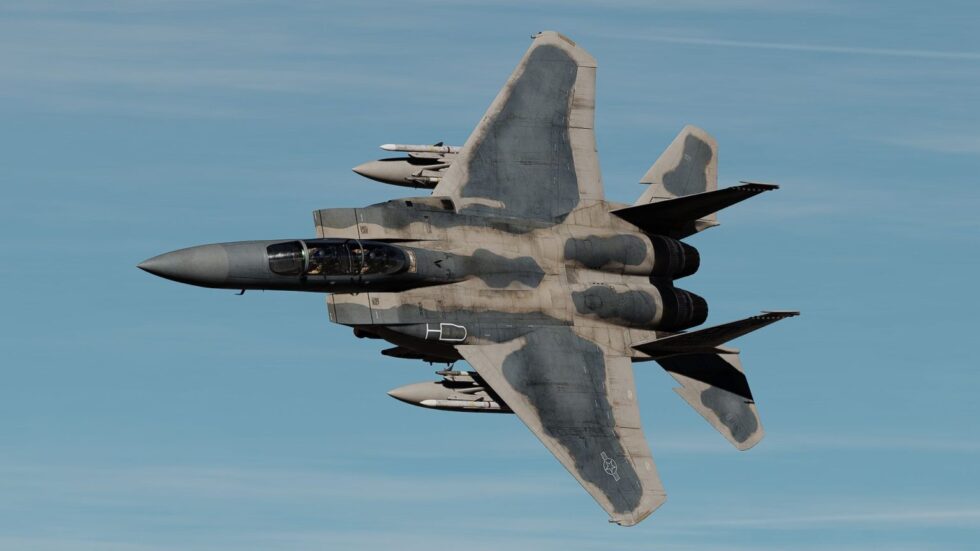
At the MSPO 2025 defence fair in Kielce, Poland, Boeing formally presented its F-15EX Eagle II, positioning it as one of the most capable non-stealth fighters currently in production. The aircraft forms part of the broader Team Eagle consortium, which includes General Electric, BAE Systems and Raytheon. Alongside the jet, the MQ-28 Ghost Bat drone was unveiled, a system designed to operate as a “loyal wingman” in future Collaborative Combat Aircraft (CCA) programmes, reports The WP Times.
Technical profile of the F-15EX
The F-15EX is marketed as a “Generation 4++” platform, complementing stealth designs such as the F-35 Lightning IIand B-21 Raider. Key features include the AN/APG-82 AESA radar, the EPAWSS electronic warfare suite, and an open mission architecture enabling fast integration of new weapon systems. Its payload capacity is striking: up to 22 air-to-air missiles, combined with precision-guided bombs and cruise missiles. With a maximum take-off weight of over 36 tonnes, an operational ceiling of 18 km and a combat radius of 1,100 km, the F-15EX is positioned as one of the most heavily armed fighters available to NATO allies.
Strategic relevance for NATO and Britain
While the United States Air Force will use the F-15EX to replace ageing F-15C/D variants, the aircraft’s relevance extends across NATO. For countries such as Poland, it provides a cost-effective counterbalance to advanced Russian air defences. In the UK context, the arrival of the F-15EX strengthens NATO’s northern and eastern flanks, ensuring additional mass where stealth aircraft alone are insufficient. Britain itself is committed to the F-35B Lightning II and the Tempest programme, but London will watch closely how the F-15EX integrates into NATO structures — particularly for missions requiring long-range strike and high payload delivery, where the jet offers advantages over lighter stealth platforms.
Industrial and political dimensions
Boeing has indicated that local production and final assembly could be offered to partner nations, a prospect that may be relevant for Poland and other Eastern European allies. For the UK, the interest is more strategic than industrial: the Royal Air Force remains aligned to domestic programmes, but London is increasingly dependent on NATO interoperability. A proven and modernised platform like the F-15EX gives the Alliance additional resilience — a message that matters both for deterrence and for transatlantic defence cooperation.
The F-15EX Eagle II is not a rival to Britain’s stealth ambitions, but rather a complementary capability that shores up NATO’s force structure. Its debut at MSPO 2025 in Poland underlines Boeing’s intention to position the fighter as a workhorse for allies seeking long endurance, high payload and flexible mission profiles. For London and Brussels, the aircraft’s real significance lies in its contribution to collective NATO air power at a time of renewed strategic competition.
Read about the life of Westminster and Pimlico district, London and the world. 24/7 news with fresh and useful updates on culture, business, technology and city life: Newest Russian missiles could reach London and Madrid within minutes – Rutte