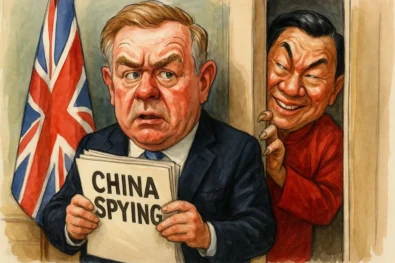
China has poured tens of billions of pounds into UK businesses and projects this century, a significant portion of which inadvertently provided Beijing with access to technology deemed military-grade, according to an investigation by BBC Panorama. This massive spending campaign, valued at £45 billion (or $59 billion at 2023 prices), reached its peak following a 2015 directive from the Chinese state aimed at establishing the nation as a global leader in advanced high-tech industries. Data from the US-based research group AidData indicates that, relative to its population and economic size, the United Kingdom has been the primary destination for these investments among all G7 nations, reports The WP Times with reference to BBC.
The investigation explored how this flow of funds led to the transfer of sophisticated technology and skills to China. According to a former head of GCHQ, the UK was "far too free in allowing access to strategically important industries." The BBC was granted exclusive early access to the data collected by AidData, a research unit at William & Mary University in Virginia, which tracks government overseas spending.
Dr. Brad Parks, AidData's executive director, explained that while some government-backed Chinese investments were purely commercial, others were clearly aligned with Beijing’s long-term strategic objectives. These objectives were outlined a decade ago in a plan by China's communist leaders called "Made In China 2025," which set ambitious targets for the country to achieve industry leadership in 10 high-tech sectors, including aerospace, robotics, and electric vehicles. Professor Keyu Jin of the Hong Kong University of Science and Technology described this as a "longer-term strategic thinking that China has always had."
The BBC's analysis of the AidData research specifically examined how the acquisition of certain UK companies resulted in the transfer of technology with potential military applications to China. One such firm investigated by Panorama was Imagination Technologies, a Hertfordshire-based specialist in semiconductor design—the creation of the tiny electronic circuits that power chips in devices like smartphones and computers.
In 2017, Imagination was bought for £550 million by Canyon Bridge, a private equity firm based in California. This fund’s sole investor was Yitai Capital, whose largest stakeholder is China Reform, an organization that reports directly to the State Council (the body executing Communist Party policies). Notably, two months prior to the Imagination acquisition, Canyon Bridge had been blocked from buying a similar semiconductor company in the US due to American investment-screening laws.
The core value of Imagination lay in its intellectual property—decades of expertise accumulated by its engineers. The algorithms behind its technology, though developed for commercial products, could potentially be repurposed for military uses in drones and missiles. Ron Black, the company’s former CEO, stated in his first interview since leaving that the UK government had vetted the deal, and Canyon Bridge had told him "unequivocally" that China Reform would act only as a passive, financial investor.
However, in 2019, Mr. Black recounted being called to a meeting in Beijing, where he was allegedly asked to work directly for China Reform and oversee the wholesale transfer of Imagination's technology and expertise to China. Mr. Black claims the China Reform representative explicitly requested the technology transfer "from the heads of the British engineers to the Chinese engineers, then lay off the British engineers." Black refused. He later says China Reform attempted to install four new directors "with no understanding of semiconductors" onto the Imagination board, whose only apparent qualification was a relationship with China Reform.
Convinced the technology carried military potential, Mr. Black alerted the UK government but was initially told it was a private industry matter beyond their immediate action. Fearful, Mr. Black resigned. Only then, he says, did the UK government become seriously interested, leading China Reform to halt its attempt to install the new directors. Mr. Black withdrew his resignation but was fired three days later—a dismissal later ruled unfair by an employment tribunal. After his departure, Imagination's homegrown technology was transferred to China.
Imagination stated to Panorama that its technology is not used in military products and that it "has always complied with applicable export and trade compliance laws." Canyon Bridge maintained that the transaction was "sourced and led exclusively by Canyon Bridge and its advisers." China Reform did not comment on Mr. Black’s allegations. The Chinese Embassy asserted that its government "has always required Chinese enterprises operating overseas to strictly comply with local laws and regulations" and that their investments actively contribute to local economic growth, social development, and job creation.
The situation occurred because, in 2017, the UK lacked strong mechanisms to block such sales. The "golden era" of China-UK relations, heralded during the 2015 state visit of Chinese leader Xi Jinping under Prime Minister David Cameron, fostered a perception that China was a benign and lucrative partner. Sir Jeremy Hunt, who was Health Secretary at the time, admitted: "We thought China was basically a very friendly power... But under the surface, we were beginning to sense a much more assertive China."
The challenge of balancing trade and national security remains unresolved. Sir Jeremy Fleming, former head of GCHQ, called it the "trillion-dollar question," arguing the UK benefited from trade but "has been far too free in allowing access to strategically important industries." He contrasts this with China’s "very strategic and careful" approach to barring Western investment in its key sectors. The UK, like the US, Germany, and Italy (which tightened their vetting by 2018), only strengthened its foreign investment screening laws in 2022.
The results of China's long-term strategic planning, rooted in its autocratic system, have been "nothing short of remarkable," according to Prof. Keyu Jin, who notes the ability of the system to set "multi-decade-long goals." AidData research shows China has been the world's largest overseas lender this century, peaking in 2016-2017.
Despite security concerns, the current government, like its predecessor, faces the economic reality that the UK needs investment. Chancellor Rachel Reeves has already visited Beijing to seek foreign investment, acknowledging that in many areas, Chinese financing poses "no real threat of national security." However, Labour MPs, including Dame Emily Thornberry MP, Chair of the House of Commons Foreign Affairs Committee, have expressed concern that the government has not published its full China audit, citing security classification.
Read about the life of Westminster and Pimlico district, London and the world. 24/7 news with fresh and useful updates on culture, business, technology and city life: Ukraine and UK Launch Strategic Dialogue Session on Century Partnership, Focusing on Security