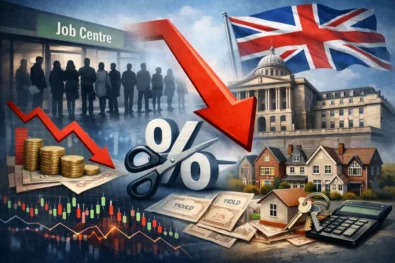
UK inflation, Bank of England interest rates, labour market data, GDP growth and borrowing costs moved sharply into focus after fresh figures showed a steeper-than-expected slowdown in price pressures, reinforcing expectations that the Bank of England will cut interest rates at its final policy meeting of the year. Inflation cooled to 3.2% in November, significantly below forecasts, as easing food prices and softer goods inflation added to evidence of a weakening UK economy and rising unemployment. This is reported by The WP Times, citing CNBC News.
Inflation undershoots forecasts as food prices fall
According to the Office for National Statistics (ONS), UK consumer price inflation fell to 3.2% year-on-year in November, down from 3.6% in October. Economists surveyed by Reuters had expected inflation to ease only to 3.5%, making the slowdown more pronounced than anticipated and marking the lowest annual inflation rate since March.
Core inflation, which strips out volatile items such as energy, food, alcohol and tobacco, also slowed to 3.2%, down from 3.4% in October. The decline suggests that price pressures are easing not only at the headline level but also across more persistent components that are closely watched by policymakers.
ONS chief economist Grant Fitzner said lower food prices were the main driver of the decline, despite seasonal expectations of price rises in the run-up to Christmas.
“Food prices fell this month, with notable declines for items such as cakes, biscuits and breakfast cereals,” Fitzner said.
“Tobacco prices also helped pull the rate down, while women’s clothing prices fell, adding further downward pressure.”
He added that while factory gate inflation slowed, the annual cost of raw materials for businesses continued to rise, underlining that cost pressures have not disappeared entirely.
Political reaction highlights cost-of-living pressures
UK Chancellor Rachel Reeves welcomed the fall in inflation but cautioned that households are still feeling the strain of elevated living costs.
“I know families across Britain who are worried about the cost of living will welcome this fall in inflation. But there is more work to do,” Reeves said in comments posted on X.
Her remarks reflect a broader political concern that, while inflation is easing, prices remain significantly higher than before the post-pandemic surge, keeping pressure on real household incomes.
Labour market weakness adds to case for easing
The inflation data follows figures released earlier in the week showing that the UK unemployment rate rose to 5.1%, its highest level in nearly five years. Wage growth has also slowed, easing concerns that pay increases could sustain inflation even as headline price pressures decline.
For the Bank of England, the combination of cooling inflation and a loosening labour market is particularly significant. Policymakers have repeatedly stressed that wage dynamics and employment conditions are central to decisions on when it is safe to ease monetary policy.
Rate cut increasingly likely at December meeting
Taken together, the data is expected to encourage the Bank of England’s nine-member Monetary Policy Committee (MPC) to reduce the benchmark interest rate by 25 basis points, from 4% to 3.75%, at its meeting on Thursday.
Economists widely expect a 5–4 vote split, with Governor Andrew Bailey likely to cast the deciding vote in favour of a cut. If confirmed, the move would mark the first rate reduction since August and lower borrowing costs to their lowest level in three years.
Suren Thiru, economics director at the Institute of Chartered Accountants in England and Wales (ICAEW), said the direction of policy now appears clear.
“These figures, alongside the recent deluge of downbeat data, mean that an interest rate cut tomorrow looks certain,” Thiru said.
“They offer reassurance that the UK is moving towards a more modest inflation environment, helped by lower food prices.”
He added that weakening demand and a loosening labour market should continue to exert downward pressure on inflation in the months ahead.
Growth remains fragile despite easing inflation

Despite the improvement in inflation, the broader economic backdrop remains weak. The UK economy expanded by just 0.1% in the third quarter, according to the most recent data, and momentum heading into the final months of the year appears subdued.
Economists warn that the Bank of England faces a delicate balancing act: easing policy enough to support demand without reigniting inflation at a time when price pressures, though easing, remain above the 2% target.
While a December rate cut now looks increasingly likely, most economists expect the Bank of England to proceed cautiously in 2026. Further cuts are expected to be gradual and data-dependent, reflecting ongoing uncertainty around global growth, domestic demand and the persistence of underlying inflation pressures. For households and businesses, the shift signals the beginning of a slow easing cycle rather than a rapid return to ultra-low interest rates.
Read about the life of Westminster and Pimlico district, London and the world. 24/7 news with fresh and useful updates on culture, business, technology and city life: How is Royal London using AutoRek to scale finance operations and cut reconciliation costs