

More than 5.5 million adults in the UK are estimated to have used nasal decongestant sprays beyond the recommended safety limit, according to a national survey by ITV News and Ipsos (December 2025). The products, sold without prescription in pharmacies and supermarkets across England, Scotland, Wales and Northern Ireland, are commonly used to relieve blocked noses caused by colds, influenza, allergies and sinus infections. They work by rapidly constricting swollen blood vessels inside the nasal lining. However, new evidence shows that nasal spray warnings are being widely ignored, contributing to a growing number of patients developing drug-induced congestion. As The WP Times reports, citing the Royal Pharmaceutical Society and ITV News data, this pattern is now being observed nationwide.
The medicines at the centre of the warnings contain the active ingredients xylometazoline and oxymetazoline, which act directly on blood vessels in the nasal tissue. By narrowing those vessels, the sprays quickly reduce swelling and restore airflow. But when used continuously for more than seven consecutive days — the maximum duration stated in UK product leaflets and NHS guidance — they can trigger rebound congestion, also known as rhinitis medicamentosa, a condition in which the nose becomes chemically dependent on the spray to remain open (Royal Pharmaceutical Society, 2025).

Instead of improving, the nasal lining reacts by swelling more aggressively once the spray wears off. This leaves users feeling more blocked than before, pushing them to reapply the medicine, often more frequently and in higher doses. Over time, this creates a self-sustaining cycle in which nasal congestion is no longer driven by infection or allergy, but by the pharmacological effect of the spray itself (ITV News investigation, December 2025).
What symptoms indicate rebound congestion
Rebound congestion is a recognised drug-induced condition and is clinically different from a lingering cold, sinus infection or seasonal allergy. Pharmacists and clinicians say it follows a characteristic pattern that develops after repeated use of decongestant sprays containing xylometazoline or oxymetazoline beyond the recommended seven-day limit.
The condition begins when the blood vessels inside the nasal lining stop responding normally after continuous chemical constriction. As the spray wears off, those vessels expand more than they should, causing the nasal tissue to swell excessively and restrict airflow.
In practice, this produces a predictable group of symptoms:
- Nasal blockage that returns within one to three hours of using the spray, often worse than before
- Compulsive re-dosing, with users needing the spray several times a day simply to breathe
- Severe congestion when the spray is stopped, even in the absence of infection
- Reduced or fluctuating sense of smell, caused by chronically swollen nasal tissue
- Sleep disruption, with users waking repeatedly during the night to reapply the spray
- Anxiety, panic or claustrophobic sensations triggered by the feeling of not being able to breathe
Community pharmacists report that affected patients often buy multiple bottles at a time and return frequently, sometimes every few days, saying that their nose “closes up” without the spray. Many describe being unable to sleep, exercise or leave the house without carrying it.
Interviews conducted by ITV News (December 2025) documented similar patterns. Several long-term users said they could not eat or sleep if they ran out of spray. One patient described driving to 24-hour supermarkets in the middle of the night after finishing a bottle, while another said the sensation of blockage caused “full-blown panic attacks”.
Pharmacists say these behaviours are a key warning sign that congestion is no longer caused by illness but by rhinitis medicamentosa, where the nasal lining has become physiologically dependent on the medication itself.
How widespread the problem is in the UK
The scale of nasal spray overuse has been mapped through two independent national studies carried out in late 2025.
A survey of more than 300 community pharmacists, conducted by the Royal Pharmaceutical Society (RPS) between 25 November and 5 December 2025, found that misuse of decongestant sprays is now routine rather than exceptional. Nearly six in ten pharmacists (59%) said most patients were unaware that the sprays should not be used for longer than seven days. Almost three quarters (74%) said the current packaging does not communicate this risk clearly enough, while 63% reported personally stepping in to deal with suspected overuse, including advising patients to stop or refusing further sales.
In parallel, a population survey by ITV News and Ipsos found that more than 20% of adults who had used decongestant sprays had exceeded the seven-day limit. When applied to the UK adult population, this suggests that around 5.5 million people may have exposed themselves to rebound congestion and drug-induced nasal dependency.
Taken together, the two data sets show the same pattern from opposite sides of the counter: widespread consumer overuse matched by growing clinical concern inside UK pharmacies.
Which nasal sprays are involved
Only a specific group of over-the-counter nasal sprays is responsible for rebound congestion. The risk is linked to sprays that chemically constrict blood vessels inside the nose.
Types of nasal sprays and their risk profile
| Type of nasal spray | Active ingredient | Main purpose | Risk of rebound congestion |
|---|---|---|---|
| Decongestant spray | Xylometazoline | Rapid relief of blocked nose | High |
| Decongestant spray | Oxymetazoline | Rapid relief of blocked nose | High |
| Saline spray | Salt water | Moisturising and cleansing | None |
| Steroid spray | Corticosteroids | Treating allergic inflammation | None |
| Nasal rinse / irrigation | Salt solution | Washing mucus and allergens | None |
Xylometazoline and oxymetazoline are designed to produce immediate relief by narrowing blood vessels in the nasal lining. This effect makes them highly effective in the short term but also makes them capable of triggering rebound congestion if used beyond seven days. These ingredients are found in many popular “blocked nose” sprays sold in UK pharmacies and supermarkets.
Saline sprays, steroid sprays and nasal rinses work through different biological mechanisms. They do not constrict blood vessels and therefore do not cause drug-induced congestion.
What happens when people try to stop
When someone with rebound congestion stops using a decongestant spray, the nasal lining often swells dramatically. This can last for days or weeks and frequently disrupts sleep, eating and daily functioning. Clinicians say this withdrawal phase is the main reason patients relapse.
To manage this period, pharmacists and doctors commonly recommend switching to steroid nasal sprays, which reduce inflammation while the nasal tissue recovers. Saline rinses, nasal strips, menthol inhalation and steam are also used to support breathing during withdrawal.
The Medicines and Healthcare products Regulatory Agency (MHRA) advises patients to follow the instructions provided with their medicine and report side effects via its Yellow Card scheme. In a statement, the regulator said: “Patient safety is MHRA’s top priority. We continuously monitor all licensed medicines for safety and effectiveness.”
The Royal Pharmaceutical Society says clearer labelling is now required because existing warnings are not preventing misuse. Its survey shows pharmacists are routinely encountering patients who have exceeded the seven-day limit, often without realising they were at risk. ITV News data suggests this is no longer confined to isolated cases but affects a significant share of regular users.
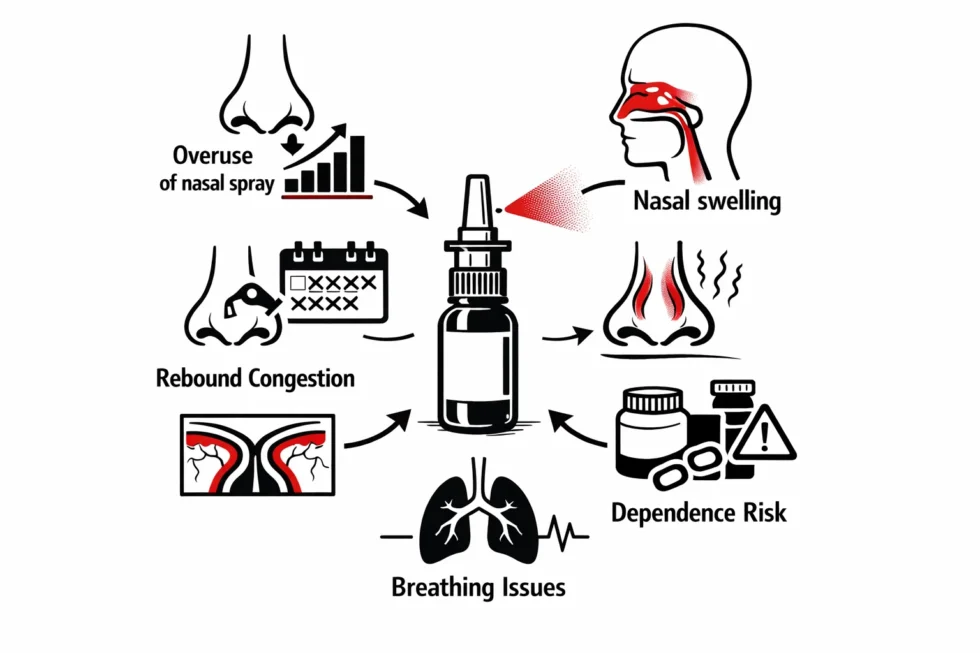
While manufacturers maintain that safety instructions are already provided in leaflets, pharmacists report that many customers either do not read them or do not understand the clinical consequences of prolonged use. With demand for decongestant sprays remaining high throughout extended cold, flu and allergy seasons, both the RPS and regulators say front-of-pack warnings are needed to make the seven-day limit visible at the point of sale and reduce the number of people developing drug-induced nasal congestion.
Read about the life of Westminster and Pimlico district, London and the world. 24/7 news with fresh and useful updates on culture, business, technology and city life: Luxury gyms in London: why are the best clubs concentrated in SW1 and Westminster in 2026