
London’s housing crisis is no longer just about rent levels — it is about who is allowed to live in the centre of the capital. That tension came into the open after City Hall approved a 90-metre, twin-tower student development at Paddington Basin, overruling Westminster City Council and triggering one of the sharpest planning disputes in London in recent years. As first reported by the Evening Standard and confirmed by local Westminster and Paddington outlets, the decision is now being seen as a test of whether boroughs still retain real control over the future of their neighbourhoods.
London’s housing crisis is no longer just about rent levels — it is about who is allowed to live in the centre of the capital. That tension came into the open after City Hall approved a 90-metre twin-tower student development beside Paddington Basin, overriding Westminster Council and triggering one of the sharpest planning disputes in recent years. As The WP Times reports, local media describe the decision as a test of whether boroughs still have real control over the future of their neighbourhoods.
Why Westminster says the towers will worsen London’s housing crisis
Westminster Council argues that the project represents a missed opportunity to provide homes for permanent residents in one of the best-connected parts of the capital. The borough currently has around 4,500 families in temporary accommodation, costing £60 million a year, and councillors say land near major transport hubs should be used to reduce that pressure. They also point to falling school rolls — including at Marylebone Boys’ School, which is operating well below capacity — as evidence that families are being priced out of central London.
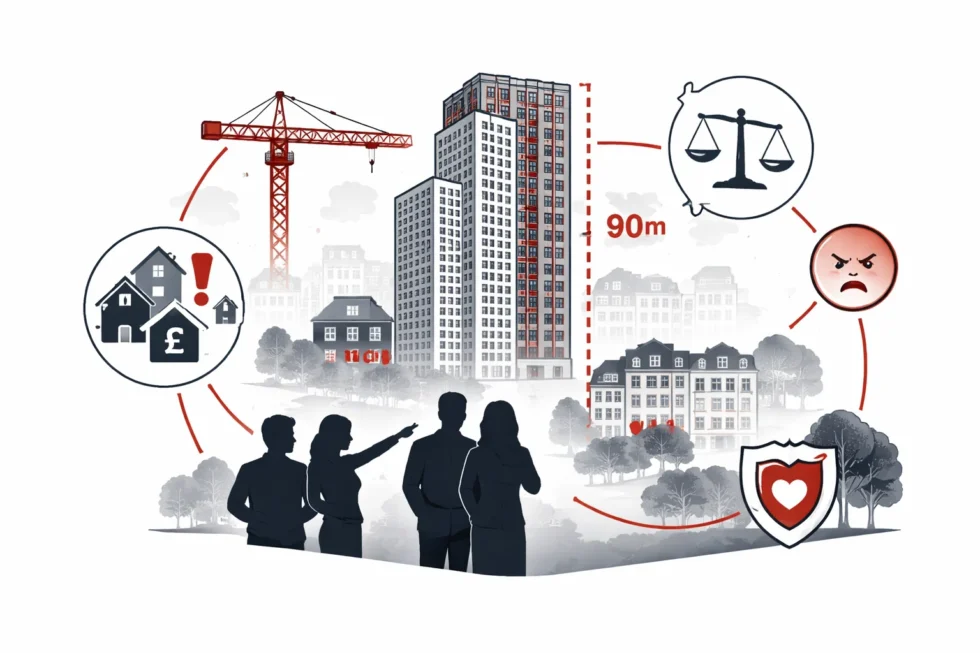
Residents living in Sheldon Square and Dudley House across the canal raised concerns about loss of daylight and privacy, while those in Little Venice, Warwick Avenue and Blomfield Road warned the towers would permanently alter the character of the area. More than 100 objections were submitted to the Greater London Authority.
Why City Hall approved the Paddington student towers
City Hall says the development will help relieve pressure on London’s private rental market by providing purpose-built accommodation for students, who would otherwise compete with families for flats. Planning officers also said the scheme would generate funding for affordable housing and deliver public benefits that outweigh its impact on the surrounding area.
Key figures behind the decision
| Measure | City Hall assessment |
|---|---|
| Student bedrooms | 605 |
| “Homes equivalent” | 242 |
| Affordable student rooms | 182 (30%) |
| Developer housing contribution | £3.5 million |
| New canal-side routes | Walking and cycling paths |
| Main university served | King’s College London |
The tallest tower will reach 90 metres, around 30 metres higher than initially expected for the site. City Hall acknowledged the impact on the skyline and nearby properties but concluded that the overall public benefits justified approval. Developers say construction is expected to begin in early 2026, with the accommodation mainly serving students travelling to King’s College London’s Strand campus via the Bakerloo Line. The Paddington decision now stands as a significant precedent for how far the Mayor of London is willing to go in using planning powers to increase housing density in the city’s most valuable and contested areas.
Read about the life of Westminster and Pimlico district, London and the world. 24/7 news with fresh and useful updates on culture, business, technology and city life: Where can you experience a real tea ceremony in London’s Westminster & Pimlico