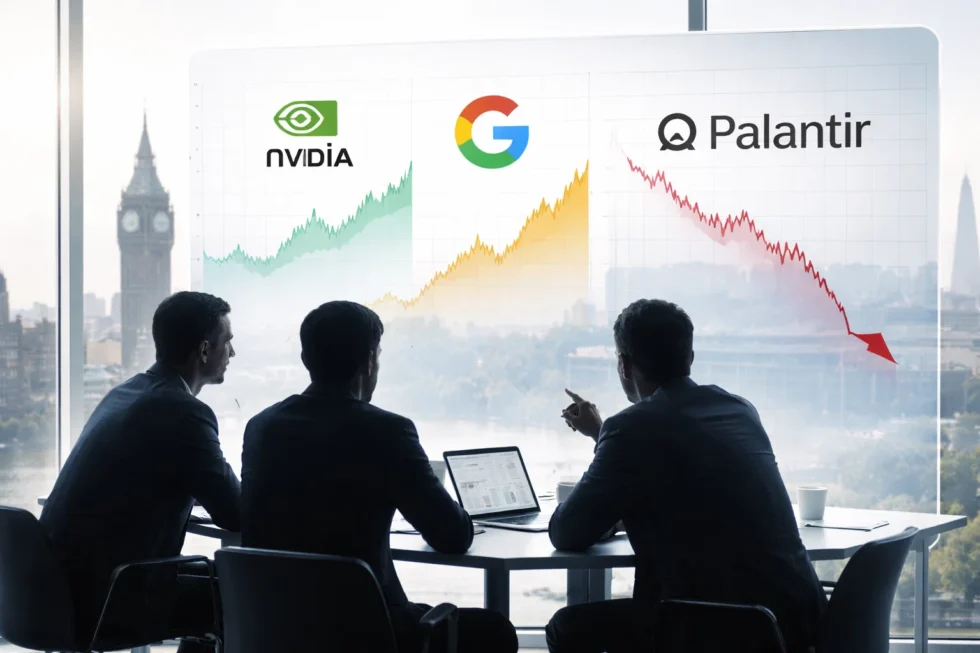
In January 2026, one of the most heavily traded US technology stocks in British ISAs, SIPPs and retail trading accounts is no longer Tesla or Amazon — it is Palantir Technologies, a US artificial intelligence company deeply embedded in the NHS, UK police forces and central government data systems. As Palantir, Nvidia and Google dominate UK AI investing, the stock has become a symbol of Britain’s growing exposure to the global artificial intelligence boom and to Wall Street-driven technology valuations.
After rising almost 140% in 2025 and more than 340% the year before, Palantir now sits inside thousands of British pension, ISA and private investor portfolios. But as its valuation climbs to levels normally associated with market bubbles, City analysts and fund managers are increasingly warning that UK investors may be taking far more financial risk than they realise.This is reported by The WP Times, citing investment media.
Palantir is no longer just an American tech stock for Britain
For UK investors, Palantir Technologies has become far more than a Nasdaq-listed AI stock. It is now a company that sits at the intersection of Wall Street, Whitehall and the NHS. While most British savers discover Palantir through US stock platforms such as Trading212, Hargreaves Lansdown and AJ Bell, its technology is already deeply embedded inside the UK public sector — powering data systems used by NHS England, the Home Office and UK policing.

This combination makes Palantir uniquely powerful in the British market. It is seen simultaneously as a high-growth US artificial intelligence share and as a strategic supplier to the British state, a rare position that few foreign technology firms occupy. That dual role is one of the key reasons Palantir has become one of the most widely held US AI stocks in UK ISAs, SIPPs and private investor portfolios going into 2026.
Palantir software is used by:
- NHS England to manage healthcare data
- the Home Office for immigration and security systems
- law enforcement agencies
- parts of the Ministry of Defence
This has created a powerful psychological effect in the UK investment community. Many British savers see Palantir as a “safe” AI stock because it is tied to government contracts rather than consumer advertising or social media. But stock markets do not price political importance — they price earnings and risk.
The valuation problem no one in the UK wants to talk about
While Palantir’s government contracts and AI narrative have made it one of the most popular US tech stocks among British investors, far fewer people are asking the uncomfortable financial question: how much are UK savers actually paying for that story? In a market where millions of pounds of pension and ISA money are now flowing into US technology shares, valuation matters as much as vision. And by almost every standard used by professional fund managers in the City of London, Palantir now looks exceptionally expensive.

Palantir currently trades on a forward price-to-earnings ratio above 180. That means investors are paying more than £180 for every £1 of profit the company is expected to generate over the next year — a level normally associated with speculative growth stocks rather than firms supplying mission-critical systems to governments. In comparison:
| Company | Forward P/E | Core business |
|---|---|---|
| Palantir | ~182 | Government and enterprise AI software |
| Nvidia | ~45 | AI processors and data-centre hardware |
| Alphabet | ~28 | AI, cloud, search and platforms |
| Micron | ~9 | AI memory and data-centre components |
This is the central issue now confronting UK investors. Palantir is priced as if it will dominate the AI world for a decade. Nvidia and Alphabet, which actually control the infrastructure that AI runs on, are far cheaper.
Why Nvidia is winning the AI money
Nvidia is not simply another technology stock listed on Wall Street. In the global investment world — including the City of London — it is now viewed as the core infrastructure supplier of the entire artificial intelligence economy. While companies such as Palantir sell AI software and analytics, Nvidia sells the physical computing power that makes all of those systems work.
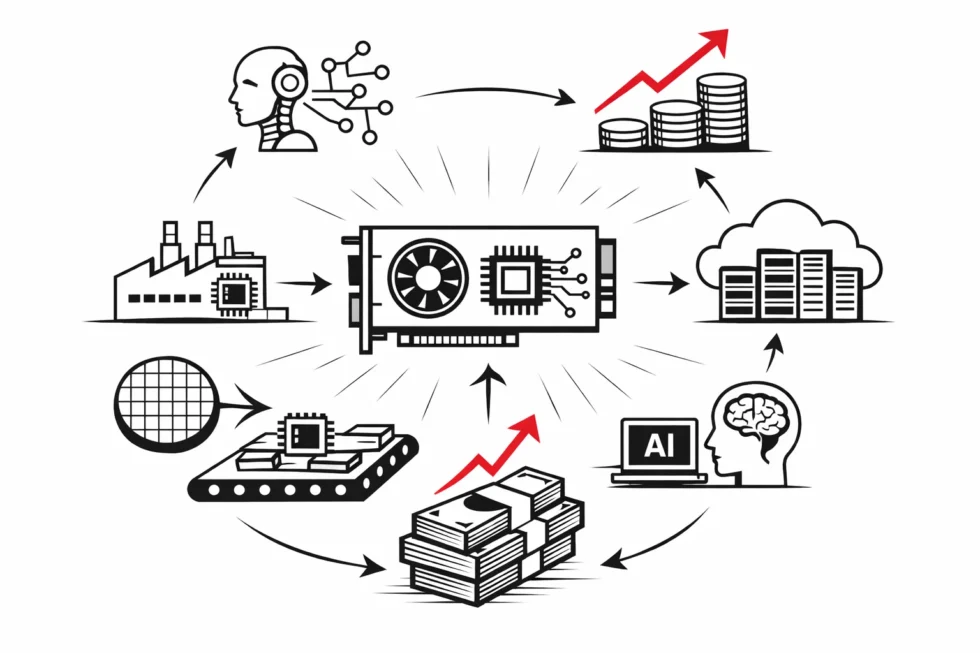
Whether it is OpenAI training large language models, Google running Gemini, Microsoft powering Copilot, Palantir processing government intelligence, or the NHS deploying clinical AI across hospitals, they all ultimately rely on the same thing: Nvidia’s processors inside the world’s data centres. What makes this especially relevant for British investors is that Nvidia’s financial growth now closely matches Palantir’s, while its valuation remains far more conservative.
In late 2025:
- Palantir’s revenue rose by 63% year-on-year
- Nvidia’s revenue rose by 62% year-on-year
Despite this, Nvidia is priced far more cheaply by the market.
| Company | Revenue growth (2025) | Forward P/E | Business role in AI | Risk profile |
|---|---|---|---|---|
| Palantir | ~63% | ~182 | AI software and government data platforms | High – dependent on contracts and valuation |
| Nvidia | ~62% | ~45 | Chips powering every major AI system | Lower – benefits from entire AI industry |
For UK pension funds, SIPP holders and long-term ISA investors, this gap is critical. When two companies grow at almost the same speed, the one with the lower valuation and stronger pricing power offers far better protection if markets turn volatile. That is why, across London’s professional investment community, Nvidia is increasingly seen as the safer way to own the AI boom, even as Palantir dominates headlines.
Alphabet’s quiet dominance in British AI portfolios
In the UK, Alphabet is still widely seen as a mature advertising group built around Google Search and YouTube. In reality, it has become one of the most powerful and diversified players in the global artificial intelligence economy — and, increasingly, a core holding in many British investment portfolios.
Alphabet now controls several of the most critical layers of the AI stack:
- Google Cloud, which hosts a large share of the world’s leading AI start-ups and enterprise AI workloads
- Gemini, currently one of the most advanced large language model families in production
- proprietary AI chips (TPUs), already used by Apple, Meta and Anthropic to train and run generative AI systems

This gives Alphabet a structural advantage that very few companies can match. It earns revenue whether a particular AI application succeeds or fails, because most of them run on its cloud, models or hardware. Palantir, by contrast, makes money only if Palantir itself wins contracts and expands its own software footprint. Despite this, Alphabet trades at a much lower valuation than Palantir, making it, in the eyes of many UK fund managers, a more balanced way to own the AI revolution without paying a speculative premium.

Micron: the hidden AI infrastructure stock
Micron rarely makes headlines in the UK, yet without it, the global artificial intelligence boom would simply not function. While investors focus on software and chatbots, Micron supplies one of the most critical components in every AI system: high-bandwidth memory, the ultra-fast data storage that allows Nvidia’s chips and large language models to operate at scale. Only three companies in the world are capable of producing this technology — and Micron is one of them. From a valuation perspective, the contrast with Palantir is stark.
Micron trades at:
- a forward price-to-earnings ratio of around 9
- a PEG ratio of approximately 0.5, meaning investors are paying relatively little for each unit of future growth
Palantir, by comparison, trades at:
- a PEG ratio of roughly 2.8
For British investors, this means something very simple but very important: they are paying several times more for the same growth when they buy Palantir instead of Micron. In a market where pensions and ISAs are increasingly exposed to US technology stocks, that difference in valuation could prove decisive if AI enthusiasm begins to cool.
Why this matters for UK pensions and ISAs
Millions of British households now have direct exposure to US technology stocks, often without realising it. Through workplace pensions, SIPPs, Stocks and Shares ISAs and robo-advisers, savers across the UK are increasingly invested in American AI and technology companies as part of their long-term retirement and savings plans.
Palantir is frequently included in these portfolios because of its strong share-price performance and its links to UK government contracts. To many investors, that creates a sense of security. But markets do not reward political connections — they reward earnings, cash flow and sustainable growth.

If the AI boom slows, or if global markets begin to question today’s extreme valuations, the most expensive stocks tend to fall first and fastest. With Palantir trading at one of the highest valuation multiples in the entire technology sector, a disproportionate share of that risk is now sitting inside British pension funds and ISA portfolios.
Political risk inside the UK
Unlike Nvidia or Alphabet, Palantir operates deep inside some of the most sensitive systems of the British state. Its software is used to process and analyse NHS patient data, immigration records and police intelligence, placing the company at the centre of public trust, privacy and national security. This creates a level of regulatory and political risk that many Wall Street investors tend to underestimate, but which matters greatly in the UK, where government technology contracts are subject to legal challenge, parliamentary scrutiny and public backlash. For British investors, this means Palantir faces risks that most US tech stocks do not, including:
- Regulatory intervention under UK data-protection and health privacy laws
- Parliamentary investigations into the use of AI and surveillance technology
- Contract renegotiations or cancellations following changes of government
- Reputational damage if NHS or policing data is misused or mishandled
- Legal action from campaign groups or civil liberties organisations
Any one of these could materially affect Palantir’s UK revenue stream — and therefore the earnings that its current share price depends on. For pension and ISA holders, that makes Palantir not just a technology bet, but also a political and regulatory gamble inside the British system.

Palantir remains a powerful and fast-growing artificial intelligence company, but in 2026 its share price reflects extremely high expectations that leave little room for disappointment. With Nvidia delivering almost identical revenue growth while controlling the hardware that every AI system depends on, Alphabet owning the cloud, models and chips that underpin most of the sector, and Micron supplying the memory that makes large-scale AI possible, British investors now have multiple ways to gain exposure to artificial intelligence without paying Palantir’s premium valuation. For pension funds, ISA holders and long-term savers, the key issue is no longer whether AI will grow, but which companies offer that growth at a price that still makes financial sense.
Read about the life of Westminster and Pimlico district, London and the world. 24/7 news with fresh and useful updates on culture, business, technology and city life: Credit cards: how and why JPMorgan is taking over Apple Card’s $20bn debt from Goldman