What exactly must UK solar panel owners do before the 31 January tax deadline if they have earned money from exporting electricity to the grid, and why has solar panel tax self assessment suddenly become a critical issue for thousands of households across Britain? With more than 1.6 million homes now fitted with rooftop photovoltaic systems and receiving Smart Export Guarantee (SEG) payments, many homeowners do not realise that this extra income can count as taxable earnings when combined with other side income. HMRC rules state that once total supplementary income exceeds the £1,000 trading allowance, a self assessment return is legally required. Missing the deadline can trigger an automatic £100 fine even if no tax is ultimately owed. This is reported by The WP Times, citing the source.
Why solar panel income can create a tax obligation
For many years, domestic solar panels were seen purely as a way to reduce household electricity bills. But the introduction of the Smart Export Guarantee changed the picture. Under SEG, energy suppliers pay homeowners for surplus electricity sent back to the national grid. Those payments are real income – and HMRC treats them in the same way as other small-scale earnings. The problem is that most solar panel owners never think of themselves as “businesses” or “traders”. As a result, thousands are unaware that they may already fall under self assessment rules.
Key HMRC principle
The crucial rule is simple:
- The first £1,000 of total supplementary income per tax year is tax-free
- Anything above that must be declared to HMRC
- SEG payments count toward this limit
- The allowance covers ALL side income combined – not just solar earnings
That means a homeowner earning £300 from SEG and £900 from freelance work has exceeded the allowance – and must file a return.
How many people could be affected
Industry estimates suggest that:
- Around 1.6 million UK households now have solar panels
- Hundreds of thousands receive SEG payments
- Typical SEG earnings range from £200 to £500 per year, depending on system size
- Many homeowners also have additional side income from small gigs, online sales or freelance work
When those income streams are added together, a significant proportion of solar households may unknowingly cross the £1,000 threshold.
What counts as taxable – and what does not
Understanding exactly how HMRC treats solar panel tax self assessment income is the most confusing part for UK homeowners. Many people assume that money earned from rooftop panels is automatically tax-free because the system is installed on a private home. In reality, HMRC rules are more nuanced. Whether Smart Export Guarantee payments, feed-in income or other renewable energy earnings must be declared depends on the total amount received and how it fits within the £1,000 trading allowance. Knowing the difference between simple household savings and taxable income is essential to avoid mistakes, late filing penalties and unnecessary stress. Not every penny connected with solar panels creates a tax liability.
Usually NOT taxable
- Savings on your own electricity bill
- Using the power you generate at home
- Small SEG payments that stay under £1,000 in total income
Usually taxable
- SEG payments that push you over the £1,000 trading allowance
- SEG income combined with other untaxed earnings
- Export income from larger or profit-oriented installations
HMRC looks at the overall intention and total income, not just the existence of solar panels.
Real-life examples
For UK households, the concept of solar panel tax self assessment becomes clearer when translated into everyday situations rather than legal definitions. The key question is whether income from Smart Export Guarantee payments, combined with other side earnings, exceeds the HMRC £1,000 trading allowance. Many homeowners do not realise that SEG income is treated as taxable miscellaneous income once the allowance is breached. Understanding how SEG earnings, freelance income, online sales and casual work interact is essential for deciding whether a self assessment return must be filed. The examples below show practical scenarios that explain when UK solar panel owners must declare export income to HMRC and when no action is required.
| Situation | Need to file self assessment? |
|---|---|
| You only use solar power at home, no SEG payments | No |
| SEG income £400, no other side income | No |
| SEG income £800 + Etsy sales £500 | Yes |
| SEG income £300 + tutoring income £900 | Yes |
| Already registered for self assessment | Yes – include SEG income |
The deadline problem
HMRC does not care whether your SEG earnings were intentional or accidental. The rule is purely administrative:
- Online self assessment returns for 2024–25 must be filed by midnight on 31 January 2026
- Late filing triggers a £100 automatic penalty
- Further fines apply after 3, 6 and 12 months
Many homeowners wrongly assume that if they owe little or no tax, they can ignore the deadline. That assumption is incorrect.
What homeowners should check now
As the 31 January deadline approaches, every UK solar panel owner should take a moment to review whether solar panel tax self assessment applies to them. Many households receive Smart Export Guarantee payments without realising that this income may need to be declared to HMRC when combined with other untaxed earnings. The key step is to check total supplementary income for the 2024–25 tax year and compare it with the £1,000 trading allowance. Acting early – by reviewing energy supplier statements, adding up SEG income and confirming whether a self assessment return is required – can prevent unnecessary fines and last-minute stress.
Tax specialists recommend that solar panel owners do the following immediately:
- Review energy supplier statements for SEG payments between 6 April 2024 and 5 April 2025
- Add up any other untaxed income from:
- freelance work
- online sales
- casual jobs
- gig economy platforms
- Compare the total with the £1,000 trading allowance
- If above £1,000 – register for self assessment and file before 31 January
Even people who have never dealt with HMRC before may suddenly find themselves required to submit a return.
How to declare SEG income correctly
When filing online, SEG payments are usually entered as miscellaneous income within the self assessment form. Homeowners should keep:
- Annual export payment summaries
- Statements from their electricity supplier
- Records of any related expenses
- Confirmation of meter readings
Good record-keeping is essential in case HMRC ever asks for proof.
Why awareness remains low
Unlike salary income, SEG payments arrive quietly through energy suppliers rather than employers. There is no automatic tax deduction and no warning from HMRC. As a result:
- Many people assume SEG income is automatically tax-free
- Others believe only large commercial systems are taxable
- Some simply never add up their different income streams
This lack of awareness is exactly what creates the current risk of penalties.
What happens if you miss the deadline
Understanding the consequences of missing the 31 January deadline is crucial for any homeowner dealing with solar panel tax self assessment. HMRC penalties apply automatically, regardless of whether you actually owe tax on your Smart Export Guarantee income. That means a simple oversight – forgetting to register or file on time – can lead to immediate fines, rising charges and unnecessary stress. Knowing exactly what happens after the deadline, how quickly penalties escalate and what steps you can still take to limit the damage gives homeowners a clear incentive to act early and avoid costly mistakes. If a return is not filed by 31 January:
- An immediate £100 fine is issued
- Additional daily penalties can follow
- Interest may be charged on any unpaid tax
- HMRC can pursue late filers even years later
For many UK homeowners, the financial gains from Smart Export Guarantee payments are modest – often just a few hundred pounds a year. Yet an automatic £100 HMRC late-filing penalty can quickly wipe out most of that benefit. That is why tax advisers warn against dismissing SEG income as “too small to worry about”. Even relatively low earnings from exporting electricity may create a legal obligation to complete solar panel tax self assessment if total supplementary income, from all sources combined, exceeds the £1,000 trading allowance.
To stay compliant and avoid unnecessary problems, experts recommend three practical principles:
- Do not ignore small amounts of income, as they can still trigger HMRC reporting requirements.
- File early rather than at the last minute, leaving enough time to gather documents and correct any mistakes.
- When in doubt, declare it, instead of risking penalties and complications later.
Taking a few simple steps can save significant stress. Keep annual SEG statements from your energy supplier, add up all untaxed earnings for the tax year, and register for self assessment in good time if it looks necessary. Homeowners who are unsure about their position can obtain free, official guidance directly from HMRC via the Self Assessment helpline on 0300 200 3310, or through the government website at gov.uk/self-assessment. Independent help is also available from Citizens Advice at citizensadvice.org.uk and from qualified accountants listed by the Chartered Institute of Taxation at tax.org.uk.
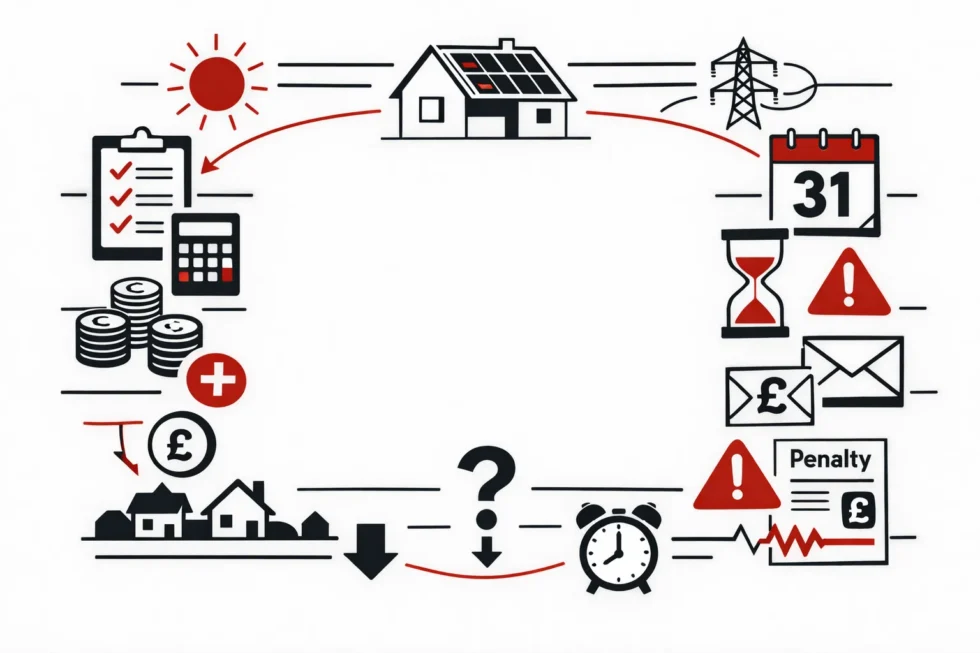
Solar panels continue to be a smart long-term investment for most households, cutting energy bills and supporting the shift to renewable power. However, the tax rules around export income mean that a simple green upgrade can now bring unexpected administrative responsibilities. Anyone receiving SEG payments should take a few minutes to review their total annual income and ensure they meet HMRC obligations before the January deadline. Overlooking the issue, even unintentionally, could turn a small environmental bonus into an unnecessary and entirely avoidable financial penalty.
Read about the life of Westminster and Pimlico district, London and the world. 24/7 news with fresh and useful updates on culture, business, technology and city life: What is known about Taylor Wimpey shares in January 2026 as the stock trades at 109p with an 8.55% dividend