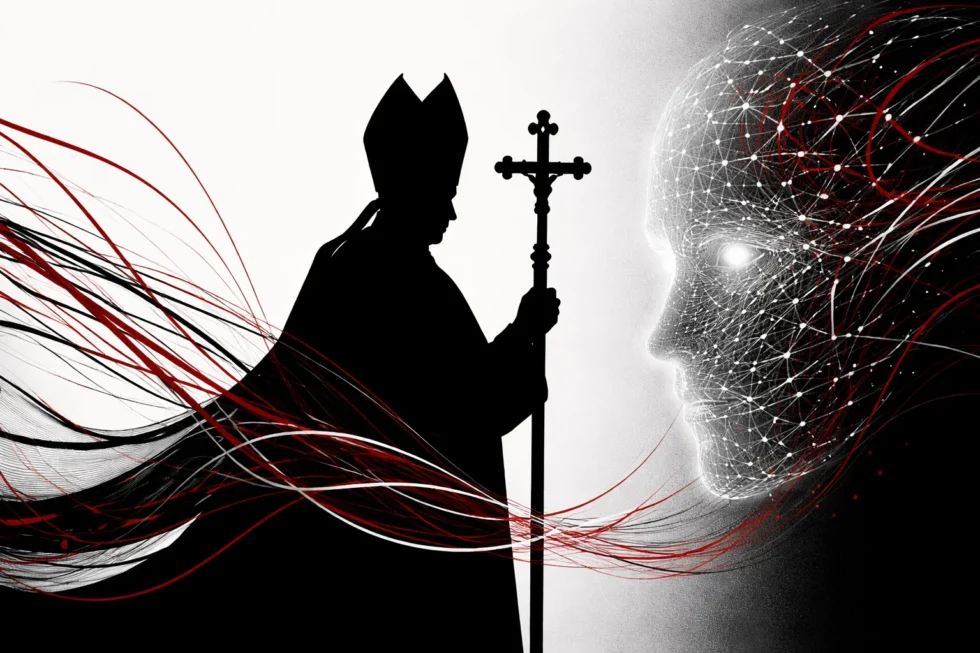
In recent months, some of the most pointed warnings about artificial intelligence have come not from Silicon Valley, but from the Vatican. Public statements by Pope Leo XIV, senior bishops and Catholic intellectuals have been unusually direct, framing AI not as a neutral tool but as a force capable of reshaping human identity, relationships and meaning. These concerns, articulated in official Vatican documents and addresses, raise a question now being asked far beyond religious circles: what exactly is the Catholic Church afraid of — and why is it sounding the alarm now, reports The WP Times.
At first glance, Catholicism appears one of the least vulnerable institutions in the digital age. Its rituals are physical, its theology deeply embodied, and its authority grounded in face-to-face community rather than screens or platforms. Yet it is precisely this dependence on human presence, struggle and limitation that lies at the heart of the Church’s unease. Catholic leaders argue that technologies designed to remove friction, effort and vulnerability risk hollowing out the very conditions through which moral growth, responsibility and faith are formed.
This article examines what is known about the Vatican’s position on artificial intelligence, drawing on official Church statements and expert commentary to explain why Catholic leaders frame AI as a moral and spiritual challenge — and whether a technology built to simulate knowledge, companionship and guidance could ultimately reshape, undermine or even replace elements of religious experience itself.
A pope shaped by a new industrial revolution
When Pope Leo XIV addressed cardinals shortly after his election, he did so with a deliberate sense of historical continuity. By choosing the name Leo, he explicitly aligned himself with Pope Leo XIII, the pontiff who confronted the social dislocation of the first industrial revolution at the end of the 19th century — a period marked by mechanisation, labour exploitation and the erosion of traditional social bonds.
Nearly a century and a half later, Leo XIV has framed artificial intelligence as the defining force of a new industrial age. In his early remarks, he described AI as posing “unprecedented challenges” to human dignity, justice and labour, signalling that the Church sees technological change not merely as an economic issue but as a transformation that reaches into thought, work, relationships and even prayer itself.
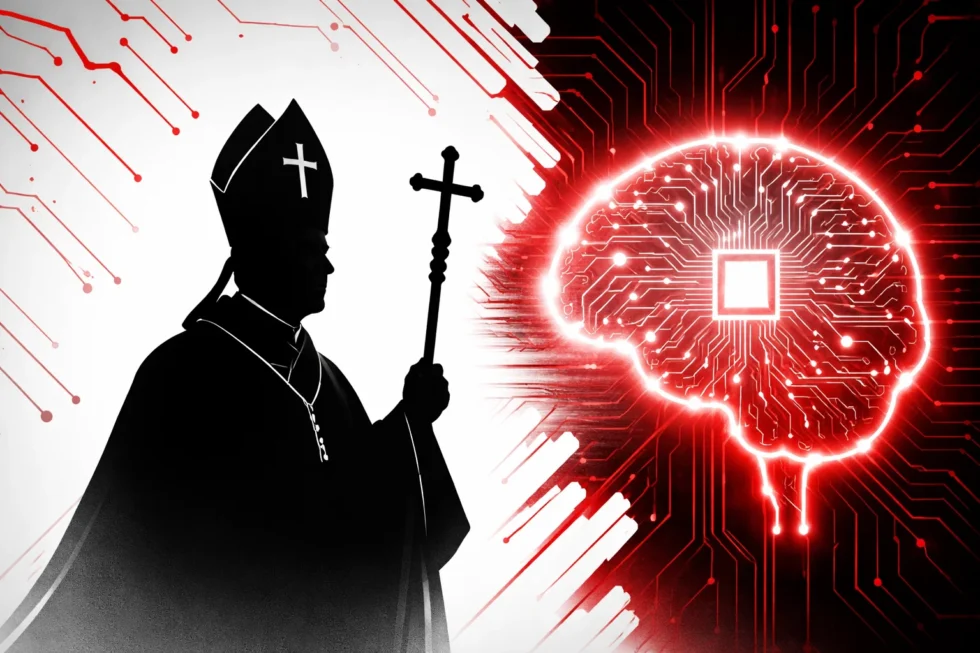
That concern soon sharpened. By January, in his official message for the World Day of Social Communications, the pope adopted a markedly more urgent tone. Artificial intelligence, he warned, has the potential to “invade and occupy” the most intimate spaces of human life — reducing individuals to passive consumers of ideas they did not create and relationships they did not actively choose, and quietly reshaping the conditions under which meaning, responsibility and faith are formed.
Why Catholics feel the threat more sharply than others
Catholicism is among the most embodied of the world’s major religions. Its central practices rely on physical presence and material signs: water poured in baptism, ash traced on the forehead, bread and wine received by the body, words spoken aloud and heard by another human being. Confession requires a priest who listens in person; communion requires a gathered community. Forgiveness, authority and belonging are all mediated through direct human relationship rather than private experience alone.
This sacramental structure leaves little room for frictionless substitutes. Catholic theology does not treat difficulty, delay or dependence as design flaws. On the contrary, effort and limitation are understood as formative conditions of moral and spiritual growth. Faith is not something accessed instantly, but something practised, sustained and tested over time, often through discomfort.
For this reason, many Catholic theologians argue that the central risk of artificial intelligence is not technological failure but technological success. Systems designed to remove effort, smooth emotional friction and provide immediate reassurance may also strip away precisely those experiences through which patience, responsibility and empathy are learned. When struggle is optimised out, formation itself is weakened.
Several senior clergy across Europe describe this concern in explicitly anthropological terms. One Rome-based priest, speaking privately, framed it bluntly: Christianity does not teach people to avoid weakness, but to confront it and live through it. Artificial intelligence, by contrast, is engineered to minimise weakness wherever possible — to offer answers without uncertainty, companionship without obligation and guidance without personal cost. It is this divergence, rather than abstract fears about machines, that explains why Catholic leaders perceive AI as a particularly acute challenge. A technology that works “too well” risks bypassing the relational, effort-based processes through which faith, conscience and community are formed — not by attacking them directly, but by quietly making them feel unnecessary.
AI as companion, counsellor — or spiritual shortcut
Large language models are designed to offer what many human relationships cannot guarantee: instant answers, constant availability and emotionally adaptive responses. In practical terms, they already function as tutors, therapists, confidants and companions, capable of sustaining long, personalised interactions that feel attentive, supportive and reassuring.
It is this convergence of accessibility and emotional simulation that increasingly troubles Catholic leaders. The concern is not hypothetical. Church figures now openly ask where the boundary lies between assistance and substitution. What happens when individuals turn to AI instead of community? What does confession mean if moral reflection is outsourced to a chatbot? And what becomes of prayer when dialogue is redirected towards an algorithm trained to imitate empathy?
Several theologians warn that this shift risks fostering a form of “digital idolatry” — not the conscious worship of machines, but a gradual emotional reliance on systems that are easier, more responsive and less demanding than real human relationships. Unlike faith, community or conscience, AI does not require patience, accountability or perseverance. It responds instantly and without resistance.
The temptation, they argue, is structural rather than ideological. A chatbot does not challenge assumptions or require reconciliation. It does not ask users to submit to doubt, discipline or silence. Crucially, it does not require presence — physical or moral. There is no need to show up, to listen to others, or to remain committed when engagement becomes uncomfortable.
From a Catholic perspective, this matters profoundly. Spiritual life is understood not as a stream of personalised reassurance, but as a process shaped through effort, encounter and responsibility. A system that offers guidance without cost may feel compassionate, yet risks bypassing the very conditions through which moral and spiritual maturity are formed. In that sense, the Church’s fear is not that AI will replace religion outright, but that it will quietly reframe faith as something frictionless — and therefore something fundamentally altered.
Lessons learned from the social media era
Within the Catholic Bishops’ Conference of England and Wales, current discussions on artificial intelligence are shaped by a clear sense of institutional hindsight. Senior figures openly acknowledge that religious leaders were slow to recognise the psychological and social consequences of social media during its rapid expansion in the early 2000s. By the time its effects on attention, identity and community became fully visible, patterns of behaviour were already deeply entrenched.
This time, Church officials argue, the stakes are significantly higher. Social media transformed what people consume: news, images, opinions and narratives. Artificial intelligence, by contrast, is seen as capable of reshaping how people think — how they process meaning, exercise judgment and form inner convictions. From a Catholic perspective, this shift has direct implications for how individuals understand truth, responsibility and ultimately God.
That distinction explains why the Church’s present concern centres less on misinformation or content moderation and more on consciousness itself. AI is not merely another channel through which ideas pass, but a system that increasingly mediates cognition, emotional response and moral reasoning. For Church leaders, this represents a qualitative change rather than a continuation of earlier digital trends.
Can AI replace religion
Few Catholic leaders suggest that artificial intelligence could literally replace belief in God. The concern expressed far more frequently is quieter and more practical: that AI may replace the habits through which faith is sustained. Religion and AI share a number of unsettling structural similarities. Both are constantly available, claim a form of authority and offer guidance during moments of uncertainty or loneliness. Both can receive private confessions of fear, guilt or doubt. The crucial difference lies in cost. Faith requires effort, discipline and participation in a community that does not always respond conveniently or comfortably. AI, by contrast, is immediate, personalised and free.
Several bishops concede privately that, sooner or later, some individuals will attempt to substitute elements of spiritual life with sustained relationships with AI systems — not out of ideological rejection of religion, but simple convenience. In that sense, the perceived risk is not apostasy, but gradual disengagement.
Why the Church still believes it will survive
Despite the warnings, Catholic leaders are not uniformly pessimistic. Many point to what they regard as the Church’s non-negotiable core: physical sacraments and embodied community. No algorithm can administer communion. No machine can hear confession face to face. These practices, they argue, impose limits that technology cannot cross. There is also cautious optimism that widespread exposure to AI may eventually provoke a cultural backlash — a renewed desire for what is tangible, irreversible and genuinely human. One Berlin-based priest observed that while digital mistakes can persist indefinitely, forgiveness offered in confession disappears entirely. That contrast, he believes, retains moral power in a world saturated with data.
Others are less confident. They warn that adoption will be uneven, reflection insufficient and harm unavoidable, particularly among younger users whose cognitive and emotional habits are still forming. From this perspective, the Church expects disruption before adaptation. Yet even among the most anxious voices, one assumption remains consistent. Christianity, they note, has endured political collapse, pandemics, scientific revolutions and social upheaval before. Artificial intelligence, they argue, will not be the first transformative force it is forced to confront — nor necessarily the last it outlives.
What we know so far
- The Vatican does not oppose artificial intelligence as such, nor does it call for a halt to technological development. Official documents consistently frame AI as a legitimate tool when used responsibly and transparently.
- The Church’s primary concern is anthropological rather than technical. Vatican warnings focus not on system failures or hardware risks, but on how AI reshapes human identity, cognition, relationships and moral agency.
- Catholic leaders repeatedly emphasise risks related to consciousness, emotional dependence and the erosion of meaning, particularly where AI systems simulate companionship, guidance or authority.
- Artificial intelligence is viewed as a tool — but a uniquely absorbing one, capable of mediating thought, emotion and decision-making in ways previous technologies did not. This qualitative difference underpins much of the Church’s unease.
- The Vatican expects disruption rather than collapse. Church figures acknowledge that harm and misuse are likely, but maintain that adaptation is possible through regulation, education and a renewed emphasis on embodied human relationships.
What is clear is that the debate has moved beyond abstraction. Artificial intelligence is no longer discussed solely in laboratories or policy forums, but from pulpits and in formal theological teaching. For one of the world’s oldest institutions, that shift alone signals that AI is being understood not merely as a technological development, but as a civilisational force with lasting consequences.
Read about the life of Westminster and Pimlico district, London and the world. 24/7 news with fresh and useful updates on culture, business, technology and city life: Is Your System Safe? Windows 10 End of Support and Cybersecurity Risks