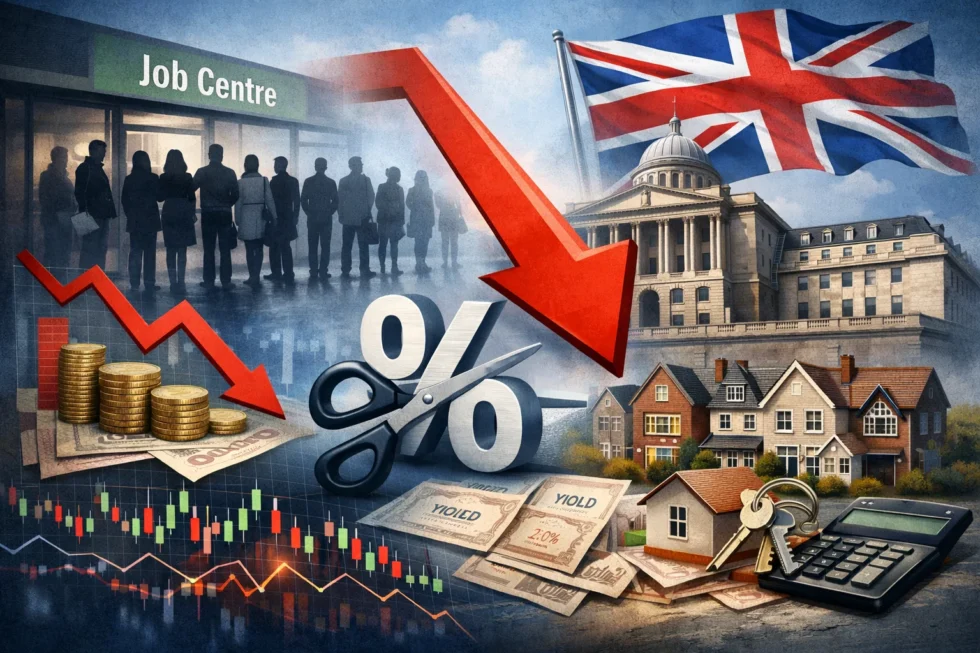
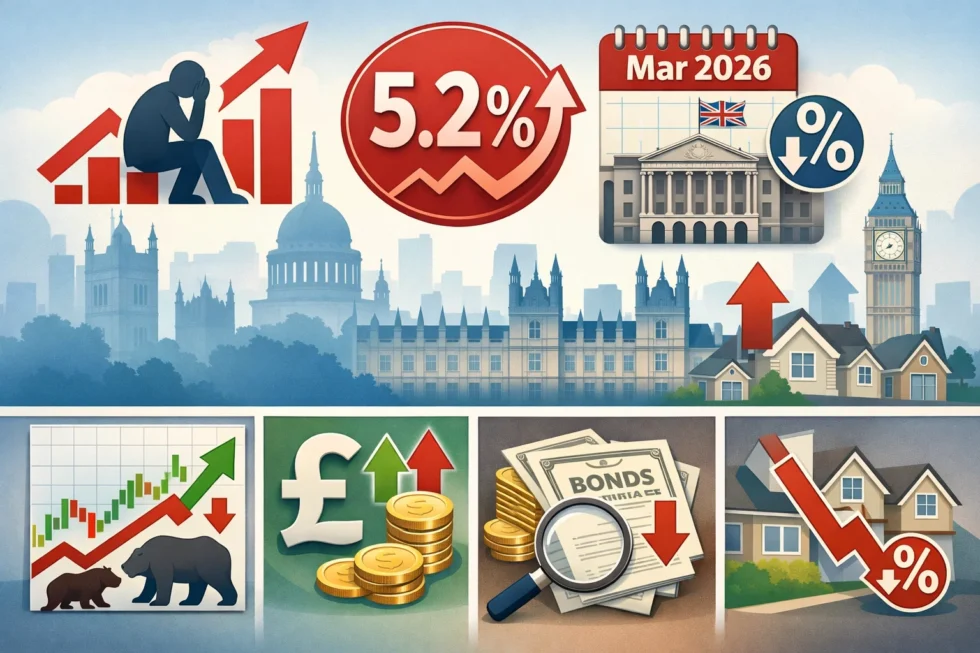
The likelihood of a UK interest rate cut in March 2026 has risen sharply after new labour market data showed UK unemployment increasing to 5.2%, its highest level since early 2021, while wage growth slowed to 4.2%, easing domestic inflationary pressure. Following figures published on 17 February 2026, financial markets in the City are now pricing in a near-75% probability that the Bank of England will lower the Bank Rate to 3.5% at its next Monetary Policy Committee meeting in March, according to analysis by The WP Times editorial team.
The shift in expectations reflects growing concern over a softening labour market, with particular attention on rising youth unemployment in the UK, alongside evidence that pay pressures are easing faster than previously anticipated. The data has already led to a fall in UK government bond yields, a weakening of sterling against the US dollar, and a repricing across UK housing, consumer credit and equity markets, underlining both the risks and potential opportunities now facing UK-based investors.
What the latest UK labour data shows
Data published by the Office for National Statistics shows that the UK unemployment rate rose to 5.2% in the final quarter of 2025, marking its highest level since early 2021. The increase points to a continued softening in labour market conditions following a prolonged period of economic stagnation.
At the same time, headline wage growth slowed to 4.2%, down from 4.4% in the previous quarter. The deceleration in pay growth suggests that pressure on employers’ labour costs is easing, a development closely monitored by the Bank of England amid concerns over domestically driven inflation. Several indicators underline the changing dynamics of the jobs market:
- Payroll employment continues to decline, with losses concentrated in consumer-facing sectors such as hospitality and retail
- Job vacancies have stabilised after a sustained period of contraction, indicating weaker demand for new hires rather than an abrupt collapse
- Redundancies remain relatively contained, although economists warn that risks could increase later in 2026
- Real wage growth stands at 0.8%, offering limited improvement in household purchasing power
For policymakers, the combination of rising unemployment and slowing wage growth reduces concerns over a wage-price spiral. It also strengthens the case for a potential easing of monetary policy, as the labour market shows clearer signs of cooling without a sharp increase in job losses.
Youth unemployment emerges as the biggest warning sign
While the rise in headline unemployment has focused market attention on the broader labour outlook, economists and business groups are increasingly concerned about conditions facing younger workers. Unemployment among 18–24-year-olds has climbed to 14%, reaching a joint 10-year high when the pandemic period is excluded, according to official data.
The advisory firm Blick Rothenberg has warned that youth unemployment is likely to increase significantly in the coming months, as large numbers of school leavers and university graduates enter a labour market that is showing clear signs of weakening. Analysts note that entry-level and consumer-facing roles — traditionally a gateway for young workers — have been among the most affected by slower hiring. The trend matters for investors because sustained youth unemployment is associated with longer-term economic effects, including:
- Lower productivity growth, as early-career skills development is disrupted
- Delayed household formation, reducing demand in the housing market
- Higher fiscal pressure, through increased welfare and support spending
- Weaker consumer confidence, with lasting effects on spending patterns
From a macroeconomic perspective, the deterioration in youth employment also increases the risk that the slowdown in the labour market becomes more entrenched, strengthening the case for monetary policy easing to limit longer-term damage to growth and employment prospects.the Bank of England cuts rates sooner — and potentially more aggressively — to limit structural damage.
Why the Bank of England is on track for a March cut

Financial markets in the City now imply around a 75% probability that the Bank of England will cut interest rates at its March 2026 meeting, up from below 70% just days earlier. Expectations have shifted rapidly following weaker labour market data and signs that domestic inflationary pressure is continuing to ease. Several economists now anticipate at least two rate cuts by the end of 2026, which would lower the Bank Rate to around 3.25%. The case for monetary easing is built on three main factors.
First, wage growth is cooling. Slower pay increases reduce the risk of persistent inflation without requiring a sharp rise in unemployment. For policymakers, this is a key signal that underlying price pressures linked to the labour market are easing in a controlled manner.
Second, labour market weakness is concentrated in specific sectors. Job losses have been most pronounced in hospitality, retail and other consumer-facing industries, many of which are still adjusting to higher employer taxes and increases in minimum wage levels. Outside these sectors, employment has been more stable, suggesting a gradual slowdown rather than a sudden deterioration. Third, the Bank may be focused on pre-emptive risk management. Cutting interest rates earlier could help limit a more pronounced rise in unemployment later in the year, particularly as economic growth remains subdued and hiring intentions soften.
Some economists have urged caution, however, pointing out that the historical relationship between unemployment and inflation in the UK has been relatively weak. From this perspective, a March rate cut is not guaranteed. Even so, the balance of risks has shifted, with policymakers under growing pressure to support the economy as labour market conditions continue to soften.ak. Even so, the direction of travel is now clear.
Market reaction so far: bonds, pound and equities
UK financial markets moved swiftly after the release of the latest labour market data, as investors repositioned in anticipation of a potential interest rate cut by the Bank of England. UK government bond yields fell, signalling lower expected borrowing costs as markets priced in a looser monetary policy stance. The move reflects growing confidence that the Bank may prioritise labour market stability as wage pressures ease. At the same time, sterling weakened by around one cent against the US dollar, as expectations of lower UK yields reduced support for the currency.
In equity markets, interest-rate-sensitive sectors such as housebuilders and utilities found support, with investors anticipating easier financing conditions and improved demand. Bank shares, however, came under pressure as markets reassessed the outlook for net interest margins in an environment of falling policy rates. Overall, market pricing indicates that investors are increasingly looking beyond the outcome of the March meeting. Instead, attention is shifting towards the likelihood that the UK is entering a broader monetary easing cycle, driven by a softening labour market and slower wage growth rather than short-term market volatility.
What this means for UK investors: opportunities and risks
A potential interest rate cut in March 2026 would not, on its own, resolve the UK’s underlying economic challenges. It would, however, alter the balance of risks and returns across several asset classes, requiring investors to reassess positioning as monetary conditions begin to ease.
Potential beneficiaries
- Housing and real estate
Lower mortgage rates could help stabilise transaction volumes after a prolonged slowdown, particularly in owner-occupied housing. Any improvement is likely to be gradual, but reduced financing costs may support buyer confidence and limit further price declines. - Consumer discretionary stocks
Easing borrowing costs may provide modest support to household spending by reducing debt servicing pressures. Companies exposed to domestic consumption could benefit if real incomes stabilise and credit conditions improve. - Infrastructure and utilities
Falling bond yields tend to increase the relative appeal of assets offering predictable, long-term cash flows. Lower discount rates may support valuations in sectors often treated as bond substitutes by investors.
Key risks to watch
- Persistent youth unemployment
Elevated joblessness among younger workers risks constraining long-term economic growth by weakening skills formation and productivity, with implications for future earnings across the economy. - Sterling weakness
A softer pound could raise import costs and complicate the inflation outlook, limiting the scope for sustained monetary easing and affecting companies reliant on overseas inputs. - Sluggish productivity recovery
Without a clear improvement in productivity growth, lower interest rates alone may struggle to translate into stronger corporate earnings or higher potential output.
Investors are also likely to focus on fiscal policy signals, particularly any measures aimed at supporting employment among younger workers or reducing the cost of hiring. Such interventions could influence both the pace of the economic adjustment and the effectiveness of monetary easing in the months ahead.
Pressure mounts on government and employers
Business groups argue that policy decisions are compounding labour market weakness. The hospitality sector, represented by UKHospitality, says higher employer National Insurance contributions are discouraging recruitment into entry-level roles traditionally filled by young people. From an investor perspective, this raises questions about:
- The sustainability of service-sector margins
- The likelihood of targeted tax relief or subsidies
- Potential political risk ahead of future budgets
Calls for a “Covid-style mobilisation” to tackle youth unemployment underline the scale of concern — and the potential for policy intervention.
Data snapshot: UK labour market and rates outlook
| Indicator | Latest reading | Trend |
|---|---|---|
| Unemployment rate | 5.2% | Rising |
| Youth unemployment (18–24) | 14% | Rising sharply |
| Wage growth | 4.2% | Cooling |
| Real wage growth | 0.8% | Flat |
| Market-implied March rate cut | ~75% | Increasing |
| Expected Bank Rate by end-2026 | 3.25% | Falling |
Key dates and signals investors should watch next
With markets increasingly pricing in a UK interest rate cut in March 2026, the focus now shifts to a series of data releases and policy signals that will determine both the timing and the pace of further easing. In the coming weeks, investors will be watching several developments closely:
- February and March 2026 inflation data
These releases will be critical in assessing whether cooling wage growth is translating into sustained disinflation, a key condition for further rate cuts. - Bank of England policy signals and updated forecasts in April 2026
The Bank’s next set of economic projections will offer clearer guidance on growth, inflation and employment, shaping expectations beyond the March meeting. - Graduate hiring and job vacancy trends in spring 2026
Data on entry-level recruitment will indicate whether labour market weakness is broadening, particularly among younger workers entering the workforce. - Fiscal policy announcements linked to employment support
Any measures aimed at reducing hiring costs or supporting youth employment could influence both labour market dynamics and the overall policy mix.
While a March rate cut now appears likely, the scale and speed of any further easing will depend on whether labour market softness remains concentrated in consumer-facing sectors or begins to spread more widely across the economy.
Read about the life of Westminster and Pimlico district, London and the world. 24/7 news with fresh and useful updates on culture, business, technology and city life: Why is Merton raising council tax in April 2026 – and what does it really mean for households