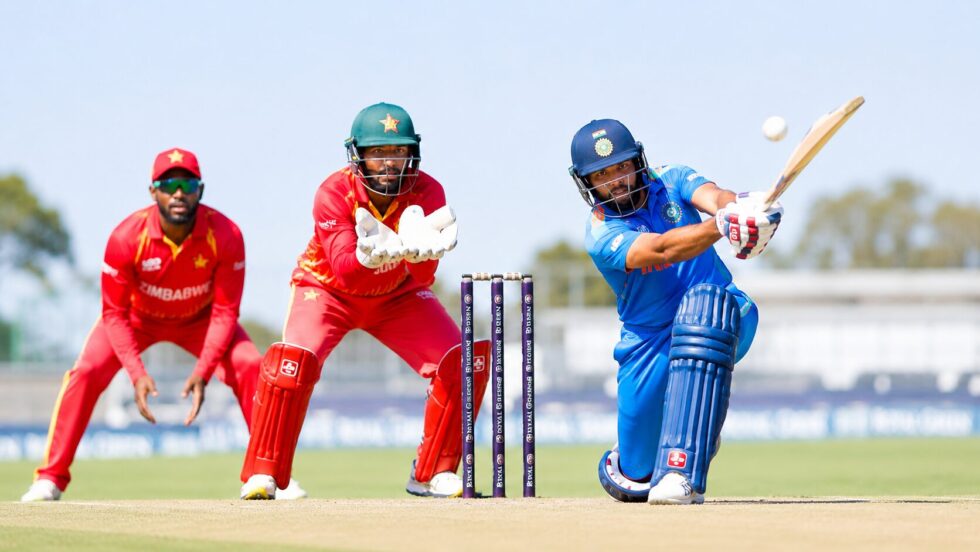
India vs Zimbabwe entered a decisive phase in Harare on 25 July 2026 as Ishan Kishan led India’s recovery from two early wickets and carried the tourists to 104 for three after 11 overs in the second T20 international. Zimbabwe captain Sikandar Raza chose to bowl first at Harare Sports Club, and his seamers briefly checked India’s aggressive opening before Kishan and captain Shreyas Iyer rebuilt the innings through a controlled third-wicket partnership, The WP Times reports.
India were seeking an unassailable 2–0 lead in the three-match series after ending a seven-game T20I winless sequence with a seven-wicket victory in Thursday’s opener. Vaibhav Sooryavanshi, the 15-year-old opener who had struck an 18-ball fifty in the first match, again attacked immediately but fell for 20 from nine deliveries. Kishan remained unbeaten on 44 from 26 balls at the 11-over checkpoint, while Iyer’s 25 from 20 helped move India from 29 for two to 95 for three before Brian Bennett removed the captain.
India vs Zimbabwe live score: Kishan restores control after two early wickets
Zimbabwe’s decision to field produced an immediate return when Blessing Muzarabani removed Abhishek Sharma for eight in the second over. Sharma had struck two boundaries but was caught by Ryan Burl, leaving India 10 for one and giving the hosts the early breakthrough they required after struggling to contain India’s top order in the opening match.
Sooryavanshi responded in his characteristic fashion. The left-hander scored 20 from nine balls, including three fours and a six, and operated at a strike rate above 220. His innings was brief but sufficient to force Zimbabwe away from a purely attacking line, with the teenager prepared to take on pace from the beginning rather than use the powerplay as a settling period.
Richard Ngarava eventually removed him with the final delivery of the third over. Sooryavanshi attempted another attacking stroke but was caught by Muzarabani, reducing India to 29 for two. The dismissal prevented him from repeating the historic half-century he had made two days earlier, but it did not alter the tactical problem he presents: bowlers have little margin for error because he is prepared to attack both length and short-pitched deliveries from his first few balls. Kishan and Iyer then changed the rhythm of the innings. They did not abandon India’s scoring intent, but they selected lower-risk areas and allowed the partnership to develop. Kishan drove and pulled decisively whenever Zimbabwe missed its length, while Iyer used the off side effectively and rotated the strike during the middle overs.
The pair added 66 for the third wicket before Bennett dismissed Iyer for 25 from 20 balls at the end of the tenth over. India nevertheless reached 100 in 10.3 overs, with Kishan still established and Tilak Varma joining him for the second half of the innings. At 104 for three after 11 overs, India were scoring at 9.45 runs per over. The immediate question was whether Kishan could convert his start into a substantial innings and whether India’s middle order could take the total towards the projected region of 180 or beyond.
India’s score at the 11-over checkpoint
| Batter | Runs | Balls | Fours | Sixes | Strike rate |
|---|---|---|---|---|---|
| Vaibhav Sooryavanshi | 20 | 9 | 3 | 1 | 222.22 |
| Abhishek Sharma | 8 | 8 | 2 | 0 | 100.00 |
| Ishan Kishan | 44 not out | 26 | 6 | 0 | 169.23 |
| Shreyas Iyer | 25 | 20 | 4 | 0 | 125.00 |
| Tilak Varma | 5 not out | 3 | 1 | 0 | 166.66 |
| Extras | 2 | — | — | — | — |
| India | 104/3 | 11 overs | — | — | 9.45 run rate |
The figures above reflect the live score checkpoint supplied during India’s innings and are not the final match score.
How Ishan Kishan shaped India’s second T20I innings in Harare
Kishan’s role became particularly important because India lost both openers inside three overs. A further wicket during the powerplay could have forced the visitors into a prolonged rebuilding phase and allowed Zimbabwe to control the pace of the innings. Instead, Kishan ensured the score continued to move. He reached 17 from 11 balls during the powerplay and then accelerated as the field spread, finding boundaries without depending entirely on aerial strokes. By the ten-over drinks interval, he had moved to 40 and India were 95 for three. His innings was built around timing rather than constant improvisation. Zimbabwe occasionally offered width outside off stump, but Kishan was equally productive when the bowlers shortened their length. Six fours in his first 26 deliveries indicated how often he had beaten the field rather than relied on six-hitting.
The wicketkeeper-batter also prevented Zimbabwe from sustaining pressure after quiet deliveries. This mattered during the partnership with Iyer because Raza repeatedly changed his bowlers in an attempt to interrupt India’s momentum. Kishan’s ability to score through several areas meant there was no simple defensive field available.
Iyer played a more measured innings, scoring 25 from 20 balls with four boundaries. His contribution was important because he absorbed the period immediately after Sooryavanshi’s dismissal and helped India avoid losing a third wicket during the remainder of the powerplay. Bennett eventually induced the mistake Zimbabwe needed, with Brad Evans completing the catch. Yet by that point India had recovered sufficiently to retain the initiative, and the arrival of Tilak Varma ensured another left-hander could continue targeting favourable match-ups.
Vaibhav Sooryavanshi remains central to the India vs Zimbabwe series
Sooryavanshi entered the second match following one of the most significant innings by a young international cricketer. In the first T20I, he made 50 from 19 balls after reaching his half-century from only 18 deliveries, becoming the youngest player to score an international fifty. India chased Zimbabwe’s 125 for seven with 40 balls remaining in that match, giving Iyer his first victory as India’s T20I captain and ending the team’s longest winless run in the format. Sooryavanshi’s innings contained four fours and four sixes and immediately shifted the contest away from the hosts.
The teenager said afterwards that producing an innings of that kind at the start of his international career had strengthened his confidence.
“When it’s the starting phase of your career, and you get these kinds of innings early on, and you perform well, it builds confidence for the upcoming matches,” Sooryavanshi told BCCI.tv after the opener.
He added that he had felt comfortable at the crease and had trusted the attacking methods that brought him into the national side.
“It felt like I was in my zone and I just backed my strengths. That was all,” he said.
Sooryavanshi dedicated the innings to his family, coaches and those who had supported him during both successful and difficult periods of his development. He also explained that one element of his celebration was intended for his mother, while another followed a conversation with India team-mate Rinku Singh. Although he did not make another half-century on Saturday, his nine-ball 20 showed that India have not asked him to become more conservative. His purpose remains to exploit the powerplay, challenge the new-ball bowlers and give the middle order a platform even if his own innings is short.
Why Harare Sports Club has become a significant venue for Sooryavanshi
Harare already holds unusual importance in Sooryavanshi’s rapidly developing career. Earlier in 2026, he made 175 from 80 balls in the Under-19 World Cup final against England at the same ground, an innings that helped India win the title. His return to Harare with the senior side therefore brought both familiarity and expectation. After the opening T20I, he acknowledged that the ground suited him but insisted that previous success did not guarantee future runs.
“I love the vibe here,” he said. “There are certain grounds where you love to score runs, and that’s maybe the case here, but I’m certainly not taking anything for granted.”The quotation was revealing because it reflected the balance India are attempting to maintain around him. Sooryavanshi is being encouraged to preserve the instinctive aggression that distinguishes his batting, while also learning that international attacks will adjust rapidly.Zimbabwe’s bowlers changed their method in the second match. Muzarabani operated with greater control, conceding only six runs from his first two overs and dismissing Sharma. Ngarava was more expensive but secured Sooryavanshi’s wicket before the teenager could dominate the full powerplay.
That exchange represented a small but relevant tactical response from Zimbabwe. Rather than allowing Sooryavanshi to dictate every contest, the hosts used different lengths and placed boundary fielders for the strokes he favours against pace.
Zimbabwe’s bowling plan produced wickets but not sustained control
Zimbabwe began the second T20I with a clear objective: take early wickets and expose an Indian middle order still being reshaped under Iyer’s captaincy.Muzarabani executed that plan most effectively. His opening spell of two overs for six runs and one wicket gave Zimbabwe control at one end, while Ngarava accepted a higher economy rate in exchange for attacking Sooryavanshi.Raza used himself for three overs during the first half of the innings, conceding 26 without taking a wicket. His spell offered India fewer obvious boundary deliveries than some of the seamers, but Kishan and Iyer were able to keep the scoreboard moving.
Brad Evans conceded 12 from his first over, Newman Nyamhuri gave away 19 from two, and Bennett’s first over cost 15 despite producing Iyer’s wicket. Those figures illustrated Zimbabwe’s central difficulty: the hosts were taking wickets, but they were not stringing together enough quiet overs to force India below a competitive scoring rate.The fielding side’s position remained recoverable because three wickets had fallen before the final nine overs. However, Zimbabwe required further breakthroughs against Kishan, Varma and the power hitters still to come.
India’s unused batting at the 11-over point included Rinku Singh, Shivam Dube and a lower order capable of supporting a late acceleration. Zimbabwe therefore needed to avoid entering the final four overs with Kishan set and several recognised batters still available.
Zimbabwe’s bowling figures after 11 overs
| Bowler | Overs | Runs | Wickets | Economy |
|---|---|---|---|---|
| Sikandar Raza | 3 | 26 | 0 | 8.66 |
| Blessing Muzarabani | 2 | 6 | 1 | 3.00 |
| Richard Ngarava | 2 | 26 | 1 | 13.00 |
| Brad Evans | 1 | 12 | 0 | 12.00 |
| Newman Nyamhuri | 2 | 19 | 0 | 9.50 |
| Brian Bennett | 1 | 15 | 1 | 15.00 |
Shreyas Iyer seeks an India vs Zimbabwe series victory after difficult start
The Zimbabwe series carries added importance for Iyer because his first weeks as India’s T20I captain were marked by defeats. India lost 2–0 in Ireland and then suffered a 4–0 defeat in England, with another match abandoned because of rain. The sequence left the reigning T20 world champions without a victory in seven consecutive internationals before the first match in Harare.
Thursday’s win therefore carried more significance than the margin alone suggested. India restricted Zimbabwe to 125 for seven before completing the chase in 13.2 overs, with Sooryavanshi providing the early acceleration and Mayank Yadav taking two wickets for 18 runs on his return from a prolonged injury absence. Mayank later described the difficulty of remaining motivated through repeated injury setbacks. He had played three T20Is in 2024 before physical problems interrupted his progress, making his successful return in Harare an important development for India’s fast-bowling depth. For Iyer, the challenge in the second match was different. India were batting first after Zimbabwe won the toss, removing the certainty of a defined chase. The captain was required to judge the surface, establish a competitive target and organise his bowlers without knowing precisely how conditions would change during the second innings.
His own 25 was not a dominant score, but it stabilised the innings after the early wickets. More broadly, India’s response offered evidence that the new-look side could adjust when the opening attack did not produce a large partnership.
India’s selection changes underline the experimental nature of the tour
India arrived in Zimbabwe with several changes to the group used during the earlier part of the international season.
The Board of Control for Cricket in India selected uncapped players Prabhsimran Singh, Yash Thakur and Ashok Sharma for the tour, while Harsh Dubey was included for a possible first T20I appearance. Rinku and Mayank returned to the national set-up, and Ravi Bishnoi was later brought into the squad as a replacement for the injured Varun Chakaravarthy.
Sanju Samson, Axar Patel, Arshdeep Singh, Harshit Rana and Mohammed Siraj were among the established players not included. The selection created opportunities for India to assess new combinations while continuing to compete for a bilateral series.
Yash Thakur made his T20I debut in the second match, replacing Ashok Sharma in the playing XI. His inclusion provided another chance for India to examine its pace resources alongside Mayank ahead of more demanding international assignments.
India’s batting order also reflected the experimental approach. Sooryavanshi and Sharma opened, Kishan took responsibility at number three, Iyer followed at four and Varma entered at five. Rinku and Dube remained available as finishers, giving the tourists considerable left-handed strength through the middle and closing overs.
India vs Zimbabwe head-to-head record favours the tourists
India entered the series with a substantial historical advantage over Zimbabwe in men’s T20 internationals. Before the current tour, the teams had met 14 times in the format, with India winning 11 and Zimbabwe three. India also won their previous bilateral T20I series in Zimbabwe 4–1 in July 2024. Their most recent meeting before this tour came at the 2026 T20 World Cup, where India won by 72 runs despite an unbeaten 97 from Zimbabwe opener Brian Bennett. The result reflected the difference in depth between the teams, although Bennett’s innings showed Zimbabwe possess players capable of troubling elite attacks.
The current series nevertheless arrived at a delicate moment for India. The world champions were rebuilding under a new captain, selecting younger players and attempting to correct the weaknesses exposed in Ireland and England. Zimbabwe, meanwhile, approached the contest as an opportunity to test their side against a powerful opponent at home. Raza’s team included Bennett, Burl, Ngarava, Muzarabani, Evans, Wessly Madhevere and Dion Myers, giving the hosts experience across both batting and bowling departments.
Where to watch India vs Zimbabwe and when the third T20I begins
The second T20I began at 1pm local time in Harare and 4.30pm Indian Standard Time on Saturday, 25 July. In India, the series was scheduled for streaming through FanCode, with television coverage available through Unite8 Sports and DD Sports on DD Free Dish. The availability of individual services may depend on region and subscription arrangements. The third and final T20I is scheduled at Harare Sports Club on Sunday, 26 July, again beginning at 1pm local time and 4.30pm IST. The ICC confirmed that all three games would be staged in Harare, with the first played on 23 July, the second on 25 July and the third on 26 July.
India vs Zimbabwe T20I series schedule
| Match | Date | Venue | Status |
|---|---|---|---|
| First T20I | 23 July 2026 | Harare Sports Club | India won by seven wickets |
| Second T20I | 25 July 2026 | Harare Sports Club | Live |
| Third T20I | 26 July 2026 | Harare Sports Club | Scheduled |
What India need from the final nine overs against Zimbabwe
At 104 for three after 11 overs, India had established a strong scoring base without completely removing Zimbabwe from the contest. A total close to 180 would require approximately 76 runs from the remaining nine overs. That rate was attainable with Kishan established, Varma newly arrived and Rinku and Dube still to bat. A score approaching 190 would demand a more sustained attack and would probably require at least one batter to remain until the final two overs. Zimbabwe’s priority was Kishan. Removing him quickly would force a new batter to adjust to the pitch and could delay India’s final acceleration. Keeping Muzarabani or another reliable seamer available for the closing overs would also be essential, particularly against Rinku and Dube.
For India, the innings had already demonstrated a degree of resilience. The visitors lost Sharma and Sooryavanshi early but did not retreat into a defensive approach. Kishan and Iyer rebuilt while maintaining a run rate above nine, preserving both wickets and scoring pressure. The second half of the contest would determine whether that recovery was converted into a series-winning position. India held the stronger platform, but Zimbabwe had taken enough wickets to retain a route back into the match if they could disrupt the middle order before the death overs.
Where to watch India vs Zimbabwe live in London and the UK
Cricket supporters in London and across the United Kingdom can watch the India vs Zimbabwe T20I series live on Hotstar UK. The second match began at 12 noon BST on Saturday, 25 July 2026, corresponding to the 1pm local start at Harare Sports Club and 11am GMT.
Viewers should open the Hotstar UK app or website before the scheduled start and check that their subscription and device access are active. The service can be used on supported phones, tablets, computers and connected televisions, although availability may depend on the viewer’s account and location.
The match is not listed as part of the regular Sky Sports Cricket schedule. UK viewers should therefore use the officially announced Hotstar UK stream rather than the Indian television and streaming services, which may be geographically restricted outside India.
India vs Zimbabwe UK viewing details
| Detail | Information |
|---|---|
| Match | Zimbabwe vs India, second T20I |
| Date | Saturday, 25 July 2026 |
| London start time | 12 noon BST |
| Venue | Harare Sports Club, Harare |
| UK live stream | Hotstar UK |
| Toss time in London | Approximately 11.30am BST |
| Third T20I | Sunday, 26 July 2026 |
| Third T20I London time | 12 noon BST |
India vs Zimbabwe questions and answers for UK viewers
What time did India vs Zimbabwe start in London?
The second T20I started at 12 noon British Summer Time on Saturday, 25 July 2026. Harare is one hour ahead of London during British Summer Time, so the 1pm local start translated to midday in the UK.
Where can India vs Zimbabwe be watched in the UK?
The Zimbabwe vs India T20I series is available through Hotstar UK. Viewers should check the platform directly before play for access, subscription requirements and supported devices.
Is India vs Zimbabwe being shown on Sky Sports?
The series has not been listed as a regular Sky Sports Cricket broadcast. Hotstar UK is the announced streaming destination for viewers in the United Kingdom.
Can UK viewers watch the match on FanCode?
FanCode holds the streaming coverage promoted for viewers in India. Access from the UK may be restricted because sports broadcasting rights are usually allocated by territory. British viewers should use Hotstar UK.
Can the match be watched free in Britain?
No confirmed free-to-air UK broadcast has been announced. DD Sports provides free-to-air coverage in India through DD Free Dish, but that service is not the UK broadcaster.
When is the third India vs Zimbabwe T20I?
The third and final match is scheduled for Sunday, 26 July 2026, at Harare Sports Club. It is due to begin at 12 noon BST in London, subject to any late scheduling or weather-related changes.
Where can live scores be followed in the UK?
Live scores, ball-by-ball commentary and full scorecards are available through major cricket platforms, including ESPNcricinfo, the BCCI match centre and other recognised sports services. These can be used when a live video subscription is unavailable.
Why is the India vs Zimbabwe series important?
India entered the tour with a reshaped T20I squad under Shreyas Iyer and used the three matches to assess emerging players. Zimbabwe, captained by Sikandar Raza, were attempting to challenge India at home and keep the series alive after losing the opening match.
Read about the life of Westminster and Pimlico district, London and the world. 24/7 news with fresh and useful updates on culture, business, technology and city life: Will Elon Musk’s Tesla Tiny House Really Reach the UK – or Is It Just Another Vision
Live score note: This report reflects the match position at 104 for three after 11 overs of India’s innings. The final score, result and individual figures may change as play continues.