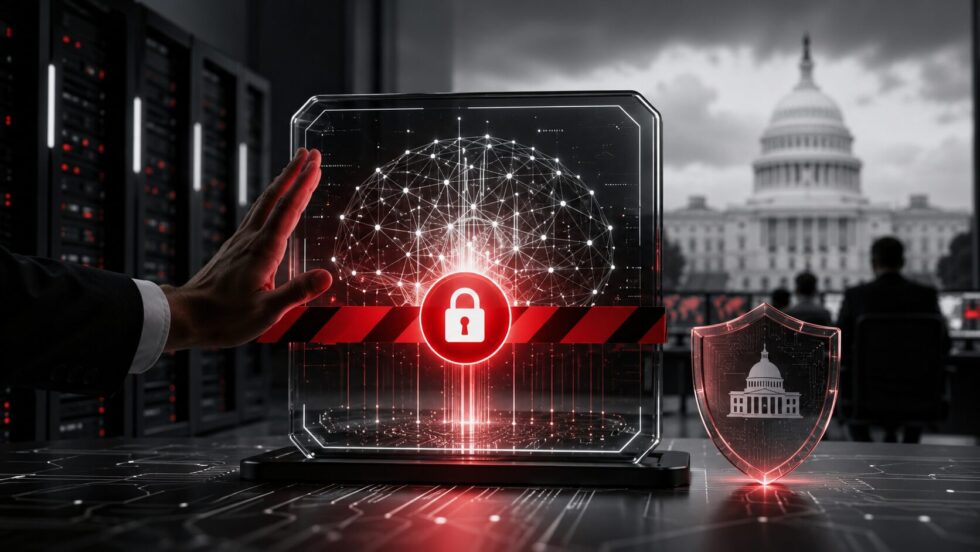
Anthropic suspends new AI tools over US government security concerns after Washington ordered the company to cut off foreign access to its most advanced models, Fable 5 and Mythos 5, in one of the sharpest state interventions yet into frontier artificial intelligence. The San Francisco AI company said it had to disable both systems for all customers because the order applied to foreign nationals and left the company without a practical way to separate eligible and non-eligible users fast enough, The WP Times reports.
The decision came only days after Claude Fable 5 was made publicly available and after months of concern in government, finance and technology circles about whether the most capable AI systems could be used to identify software vulnerabilities, accelerate cyber operations or bypass safeguards. Anthropic said the US government had cited national security authorities but had not provided detailed public evidence of a specific threat. That distinction matters: this is not simply a product recall, but a new test of whether advanced AI models are now being treated more like strategic technology than ordinary software.
Anthropic suspends new AI tools after a sudden US export-control directive
Anthropic said it received the government directive late on Friday and was ordered to suspend access to Fable 5 and Mythos 5 for any foreign national, whether inside or outside the United States. The company said the rule also covered foreign national employees at Anthropic, making compliance unusually complex for a global AI business. Because the company could not safely guarantee instant nationality-based access controls across all users, it chose to disable the models for all customers. Access to other Anthropic models was not expected to be affected under the company’s statement.
The immediate trigger appears to be a government concern that Fable 5 could be “jailbroken”, meaning users might find a way around restrictions designed to prevent dangerous or prohibited outputs. Anthropic said it had reviewed a demonstration of the technique and found that it identified only a small number of previously known, minor vulnerabilities. The company argued that similar results could be produced by other publicly available models, which is why it described the government action as disproportionate. Washington has not publicly set out the full technical basis for the order, leaving a gap between national security claims and the evidence available to users, developers and international partners.
What Fable 5 and Mythos 5 are
Fable 5 is presented as a publicly released version of Anthropic’s more powerful Mythos line, with safeguards designed to limit sensitive outputs in areas such as cybersecurity, biology and chemistry. Mythos 5, by contrast, has been treated as a more restricted system because of its potential ability to assist with vulnerability discovery and other high-risk technical tasks. This is why the case has drawn attention beyond the usual AI product cycle. The issue is not whether a chatbot can write text, but whether a frontier model can materially lower the barrier to offensive cyber work.
For users, the practical result is immediate: access to the two models has been interrupted even for people who were not the target of the order. For enterprise customers, the impact is more complicated. Companies testing AI tools for software security, regulated industries, banking, telecoms or government workflows may now have to pause pilots, move to less capable models or wait for a clearer compliance route. For Anthropic, the reputational problem is double-edged: the models are being treated as powerful enough to worry Washington, but the shutdown also raises questions about commercial reliability.
Why US officials are worried about AI models and cyber risk
The core security concern is that advanced AI systems can move beyond simple coding assistance into vulnerability discovery, exploit chaining, reconnaissance and automated troubleshooting. In defensive hands, that can help companies find weak points before attackers do. In malicious hands, the same capability can reduce the time needed to identify flaws, understand systems and generate attack pathways. That dual-use problem is now at the centre of the AI regulation debate.
Jailbreaking makes the issue more serious because safeguards are only useful if they are difficult to bypass at scale. A model may refuse a direct request for malware or exploit instructions, but a determined user may try indirect prompts, role-play, tool use, fragmented tasks or technical framing to extract restricted information. Anthropic said the specific demonstration it reviewed did not show a unique or catastrophic risk. US authorities appear to have reached a different conclusion, or at least decided that uncertainty itself justified immediate restriction.
The policy shift is significant because export controls have traditionally focused on chips, hardware, cloud access and advanced computing infrastructure. This order moves closer to controlling access to the model itself. If that approach becomes standard, AI companies may have to build nationality checks, access tiers, audit trails and government-facing compliance systems into the core of their products. That could reshape how frontier models are launched, tested and sold internationally.
The Amazon factor and the political context
The Wall Street Journal reported that Amazon CEO Andy Jassy discussed concerns about Anthropic’s models with senior US officials, including Treasury Secretary Scott Bessent. According to that reporting, Amazon researchers had used prompts to obtain information from Fable 5 that was meant to be off-limits and could potentially aid cyberattacks. Amazon is not a neutral bystander in the AI market: it has a deep commercial relationship with Anthropic and has invested heavily in the company.
That makes the story unusually delicate. On one side, a major technology partner appears to have raised security concerns with the government. On the other, the result was a sweeping order that affects Anthropic’s global customers and foreign employees. The decision also lands amid a broader dispute between Anthropic and parts of the Trump administration over government and military use of AI tools. Earlier tensions around defence access, acceptable use and national security procurement have made this more than a narrow technical disagreement.
What the shutdown means for Britain, Europe and global AI users
For Britain and Europe, the Anthropic shutdown is not just an American regulatory story. It raises an immediate question: can allied countries rely on US-built frontier AI tools if access can be interrupted by Washington on national security grounds? European officials have already been discussing access to advanced AI systems for cybersecurity and public-sector resilience. The latest move strengthens arguments in Brussels, London and other capitals that technological sovereignty is no longer an abstract slogan but a practical risk-management issue.
The UK has a particular interest because it has invested political capital in AI safety and security testing. If the most capable models are restricted before foreign researchers can test them properly, governments outside the US may struggle to assess risks independently. That could slow down defensive research, weaken international coordination and make AI safety more fragmented. The paradox is clear: restricting access may reduce misuse by some actors, but it may also reduce the ability of trusted foreign institutions to understand and manage the same systems.
For companies, the immediate lesson is operational. Businesses building workflows around frontier AI cannot assume permanent access to the newest model. Legal status, export rules, customer nationality, data location and government policy may become as important as price, latency or benchmark performance. Procurement teams will need to ask not only whether an AI system works, but whether it can be legally accessed tomorrow.
Key consequences for the AI market
| Area | Immediate effect | Longer-term risk |
|---|---|---|
| Anthropic customers | Fable 5 and Mythos 5 access disrupted | Loss of confidence in model availability |
| Foreign users | Restricted under US directive | More nationality-based access controls |
| AI companies | Pressure to prove safeguards work | Heavier compliance before model launches |
| Governments | More control over frontier AI deployment | Fragmented global AI governance |
| Cybersecurity teams | Defensive testing may be interrupted | Less international access to top tools |
| Europe and UK | Renewed debate on AI sovereignty | Push for domestic or regional alternatives |
Anthropic disputes the scale of the threat but complies with Washington
Anthropic’s public position is careful. The company is not refusing the order, and it is not saying cyber risk is imaginary. Instead, it argues that the specific evidence it has seen does not justify a sweeping shutdown. It says the vulnerabilities demonstrated were already known, minor and not unique to Fable 5. That is a crucial editorial distinction: Anthropic is complying with the law while challenging the proportionality of the decision.
The company also has a broader strategic interest in defending its safety record. Anthropic has built its brand around AI safety, constitutional AI, responsible deployment and controlled access to high-risk capabilities. A government order implying that one of its newest models may be unsafe directly pressures that brand. At the same time, being viewed as “too powerful” can fuel market attention and investor interest, which is why critics have accused the company and the wider AI sector of turning risk language into product theatre.
Still, the commercial damage may be real. If customers cannot access a model shortly after launch, they may hesitate to build critical products around it. If foreign employees cannot use internal systems, development and security testing may be disrupted. If governments can intervene suddenly, every major AI release now carries a geopolitical risk premium.
What Anthropic said in its statement
Anthropic said the net effect of the order was that it had to “abruptly disable” Fable 5 and Mythos 5 for customers to ensure compliance. The company also said the government letter did not provide specific details of the national security concern. According to Anthropic, its understanding is that officials believe they have become aware of a method of bypassing, or jailbreaking, Fable 5.
That wording is important because it leaves several questions unanswered. Did the government identify a novel capability, or did it react to a familiar jailbreak risk? Did the model produce genuinely dangerous new information, or did it reveal known vulnerabilities faster than expected? Was the concern technical, political, procedural or a mixture of all three? Until those questions are answered, the shutdown will remain a symbol of how little public visibility exists around frontier AI governance.
Why this could become a turning point for AI regulation
The Anthropic case may become a precedent for a new phase of AI control. Until now, much of the public debate has focused on training data, copyright, hallucinations, bias, privacy and job disruption. Those issues remain important, but the Fable 5 and Mythos 5 decision points to a harder national security question: when does an AI model become a controlled strategic asset?
If Washington can restrict foreign access to a model because of cyber capability, other governments may follow with their own rules. China, the EU, the UK and other jurisdictions could demand local evaluation, local hosting or local access guarantees. AI companies may be forced to maintain different versions of the same model for different markets. That would make the global internet of AI tools more fragmented, more regulated and more expensive.
For the public, the story is also a warning about the speed of AI deployment. A model can move from preview to public release to government restriction within days. That pace is difficult for lawmakers, customers, researchers and even company employees to manage. The market wants rapid launches; governments want security; users want stability; researchers want access. The Anthropic shutdown shows that those demands are now colliding in real time.
What happens next for Anthropic, Fable 5 and Mythos 5
The next stage will depend on whether Anthropic and the US government can agree on a narrower compliance system. That could mean citizenship verification, restricted enterprise access, government-approved users, additional monitoring, stronger safeguards or a special framework for allied governments and vetted researchers. It could also mean the models remain unavailable while legal and technical negotiations continue. The most important issue is transparency. If the government has evidence that Fable 5 or Mythos 5 creates a distinctive cyber risk, the industry will need enough detail to understand the standard being applied. If the evidence is weak or comparable to risks in competing models, the order may be seen as selective, political or commercially disruptive. Either way, the case has already changed the conversation. Anthropic suspends new AI tools after US government security concerns is therefore not just another AI headline. It is a story about who controls the most powerful models, who gets to test them, who is trusted to use them and whether frontier AI is now entering the same strategic category as chips, cloud infrastructure and military-grade software. For Britain, Europe and the wider technology market, the message is blunt: access to the newest AI systems may no longer be a purely commercial decision.
Read about the life of Westminster and Pimlico district, London and the world. 24/7 news with fresh and useful updates on culture, business, technology and city life: How to Get iOS 26.5 on iPhone: Top New Features, RCS Encryption, Apple Maps Ads and USB-C Updates