China has announced a far-reaching vehicle safety regulation that will ban fully concealed door handles on electric vehicles (EVs) sold across the country, following mounting evidence that such designs can prevent occupants and rescuers from opening doors after serious crashes. This is reported by The WP Times, citing Financial Times.
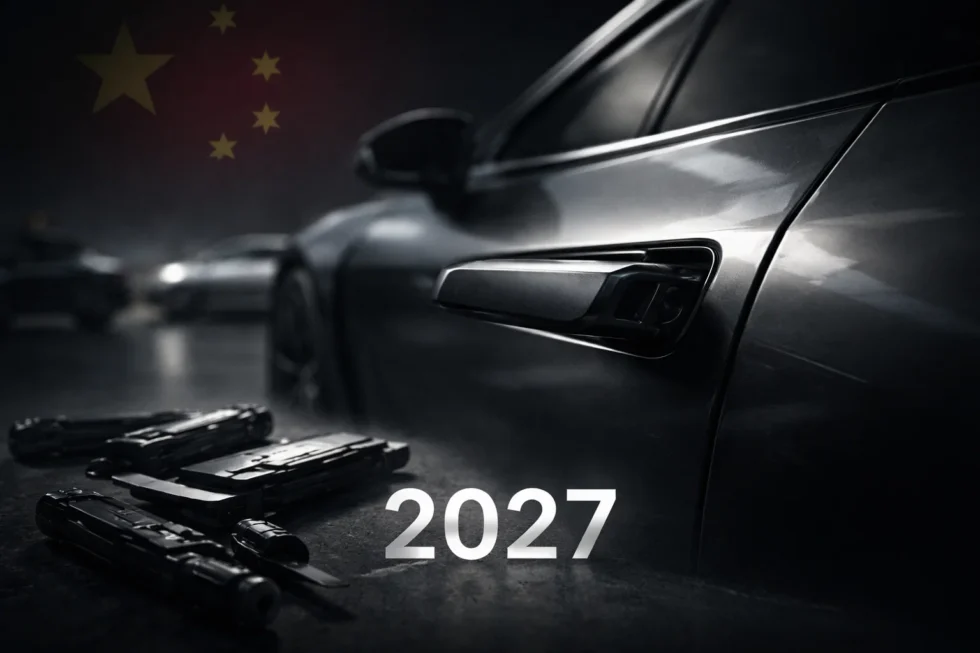
The decision, formally unveiled on Monday by China’s Ministry of Industry and Information Technology, makes China the first major automotive market to explicitly outlaw electrically dependent door-handle systems on safety grounds. Under the new regulation, all passenger vehicles sold domestically will be required to feature manual mechanical door releases, accessible from both inside and outside the vehicle, ensuring operability even in the event of power loss.
The rules will come into force on 1 January 2027, with transitional arrangements allowing certain models already approved for sale to comply during a limited grace period. Chinese regulators said the measure is intended to strengthen emergency access standards and reduce the risk of occupants becoming trapped following collisions, fires or electrical failures.
Hidden handles — why they became popular
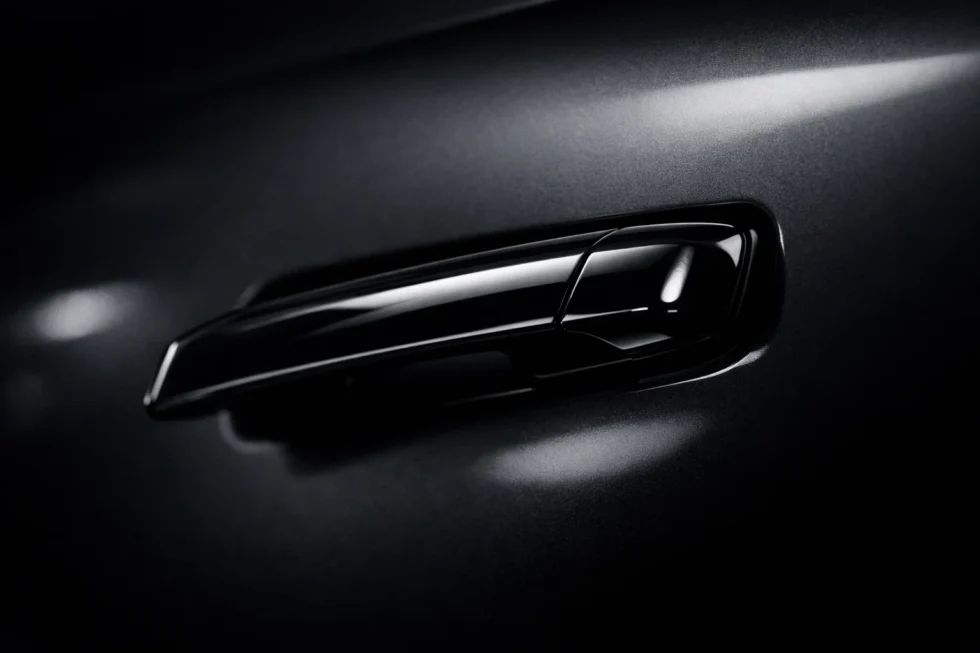
Flush-mounted, pop-out door handles entered the automotive mainstream after Tesla introduced the design on the Model S in 2012. By integrating the handle seamlessly into the bodywork and activating it only when required, manufacturers were able to achieve incremental aerodynamic gains, reducing drag and marginally improving energy efficiency — a key selling point in the highly competitive EV market, where driving range remains a primary consumer concern.
Beyond efficiency, concealed handles also became a visual marker of technological sophistication, reinforcing the minimalist, high-tech aesthetic associated with modern electric vehicles. As EV adoption accelerated, the design was widely copied by both established automakers and newer entrants seeking to signal innovation and premium positioning. These perceived advantages drove rapid global uptake. In China in particular, state media estimates that around 60 per cent of the top 100 best-selling “new energy vehicles” — a category covering fully electric and plug-in hybrid models — now feature some form of hidden or electrically actuated door handle, making the design a defining element of the country’s EV landscape.
Safety warnings and fatal accidents
Despite their widespread adoption, flush-mounted door handles have increasingly drawn scrutiny from safety regulators. In most implementations, the handles rely on electrical signals to activate the latch, meaning they can fail if a collision disrupts power supply, damages wiring or triggers an automatic system shutdown following a fire. In such scenarios, doors may remain locked even when the vehicle structure itself is intact.
Chinese regulators cited a number of fatal incidents that brought these risks into sharper focus. In October 2025, a high-profile crash in Chengdu involving an electric sedan produced by Xiaomi reportedly left bystanders unable to open the vehicle before it caught fire, intensifying public debate over emergency access and rescue times.
Concerns have also been raised outside China. In the United States, the parents of a teenager killed in a 2024 crash involving a vehicle produced by Tesla have filed a lawsuit alleging that a post-collision power failure rendered the car’s electronically operated doors inoperable, trapping occupants inside. The case has been cited in international reporting as part of a broader reassessment of electronically dependent vehicle access systems.
While regulators stress that such incidents are statistically rare, they have featured prominently in safety reviews across multiple jurisdictions. According to industry analysts, it was the combination of low probability but high-consequence outcomes that prompted China’s automotive regulator to move first with a binding nationwide rule.
New rules: what they mandate
Under the new regulation, every new vehicle sold in China must meet several specific requirements:
- Manual mechanical release mechanisms must be provided on every door, operable from inside and outside the vehicle, excluding the boot.
- Each door must feature a hand-operable space measuring at least 6cm × 2cm × 2.5cm to ensure users can manually release the latch without power.
- Clear signage inside the cabin must instruct occupants on how to operate the door manually.
Vehicles already approved and nearing launch can benefit from a two-year grace period to adapt designs, but all new introductions after January 2027 must comply.
Impact on manufacturers
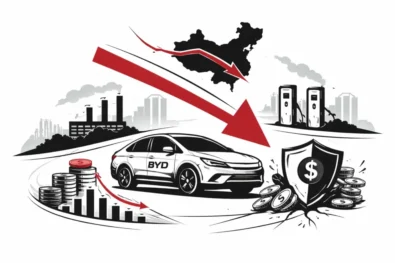
For many carmakers, particularly Chinese brands that have aggressively expanded their EV lineups, the new rule will prompt significant design revisions. Beyond Tesla and Xiaomi, major players such as BYD, which overtook Tesla to become the world’s largest EV seller last year, will need to ensure future models incorporate compliant door mechanisms.
Automotive industry analysts say the regulation could also affect imports and vehicles developed for global markets. Because China is the largest EV market in the world, many manufacturers design models primarily for Chinese consumers. The change may lead to broader adoption of mechanical door systems across other regions, including Europe and North America.
Global regulatory context
At present, no other major automotive market has introduced a formal nationwide ban on electrically dependent door handles comparable to China’s move. However, regulators in the United States, the European Union and the United Kingdom have stepped up scrutiny of electronic vehicle access systems, particularly in post-crash scenarios involving fires or power loss.
In the US, the National Highway Traffic Safety Administration has reviewed multiple crash reports in which electronic latches failed after collisions, as part of broader investigations into EV fire safety and emergency egress. While no ban has been proposed, NHTSA guidance increasingly stresses the importance of power-independent exit mechanisms for occupants and first responders.
Within the EU, vehicle safety oversight coordinated by the European Commission and implemented through UNECE regulations has focused on post-crash accessibility, including rescue times and door operability following electrical failure. Industry data suggests that more than half of new EV models launched in Europe since 2022 rely primarily on electronic door actuation, making the issue increasingly relevant for regulators.
In the UK, the Driver and Vehicle Standards Agency and emergency services bodies have issued technical guidance addressing electrical system shutdowns after impact, though no model-specific restrictions are currently in force. Against this backdrop, China’s decision is widely seen by analysts as a potential catalyst for regulatory convergence, particularly given the scale of its domestic EV market and its influence on global vehicle platforms.
Consumer safety organisations have broadly welcomed the move, arguing that emergency escape and rescue access must outweigh marginal aerodynamic gains, which typically improve vehicle range by only a few kilometres per charge. Automakers, by contrast, have warned that redesigning door modules could increase unit production costs and engineering complexity, especially on vehicles built around fully electronic architectures. Even so, few manufacturers are expected to eliminate mechanical backup systems, as doing so would expose them to both regulatory and reputational risk.
Looking ahead
As manufacturers adapt vehicles to meet China’s 2027 standard, attention will increasingly turn to regulatory responses in Europe and North America. Should similar requirements be adopted elsewhere, the industry may move towards standardised mechanical fallback solutions across global platforms, reducing the need for region-specific designs.
For drivers and prospective EV buyers, the shift highlights a broader recalibration in vehicle design priorities: away from features that prioritise visual minimalism or incremental efficiency gains, and towards robust, power-independent safety systems that function reliably under emergency conditions. In that sense, China’s rule may signal not an isolated policy decision, but the early stages of a global rethink of EV access and rescue standards.
Read about the life of Westminster and Pimlico district, London and the world. 24/7 news with fresh and useful updates on culture, business, technology and city life: Which PlayStation Plus games are free in с2026 for UK subscribers