England schools smartphone ban rules come into force on Monday, 29 June 2026, making state-funded schools legally responsible for following national guidance that says pupils should not use mobile phones or similar smart devices during the school day. The change gives statutory weight to what many schools already do in practice: keeping phones away during lessons, corridors, breaktimes and lunchtime to reduce distraction, bullying risks and classroom disruption, The WP Times reports.
The new law does not mean every pupil must leave a phone at home. In many schools, children may still bring a device for travel, safety or family contact before and after school. The central point is different: once the school day begins, the phone should not be used, seen or heard unless there is a specific agreed exception, such as a medical need or an accessibility requirement.
What is changing under the England schools smartphone ban
The practical change is that mobile phone guidance for schools in England now has legal force. Section 36 of the Children’s Wellbeing and Schools Act 2026 requires state-funded schools to have regard to published guidance on mobile phones, and that provision starts on 29 June 2026.
Before this date, the Department for Education guidance was non-statutory. It already said schools should develop a policy prohibiting mobile phones and smart technology with similar functionality throughout the school day, including lessons, time between lessons, breaktimes and lunchtime.For parents and pupils, the change will be seen in school behaviour policies, letters home, tutor-time reminders, sanctions and storage systems. For headteachers and academy trusts, the change is more formal: they must now be able to show how their school policy follows the national expectation of a phone-free day.
Can pupils still take phones to school
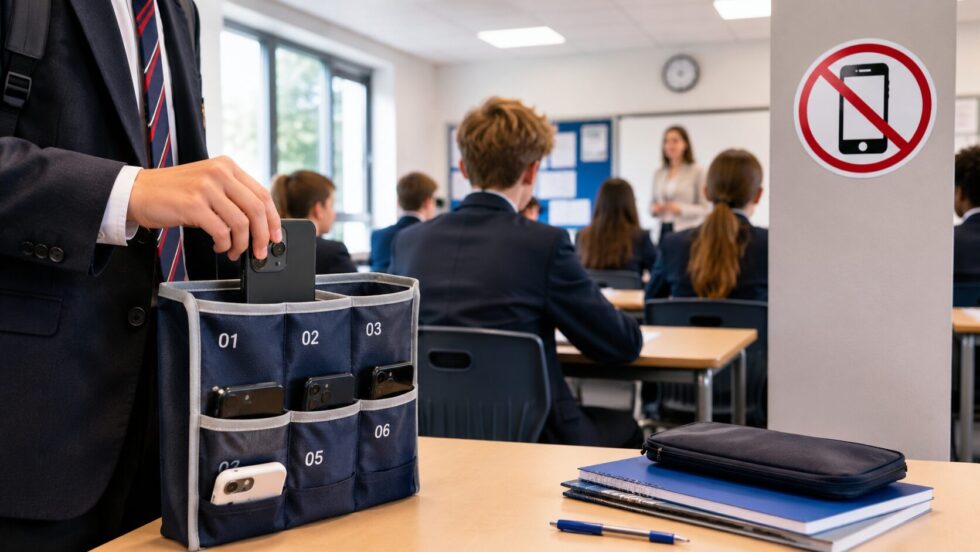
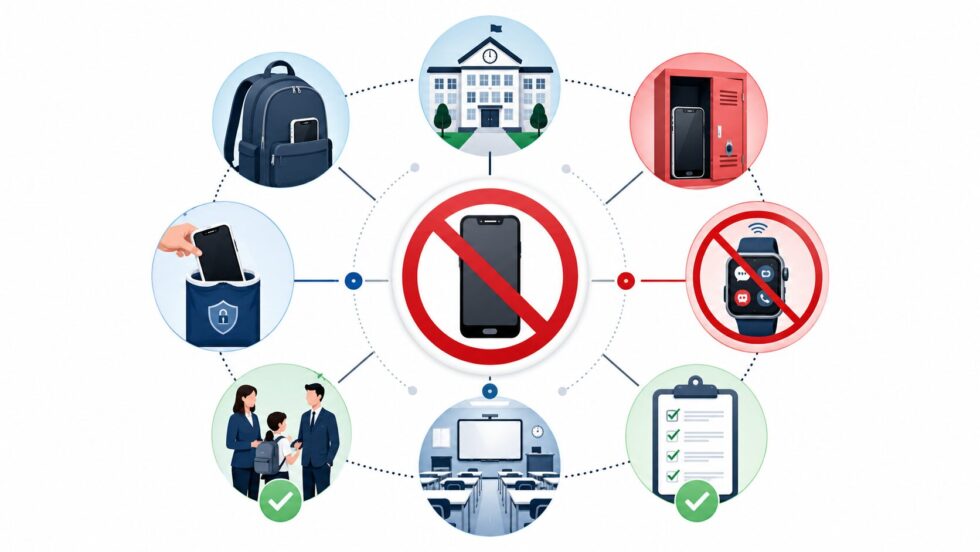
In many cases, yes. The England schools smartphone ban is not automatically a bag-search ban on every device entering the school gate. Schools can still allow pupils to bring phones, especially where parents rely on them for travel, safeguarding or after-school arrangements. But the phone will usually need to stay switched off and stored away. Some schools use a “not seen, not heard” rule. Others collect phones at registration, require pupils to place them in lockers, or use sealed pouches that are opened only at the end of the day. The key test is not whether the phone is physically on the premises. The key test is whether pupils have access to it during the school day.
Where will phones go during the school day
Schools can choose the system that fits their site, budget and pupil numbers. The government guidance leaves implementation to heads and trusts, because a small rural secondary, a large urban academy and a special school may need different arrangements.
| School phone system | How it works | What it means for pupils |
|---|---|---|
| “Not seen, not heard” | Phone remains in bag or blazer, switched off | Cheapest model, but harder to police |
| Tutor-time collection | Phones handed in during morning registration | Clearer control, but needs admin time |
| Lockers | Pupils store phones securely on arrival | Stronger system, but needs space and funding |
| Magnetic pouches | Phone is locked in a pouch during the day | Allows pupils to carry phone but not access it |
| Medical-access pouches | Softer access for approved health needs | Used for insulin pumps or other agreed cases |
The guidance allows schools to decide what is proportionate. However, unions and school leaders have warned that stricter systems cost money, especially if schools need lockers, secure storage or phone pouches.
Why is England banning smartphones in schools
The policy is driven by three linked concerns: learning, behaviour and wellbeing. Ministers argue that phones distract pupils in lessons, create pressure during breaks and can worsen bullying or social-media conflict. The Department for Education guidance says pupils should be taught the risks linked to mobile phones, including loss of focus, classroom disruption and increased bullying. The government has also tied the school phone rules to wider concern about children’s relationship with technology and social media. In January 2026, ministers said Ofsted inspectors would check whether mobile phone bans were being properly enforced in schools, while the government opened a wider conversation about children’s social media use and online safety.
What did Bridget Phillipson say about phone-free schools
Education Secretary Bridget Phillipson has pushed schools towards a full phone-free day, not just a classroom ban. Earlier in 2026, she told headteachers that schools should be smartphone-free environments by default. The government position is that phones should not be used during lessons, between lessons or at lunch and break. The guidance also says staff should avoid using personal phones in front of pupils for personal reasons, so that adults can enforce the rules consistently. The message to schools is simple: a ban that only works during maths, English or science is not enough. The policy is aimed at the whole school day.
What about teachers’ phones
Teachers are not banned from using phones for legitimate work reasons. The guidance allows staff to use mobile devices where needed, for example to log into secure systems, use two-step verification, issue homework, record behaviour, give rewards or manage school systems. But staff should not use personal phones casually in front of pupils. The reason is consistency. If pupils are told phones damage attention and behaviour, schools do not want adults visibly scrolling during the same school day. This matters because phone rules often fail when pupils see double standards. The new guidance puts responsibility not only on pupils, but also on school culture.
Are smartwatches and other devices included
Yes, where they work like phones. The guidance covers mobile phones and smart technology with similar functionality, including devices that can send or receive messages, notifications or record audio and video. That means a smartwatch may be treated like a phone if it can receive alerts, messages or calls. Schools are expected to close loopholes rather than simply remove the word “phone” from the problem. For pupils, the safest assumption is this: if the device can message, notify, film, record or connect like a phone, the school may restrict it.
What are the exceptions
Schools can make exceptions, but they should be clear and limited. The most obvious cases are medical, disability, safeguarding and accessibility needs. A pupil who uses a phone to manage an insulin pump, monitor blood glucose or support an agreed health plan may need access. A pupil with special educational needs or a disability may also need an agreed device for communication or support.The important point is that exemptions should be written into the pupil’s plan or agreed with the school. They should not become a general excuse for ordinary phone use.
What sanctions can schools use
Sanctions will depend on each school’s behaviour policy. Common responses may include confiscation, detention, contact with parents, loss of privileges or escalation for repeated refusal. Schools already have powers to confiscate items where this is reasonable and consistent with policy. The new legal backing makes it easier for schools to defend a clear phone-free rule if parents or pupils challenge it. Parents should expect letters or policy updates explaining what happens if a phone is seen, heard or used during the day.
How does this affect parents
Parents may notice the biggest cultural change. Many families are used to messaging children during the school day about lifts, clubs, forgotten PE kits or family arrangements. Under the phone-free model, that contact should go through the school office.That may feel slower, but it is central to the policy. The aim is to stop the school day becoming an extension of group chats, family messages, social media alerts and online pressure. Parents should check three things before 29 June: whether the school allows phones on site, where the phone must be stored, and what happens if a child needs urgent contact during the day.
What about the rest of the UK?
Education is devolved, so the England schools smartphone ban does not automatically apply in Scotland, Wales or Northern Ireland. That means there is no single UK-wide rule starting on 29 June 2026. England is moving to statutory backing through the Children’s Wellbeing and Schools Act 2026, while the other nations are using national guidance, local council decisions or pilot schemes.
In Scotland, the government has backed phone-free learning, but the system is still different from England’s legal model. Scottish guidance allows headteachers to restrict or ban phones where they believe it is right for their school. Edinburgh is going further from August 2026, with a “bell-to-bell” ban across council schools: secondary pupils will place phones in lockable pouches for the full school day, while primary pupils will store phones in locked cabinets.
Wales does not currently have a national legal ban on mobile phones in schools. Headteachers and governing bodies can already restrict or ban devices, but the policy can vary from school to school. Welsh ministers have said they want clearer national expectations, which means parents may see tougher rules even without a single England-style law.
Northern Ireland has also been testing phone-free approaches. A pilot scheme involving nine schools ended earlier in 2026, with findings expected to shape future policy. For now, the position remains more cautious than England: schools can act locally, but there is not yet the same statutory national requirement.
The UK picture is therefore split. England is making phone-free guidance legally enforceable for state-funded schools from 29 June 2026. Scotland is moving through guidance and local action, with Edinburgh becoming a major test case. Wales is relying on school-level powers and promised national expectations. Northern Ireland is still assessing pilot evidence before deciding the next step.
England schools smartphone ban: what pupils should do now
Pupils should not assume last term’s informal phone rule will continue unchanged. From 29 June, schools in England are likely to tighten routines at the gate, during morning registration, in corridors and at breaktime. A phone policy that was once treated as a classroom rule may now become a full-day behaviour rule.
The safest approach is simple: bring a phone only if it is genuinely needed for travel, safety or after-school contact. Before entering school, pupils should switch it off, put it away and follow the exact storage rule used by their school. If the school uses lockers, pouches or form-time collection, pupils should not wait to be challenged by staff.
Breaktime and lunchtime are the key areas where some pupils may notice the biggest change. The government guidance expects schools to be phone-free throughout the day, not just during lessons. That means scrolling, filming, messaging, gaming, checking social media or using a phone as a calculator should not be treated as normal school-day behaviour.
Smartwatches should not be seen as a loophole. If a watch can receive messages, notifications, calls or alerts, a school may treat it as smart technology with similar functionality to a phone. Pupils who need a device for medical, disability or safeguarding reasons should make sure the exemption is agreed with the school in advance.
What parents should ask schools
Parents should look for clear answers, not slogans. A serious phone policy should explain whether phones are allowed on site, whether they must be handed in, stored in bags, placed in lockers or locked in pouches, and what happens if a phone is seen, heard or used during the day.
Parents should also ask how urgent communication will work. If a child is ill, has a travel problem, forgets equipment or needs to contact home, the school should explain whether communication goes through reception, the pastoral team, the year office or another named system. The same applies if parents need to pass on an urgent message during the day.
Medical and accessibility exemptions need particular care. Pupils using a phone to manage diabetes technology, health monitoring, communication support or another agreed need should not be left in uncertainty. Parents should ask whether the exemption will be written into a care plan, SEND plan, behaviour note or separate school agreement.
The policy should also explain sanctions. Parents should know whether a first breach leads to a warning, confiscation, detention, parental collection or a behaviour log. Repeated breaches should be clear too, especially for secondary pupils where phone use can become part of wider behaviour monitoring.
This is especially important for Year 7 pupils, children travelling alone, pupils with health conditions, pupils with SEND, young carers and families with complex after-school arrangements. The strongest policies will be strict enough to protect learning but clear enough to avoid confusion at the school gate.
Background: why the phone ban became law
Most schools in England already had some form of mobile phone policy before the law changed. The problem was consistency. Some schools collected phones at the start of the day, some used lockers or pouches, and others relied on “not seen, not heard” rules that depended heavily on staff enforcement.
The political argument was whether guidance was enough. Ministers previously said a statutory ban was not necessary because most schools already restricted phones. But pressure grew from parents, MPs, campaigners and school leaders who argued that heads needed stronger national backing, especially when families challenged confiscations or when pupils treated rules differently from school to school.
The final model does not impose one identical storage system on every school. It does not say every pupil must leave a phone at home, and it does not require every school to buy expensive pouches. Instead, it gives legal force to the national expectation that schools should be mobile phone-free environments by default.
That matters because the school day includes more than lessons. The policy covers classrooms, corridors, movement between lessons, breaktime and lunchtime. The aim is to reduce distraction, stop phone-led disruption, limit bullying risks and give staff a clearer basis for enforcement.
Final picture for 29 June
The England schools smartphone ban is not just a symbolic announcement. From Monday, 29 June 2026, state-funded schools in England must have regard to statutory guidance on mobile phones, making phone-free school policy a legal responsibility rather than a loose recommendation.
For pupils, the everyday rule is straightforward: the phone may travel to school if the school allows it, but it should not become part of the school day. For parents, routine contact should go through the school rather than direct messages to children. For teachers, enforcement should become easier because the national expectation is now clearer.
The real test will be consistency. Schools that only say “not seen, not heard” may still face pressure if phones remain easy to access. Schools that use pouches, lockers or morning collection may find enforcement simpler, but they will need clear systems for emergencies, medical exemptions and end-of-day return.
The policy’s success will depend on whether schools can create a culture where lessons, corridors and lunch breaks are not shaped by notifications, group chats, filming, gaming and social media pressure. The law sets the direction; the daily routine inside each school will decide how much actually changes.
Questions and answers: England schools smartphone ban
Does the England schools smartphone ban mean pupils cannot bring phones to school?
Not always. Many schools may still allow pupils to bring phones for travel or safety before and after school. The key rule is that pupils should not have access to phones during the school day unless there is an agreed exception.
Does the ban apply during breaktime and lunchtime?
Yes. The government guidance covers the whole school day, including lessons, movement between lessons, breaktimes and lunchtime. It is not designed as a lessons-only rule.
Are smartwatches included?
They can be. If a smartwatch can receive messages, notifications or calls, or works like a phone, a school may restrict it under the same policy.
What happens if a pupil needs a phone for medical reasons?
Schools can allow exceptions for medical, disability, safeguarding or accessibility reasons. These should be agreed in advance and clearly recorded so staff know what is permitted.
Can teachers use phones?
Teachers can use phones or similar devices for legitimate work reasons, such as two-step verification, homework systems, rewards or sanctions. They are expected not to use personal phones casually in front of pupils during the school day.
Does the rule apply to private schools?
The statutory duty is focused on state-funded schools in England. Independent schools may have their own policies, but many already restrict phones.
Is this the same as a social media ban for under-16s?
No. The school smartphone ban is about phone use during the school day. Wider social media restrictions for children are a separate policy debate.
What should parents do if they need to contact their child urgently?
Parents should contact the school office or the school’s named pastoral system. Schools should explain this clearly in their policy.
Can schools confiscate phones?
Schools can use sanctions set out in their behaviour policy, including confiscation where reasonable. Parents should check how and when confiscated phones are returned.
What changes from 29 June 2026?
From 29 June, England’s phone-free school guidance gains legal force for state-funded schools. Schools must treat mobile phone policy as a formal responsibility, not just a preference.
Read about the life of Westminster and Pimlico district, London and the world. 24/7 news with fresh and useful updates on culture, business, technology and city life: What are tonight’s Lotto results and National Lottery numbers for Saturday 27 June 2026