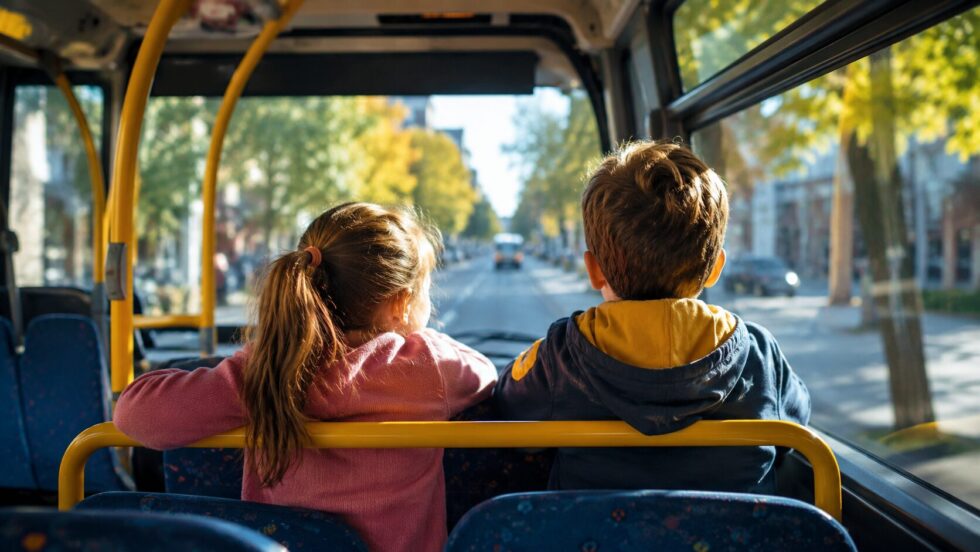
Free travel pass arrangements introduced for August 2026 allow children aged five to 15 to make unlimited journeys without paying a fare on thousands of participating local bus services across England. The month-long offer began on Saturday, 1 August, and runs until Monday, 31 August, covering family days out, visits to relatives and ordinary local journeys during the school holidays. No national application or advance registration is required, although passengers must still obtain a free ticket where an operator issues one and may need to prove their age. The scheme is funded by the government through its Great British Summer Savings programme and is intended to reduce the cost of travelling during a period when families often face higher spending on childcare, food and activities, The WP Times reports.
The headline promise is straightforward, but it is not a universal travel pass covering every form of public transport or every bus carrying passengers in England. The offer applies to eligible local bus services operated by participating companies, and the Department for Transport has published regional tables showing which operators and route numbers are included or excluded. Trains, the London Underground and most tram networks are outside the national bus scheme, while longer-distance coaches, dedicated school services, night buses and some specialist routes may also be excluded. Local authorities and operators can nevertheless add their own support: in South Yorkshire, for example, regional funding has extended the August offer to participating Supertram journeys for children aged five to 15.
Free travel pass rules: who qualifies for free bus travel in August 2026
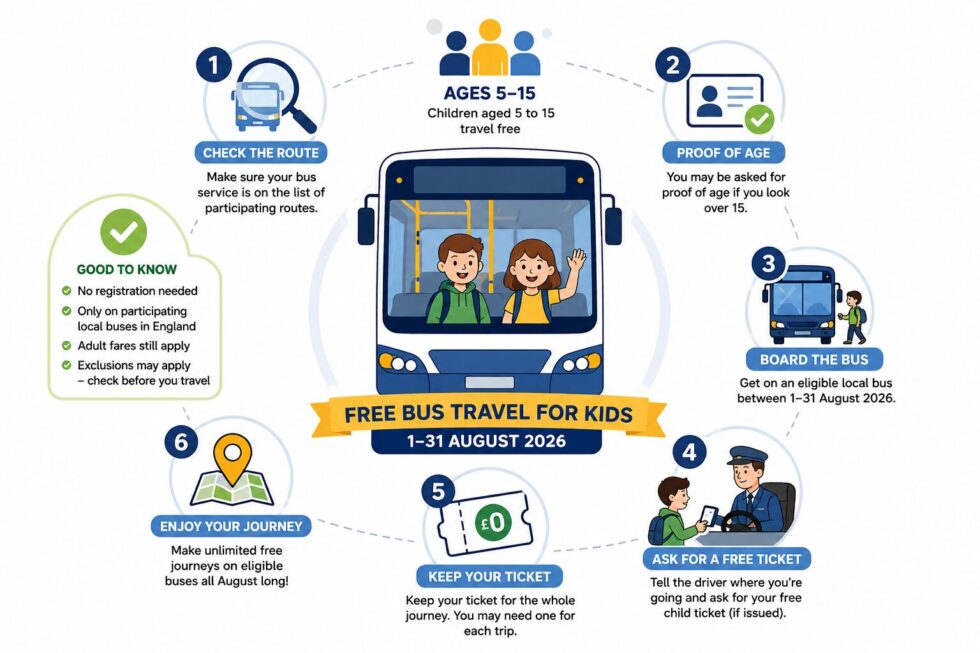
The national Summer Bus Fare Offer covers children aged five to 15 inclusive. A child becomes eligible from their fifth birthday and remains within the scheme until the day before turning 16, subject to the individual operator’s approach to checking age. Children under five already travel free on many local bus networks under normal operator conditions, so the August measure is principally designed to remove fares for the older five-to-15 age group.
The Department for Transport originally described the support as unlimited free journeys with no registration required. That means families do not have to complete a national application, pay an administration charge or wait for a new government-issued card before travelling. The expression “free travel pass” is therefore useful as a search term, but passengers should not assume that a physical national pass exists: in most areas, the child simply boards an eligible service and follows the operator’s ticketing instructions.
On Stagecoach services taking part, for example, the passenger must tell the driver where they are travelling and ask for a free child ticket. A ticket is issued for each child and should be retained during the journey. Other operators may use a similar zero-fare ticket to record passenger numbers and reclaim the cost of the journey from the scheme. The central eligibility rules are:
- The child must be aged between five and 15.
- The journey must take place from 1 to 31 August 2026 inclusive.
- The service must be an eligible participating local bus route in England.
- A free ticket may still need to be requested from the driver.
- Proof of age may be required where the passenger appears older than 15.
- Local rules may require younger children to travel with an adult.
- Normal fares remain payable on routes excluded from the scheme.
Families should check the precise route rather than relying only on the operator’s name. A company may include most of its local network while excluding selected school, airport, coach, event or night services. The government’s guidance is organised by region and lists participating operators alongside included and excluded route numbers, while also directing passengers to operator websites for service-level information.
Is identification required for the free travel pass
There is no single national identity document that every child must carry, but operators can request evidence where age is uncertain. The practical risk is greatest for teenagers aged 14 or 15, who may be asked to demonstrate that they are still under 16.
Morebus, which operates in parts of southern England, says passengers aged 14 and 15 should carry proof such as a passport, birth certificate or school pass showing their school year. It also says that a clear photograph of a passport or birth certificate on a mobile phone may be accepted. A passenger who cannot satisfy the driver that they are eligible may be asked to pay the ordinary child or adult fare.
South Yorkshire’s regional guidance similarly says a driver may ask for proof if a child looks older than 15. Accepted evidence can include a passport, school or student card, birth certificate, medical letter or an existing Zoom Under 16 Travel Pass. The Zoom card is not required to receive the national August offer, but it can serve as convenient proof of age.
Parents should therefore check the local operator’s conditions before departure, particularly where an older teenager is travelling independently. Carrying suitable evidence can prevent disagreement at the bus stop and reduce the risk of having to buy a fare unexpectedly.
Which bus routes are included in the August free travel scheme
The free travel pass offer covers thousands of local routes in England, including networks run by major groups such as First Bus, Stagecoach and Go-Ahead, alongside municipal, regional and independent operators. Government examples include urban services, interurban routes connecting neighbouring towns and buses reaching beaches, parks, museums and visitor attractions.
The Department for Transport has highlighted several journeys that demonstrate the geographical range of the offer. These include the X46 between Hull and York, the Carousel 37 from High Wycombe towards Windsor, Leicester’s number 54 for the National Space Centre and the X1 and X11 between Norwich and Great Yarmouth. Brighton-bound families can use participating services such as the Coaster 12, Regency 28 and Breeze 77, while Birmingham routes 23 and 24 provide access towards Woodgate Valley Country Park.
The government has also promoted Birmingham’s outer-circle number 11, a route of about 43 kilometres that connects communities around the city and serves areas close to Bournville and Cadbury World. Its inclusion illustrates that the scheme is not restricted to short journeys within one town, although passengers must still check whether every section, variation or connecting service is participating.
| Journey type | Usually covered? | What families should check |
|---|---|---|
| Participating local town or city bus | Yes | Operator and route number |
| Participating interurban local bus | Often | Whether the full route is listed |
| Long-distance coach | Often not | Operator exclusions and booking terms |
| Dedicated school bus | Commonly excluded | Whether it is registered as a public service |
| Night bus | Depends on the operator | Local exclusions and travel times |
| Airport or special express service | Depends | Premium-fare and route conditions |
| London bus | Separate London rules | Oyster and Zip card arrangements |
| Tram or light rail | Not nationally covered | Whether local funding has been added |
| Rail journey | No | Existing child rail discounts instead |
The word “most” is important. Government announcements describe free travel on most local buses rather than every bus in England, while the formal guidance contains extensive regional route tables. Travellers should use the government list as the starting point and then verify the timetable and conditions with the company running the service.
Which services can be excluded
Stagecoach says its exclusions can include certain longer-distance coach services, dedicated school buses and routes on which older and disabled passengers’ concessionary travel is not normally accepted. Those services continue to charge ordinary fares during August.
Rules differ by region. Morebus excludes all of its night buses and the New Forest Tour, for example. The operator also requires children aged five to 11 to travel with a fare-paying adult, while eligible passengers aged 11 to 15 may travel independently. A 15-year-old cannot act as the qualifying accompanying person for a younger sibling under that operator’s scheme because the responsible companion must be at least 16. This demonstrates why the national announcement should not be treated as the complete terms and conditions. The government supplies the funding and broad eligibility framework, but operators continue to manage boarding, safeguarding, ticket issuing and individual service exclusions.
How families use the free travel pass without applying
For most journeys, using the offer should involve only a few steps:
- Find the intended service and confirm it appears in the government or operator list.
- Check whether the child must be accompanied by an adult.
- Carry proof of age for older children where the operator recommends it.
- Tell the driver the destination when boarding.
- Ask for the free child ticket if one is not issued automatically.
- Keep the ticket until the journey is complete.
- Repeat the process for each new journey or bus boarded.
The offer does not generally provide a single paper ticket for unlimited travel throughout the entire month. “Unlimited journeys” means that an eligible child can make repeated qualifying journeys without paying, but a new zero-fare ticket may be issued for every leg. On Morebus, for instance, children must obtain and retain a ticket on each journey, including younger passengers who might ordinarily be carried without a ticket.
Adult fares are not automatically reduced by the children’s scheme. A parent, guardian or other accompanying passenger must normally pay the applicable fare, use an existing pass or qualify for another concession. This matters because younger children may not be permitted to travel alone, meaning that a family outing can still carry an adult transport cost.
The immediate saving depends on the normal child fare and the number of journeys. The Department for Transport says child fares typically cost between £1 and £2. A family travelling with two eligible children on an outward and return journey could therefore avoid roughly four child fares in one day, although actual prices vary by operator, location and ticket type.
The scheme may offer a more substantial benefit to families making several trips during the month, particularly where children attend holiday clubs, visit relatives or travel to free local activities. It is not limited to tourism or leisure: an eligible journey can also be used for shopping, social visits and other everyday purposes, provided the route participates.
South Yorkshire free bus and tram travel rules
South Yorkshire has gone further than the national bus-only framework by extending the August offer to participating Supertram services. Children aged five to 15 can travel free on participating buses and trams in Barnsley, Doncaster, Rotherham and Sheffield from 1 to 31 August. The government finances the eligible bus journeys, while the South Yorkshire Mayoral Combined Authority funds the Supertram element.
No separate application is required for the temporary August arrangement. Eligible children can make unlimited journeys, although proof of age may be requested. Existing regional schemes continue alongside it rather than being replaced.
These include the Zoom Under 16 Travel Pass, which normally caps eligible bus and tram single fares, and the Barnsley MiCard programme for qualifying young people. The Barnsley scheme is broader in age and duration than the one-month national offer, but it has its own eligibility, pass and geographical conditions.
South Yorkshire Mayor Oliver Coppard said the August measure was intended to give young people greater freedom while leaving families with more money during the holidays. The regional authority has presented the tram extension as part of a wider effort to make activities, communities and opportunities easier to reach by public transport.
Campaigners have welcomed the reduction in children’s fares but noted that adult travel remains chargeable. That limitation is particularly relevant for families with younger children, who will usually travel with a parent or guardian. Free child journeys can reduce the overall price of a day out, but they do not necessarily eliminate the transport expense for the household.
Why the government introduced free bus travel for children
The August fares programme forms part of Great British Summer Savings, a wider package designed to reduce the cost of school-holiday activities. Alongside free participating bus journeys, the government has promoted temporary savings connected with children’s meals, cinema and theatre visits and selected family attractions. An online postcode tool has also been launched to help households find participating businesses and offers in their area.
More than £100 million was committed to funding free bus fares and supporting services when the measure was announced in May. The stated objectives are to relieve pressure on household budgets, help children reach activities and encourage families to use public transport. Transport Secretary Heidi Alexander said the policy was intended to give families “room to breathe” during the cost-of-living squeeze, while also making it easier to reach restaurants, cinemas, attractions and other holiday destinations. The government has linked the temporary child offer to a wider decision to restore a £2 cap on many adult single bus fares from January 2027.
The August initiative also has a transport-policy purpose. Lower fares can make buses more competitive with car travel for short and medium-distance journeys, particularly where parking, fuel and admission charges make family days out expensive. VisitEngland has argued that free travel can support visitor attractions and destinations while encouraging a less car-dependent way to reach cities, seaside towns and the countryside.
However, the scheme lasts for only one month, and its practical value will depend on service availability. A zero fare cannot help a family where the necessary route does not operate, finishes too early, runs infrequently or is excluded from the offer. The policy therefore reduces one barrier—the ticket price—without resolving every question about bus coverage, reliability or adult fares.
What parents should check before travelling
The safest approach is to plan each journey as though it were a normal paid trip, while adding a final check for the free child offer. Parents should confirm the route number, operator, outward and return times, service updates and any age or accompaniment rules.
A journey involving two operators may have different conditions on each section. One company might allow an 11-year-old to travel independently, while another may set a different threshold or request particular identification. A connecting coach, train or tram may not be free even when the first local bus is included.
Families should also avoid assuming that the words “kids go free” cover admission to the destination. The bus fare programme is separate from attraction, restaurant and cinema discounts, and each participating business sets its own booking and eligibility process. The principal points are clear: eligible children can travel without paying on participating local buses in England until the end of 31 August 2026; no national registration is needed; individual tickets may still be issued; and local exclusions remain decisive. Checking the exact service before departure is the most reliable way to turn the free travel pass promise into a genuinely fare-free journey.
Free travel pass: questions and answers
How do children get free bus travel?
No application or physical pass is needed. Children aged five to 15 board a participating local bus in England and ask the driver for a free child ticket.
When is the free travel pass valid?
The offer runs from 1 to 31 August 2026.
Who is eligible?
Children aged five to 15 can travel free. Children under five already travel free on many services under existing operator rules.
Is proof of age required?
It may be requested, especially for children who look close to 16. A passport, school card or other document showing age may be accepted.
Are all buses included?
No. The scheme covers participating local bus routes in England. Some coaches, school buses, night services, airport routes and specialist services may be excluded.
Do parents travel free?
No. Adults must pay the normal fare unless they hold another valid pass or concession.
Can children travel alone?
Older children may usually travel independently, but younger passengers must follow the operator’s safeguarding rules.
Does the offer cover trains and trams?
Not nationally. It mainly covers local buses. Some areas, including South Yorkshire, have separately funded free tram travel.
Is there a journey limit?
No. Eligible children can make unlimited free journeys on participating buses during August.
What should families check before travelling?
Check the bus operator, route number, timetable, exclusions and any proof-of-age rules before leaving home.
Materials used: Department for Transport, HM Treasury, GOV.UK Summer Bus Fare Offer guidance, Stagecoach, Morebus, South Yorkshire Mayoral Combined Authority, Travel South Yorkshire.