
DWP pension payment changes in August 2026 will affect people whose usual benefit or State Pension payday falls on one of the month’s two summer bank holidays, with separate dates applying in Scotland and the rest of the UK. Scottish claimants normally paid on Monday 3 August are generally expected to receive DWP-administered payments on Friday 31 July, while recipients in England, Wales and Northern Ireland whose payment is due on Monday 31 August should normally be paid on Friday 28 August.
Most payments during August will continue on their usual dates, and claimants do not need to submit a form or request an advance. The change is an automatic calendar adjustment rather than an additional payment: money arrives earlier because banks and government offices may not process normal transactions on the holiday itself. Child Benefit follows a separate HMRC timetable, including payments after rather than before the Scottish holiday, The WP Times reports following a review of official government payment guidance.
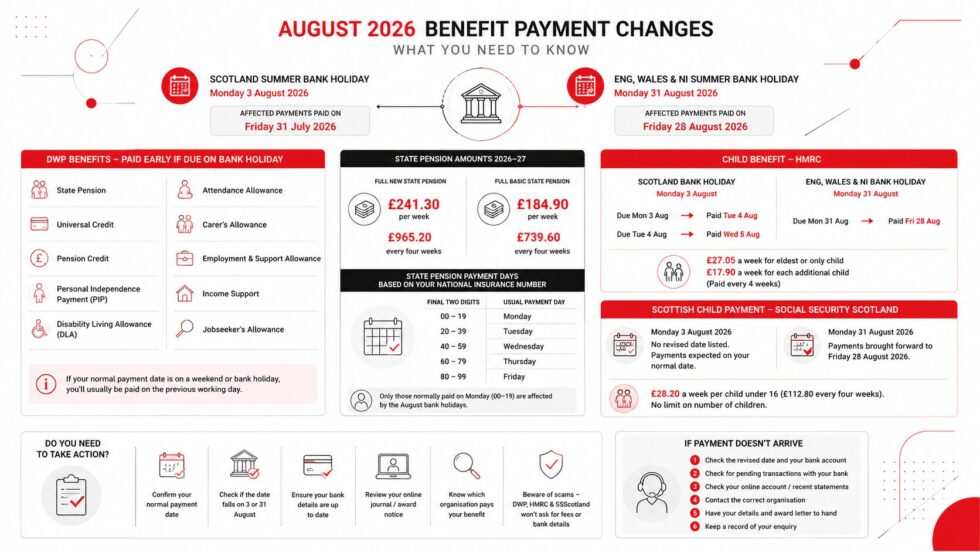
DWP Pension Payment Changes in August 2026: The Key Dates
The first disruption comes in Scotland, where the summer bank holiday falls on Monday 3 August 2026. The equivalent holiday in England, Wales and Northern Ireland falls four weeks later, on Monday 31 August 2026. Both dates are confirmed in the official UK bank holiday calendar. Under the standard Department for Work and Pensions rule, a payment due on a weekend or bank holiday is usually transferred on the preceding working day. That means a Monday payment will generally move back to the previous Friday.
| Area | Normal payment date affected | Expected DWP payment date | Change |
|---|---|---|---|
| Scotland | Monday 3 August 2026 | Friday 31 July 2026 | Three calendar days early |
| England | Monday 31 August 2026 | Friday 28 August 2026 | Three calendar days early |
| Wales | Monday 31 August 2026 | Friday 28 August 2026 | Three calendar days early |
| Northern Ireland | Monday 31 August 2026 | Friday 28 August 2026 | Three calendar days early |
People normally paid on other working days should receive their money according to the usual schedule unless their individual award notice, online journal or payment statement says otherwise. The adjustment does not change the amount to which a claimant is entitled. It also does not create a second payment or shorten the full benefit assessment period. The payment simply reaches the recipient’s account earlier than it otherwise would.
Who Will Receive an Early State Pension Payment in August 2026
State Pension payment days are linked to the final two digits of a person’s National Insurance number. People whose National Insurance numbers end in 00 to 19 are normally paid on a Monday and are therefore the principal group affected by the two August bank holidays. The standard timetable is:
| Final two National Insurance digits | Normal State Pension payday |
| 00–19 | Monday |
| 20–39 | Tuesday |
| 40–59 | Wednesday |
| 60–79 | Thursday |
| 80–99 | Friday |
A pensioner in Scotland whose number ends between 00 and 19 and whose four-weekly payment is due on 3 August should therefore normally see the transfer on Friday 31 July. A pensioner in England, Wales or Northern Ireland whose payment is due on 31 August should normally receive it on Friday 28 August.
Not every pensioner with a Monday payday will receive money on those dates. State Pension is ordinarily paid every four weeks, so the change only affects people whose particular four-week cycle lands on the relevant bank holiday.
Recipients do not need to change their bank details, contact the DWP or complete a special application. The money should be sent automatically to the same bank, building society or credit union account used for previous payments.
How Much Could the Early State Pension Payment Be
For the 2026–27 financial year, the full new State Pension is £241.30 a week, while the full basic State Pension is £184.90 a week. The rates increased from £230.25 and £176.45 respectively from April 2026. Because State Pension is usually paid every four weeks, a person receiving the full new rate could receive:
£241.30 × four weeks = £965.20
A pensioner receiving the full basic rate could receive:
£184.90 × four weeks = £739.60
The amount of £705.80 reported in some secondary coverage is based on the previous basic State Pension rate of £176.45 and is therefore not the correct maximum four-week figure for August 2026. The applicable 2026–27 full basic rate is £184.90 a week. The maximum figures do not apply to everyone. A person’s actual State Pension depends on their National Insurance record, whether they were contracted out before 2016, any inherited or additional pension entitlement, and whether a protected payment forms part of the award. Someone whose National Insurance record began after April 2016 will normally require 35 qualifying years for the full new State Pension. People with earlier records may need more than 35 years if they were contracted out, while some recipients can receive more than the standard full rate because of protected pre-2016 entitlement.
Which DWP Benefits May Be Paid Early
The bank holiday rule can apply across a broad range of DWP-administered benefits where the normal payment date falls on the holiday. Those payments can include:
- State Pension;
- Universal Credit;
- Pension Credit;
- Personal Independence Payment;
- Disability Living Allowance;
- Attendance Allowance;
- Carer’s Allowance;
- Employment and Support Allowance;
- Income Support;
- Jobseeker’s Allowance.
The precise impact depends on the claimant’s established payment date. A person paid on Tuesday 4 August, for example, would not normally have a DWP payment brought forward solely because Monday 3 August is a Scottish bank holiday.
Universal Credit recipients should also distinguish between their assessment period and their payment date. An early bank holiday transfer does not move the assessment period or permanently alter the monthly schedule. It changes only the date on which the affected payment reaches the account. Claimants should check their Universal Credit online journal, award letter or recent bank statement if they are uncertain about their normal payment date.
Why an Early DWP Payment Is Not Extra Money
An early payment can create a longer interval before the following transfer. Someone paid on Friday instead of Monday receives the same award three calendar days sooner, but their next scheduled payment will generally remain tied to the normal cycle. That distinction can matter for household budgeting. The earlier transfer may need to cover a slightly longer period before the next payment arrives. For example, a four-weekly pension paid on Friday 28 August instead of Monday 31 August does not normally mean that the next payment will also arrive three days early. The subsequent payment should return to the recipient’s established payment schedule unless another weekend or public holiday intervenes. Claimants should therefore avoid treating the early arrival as a bonus or emergency advance. It is the normal payment released ahead of a non-working day.
How Child Benefit Payments Will Change in Scotland
Child Benefit is administered by HM Revenue and Customs rather than the DWP and follows a separate bank holiday timetable. Official HMRC guidance confirms that a Child Benefit payment due in Scotland on Monday 3 August 2026 will be made on Tuesday 4 August, one day later. A payment ordinarily due on Tuesday 4 August will move to Wednesday 5 August. This is an important exception to the more familiar DWP rule under which payments are usually brought forward.
| Original Child Benefit date | Revised date | Area |
| Monday 3 August 2026 | Tuesday 4 August 2026 | Scotland only |
| Tuesday 4 August 2026 | Wednesday 5 August 2026 | Scotland only |
| Monday 31 August 2026 | Friday 28 August 2026 | UK areas affected by the late-August holiday |
Child Benefit is generally paid every four weeks on a Monday or Tuesday, although some eligible households can receive it weekly. For 2026–27, the weekly rate is £27.05 for the eldest or only child and £17.90 for each additional child. A standard four-week payment for the eldest or only child is therefore £108.20. Families should not apply the DWP timetable automatically to Child Benefit. The official HMRC bank holiday table is the appropriate source for determining whether a transfer will be early or late.
What Happens to Child Benefit on 31 August 2026
Child Benefit payments due on Monday 31 August 2026 will not be made on the bank holiday itself. HM Revenue and Customs has confirmed that affected households will instead receive the money on Friday 28 August, the final working day before the long weekend. The adjustment applies to payments scheduled for 31 August across the UK, although the date is the summer bank holiday specifically in England, Wales and Northern Ireland.
Child Benefit is normally paid every four weeks on a Monday or Tuesday. Some single parents and households receiving qualifying benefits can ask for weekly payments, but the bank holiday change applies in the same way whenever the household’s scheduled payday falls on 31 August.
The revised timetable is straightforward:
| Normal Child Benefit date | Revised payment date | What changes |
|---|---|---|
| Monday 31 August 2026 | Friday 28 August 2026 | Payment arrives three calendar days early |
| Next scheduled payment | Normal Monday or Tuesday date | Ordinary four-weekly cycle resumes |
The early transfer does not increase the value of the award and should not be treated as an additional payment. It is the household’s normal Child Benefit instalment released before the bank holiday, meaning the money may have to cover a slightly longer interval before the next payment arrives.
For the 2026–27 tax year, Child Benefit is paid at £27.05 a week for the eldest or only child and £17.90 a week for every additional child. A household receiving the standard four-weekly payment will therefore normally get £108.20 for the eldest or only child, plus £71.60 for each additional child. Examples of the four-weekly amounts are:
| Number of eligible children | Illustrative four-weekly Child Benefit |
| One child | £108.20 |
| Two children | £179.80 |
| Three children | £251.40 |
| Four children | £323.00 |
These figures assume the household receives the full payment and has not chosen to stop receiving it because of the High Income Child Benefit Charge. The bank holiday adjustment does not affect eligibility, change the applicable rates or alter any tax liability connected with the claim.
Families should also distinguish the 31 August arrangement from the separate Scottish timetable at the beginning of the month. HMRC states that Scottish Child Benefit due on Monday 3 August will be paid on Tuesday 4 August, while payments due on Tuesday 4 August will move to Wednesday 5 August. In other words, the early-August Scottish payments are delayed by one working day, whereas the 31 August payment is brought forward to the preceding Friday. That difference is why claimants should check the precise HMRC table rather than assuming that every bank holiday payment is automatically made early.
Households do not need to apply for the revised 28 August payment or contact HMRC in advance. The money should be transferred automatically to the same account used for the claim. Claimants should nevertheless check that their bank details remain current, particularly if they have recently switched accounts or reported a change in circumstances.
Will Scottish Child Payment Be Affected in August 2026
Scottish Child Payment is administered by Social Security Scotland, rather than the Department for Work and Pensions or HMRC. It is available to qualifying low-income households responsible for children under 16 and is worth £28.20 a week for each eligible child, normally paid once every four weeks. This produces a standard payment of £112.80 per eligible child every four weeks, with no limit on the number of children in a family who can qualify.
The official Social Security Scotland bank holiday timetable does not list Monday 3 August 2026 as a revised payment date. It does, however, state that payments expected on Monday 31 August 2026 will be brought forward to Friday 28 August 2026. The practical position is therefore:
| Expected Scottish benefit date | Anticipated payment date | Official position |
| Monday 3 August 2026 | No revised date listed | Claimants should expect their notified payment date unless told otherwise |
| Monday 31 August 2026 | Friday 28 August 2026 | Payment brought forward |
This distinction corrects reports suggesting that every Scottish benefit due on 3 August must either be paid early or delayed. The official published calendar provides no general revised date for Social Security Scotland payments due that day. Claimants should therefore rely on the payment date shown in their award notice, online account, text notification or direct communication from Social Security Scotland.
For a household with more than one eligible child, the four-weekly Scottish Child Payment can be substantial:
| Eligible children | Four-weekly payment |
| One child | £112.80 |
| Two children | £225.60 |
| Three children | £338.40 |
| Four children | £451.20 |
An early payment on 28 August remains the ordinary four-weekly award rather than an extra grant. The next payment should normally return to the household’s established cycle.
The Social Security Scotland bank holiday arrangements also cover a range of devolved benefits, including Scottish Child Payment, Adult Disability Payment, Child Disability Payment, Carer Support Payment, Pension Age Disability Payment and Scottish Adult Disability Living Allowance. Where an official revised date applies, the transfer should be made automatically.
Best Start Foods should not be confused with Scottish Child Payment. It is delivered through a prepaid card rather than as an ordinary scheduled bank transfer, so it does not follow the same bank holiday payment-date table. Families may also receive Best Start Grant or other Scottish family support, but each scheme has its own payment structure and should be checked separately. Anyone whose Scottish Child Payment is expected around the bank holiday should verify three points:
- the exact date stated in their latest payment notification;
- whether the payment is from Social Security Scotland or another department;
- whether their bank account or personal circumstances have recently changed.
Claimants should not rely on a DWP or HMRC timetable for a Social Security Scotland award. Although the three organisations all administer public payments, they use separate systems and can apply different arrangements to the same bank holiday.
Do Claimants Need to Take Any Action Before the August Bank Holidays
Most recipients do not need to do anything. DWP benefits due on a weekend or bank holiday are usually paid on the previous working day, while the specific HMRC Child Benefit and Social Security Scotland calendars determine whether their payments are brought forward, delayed or left unchanged.
There is no special August application, bank holiday form or request for an advance. A revised payment should be processed automatically and sent to the bank, building society or credit union account already registered for the claim. However, claimants should carry out several checks before the holiday weekend.
Confirm Which Organisation Pays the Benefit
The name of the benefit determines which timetable applies:
| Payment | Responsible organisation |
| State Pension | DWP |
| Universal Credit | DWP |
| Pension Credit | DWP |
| Personal Independence Payment | DWP |
| Attendance Allowance | DWP |
| Child Benefit | HMRC |
| Scottish Child Payment | Social Security Scotland |
| Adult Disability Payment | Social Security Scotland |
| Child Disability Payment | Social Security Scotland |
This is important because Child Benefit does not always follow the ordinary DWP rule. GOV.UK explicitly warns that payments due on a weekend or bank holiday are usually made on the preceding working day, but that Child Benefit may be handled differently.
Check the Normal Payment Date
Claimants should look at a recent bank statement, award notice, online benefit account or Universal Credit journal to confirm the usual date. A payment is not affected simply because there is a bank holiday somewhere in the UK. The claimant’s own scheduled payday must fall on the relevant date. For example:
- a Universal Credit payment due on Monday 31 August should normally arrive on Friday 28 August;
- a Universal Credit payment due on Tuesday 1 September should ordinarily remain due on Tuesday;
- Child Benefit due on 31 August should arrive on 28 August;
- Scottish Child Benefit due on 3 August should arrive on 4 August;
- Scottish Child Payment due on 31 August should arrive on 28 August.
Universal Credit recipients can see their payment information in their online account. The assessment period itself does not change because of the bank holiday; only the transfer date is brought forward where the normal payment day is affected.
Check Bank Details Before the Holiday
People who have recently switched banks, closed an account or changed the name on an account should confirm that the relevant department has the correct details.A bank holiday change does not override an existing problem with the account. If the department sends money to an old or closed account, the payment may be rejected and returned, creating a delay that is separate from the official revised timetable.
Claimants should use only official online accounts, telephone numbers printed on their award letters or contact pages on government websites when updating details.
Budget for the Longer Gap
Receiving money early does not mean receiving more money.
A payment made on Friday 28 August instead of Monday 31 August arrives three calendar days early, but the following instalment will normally remain on the established schedule. The recipient may therefore face a longer gap before the next payment.
Households should account first for essential commitments such as:
- rent or mortgage payments;
- energy and water bills;
- food and household supplies;
- transport;
- childcare;
- medication and care costs;
- direct debits due after the bank holiday.
Claimants may also need to check whether standing orders or direct debits will leave the account before the next benefit payment. The earlier arrival can make the available balance appear temporarily higher even though the underlying monthly or four-weekly budget has not changed.
Watch for Payment Scams
Bank holiday changes can be used as a pretext for fraudulent messages. A claimant may receive a text, email, social-media message or telephone call claiming that a payment must be “confirmed”, “released” or “unlocked”. Recipients should not disclose:
- online banking passwords;
- full card security details;
- one-time passcodes;
- Universal Credit login information;
- copies of identity documents to an unsolicited caller;
- payment of an alleged processing or release fee.
The DWP, HMRC and Social Security Scotland do not require a claimant to pay a fee to receive an ordinary bank holiday adjustment. A genuine revised payment is processed automatically.
What Should You Do If the Payment Does Not Arrive?
A missing benefit payment should be investigated methodically. The first step is to establish whether the money is genuinely late, rather than checking against the claimant’s usual date when an official revised date applies.
1. Check the Correct Revised Date
The claimant should confirm:
- the name of the benefit;
- the organisation responsible for paying it;
- the normal scheduled date;
- the bank holiday date applying to that payment;
- the officially revised payment date.
For Child Benefit, the HMRC calendar should be used. For Scottish Child Payment and devolved Scottish benefits, the Social Security Scotland timetable is relevant. DWP benefits usually follow the previous-working-day rule.
2. Check the Bank Account Carefully
Payments may appear under a reference rather than the full name of the benefit. Claimants should inspect all transactions received on the expected date and check any pending or incoming-payment section offered by their bank. The time at which funds become visible can vary between financial institutions. Some banks display government transfers shortly after midnight, while others update accounts later in the morning. A payment should not automatically be treated as missing simply because it is not visible at the first check of the day. A claimant can ask the bank whether:
- an incoming payment is pending;
- a payment was rejected;
- the account has restrictions;
- a recent account switch may have affected the transfer;
- the bank is experiencing a technical problem.
The bank will not normally be able to create or trace a government payment that was never sent, but it may confirm whether a transfer reached or was rejected by the account.
3. Review the Award Notice or Online Account
Universal Credit recipients should review their latest monthly statement and use their online journal to report a missing payment. The statement shows the amount due, deductions and payment date.State Pension, Pension Credit, PIP, Attendance Allowance and other DWP claimants should check their latest award letter or recent payment history for the correct department and telephone number.Child Benefit recipients should review their HMRC online account or previous payment record. Scottish benefit recipients should check correspondence from Social Security Scotland. A difference in the amount may not be a bank holiday issue. It could result from:
- a change in earnings or household circumstances;
- a benefit deduction;
- recovery of an overpayment;
- a sanction;
- a revised award;
- a change in entitlement;
- an expired award or review decision;
- incorrect or outdated bank details.
4. Contact the Correct Department
The claimant should contact the organisation that actually administers the payment:
- Universal Credit: send a message through the online journal or use the official Universal Credit contact route;
- State Pension or Pension Credit: use the contact information on the pension award notice or official GOV.UK page;
- PIP, DLA or Attendance Allowance: contact the relevant benefit office shown on the decision letter;
- Child Benefit: contact HMRC;
- Scottish Child Payment or devolved Scottish disability benefits: contact Social Security Scotland.
Contacting the wrong department can delay the investigation because HMRC cannot normally resolve a DWP or Social Security Scotland payment, and the DWP cannot correct an HMRC Child Benefit transfer. Government telephone lines may close or operate reduced hours on the bank holiday itself. A person expecting payment on Friday 28 August should check the account during that working day and, if the money remains missing, attempt to contact the relevant service before the long weekend where possible.
5. Have the Necessary Information Ready
Before making contact, the claimant should prepare:
- their full name;
- date of birth;
- address and postcode;
- National Insurance number;
- name of the benefit;
- normal payment date;
- revised payment date expected;
- amount normally received;
- date and value of the last successful payment;
- bank account details already registered on the claim;
- recent award notice or online statement;
- details of any recent changes reported to the department.
Only information requested through an official and verified contact channel should be provided. A claimant should never give a telephone caller a banking password, full card PIN or one-time security code.
6. Explain Any Immediate Financial Risk
A claimant who has no money for food, electricity, essential travel, medication or care should say so clearly when contacting the department. The available response will depend on the benefit and the reason for the missing payment, but explaining the immediate consequences can help the service identify whether urgent support or another referral is appropriate. Universal Credit claimants should place the issue in their journal as soon as possible and state which essential costs cannot be met. Local councils may also operate welfare-assistance schemes, although eligibility and available help differ by area.
7. Keep a Record of the Enquiry
Claimants should retain:
- the date and time of the call;
- the telephone number used;
- the name or reference of the adviser where provided;
- screenshots of online journal messages;
- copies of letters;
- any payment-trace or case-reference number;
- notes of what the department said would happen next.
This record can be useful if the payment remains unresolved, the claimant needs to make a complaint or different departments dispute responsibility.
The central rule is simple: verify the official revised date, check the account and online statement, then contact the correct organisation using an official channel. Most August bank holiday changes are automatic, but a payment that remains absent after the confirmed date should not be ignored.
August 2026 DWP Payment Questions Answered
Will everyone receiving State Pension be paid early?
No. Only people whose individual four-weekly payday falls on the relevant bank holiday are affected. For State Pension, this principally concerns Monday recipients whose National Insurance numbers end from 00 to 19.
Will the August payment be larger?
Not because of the bank holiday. The normal award is being paid on a different date. Any difference in the amount would need to arise from a separate entitlement change, deduction, uprating or adjustment.
Will payments due on Tuesday be moved?
Most DWP payments due on a normal Tuesday should remain unchanged. Child Benefit is an exception in Scotland: payments due on 3 and 4 August move to 4 and 5 August respectively.
Does Scotland have the same bank holiday as England?
No. Scotland’s 2026 summer bank holiday is Monday 3 August. England and Wales observe it on Monday 31 August, as does Northern Ireland.
Is £965.20 an additional pension payment?
No. It is the equivalent of four weeks at the full new State Pension rate of £241.30. A recipient only receives that maximum if their individual entitlement reaches the full rate.
Is the full basic State Pension payment £705.80?
Not at the 2026–27 rate. Four weeks at the full basic State Pension of £184.90 equals £739.60. The £705.80 figure reflects the previous weekly rate of £176.45.
Will the next payment also arrive early?
Usually not. The payment schedule should revert to normal after the bank holiday unless another weekend or public holiday affects the next due date.
The Bottom Line for Pensioners and Benefit Claimants
The August changes are limited but important. Scottish DWP recipients whose normal payday is Monday 3 August should generally expect payment on Friday 31 July. Claimants in England, Wales and Northern Ireland who would normally be paid on Monday 31 August should generally receive their money on Friday 28 August.
State Pension recipients with National Insurance numbers ending in 00 to 19 are the most likely pension group to be affected, although only where their four-weekly cycle lands on the relevant Monday. Child Benefit requires separate attention. Scottish payments due on 3 and 4 August will move one day later, while Child Benefit due on 31 August will be paid early on 28 August. The central point is that an early DWP payment is not extra money. It is the claimant’s ordinary benefit or pension paid before a bank holiday, and it may therefore need to last slightly longer until the next scheduled transfer.
Read about the life of Westminster and Pimlico district, London and the world. 24/7 news with fresh and useful updates on culture, business, technology and city life: Why was Heritage Live cancelled and what is known about the Sandringham concerts, line-ups and refunds
Materials used: GOV.UK UK Bank Holidays, GOV.UK How and When Your Benefits Are Paid, GOV.UK Child Benefit Payment Dates, GOV.UK Benefit and Pension Rates 2026 to 2027, GOV.UK New State Pension Guidance, mygov.scot Bank Holiday Payment Dates, Social Security Scotland, Scottish Government.