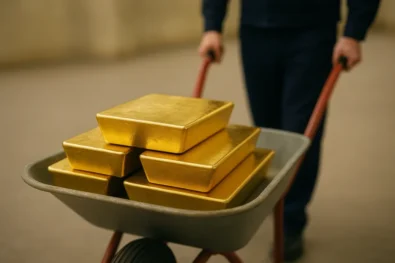
The gold price UK is back at the centre of investor attention on 5 March 2026, as markets juggle widening geopolitical risks, sharp currency moves and renewed questions about the plumbing of global finance. Gold’s appeal is not just about fear. For UK buyers, it is also about exchange rates: bullion is priced globally in US dollars, so the pound’s swings can amplify (or cushion) what British investors see on their screens.
The WP Times reports, citing Reuters, that investors have piled into the US dollar during the latest geopolitical turmoil, underlining how quickly markets can shift from “risk-on” positioning to a scramble for liquidity when uncertainty spikes. At first glance, that can sound like bad news for gold, because the metal often moves inversely to the dollar. But in real-world stress, correlations can break down. Gold and the dollar can rise at the same time when investors are not making a simple “inflation hedge” trade, but rather looking for a portfolio lifeboat: liquid cash on one side, and an asset with no issuer risk on the other.
What’s driving gold on 5 March 2026
Reuters reported on 5 March 2026 that gold gained on safe-haven demand as the Middle East conflict widened, with spot gold quoted around $5,177/oz in early trading.
For UK readers, the crucial translation is into pounds. Using the same day’s GBP/USD level (around 1.33 in the cited market data), that price implies roughly £3,888 per ounce for spot gold before dealer spreads, storage and VAT considerations on certain products (investment-grade gold is typically VAT-exempt in the UK; collectibles/jewellery treatment differs). The exact figure moves minute by minute, but the point is structural: a softer pound mechanically pushes the UK gold price higher even if the dollar gold price is flat. Gold has also been supported by a broader 2026 rally. Reuters noted bullion was up around 20% in 2026 at that point, reflecting repeated record highs during the year’s risk episodes.
Why geopolitical shocks hit the gold price UK so fast
Gold responds to geopolitical shocks because it is widely treated as a store of value when the outlook becomes harder to price. In practice, crises often create a familiar three-part market reaction:
- Safe-haven demand rises (gold, high-quality government bonds, cash-like instruments)
- Capital flows into liquid currencies (most commonly the US dollar)
- Equity volatility increases, often with abrupt, stop-loss-driven moves
Reuters market reporting this week described violent risk moves in parts of Asia alongside the wider Middle East tension, illustrating how quickly risk sentiment can deteriorate when investors fear escalation and energy disruption. For UK investors, the “geopolitics to gold” channel is therefore a double transmission: first through the global spot price (USD), then through the GBP/USD exchange rate that determines the local price.
Exchange rates: why GBP/USD matters more than most UK buyers realise
Because gold is priced in dollars, UK investors effectively hold a two-factor position:
- exposure to the global gold price in USD
- exposure to the pound-dollar exchange rate
That second factor can dominate short-term outcomes. If gold rises 1% in dollars but the pound strengthens 1% against the dollar, the UK gold price can end up close to unchanged. Conversely, if gold is steady in dollars but GBP weakens, the UK gold price can climb anyway. This is one reason UK gold charts can look “more dramatic” than US charts during sterling weakness.
What’s pushing GBP/USD around right now
FX moves in early 2026 are being shaped by the expected path of interest rates and by “risk-off” liquidity flows. In mid-February, a Reuters poll suggested a large share of economists expected the Bank of England to cut rates in March, while later Reuters reporting noted the BoE governor described a March cut as a genuinely open question. Rate expectations feed directly into currency pricing, especially when markets are jumpy. When geopolitical stress rises, the pound can also behave like a “risk currency” against the dollar, because global investors prioritise dollar liquidity and US money markets during shocks. That mechanism is central to the broader debate about dollar dominance and what happens when global leverage unwinds.
The dollar liquidity question: why it keeps resurfacing in crises
A key point from Reuters columnist Jamie McGeever is that the latest dollar surge is not necessarily a sudden change in the growth or inflation outlook. It can be about money flow: leveraged positions get cut, hedges are adjusted, and global borrowers scramble for dollars to meet obligations. In those moments, the dollar’s role is less about confidence and more about necessity. This “liquidity first” dynamic helps explain why gold and the dollar can both catch a bid. Gold is not a liability of any government. The dollar, meanwhile, is the world’s dominant settlement currency and the backbone of many funding markets.
Economist Barry Eichengreen, who studies global currency systems, has warned that transitions in monetary regimes can be unstable even when they look gradual in hindsight:
“The long-term erosion of the dollar’s dominance has been gradual, but we are learning that transitions in global finance do not always occur smoothly,” (Barry Eichengreen, University of California, Berkeley).
That framing matters for gold because it shifts the narrative away from day-to-day inflation prints and towards system resilience: investors buy insurance when they worry about how the system behaves under stress, not only about what CPI does next month.
How dominant is the dollar, really

Despite years of debate about “de-dollarisation”, the dollar remains central.
- IMF commentary and reserve data show the dollar’s share of global FX reserves has been in the high-50% rangein recent years, with movements influenced by exchange-rate effects as well as portfolio choices.
- BIS reporting on global FX markets continues to underline the dollar’s outsized footprint in trading and funding, with FX turnover hitting new highs in the latest survey cycle.
So even if the long-run share slowly drifts, the short-run crisis instinct is still: “get dollars, reduce risk, raise liquidity”. Gold benefits when investors also want an asset that is outside the credit system.
Key indicators UK investors should watch
Below is an updated, UK-focused snapshot of the indicators most likely to move the gold price UK over the next days and weeks.
| Market indicator | What it’s doing in early March 2026 | Why it matters for UK gold |
|---|---|---|
| Geopolitical risk | Elevated; conflict-driven headlines | Supports safe-haven demand for bullion |
| Spot gold (USD/oz) | Around the $5,100–$5,200 area in Reuters pricing | Sets the global baseline price |
| GBP/USD | Around the low-1.3s in cited market data | Weaker GBP → higher UK gold price |
| BoE rate expectations | March decision heavily watched | Rates move FX; FX moves UK gold |
| “Dollar liquidity” stress | A recurring theme in risk episodes | Can lift both USD and gold in the same week |
Does gold still work as a “strategic” asset
Gold’s supporters argue it remains structurally useful for three reasons:
- Limited natural supply and no ability for policymakers to “print” it
- No direct exposure to any single central bank’s credibility
- Global recognisability across jurisdictions and political systems
Critics counter that gold offers no yield and can be vulnerable when real rates jump, or when forced selling hits broad portfolios. That scepticism is not theoretical: Reuters has also highlighted episodes where gold did not behave like a perfect safe haven in the most chaotic hours of crisis trading, especially when investors sell what they can to raise cash. In other words, gold is best understood as insurance with basis risk. It often helps, sometimes fails in the very short run, and tends to matter most when held as part of a broader plan rather than as a timing trade.
What UK investors are watching next
For UK market participants tracking the gold price UK, the near-term checklist is fairly clear:
- Middle East headlines and any signs of escalation or de-escalation
- BoE policy signals ahead of the March meeting and the tone around inflation persistence
- GBP/USD direction, especially if risk aversion keeps favouring the dollar
- US macro data and Fed expectations, because US yields can sway both the dollar and non-yielding assets like gold (even when geopolitical demand is strong)
If uncertainty persists, gold can remain supported even with choppy pullbacks. If tensions ease and markets re-price toward stability, gold often consolidates — and, for UK buyers, that consolidation can still look like a rise or fall depending on what sterling does.
Read about the life of Westminster and Pimlico district, London and the world. 24/7 news with fresh and useful updates on culture, business, technology and city life:Ethereum Post-Network Upgrades: Why Investors are Monitoring ETH in 2026