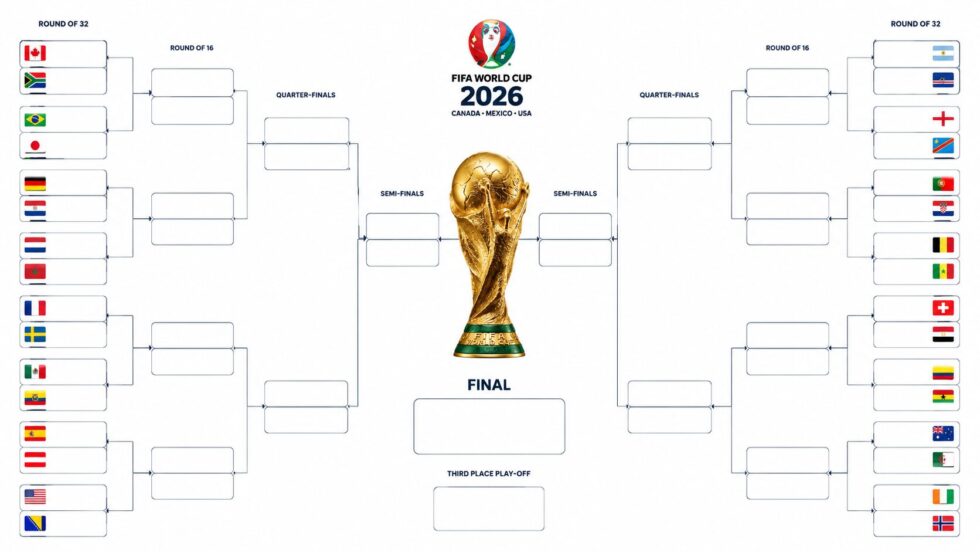
Fifa world cup 2026 bracket is now the main story of the tournament after the group stage closed on Sunday, 28 June 2026, sending 32 teams into the first knockout round across the United States, Canada and Mexico. The new expanded format has produced a heavier early bracket than any previous men’s World Cup, with South Africa vs Canada opening the Round of 32 in Los Angeles, Brazil vs Japan set for Houston, England facing DR Congo in Atlanta and Argentina drawn against Cape Verde in Miami, The WP Times reports.
The shift is structural as much as sporting. FIFA’s 48-team format sends the top two sides from each of the 12 groups into the Round of 32, along with the eight best third-placed teams, before a straight knockout path through the Round of 16, quarter-finals, semi-finals and the final on 19 July at New York New Jersey Stadium. FIFA’s official bracket page describes the phase as a “direct knockout tournament” from this point.
fifa world cup 2026 bracket changes the shape of the tournament
The old World Cup rhythm was familiar: 32 teams began, 16 survived, and the knockouts arrived with half the field gone. This edition has 32 teams still alive after the group stage, which means the first knockout layer is now as large as an entire World Cup used to be. The bracket carries more fixtures, more travel and more early jeopardy, especially for seeded teams who would previously have been much closer to the quarter-finals by this point. FIFA’s expansion has been criticised for softening the group stage, because eight third-placed teams advance. That criticism has not disappeared, but the Round of 32 now has to deliver the danger. One bad night ends the run, whether the team is France, Brazil, England, Argentina or a debutant with no historic burden.
The tournament has stopped rewarding survival and started punishing mistakes.
The list of teams through shows the scale of the change. Mexico, the United States, Germany, Brazil, France, Spain, England, Argentina, Portugal and the Netherlands are still in. So are Cape Verde, DR Congo, Canada, Bosnia and Herzegovina, South Africa and Algeria. Al Jazeera’s qualification tracker lists all 32 teams in the knockout phase, including several first-time or rare knockout qualifiers.
“For the first time in World Cup history, the knockout stage, which begins on Sunday, will feature 32 teams” (FOX Sports, 28 June 2026).
World Cup brackets put favourites into early pressure games
The world cup brackets have not given the favourites a quiet opening. Brazil face Japan, a technically sharp opponent capable of stretching the pitch and forcing mistakes in possession. Germany meet Paraguay in Foxborough, a tie that looks manageable but can become awkward if Germany do not score early. France face Sweden at New York New Jersey Stadium, where physical duels, set pieces and transitions could turn a favourite’s night into a longer contest than the rankings suggest. England’s draw against DR Congo is one of the most watchable fixtures of the round. England finished top of Group L; DR Congo advanced from Group K after beating Uzbekistan 3-1 in Atlanta. That result changed their tournament from participation into a live knockout story. The match now returns DR Congo to the same city, this time against one of the tournament’s most scrutinised teams.
Argentina’s fixture against Cape Verde carries a different kind of weight. Argentina have the status, the experience and the attacking edge. Cape Verde have the emotional pull of a debutant nation that has already turned qualification into a national moment. In a 90-minute knockout match, that contrast is not decorative; it shapes the atmosphere from the first whistle.
| Fixture | Date | Venue | Main storyline |
|---|---|---|---|
| South Africa vs Canada | 28 June | Los Angeles | First Round of 32 match |
| Brazil vs Japan | 29 June | Houston | Elite attack against organised structure |
| Germany vs Paraguay | 29 June | Foxborough | Favourite against third-placed qualifier |
| Netherlands vs Morocco | 30 June | Monterrey | One of the strongest early ties |
| France vs Sweden | 30 June | New York/New Jersey | Favourite tested by physical opponent |
| England vs DR Congo | 1 July | Atlanta | Major contender against surprise qualifier |
| USA vs Bosnia and Herzegovina | 1 July | San Francisco Bay | Host nation enters sudden death |
| Spain vs Austria | 2 July | Los Angeles | Technical control against pressure side |
| Portugal vs Croatia | 2 July | Dallas | Experienced European sides collide |
| Argentina vs Cape Verde | 3 July | Miami | Champions against debutant story |
FOX’s bracket lists the Round of 32 from 28 June to 3 July, beginning with South Africa vs Canada and ending with Colombia vs Ghana in Kansas City.
Why the 2026 World Cup bracket has more surprise teams
The 2026 World Cup bracket has pushed several lower-ranked and less familiar sides into matches that will draw global audiences. Cape Verde, DR Congo, South Africa, Canada and Bosnia and Herzegovina give the bracket a different feel from the old last-16 model. Their presence is not just a sentimental detail. It changes scouting, tempo and crowd energy because favourites now face opponents with little to protect and a rare chance to make national football history.
DR Congo’s route is the clearest example. They qualified after a 3-1 win over Uzbekistan, with Yoane Wissa scoring in Atlanta during the Group K match. The result placed DR Congo into a knockout tie with England and made them one of the central underdog stories of the first elimination round. Cape Verde’s case is even sharper because the country entered the tournament without the World Cup history of the traditional powers. Their meeting with Argentina in Miami gives the bracket an immediate champion-versus-debutant frame. It is a fixture built for global attention, but also one that can become uncomfortable if Argentina allow Cape Verde to stay level into the final half-hour. The surprise teams matter for three reasons:
- they widen the football map beyond the usual European and South American core;
- they force favourites to prepare for less familiar tactical profiles;
- they keep neutral interest high before the Round of 16;
- they test whether expansion has added depth or only extra volume.
NPR described the North American World Cup as a success at the end of the group stage, pointing to full stadiums, strong fan scenes and major atmospheres even for fixtures that looked modest before kick-off. The report cited crowds of nearly 70,000 for matches such as Cape Verde vs Saudi Arabia, Algeria vs Jordan and Bosnia and Herzegovina vs Qatar.
“The stadiums have been full, even for matchups that seemed lacklustre on paper” (NPR, 28 June 2026).
World Cup Round of 32 raises the stakes for hosts
The World Cup Round of 32 is also a test of the host nations. Canada play South Africa in Los Angeles, the United States face Bosnia and Herzegovina in San Francisco Bay, and Mexico meet Ecuador in Mexico City. Each host has a different pressure point. Canada carry the opening knockout slot. The United States carry expectation after winning Group D. Mexico carry the emotional load of a home match in the capital.
The US fixture is especially significant because the bracket gives the team a realistic but not gentle path. They face Bosnia and Herzegovina first. A win would move them into the Round of 16 against the winner of Belgium vs Senegal, according to the published knockout routes. That is not an easy draw, but it is the kind of route a host nation would accept before the tournament.
Mexico’s tie against Ecuador brings another version of pressure. Mexico topped Group A and now return to Mexico City, where the atmosphere can lift the team or tighten the match if the first goal does not come. Ecuador have enough tournament experience to turn the game into a tactical grind rather than a celebration.
Home advantage now becomes measurable only by results.
Canada’s match with South Africa is the first knockout fixture of the tournament. That gives it an unusual place in the bracket. It is not the biggest-name game of the round, but it sets the tone for the new format: two teams outside the usual champion conversation, playing a sudden-death match at one of the tournament’s headline venues.
World Cup knockout fixtures and the route to the final
The World Cup knockout fixtures now run on a compressed calendar. The Round of 32 is scheduled from 28 June to 3 July. The Round of 16 follows from 4 to 7 July, then the quarter-finals from 9 to 11 July, the semi-finals on 14 and 15 July, the third-place match on 18 July and the final on 19 July. FIFA’s official schedule page keeps the full tournament window from 11 June to 19 July.
That calendar gives teams almost no recovery space. A side that survives the Round of 32 must quickly move from celebration to travel, recovery and scouting. The deeper the tournament goes, the more the bracket rewards squads with bench depth, set-piece strength and disciplined game management. It is no longer enough to peak for one glamour tie.
Austria and Algeria were the last teams into the bracket after their 3-3 draw in Kansas City, a result that eliminated Iran and completed the Round of 32 picture. Reuters reported that both Austria and Algeria advanced through that result, closing the qualification race on the final day of the group stage.
The cleanest route belongs to nobody. Argentina must handle Cape Verde before the bracket tightens. France have Sweden first and a more physically demanding path ahead. England have to avoid turning DR Congo into a national upset story. Brazil and Germany meet opponents with enough structure to make a favourite look ordinary.
“From here on out, it is win or go home” (FOX Sports, 28 June 2026).
What to watch next in the fifa world cup 2026 bracket
The next six days will decide whether the expanded format feels justified. If the favourites advance cleanly, the bracket will move towards a powerful Round of 16. If one or two major teams fall, the tournament will be remembered for giving the new entrants enough space to change the script.
The most important early signs are simple:
- Brazil must break Japan without losing defensive balance.
- France must control Sweden’s physical rhythm.
- England must score before DR Congo settle into the occasion.
- The United States must manage home expectation against Bosnia and Herzegovina.
- Argentina must keep Cape Verde from turning Miami into a 70-minute survival contest.
- Portugal vs Croatia could become the round’s most experienced tactical match.
The bracket is large, but the logic is narrow. Every side now has one task: win once, recover fast, and do it again. The 2026 World Cup has reached the stage where format arguments matter less than finishing, defending and handling one difficult night.
Read about the life of Westminster and Pimlico district, London and the world. 24/7 news with fresh and useful updates on culture, business, technology and city life: Panama vs England 2026: Kane breaks World Cup record as England win 2-0 and top Group L