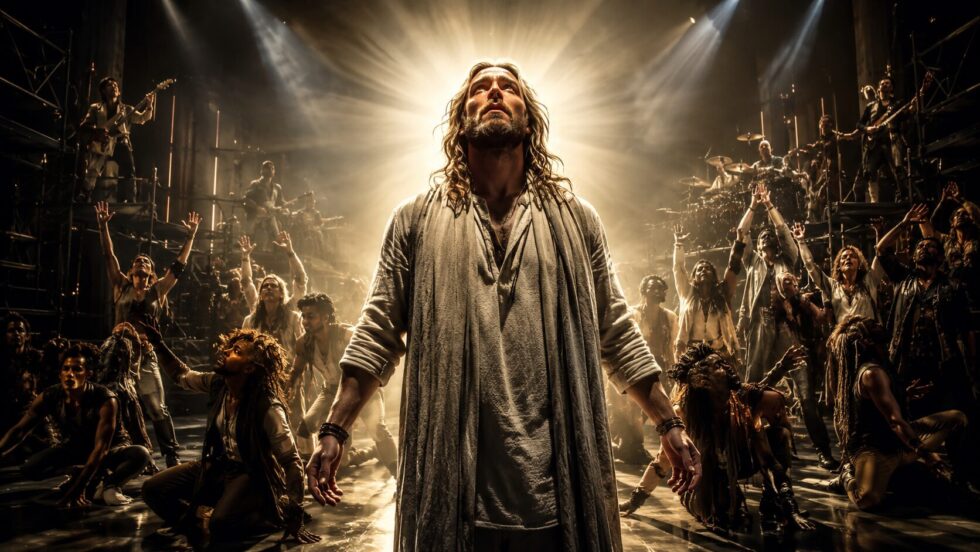
The 2026 West End return of Jesus Christ Superstar comes with the sort of casting built for the front page of an arts section. Sam Ryder, still one of Britain’s most recognisable post-Eurovision pop figures after finishing second in 2022 with “Space Man”, takes on Jesus at the London Palladium in Timothy Sheader’s revival of Andrew Lloyd Webber and Tim Rice’s rock opera. The official production site lists the Palladium run from 20 June to 5 September 2026, followed by a move to Theatre Royal Drury Lane from 16 October 2026 to 9 January 2027, The WP Times based arts desk reports.
The gamble is clear before Ryder sings a note. He has the voice, the hair, the public goodwill and the rock-frontman profile to sell the idea; what he has not fully found is the dangerous stillness the role demands. This Jesus must look like a man whose charisma has become a political problem, not merely a gifted singer placed at the centre of a famous score. The result is a strong, brooding production with a lead performance still trying to grow into the weight of the part.
Sam Ryder’s Jesus has the sound before the authority
Ryder’s casting makes immediate commercial sense. He brings a fanbase beyond the usual musical-theatre circuit, and his guitar-heavy pop profile fits a show that began as a 1970 rock opera album before becoming a stage work. Reuters reported that this revival emphasises the musical’s rock-concert roots, with Andrew Lloyd Webber speaking about the visible band and the production’s gig-like energy.
Vocally, Ryder is not exposed in the obvious way. His top notes have reach, his tone has brightness, and “Gethsemane” gives him the kind of climactic ascent that suits a singer used to standing in front of a mass audience. The Palladium crowd is likely to reward that. His challenge is not volume or pitch, but theatrical pressure.
Jesus in this musical is not simply a holy man with a difficult final song. He is an exhausted public figure being pulled apart by worship, politics, friendship and fear. The best actors in the role let the audience see a person becoming an image in real time. Ryder often looks worried rather than spiritually cornered, and that difference matters.
Time Out’s line that “Sam Ryder is not the Messiah” catches the central problem neatly: the production sells him as an event, but the drama needs him as a force. The Sam Ryder Jesus Christ Superstar review question therefore turns on acting, not singing. His Jesus can sound wounded, but he rarely makes silence feel heavy. In scenes opposite Judas, the emotional temperature should rise because Jesus refuses, delays or cannot explain himself. Here, the tension usually comes from the actor opposite him.
Timothy Sheader’s staging keeps the night alive
Sheader’s production has pedigree. The official Andrew Lloyd Webber site identifies the 2026 Palladium staging as the Regent’s Park Open Air Theatre production, whose earlier life brought major recognition, including Olivier attention for Tyrone Huntley’s Judas and the show’s award-winning revival status. The production still has muscle indoors. It does not treat Jesus Christ Superstar as polite heritage theatre. Tom Scutt’s design gives the stage an industrial severity, with scaffolding, height and a sense of exposed machinery. Drew McOnie’s choreography turns the ensemble into something volatile: part congregation, part protest, part fan base waiting to become a mob.
The visual language works because it refuses prettiness. Jerusalem becomes a pressure chamber. The on-stage seating pulls the audience into the crowd, making spectators look uncomfortably close to the action. The band’s presence reinforces the concert frame without reducing the show to a tribute act. The strongest staging details are practical rather than decorative:
- the scaffold set gives priests, followers and musicians a hierarchy of height;
- the choreography makes devotion look physical, twitchy and unsafe;
- the lighting pushes the show towards nocturnal ritual rather than biblical illustration;
- the live musical presence keeps the score hot, abrasive and immediate;
- the crowd work makes celebrity worship and religious fervour feel like the same public reflex.
The Palladium is a glamorous room, but Sheader’s staging makes it feel trapped, sweaty and watched.
Judas is the production’s real dramatic engine
Tyrone Huntley returns as Judas, and the evening changes whenever he is in command. The official cast announcement confirms him opposite Ryder, with Desmonda Cathabel as Mary Magdalene, David Thaxton as Pontius Pilate, Bob Harms as Caiaphas, Matty J as Annas, Billy Nevers as Simon and alternate Judas, and Phil King as Peter.
Huntley’s Judas is not a pantomime betrayer. He plays him as a man who can see danger gathering before anyone else is prepared to name it. His anger has moral logic. His fear feels political as well as personal. He is not simply jealous of Jesus; he is frightened by what public adoration is doing to him.
That approach gives the London Palladium Jesus Christ Superstar revival its argument. The musical is told substantially through Judas’s perspective, and Huntley understands the advantage. He drives the opening, frames the conflict and makes betrayal feel less like a sudden sin than the final act of someone who thinks he is preventing something worse.
Mary, Pilate and Caiaphas sharpen the edges
Desmonda Cathabel’s Mary Magdalene brings a calmer emotional register. “I Don’t Know How to Love Him” can easily become a stand-alone torch song, but here it sits inside the production’s broader anxiety. Mary’s care for Jesus looks private, practical and increasingly inadequate against the scale of public attention surrounding him.
David Thaxton’s Pilate brings a dry institutional authority. He gives the sense of a man irritated by a case that refuses to stay procedural. Bob Harms’ Caiaphas adds a dark vocal weight that suits the production’s monstrous clerical machinery.
The imbalance around Ryder becomes clearer because the supporting cast is so exact. Huntley has interior conflict. Cathabel has warmth without sentimentality. Thaxton has bureaucratic menace. Harms has bass-heavy threat. Ryder has the biggest symbolic burden, but too often the least dramatic definition.
Herod as celebrity cameo is clever, but limited
The role of King Herod is shared across the Palladium run. Andrew Lloyd Webber’s official site lists Jesse Tyler Ferguson from 20 June to 11 July, Simon Russell Beale from 13 to 25 July, Richard Armitage from 27 July to 1 August, Boy George from 3 to 15 August, Layton Williams from 17 to 29 August, and Julian Clary from 31 August to 5 September 2026.
This is canny West End packaging. Herod has one number, a strong costume opportunity and enough tonal permission for a celebrity turn. The rotating cast gives the run a fresh talking point every couple of weeks and may encourage some repeat bookings. It is also a reminder of what the show is about. Jesus Christ Superstar is obsessed with performance, public appetite and the conversion of spiritual crisis into spectacle. Herod’s cameo sits on that line: a vulgar showbiz interruption inside a story about state power and ritual humiliation.
| Herod performer | Scheduled Palladium dates | Casting effect |
|---|---|---|
| Jesse Tyler Ferguson | 20 Jun–11 Jul 2026 | Broadway sitcom brightness and comic ease |
| Simon Russell Beale | 13–25 Jul 2026 | Classical authority with camp potential |
| Richard Armitage | 27 Jul–1 Aug 2026 | Star gravitas in a deliberately brief turn |
| Boy George | 3–15 Aug 2026 | Pop-cultural flamboyance aligned with the show’s celebrity theme |
| Layton Williams | 17–29 Aug 2026 | Dance-theatre energy and modern stage charisma |
| Julian Clary | 31 Aug–5 Sep 2026 | Arch comic timing for the role’s cabaret edge |
Still, Herod cannot decide the night. The cameo can lift a sequence, colour the interval conversation and sell an extra tranche of tickets, but the production stands or falls with Jesus, Judas and the crowd.
The score still bites because it refuses good taste
The Andrew Lloyd Webber musical review angle cannot ignore the score’s durability. Jesus Christ Superstar remains one of Lloyd Webber and Rice’s least domesticated works. It moves through rock, gospel, soul, vaudeville, ballad and orchestral theatre without smoothing its own contradictions.
The lyrics can be blunt, odd, witty and suddenly piercing. Judas begins with argument rather than villainy. Mary introduces tenderness without solving anything. Pilate brings procedure into a situation that procedure cannot control. The crowd turns choruses into threat. The key numbers still have distinct dramatic functions:
- “Heaven on Their Minds” gives Judas the first serious reading of the crisis.
- “Everything’s Alright” turns care, money and symbolism into one argument.
- “I Don’t Know How to Love Him” gives Mary private confusion inside public chaos.
- “Gethsemane” forces Jesus into anger, fear and obedience at once.
- “Superstar” reframes the story as a posthumous interrogation of fame and meaning.
That last point is why the show survives celebrity casting. A pop star playing Jesus is not an accidental gimmick here. It sits inside the musical’s own obsession with image, projection and the cost of being turned into an answer for other people’s needs.
The production is at its best when it lets the music sound abrasive rather than respectable.
Palladium scale changes the Regent’s Park atmosphere
The Regent’s Park version had the advantage of open air. Darkness, weather and outdoor space naturally helped the production feel unstable. The Palladium gives the staging a different frame: more polish, more commercial pressure, more expectation of a West End event. That shift is not fatal. The room’s old-school variety glamour makes the production’s rough surfaces more interesting. A scaffolded, sweaty, semi-apocalyptic Jerusalem inside the Palladium creates a productive clash between showbusiness history and religious collapse. The venue also gives the crowd scenes scale.
But the Palladium is unforgiving to hesitation. A performer who can fill it looks huge. A performer still learning how to hold it can look isolated. That is the issue with Ryder. In a smaller, looser space, his sincerity might read as intimacy. At the Palladium, the same softness can look underpowered.
Why the Drury Lane transfer matters
The transfer to Theatre Royal Drury Lane suggests producers see the production as more than a summer novelty. The official site confirms the move from 16 October 2026 to 9 January 2027, keeping Ryder’s West End debut in circulation beyond the Palladium season. That longer life may help him. Stage performances often acquire detail through repetition: pauses sharpen, reactions become less general, relationships settle. Ryder’s acting does not need to become theatrical in a showy sense. It needs density. Jesus must look as though every answer costs him something.
How British critics are splitting over Ryder
The critical response has already divided around the difference between vocal event and dramatic performance. The Guardian praised the production’s sound and energy, highlighting Ryder’s vocal impact while also questioning dramatic tension and character clarity. The Times described him as vocally impressive, particularly in “Gethsemane”, while also pointing to stiffness in the acting. That split feels fair. Audiences going for a rock-theatre night out may find plenty to enjoy. Ryder gives them scale, sincerity and the thrill of a famous singer taking on a punishing role. Audiences looking for psychological danger may be less convinced.
The Time Out review is sharper on the casting problem, arguing that Ryder is “at best okay” in a role that demands greatness. Its three-star verdict fits the mixed experience: the production around him is strong, sometimes thrilling, but the centre does not burn hot enough.
The most accurate verdict is not that Ryder fails, but that the show around him is already operating at a higher theatrical temperature.This makes the Sam Ryder West End debut interesting rather than merely weak. It is a real risk, not a lazy walk-on. He has not been hidden inside a jukebox musical or given a role tailored to his existing persona. He has been placed at the centre of one of British musical theatre’s most vocally exposed parts, in one of London’s most visible rooms.
Verdict on the 2026 Jesus Christ Superstar revival
This is not a definitive Jesus Christ Superstar, but it is far from a hollow celebrity vehicle. Sheader’s production still understands the piece as sweat, argument and spectacle. Scutt’s design gives it a severe frame. McOnie’s choreography keeps the crowd dangerous. Huntley’s Judas supplies the evening’s dramatic voltage. Ryder is the unresolved part. He sings with commitment and can thrill in the obvious vocal peaks, but Jesus needs more than a strong rock tenor. He needs gravity when still, danger when silent and mystery when surrounded. At present, the performance has sound before soul, effort before authority.
For Ryder fans, the production will feel like a major event. For theatre regulars, it is a strong revival with a conspicuous weakness at its centre. For anyone interested in how West End theatre uses pop fame in 2026, it is a revealing case study: star casting can fill the room, but it cannot do the acting for the star.
FAQ
Is Sam Ryder good as Jesus?
He is vocally strong and clearly committed, especially in the higher rock passages. The acting is less secure. His Jesus often feels sincere but not yet commanding enough for a role that needs spiritual force and dramatic danger.
Where is Jesus Christ Superstar playing in 2026?
It plays at the London Palladium from 20 June to 5 September 2026, then transfers to Theatre Royal Drury Lane from 16 October 2026 to 9 January 2027, according to the official production site.
Who plays Judas opposite Sam Ryder?
Tyrone Huntley plays Judas Iscariot, returning to the role that previously earned major critical recognition in the Regent’s Park production. His performance is the revival’s strongest dramatic element.
Is the 2026 production based on the Regent’s Park version?
Yes. The Palladium and Drury Lane staging is the award-winning Regent’s Park Open Air Theatre production directed by Timothy Sheader, with choreography by Drew McOnie and design by Tom Scutt.
Who plays King Herod?
The role is shared by six performers across the Palladium run: Jesse Tyler Ferguson, Simon Russell Beale, Richard Armitage, Boy George, Layton Williams and Julian Clary. The dates vary by performer.
Is Jesus Christ Superstar at the London Palladium worth seeing?
Yes, with the right expectations. The staging, Judas, ensemble and score are strong. The reservation is Ryder’s acting, which has not yet matched the scale of his voice or the authority demanded by Jesus.
Read about the life of Westminster and Pimlico district, London and the world. 24/7 news with fresh and useful updates on culture, business, technology and city life: My Chemical Romance at Wembley Stadium 2026: Set Times, Setlist, Last-Minute Tickets and Everything You Need to Know