
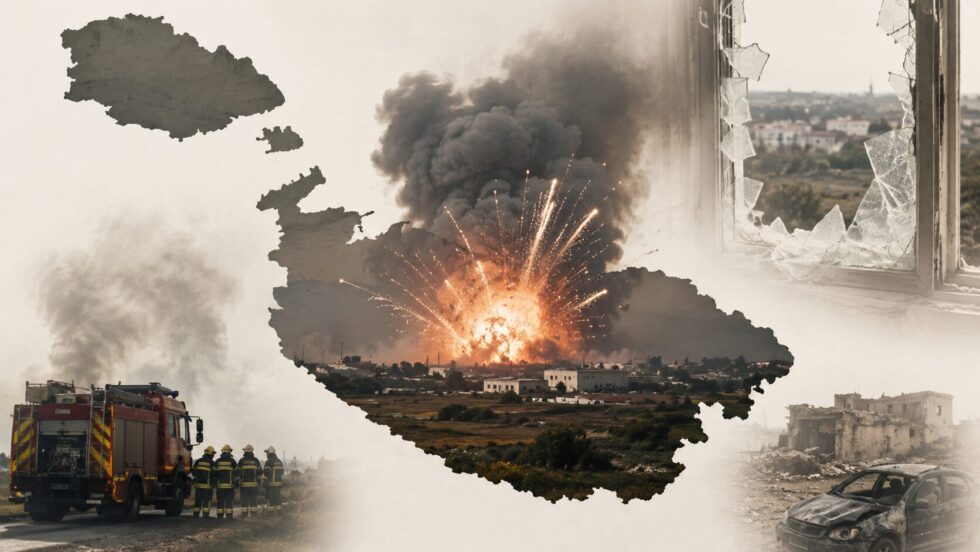
Malta explosion has left three people in hospital, killed livestock and damaged homes, farms, cars and public infrastructure after a powerful blast tore through the Ta’ Lourdes Fireworks Factory near Salina and Naxxar at about 6:30am on Monday, 1 June 2026. The early-morning explosion sent a thick plume of smoke over the rural Magħtab area, triggered secondary fireworks for hours, shattered windows, scattered stones across nearby roads and forced emergency crews to seal off the site while investigators worked to establish what caused the blast, The WP Times reports.
The explosion was strong enough to be heard across large parts of Malta, with residents reporting shaking buildings, broken glass and a shockwave that reached surrounding localities. Two men in nearby fields — aged 67 and 47 and both from St Paul’s Bay — were taken to Mater Dei Hospital with minor injuries, while another injured person was also reported. No licensed workers were inside the factory at the time, a fact that may have prevented a much higher casualty toll.
Malta Explosion in Salina: What Happened at Ta’ Lourdes Fireworks Factory
The blast happened at the Ta’ Lourdes fireworks factory on Triq tal-Qagħdi, in the Magħtab area near Salina and Naxxar. Emergency services were sent immediately after the explosion, including police, the Civil Protection Department, the Armed Forces of Malta and medical teams. Drones were used to inspect the site because of the danger from unstable fireworks and possible unexploded material.
The explosion did not end with the first blast. Fireworks continued to ignite for hours, creating an additional risk for residents, rescue teams and investigators. Authorities asked the public to avoid the area while emergency teams worked to secure the site and check surrounding farms, buildings and roads.
| Detail | Confirmed information |
|---|---|
| Date | Monday, 1 June 2026 |
| Time | Around 6:30am |
| Location | Ta’ Lourdes Fireworks Factory, Magħtab/Salina/Naxxar |
| Injured | Three people reported injured |
| Hospital | Mater Dei Hospital |
| Human fatalities | None reported |
| Animals | Four cows reported killed; other animals affected |
| Cause | Not yet identified |
| Investigation | Police and magistrate inquiry under way |
Damage to Homes, Farms, Cars and Animals After Malta Blast
The damage spread beyond the factory itself. Residents reported shattered windows, damaged façades, broken glass and stones on roads. Nearby farms and animal sanctuaries also suffered damage, while animal welfare officers were sent to assist livestock and other animals affected by the blast.
Four cows were reported killed, and local reports also mentioned birds, rabbits and dairy animals among those affected. The Animal Welfare Directorate said resources were deployed to the area and warned that some other services could face delays because teams were focused on the emergency response.
For residents, the blast created immediate fear and confusion. Some people left their homes to avoid falling debris, damaged cables and the risk of further explosions. Windows at a nearby hotel were reportedly blown in, with guests affected by shattered glass.
Witnesses Describe Shockwave Across Malta
Witnesses described the Malta explosion as sudden, violent and deeply frightening, with the first blast followed by further detonations as fireworks continued to ignite inside the damaged factory area. One person walking dogs in Kennedy Grove said the initial bang sounded like a gas cylinder exploding, before several more blasts followed within minutes. The force of the pressure wave was described as strong enough to move the person’s hair, shake trees and send nearby animals into panic. The account is important because it shows that the explosion was not felt only at the factory perimeter but across public spaces and residential zones near Salina, Magħtab and Naxxar.
Reports from surrounding localities suggest the shockwave travelled several kilometres, rattling buildings, breaking windows and leaving residents unsure at first whether the sound came from an industrial accident, a gas explosion or something more serious. In homes, hotels and farms near the site, people reported shattered glass, damaged façades, loose stones and debris on roads. The blast also affected animals, with livestock killed and animal welfare teams later deployed to assist farms and sanctuaries in the area. This wider pattern of damage explains why emergency services treated the incident not simply as a fireworks factory accident, but as a broader public safety emergency involving residents, farmers, animals, vehicles, roads and possible unexploded pyrotechnics.
Police Investigation: Cause of Malta Explosion Still Unknown
Police are investigating the cause of the Malta explosion, but officials have not yet confirmed what triggered the first blast at the Ta’ Lourdes Fireworks Factory. Magistrate Joe Mifsud is leading the inquiry, while police, Civil Protection teams and technical specialists continue to assess the damaged site and the surrounding area. Because fireworks continued to explode after the initial blast, investigators must first secure the zone before a full technical examination can be completed. This means the inquiry is likely to focus not only on the moment of the explosion, but also on storage conditions, safety procedures, the state of the fireworks material and whether any external or environmental factor played a role.
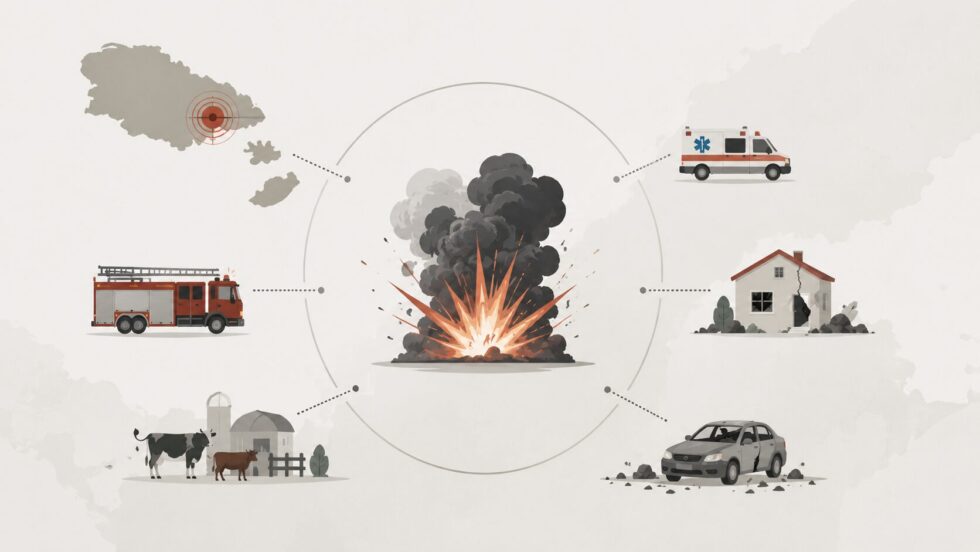
The central questions are now clear: how the explosive material ignited, whether the fireworks were stored according to safety rules, whether heat or instability contributed to the risk, and whether previous warnings or technical issues existed at the site. Officials have not announced any breach of regulations, and no final cause has been identified. Investigators are expected to review witness statements, emergency response records, damage patterns, remaining pyrotechnic material and the factory’s safety history. That history matters because the same facility suffered another explosion in 2018, when two men were seriously injured, a detail that is likely to intensify scrutiny of the site and renew debate about fireworks production safety in Malta.
Political Reaction and Emergency Response
Malta’s political leaders reacted quickly after the explosion, reflecting the scale of the incident and the public concern it created across the island. Prime Minister Robert Abela said his thoughts were with those affected and noted that national authorities had immediately sent officials and emergency workers to the scene. Opposition leader Alex Borg thanked the security forces operating in the Salina area and described the blast as one that had shocked the country. European Parliament President Roberta Metsola also expressed concern, saying the explosion had shaken Malta and thanking Civil Protection personnel and all those working on the ground in difficult conditions.
The emergency response involved police, medical teams, the Civil Protection Department, the Armed Forces of Malta and animal welfare officers. Drones were used to inspect the damaged factory area because of the continuing risk from unexploded fireworks and unstable material. Fireworks associations connected to the facility expressed solidarity with those affected and said they were relieved that none of their pyrotechnicians had been on site when the blast occurred. For emergency crews, the priority was to prevent further injuries, keep residents away from the danger zone, support affected farms and confirm whether additional explosive material remained active.
The Malta explosion matters because it combined several dangers in one incident: a powerful early-morning industrial blast, continuing secondary fireworks, injuries to civilians, damage to homes and farms, killed livestock, broken glass, road debris and the risk of unexploded pyrotechnics. The blast also happened in a country where fireworks are closely tied to local festa culture, village identity and religious celebrations. That cultural importance makes the safety debate more complex, because fireworks are not only an industry in Malta but also part of community tradition. At the same time, Monday’s explosion shows how quickly a rural fireworks facility can become a wider public safety issue when homes, farms, roads, hotels and animals are affected.
For now, the immediate priority is to secure the area, treat the injured, support residents and farmers, assist affected animals and determine the cause of the blast. Until the police and magistrate inquiry is complete, officials are unlikely to give a definitive explanation. What is already clear is that the Salina and Naxxar explosion has reopened serious questions about fireworks storage, factory locations, emergency planning, inspection systems and the protection of nearby communities. The final findings may influence not only this investigation but also the wider discussion about how Malta balances its fireworks traditions with modern safety expectations.
Read about the life of Westminster and Pimlico district, London and the world. 24/7 news with fresh and useful updates on culture, business, technology and city life: How Luke Littler Edged Luke Humphries to Reclaim the 2026 Premier League Darts Title
Sources used: The Telegraph, MaltaToday, Times of Malta, Lovin Malta, Malta Police Force, Civil Protection Department Malta, Armed Forces of Malta, Animal Welfare Directorate, official statements from the Government of Malta, witness accounts, emergency services reports.