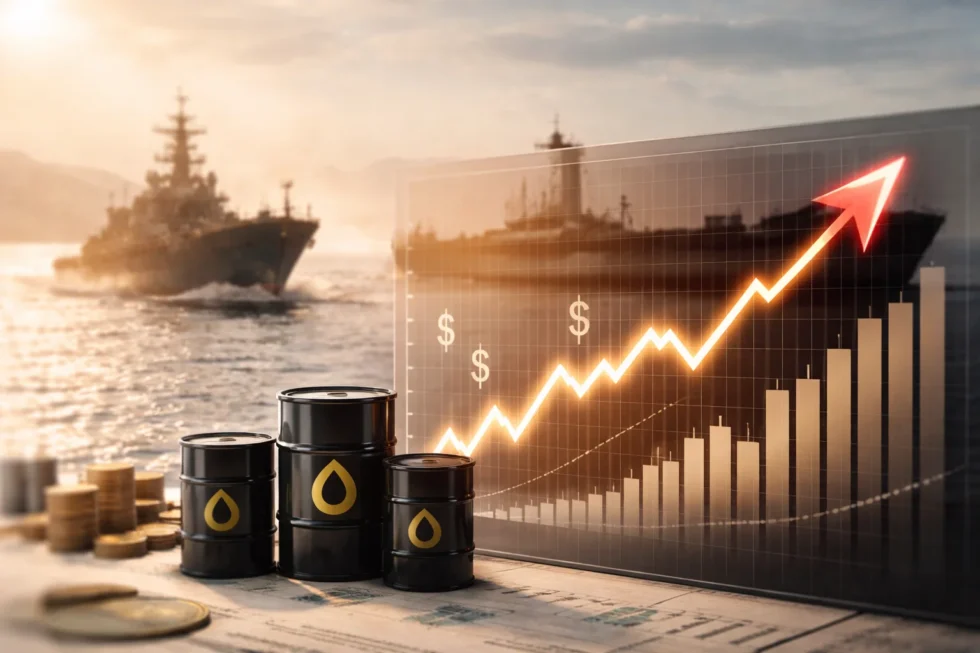
The oil price has surged across global markets as the escalating Iran war oil crisis threatens one of the world’s most important energy corridors. Traders monitoring the oil price today report that crude benchmarks jumped sharply as shipping routes in the Persian Gulf became increasingly uncertain, forcing analysts to study the latest oil price chart Iran war oil movements for signals about the scale of the disruption. As The WP Times reports, citing coverage from The Guardian and BBC, the conflict has triggered one of the most significant geopolitical shocks to the global energy system in recent years.
Energy markets reacted rapidly when tensions around Iran intensified and shipping through the Strait of Hormuz slowed dramatically. Brent crude, the global benchmark used to price most of the world’s oil, briefly climbed toward $119 per barrel, levels last seen during major geopolitical disruptions such as the early stages of Russia’s invasion of Ukraine in 2022.
The sudden surge reflects fears that exports from the Middle East could be restricted if the conflict escalates further. Oil traders from London through the time in New York trading session described the market environment as unusually volatile, with large intraday swings driven by headlines about military developments, diplomatic signals and production cuts. At the same time, political uncertainty within the Iranian leadership has drawn increasing attention from analysts assessing the long-term implications of the crisis. Discussions about figures inside Iran’s political structure — including speculation around Mojtaba Khamenei Iran — have added another layer of uncertainty for investors already concerned about global supply disruptions.
Oil price today and the scale of the market shock
The oil price today has become one of the most closely watched indicators in global financial markets as traders assess the impact of the escalating conflict involving Iran and its regional adversaries. Energy markets reacted sharply as tensions around the Persian Gulf intensified and shipping risks increased in the Strait of Hormuz, a route that carries roughly 20% of the world’s seaborne crude oil exports.
During trading on Monday, Brent crude, the international benchmark, surged above $119 per barrel, according to market data cited by the BBC and The Guardian, marking its highest level since the early months of Russia’s full-scale invasion of Ukraine in 2022. The American benchmark West Texas Intermediate (WTI) also climbed sharply, approaching $115 per barrel before later retreating during volatile trading sessions. Such rapid swings are unusual even in commodity markets known for geopolitical sensitivity. Oil prices moved more than 10% within a single trading day, reflecting uncertainty among traders about the duration of the conflict and the potential scale of supply disruption across the Middle East.
Investment banks including Goldman Sachs warned that further escalation could push crude significantly higher if exports through the Gulf remain constrained. In a research note cited by international financial media, analysts suggested that prices could move toward $150 per barrel if the Strait of Hormuz remains partially blocked.
That level would exceed the previous historic peak of $145.29 per barrel, recorded in July 2008 during the global commodity boom before the financial crisis. The projections are based largely on the strategic importance of the Hormuz shipping corridor, through which around one fifth of globally traded crude oil and a significant share of liquefied natural gas exports pass each day. Any prolonged disruption in that route would immediately tighten global supply and amplify volatility across energy markets.
Oil price chart Iran war oil and the Strait of Hormuz
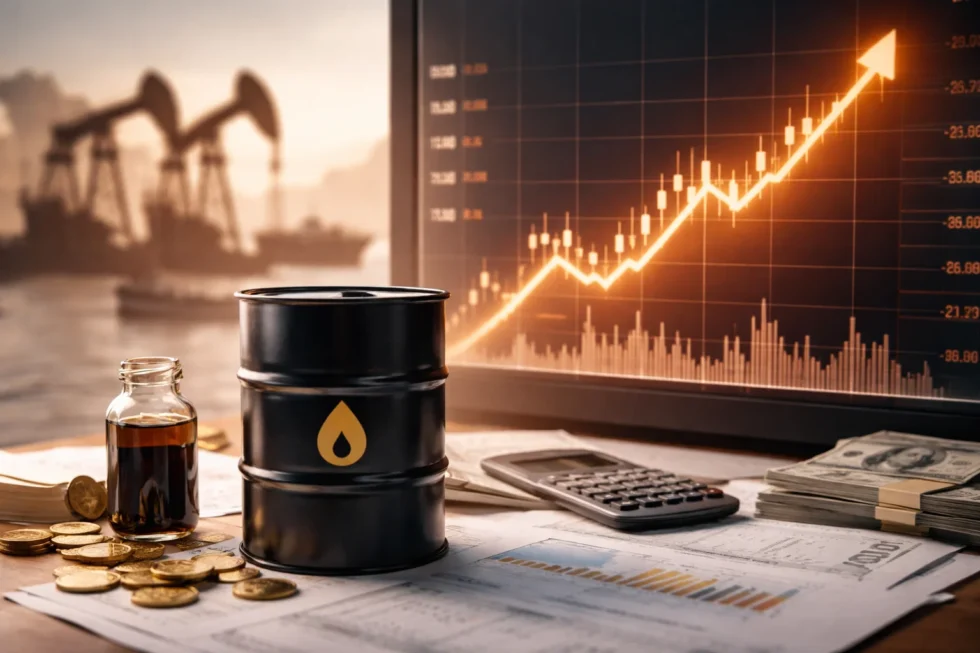
The latest oil price chart Iran war oil movements illustrate how closely global energy markets are reacting to developments around the Strait of Hormuz, one of the most critical chokepoints in the international oil trade. The narrow maritime corridor, located between Iran and Oman, connects the Persian Gulf with the Gulf of Oman and the Arabian Sea. At its narrowest point the strait is only about 33 kilometres wide, while the actual shipping lanes used by tankers measure roughly 3 kilometres in each direction, making the route particularly vulnerable to geopolitical tensions and military activity.
According to data from the US Energy Information Administration (EIA) and international shipping trackers, the Strait of Hormuz handles some of the largest volumes of energy exports in the world. Each day roughly 20 to 21 million barrels of crude oil and petroleum liquids pass through the corridor, representing close to one fifth of global oil consumption.
The route is also crucial for global gas markets. Around 20% of the world’s liquefied natural gas shipments, particularly exports from Qatar, travel through the strait. In addition, the Gulf region supplies large quantities of petrochemicals and fertiliser feedstocks, meaning disruptions can influence agricultural markets as well as energy prices.
Because of this concentration of exports, even limited restrictions on shipping traffic can rapidly affect the global energy system. Insurance costs for tankers often rise immediately during periods of tension, while some shipping companies temporarily suspend operations or reroute vessels. Energy analysts note that global oil supply and demand are typically balanced within a relatively narrow margin. As a result, even small disruptions in flows through the Strait of Hormuz can amplify volatility in the oil price chart Iran war oil, triggering rapid price movements across international markets.
Production cuts across the Gulf
Several major oil-producing countries in the Persian Gulf have already reduced output as the conflict disrupts export routes and creates logistical bottlenecks across the region. Shipping risks in the Strait of Hormuz, combined with storage constraints and transport delays, have forced producers to scale back production while assessing how long the disruption may last.
According to figures reported by international energy market analysts and shipping data cited by financial media, several Gulf producers have implemented significant reductions in crude output.
| Country | Estimated production cuts |
|---|---|
| Saudi Arabia | 2 – 2.5 million barrels per day |
| Iraq | around 2.9 million barrels per day |
| United Arab Emirates | 0.5 – 0.8 million barrels per day |
| Kuwait | around 0.5 million barrels per day |
Taken together, these reductions could temporarily remove more than 6 million barrels of oil per day from the global market, a significant share of the roughly 100 million barrels per day consumed worldwide. Energy analysts note that such cuts can have an immediate impact on prices because global oil supply and demand are typically balanced within a narrow margin. When large exporters in the Gulf reduce production simultaneously, even temporarily, the result is often sharp volatility in international crude benchmarks such as Brent and West Texas Intermediate.
The scale of the reductions also underscores the vulnerability of global energy markets to geopolitical crises in key exporting regions. Because a large share of the world’s oil production is concentrated in the Middle East, disruptions affecting the Gulf region can quickly reverberate through energy markets, supply chains and national economies far beyond the immediate area of conflict.
Why oil prices affect the global economy
Rising oil price levels influence far more than the energy sector itself. Because crude oil remains a central input for transport, manufacturing and agriculture, sustained increases in prices can quickly spread through the global economy, affecting inflation, production costs and consumer spending. Oil continues to underpin a wide range of economic activities. It is used to produce fuels for road transport, aviation and shipping, while also serving as a key feedstock in chemical industries and manufacturing. Among the sectors most dependent on oil are:
- road transport fuels such as petrol and diesel
- aviation fuel for commercial air travel
- marine fuel used in global shipping
- petrochemicals used to produce plastics and synthetic materials
- industrial manufacturing processes
- agricultural inputs including fertilisers and farm machinery
Because these sectors are deeply integrated into international supply chains, higher crude prices often feed into the cost of producing and transporting goods worldwide. Fuel prices for motorists are typically the most visible indicator of rising energy costs. In the United States, average petrol prices have climbed toward $3.50 per gallon, up from roughly $2.90 per gallon a month earlier, according to market data reported by financial media. Although the US is one of the world’s largest oil producers, domestic fuel prices still respond to global crude benchmarks.
In Europe, the impact has also been felt in gas and electricity markets. Wholesale natural gas prices in Europe have nearly doubled since tensions around Iran intensified, reflecting concerns that disruptions in Middle Eastern shipping routes could affect energy flows to international markets. Economists note that when energy prices rise sharply, businesses often face higher transportation and production costs. Those increases are frequently passed on to consumers through higher prices for goods and services, making oil market volatility a key driver of global inflation trends.
Inflation risks and central bank policy
The surge in the oil price comes as major central banks reassess monetary policy following several years of elevated inflation. After the inflation shock triggered by the Covid-19 pandemic and the energy crisis following Russia’s invasion of Ukraine in 2022, central banks including the US Federal Reserve, the European Central Bank and the Bank of England raised interest rates to their highest levels in more than a decade. By early 2026 inflation in many advanced economies had slowed compared with the peaks reached in 2022 and 2023, prompting expectations that policymakers could begin reducing borrowing costs.
A renewed increase in oil prices could complicate that outlook. Crude oil remains a core input across transport, manufacturing and agriculture. Higher crude prices raise fuel costs, increase logistics expenses and can feed through to consumer prices. Jim Reid, strategist at Deutsche Bank, said structural changes in the global economy have reduced sensitivity to energy shocks compared with previous decades.
"The global economy is less sensitive to energy shocks than half a century ago," he said.
"Economies are much less energy-intensive today, and labour markets have far lower unionisation and wage indexation, reducing the risk of a 1970s-style wage-price spiral." Even so, sustained increases in oil prices can influence inflation expectations and affect the timing of interest-rate decisions by central banks.
Could the Iran war oil shock increase recession risks
Sharp increases in energy prices have historically coincided with periods of economic slowdown. Oil supply disruptions in the Middle East were associated with global recessions in 1973, 1979 and 1990, when fuel costs rose rapidly and reduced economic activity. Ian Stewart, chief economist at Deloitte UK, said rising oil and gas prices have frequently preceded weaker growth.
"Talk of recession is back," he said.
"Surging oil and gas prices are harbingers of economic trouble. Higher energy prices, triggered by war or revolution in the Middle East, were major factors in western recessions in 1973, 1979 and 1990."
He also referenced the economic consequences following Russia’s invasion of Ukraine.
"The surge in energy prices in the wake of Russia’s invasion of Ukraine collapsed Europe’s growth rate in 2023."
Higher fuel costs reduce household purchasing power and increase operating costs for businesses, particularly in economies dependent on imported energy.
Supply chain disruptions beyond oil
The economic effects of the current crisis extend beyond crude oil. The Middle East exports several industrial commodities used in manufacturing and agriculture. Key materials include:
- aluminium used in construction and manufacturing
- sulphur used in chemical processing and metal refining
- fertiliser components including urea
Disruptions affecting these commodities can increase production costs for both agriculture and manufacturing. Farmers have reported rising fertiliser prices. US farmer Harry Ott said the increase could significantly affect agricultural margins.
"These are trying times and what we are going through now on fertiliser was totally unexpected," he said.
"Nobody's balance sheet had room to make these adjustments."
Higher fertiliser costs can translate into higher food production costs and affect agricultural supply chains.
Financial markets react to energy price volatility
Equity markets have responded to the increase in the oil price and geopolitical uncertainty in the Middle East.
Since the escalation of the conflict, several major stock indices have declined:
- Japan’s equity market has fallen about 10%
- South Korea’s main index has dropped roughly 15%
- Germany’s DAX index has declined by more than 7%
The US S&P 500 index has fallen by approximately 1.2%, a smaller decline partly reflecting the country’s position as a major oil and gas producer. Energy price volatility typically affects sectors such as transport, manufacturing, chemicals and agriculture.
Government responses and strategic reserves
Governments are considering measures aimed at stabilising energy markets and limiting the impact of rising fuel costs. Several G7 countries have indicated they may release oil from strategic petroleum reserves to increase supply and reduce price pressure. Energy analyst Hunter Kornfeind described the scale of the disruption as unusually large for modern oil markets.
"This is essentially the biggest supply shock at least in modern global oil market history," he said.
"We're talking apples to oranges in terms of the need."
Governments are also discussing support measures for households facing higher energy bills. During the energy crisis following Russia’s invasion of Ukraine, several European countries introduced subsidy programmes to reduce electricity and heating costs. However, public finances remain constrained following pandemic spending and earlier energy support packages.
Jordan Rochester, strategist at Mizuho Bank, said new support programmes could create additional fiscal pressure.
"The problem now is how much this will cost governments, with energy support packages being floated as ideas," he said.
Global dependence on Middle East energy
Despite increasing investment in renewable energy, global energy systems remain dependent on oil and gas exports from the Middle East. Transport, aviation, shipping and heavy industry continue to rely heavily on fossil fuels. As a result, disruptions affecting the Persian Gulf can influence global supply and prices within a short period of time. Recent movements in the oil price today and the oil price chart Iran war oil reflect market responses to uncertainty surrounding supply routes, production levels and geopolitical developments in the region.
Read about the life of Westminster and Pimlico district, London and the world. 24/7 news with fresh and useful updates on culture, business, technology and city life: TradFi and DeFi Merge: How Kalshi is Entering Solana's Prediction Markets