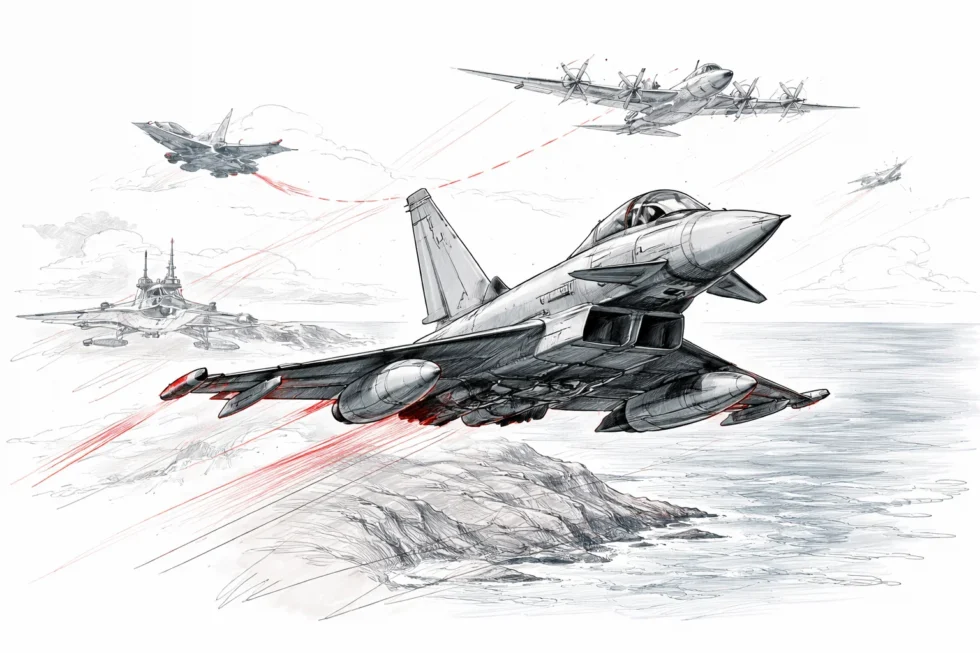
RAF jets were scrambled on Tuesday, 14 April 2026, after UK air defence systems detected an unidentified aircraft approaching the northern approaches to Britain near Shetland. Two Typhoon fighters were launched under Quick Reaction Alert from RAF Lossiemouth, supported by a Voyager refuelling aircraft from RAF Brize Norton. The aircraft, assessed by defence sources as likely Russian, remained in international airspace throughout and did not enter UK sovereign airspace, meaning no interception was carried out before the RAF jets returned to base, The WP Times reports.
The response formed part of routine UK and NATO air policing activity, with British aircraft deployed to identify and monitor the contact rather than engage it. Defence sources described the launch as precautionary, reflecting established procedures for tracking aircraft approaching NATO-monitored airspace, particularly along the northern corridor around Scotland, where surveillance remains continuous.
Response triggered in northern UK air defence zone
The alert was initiated after radar systems identified an aircraft moving towards the UK’s northern area of interest, with the Shetland region serving as a key surveillance corridor for air defence operations. Under the UK’s Quick Reaction Alert system, Typhoon fighters are maintained at immediate readiness to respond to unknown or potentially hostile aircraft. Two Typhoons were launched at short notice from RAF Lossiemouth, one of the RAF’s primary QRA bases, while a Voyager tanker from RAF Brize Norton was deployed to provide air-to-air refuelling capability if required. The inclusion of a tanker indicates the mission was configured to support extended monitoring if necessary.
| Operational detail | Information |
|---|---|
| Date | 14 April 2026 |
| Aircraft launched | 2 × Eurofighter Typhoon |
| Support aircraft | 1 × Voyager tanker |
| Launch bases | RAF Lossiemouth, RAF Brize Norton |
| Area | Northern approaches near Shetland |
| Contact | Unidentified aircraft |
| Assessment | Likely Russian military |
| Outcome | No airspace breach, no interception |
The aircraft did not cross into UK sovereign airspace. As a result, the RAF response remained at the level of tracking and identification, concluding without escalation once the aircraft moved away from the monitored area.
Aircraft classification remains unconfirmed
While some reports referred to the aircraft as a “Russian bomber”, no official confirmation of the platform has been issued. Defence sources characterised the contact as a suspected Russian military aircraft, but its exact type, role and origin remain unconfirmed. This reflects standard defence practice. Initial classification is based on radar signature, flight profile and intelligence assessment, but remains provisional until verified through additional means. In this case:
- confirmed: unidentified aircraft approaching UK-monitored airspace
- assessed: likely Russian military origin
- not confirmed: aircraft type or designation
The distinction separates verified operational facts from analytical assessment. Despite the rapid response, no interception took place. The aircraft remained outside UK sovereign airspace, removing the requirement for close engagement under both RAF operational procedures and international aviation norms. Within UK air defence terminology:
- “scrambled” refers to the immediate launch of aircraft in response to a developing situation
- “intercepted” implies controlled approach and identification at close range
In this instance, RAF aircraft maintained situational awareness without transitioning to interception, and the contact departed the area without further incident.
Broader defence context and official position
The RAF response on 14 April was described by defence sources as part of a wider allied monitoring posture rather than an isolated escalation. According to briefings cited across UK media, the sortie formed part of “a coordinated NATO response to monitoring Russian activity near allied borders” (defence source, cited by The Telegraph, 14 April 2026). Those same sources indicated the aircraft was tracked approaching the Shetland area but remained in international airspace throughout, with RAF jets deployed to identify and monitor rather than intercept (defence sources, UK media briefings, 14 April 2026).
The incident comes amid a broader pattern of Russian military activity across UK and NATO approaches. Speaking at a Downing Street briefing, Defence Secretary John Healey said:
“We see your activity over our cables and our pipelines, and you should know that any attempt to damage them will not be tolerated.”
(John Healey, Downing Street briefing, London, April 2026)
He further described Russia as “the primary threat to the UK and to NATO”, referencing submarine operations and activity near critical infrastructure in the North Atlantic (John Healey, UK government briefing, April 2026). Separately, a senior maritime security source told The i Paper that a Russian-linked vessel transiting near the UK was carrying “military relevant” cargo intended for use by Russian forces (senior maritime security source, cited by The i Paper, April 2026).
Taken together, these statements position the RAF sortie within a sustained, multi-domain monitoring posture spanning airspace, maritime routes and subsea infrastructure.
RAF capability: Typhoon and QRA profile
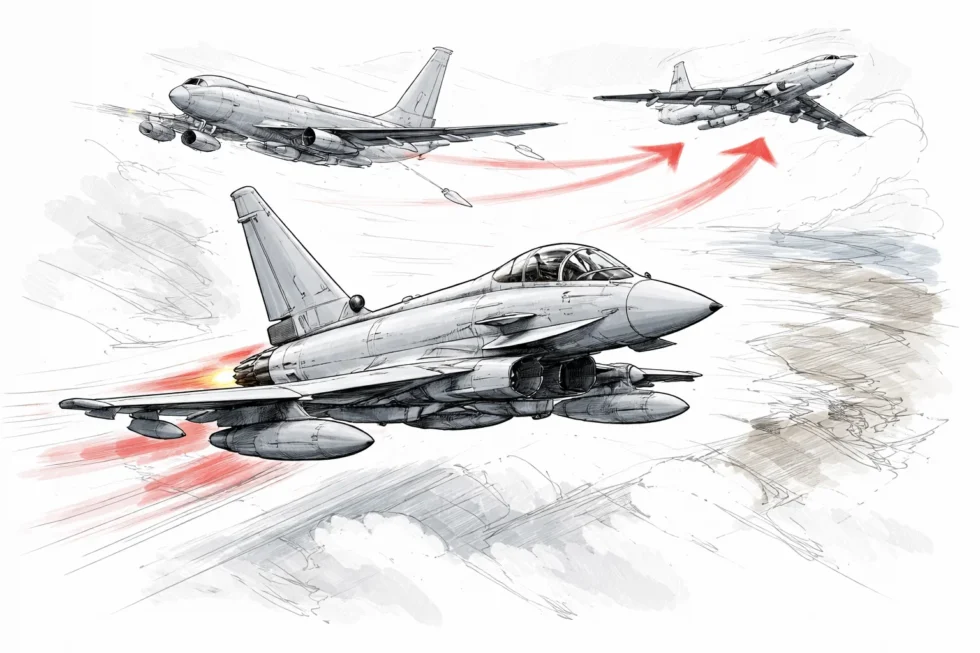
The RAF’s Quick Reaction Alert system is centred on the Eurofighter Typhoon, deployed from RAF Lossiemouth, with tanker support from RAF Brize Norton.
Eurofighter Typhoon — technical profile
| Capability | Specification |
|---|---|
| Role | Air defence / interception |
| Maximum speed | Approx. Mach 2 |
| Combat radius | ~1,300 km |
| Extended range | Up to ~2,900 km |
| Radar | Captor multi-target (AESA variants) |
| Armament | Meteor, AMRAAM, ASRAAM |
| Readiness | Launch within minutes |
Voyager (A330 MRTT)
| Capability | Specification |
|---|---|
| Role | Air-to-air refuelling |
| Function | Extends endurance and patrol time |
| Base | RAF Brize Norton |
| Use | Supports extended monitoring missions |
The deployment of a Voyager tanker alongside Typhoon fighters indicates the sortie was configured for sustained tracking, particularly given the distance and strategic sensitivity of the northern approaches.
Operationally, the incident followed a standard QRA sequence: detection, rapid launch, airborne tracking and disengagement once the contact remained outside sovereign airspace. The absence of interception reflects established rules of engagement. Without a breach of UK airspace, RAF aircraft are tasked with monitoring and identification rather than engagement. However, the significance lies in frequency and context. Repeated approaches by unidentified or Russian-assessed aircraft increase operational tempo and reinforce the requirement for continuous readiness. At the same time, these interactions remain controlled, operating within established boundaries of military signalling rather than escalation.
Read about the life of Westminster and Pimlico district, London and the world. 24/7 news with fresh and useful updates on culture, business, technology and city life: Horoscope today London 16 April 2026: Sagittarius Moon tests discipline, money and health