Reform UK-run councils across England are preparing to impose near-maximum council tax rises for the 2026–27 financial year, just months after the party won control of key authorities in the 2025 local elections on a pledge to stop household bills from rising, according to budget papers published in January 2026, with four of the five councils it controls proposing increases of up to 5% and Kent County Council — its largest and most politically significant authority — planning a 3.99% rise, just below the national cap, The WP Times reports.
The move brings Reform-led authorities into line with Conservative- and Labour-run councils across England, which are also relying on near-maximum tax rises to fund fast-growing costs in adult social care, children’s services and homelessness after years of real-terms cuts in central government grants and sharp increases in staff, energy and contract prices, leaving little room for savings and turning Reform’s central 2025 campaign claim — that council tax could be restrained by cutting waste and inefficiency — into one of the first major tests of how the party governs when faced with the financial realities of local government.
Why council tax matters more than almost any other local tax
Council tax occupies a uniquely sensitive position in Britain’s public finances because it combines high visibility, weak links to income and direct political accountability in a way no other tax does. Unlike income tax or VAT, council tax is billed directly to households once a year, not deducted automatically from wages or spread invisibly across everyday spending. It is also charged according to property bands rather than earnings, meaning people on very different incomes can face almost identical bills.
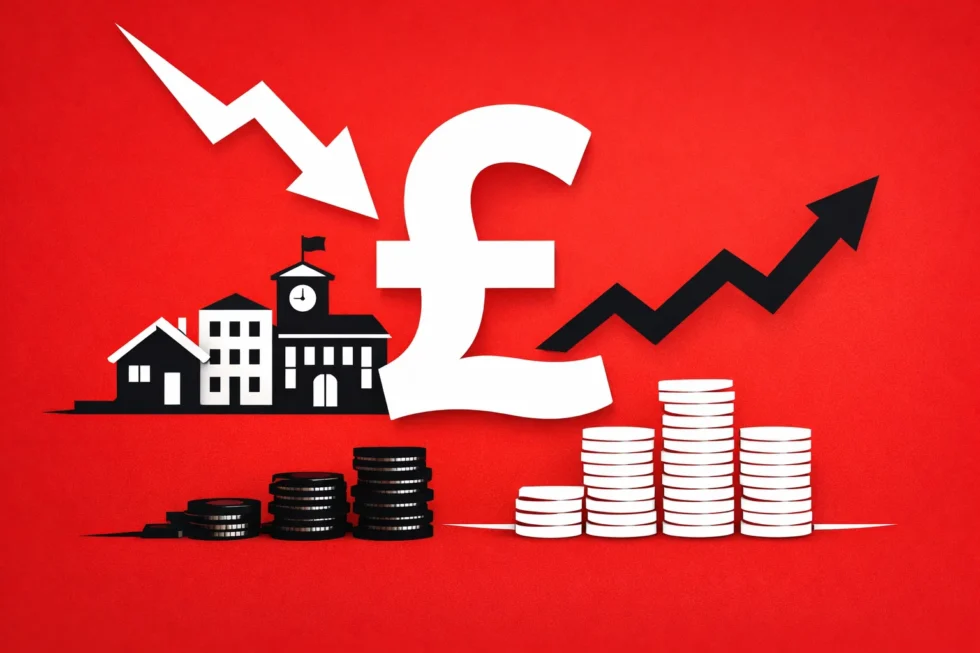
In most English councils, a Band D household now pays between £1,800 and £2,200 a year. A rise of 5% — the maximum most councils can impose without triggering a local referendum — typically adds £80 to £110 in a single step, appearing on one demand notice that households must pay regardless of income.
This makes council tax one of the most politically powerful taxes in Britain. The Institute for Fiscal Studies has repeatedly highlighted that it is one of the few charges that households “both see and feel immediately”, making it a direct test of whether local government is offering value for money.
How council tax compares with other major taxes
| Tax type | How it is paid | Linked to income? | Visibility to households | Who sets the rate |
|---|---|---|---|---|
| Council tax | Annual bill | No (property-based) | Very high | Local councils |
| Income tax | Deducted from wages | Yes | Low | UK government |
| National Insurance | Deducted from wages | Yes | Low | UK government |
| VAT | Added to prices | No | Low | UK government |
| Fuel duty | Included in pump price | No | Low | UK government |
This structure explains why council tax plays such an outsized role in local elections. It is the only major tax that is both highly visible and controlled by politicians voters can directly remove. Reform UK explicitly built its 2025 campaign around this pressure point, presenting council tax as proof that traditional parties had failed to control spending — and promising that Reform-run councils would do so instead.
What Reform UK promised voters in 2025
During the 2025 local elections, Reform UK placed council tax at the centre of its economic and political message, presenting it as the clearest symbol of what it said was a broken system of local government finance. The party repeatedly attacked what it called the “ratchet effect” — the pattern by which council tax rises year after year regardless of which party controls a council — arguing that this showed local authorities had become structurally unable to restrain spending. Reform candidates claimed that councils were no longer governed by necessity, but by what they described as institutional waste, expanding management structures and politically protected budgets.
This argument was designed to cut through to voters experiencing the cost-of-living crisis. Reform told households that rising council tax was not simply the result of higher demand for services, but of a political culture that avoided hard choices and passed the cost on to residents instead.
Kent County Council was presented as the party’s “shop window” — a flagship authority where Reform said it would demonstrate that a different model was possible. By winning Kent, the party argued, it would show that:
- taxes could be restrained
- budgets could be tightened
- and services could still be delivered
Voters were promised lower council tax, tougher spending discipline and a leaner, more accountable form of local government, in contrast to what Reform described as decades of fiscal drift under both Conservative and Labour administrations. Those pledges were not framed as marginal savings but as a test case: if Reform could not change the way council tax worked in Kent, the party’s claim to offer a new model of government would carry little weight elsewhere.
What Reform-run councils are now proposing
The January 2026 budget papers reveal how Reform UK is governing now that it controls real budgets rather than campaign leaflets. Instead of freezing or cutting council tax, Reform-run councils are proposing increases at or just below the legal maximum, placing them squarely within the same financial framework used by Conservative- and Labour-led authorities across England.
Under national rules, councils can raise council tax by up to 5% without triggering a local referendum. In practice, that ceiling has become the default setting for councils under pressure, because it is the fastest and most reliable way to raise cash without cutting legally required services. Reform councils have now chosen that same route.
At Kent County Council, the party’s flagship authority, the proposed increase for 2026–27 is 3.99%, just below the cap. Other Reform-controlled councils are proposing rises close to 5%, meaning households will see broadly the same increases as those living under councils run by Labour or the Conservatives.
In financial terms, this signals that Reform administrations are relying on higher household taxation to balance their budgets, rather than delivering the sharp reductions in spending that featured so prominently in the party’s election campaign.
Proposed council tax increases, 2026–27
| Reform-run authority | Proposed rise |
|---|---|
| Kent County Council | 3.99% |
| Council A | ~5% |
| Council B | ~5% |
| Council C | ~5% |
| Council D | ~5% |
The pattern shows that Reform councils are using the same fiscal levers as every other authority in England — raising council tax to cover rising costs rather than attempting to run down spending to meet their promises. For voters who backed Reform on the expectation that council tax would be held down, these numbers represent the first hard evidence of how the party governs when confronted with the realities of local government finance.
Why councils say they have little choice
Local government finances across England are under severe strain. The fastest-growing spending areas — adult social care, children’s services and homelessness — are not optional. Councils are legally required to provide them, and demand has risen sharply as the population ages and social pressures increase. At the same time:
- central government funding has fallen in real terms
- inflation has driven up staffing, energy and contract costs
- and many councils have already used up their reserves
Several authorities have effectively declared themselves financially unsustainable. Reform councillors now argue that the budgets they inherited left little room to manoeuvre. Without tax rises, they say, councils would face either deep cuts to statutory services or the risk of financial collapse.
Why this is politically damaging for Reform
The financial pressures facing local government are real — but that does not remove the political cost for Reform UK. The party did not win control of councils by promising to manage austerity more efficiently. It won by arguing that the system itself was broken — that council tax kept rising because of waste, bureaucracy and political timidity, not because higher bills were inevitable.
By proposing near-maximum council tax increases, Reform-run councils are now signalling something very different: that once in office they face the same legal constraints, spending pressures and fiscal trade-offs as the parties they replaced.
That shift matters because it changes how Reform is judged. Protest parties can survive on rhetoric. Governing parties are judged on budgets, bills and outcomes.
Nowhere is that test sharper than in Kent. Reform described Kent County Council as its “shop window” — the place where it would prove that lower taxes and tighter spending could go together. A 3.99% council tax rise in that flagship authority sends the opposite signal: that even where Reform has its strongest mandate, it has not found a way to break the cycle of rising household bills. For voters, the question is no longer what Reform says about local government — but whether, when given power, it actually governs differently.
What this means for the 7 May 2026 elections
On 7 May 2026, voters across England will elect councils and metro mayors in what will be the first nationwide test of Reform UK as a governing party, not just a challenger to the political establishment.
For the first time, Reform will be judged not on its message but on its record — on how it has set budgets, raised taxes and funded frontline services in the authorities it controls.
Council tax bills arriving on doormats in the spring will be among the most concrete measures of that record. In many Reform-run areas, households are set to pay £80 to £110 more a year, bringing their experience into line with that of voters in Conservative- and Labour-run councils.
That shift is politically significant. It means Reform goes into the 2026 elections not as an outsider offering a break from the past, but as an incumbent whose fiscal decisions can be directly weighed against those of its rivals across England.
Stay informed with The WP Times for independent coverage of London, Britain and global affairs as the 7 May 2026 UK elections approach. We report on how power is used across councils, city halls and Parliament so readers can understand what is changing in their communities.
All photos are our original editorial creative