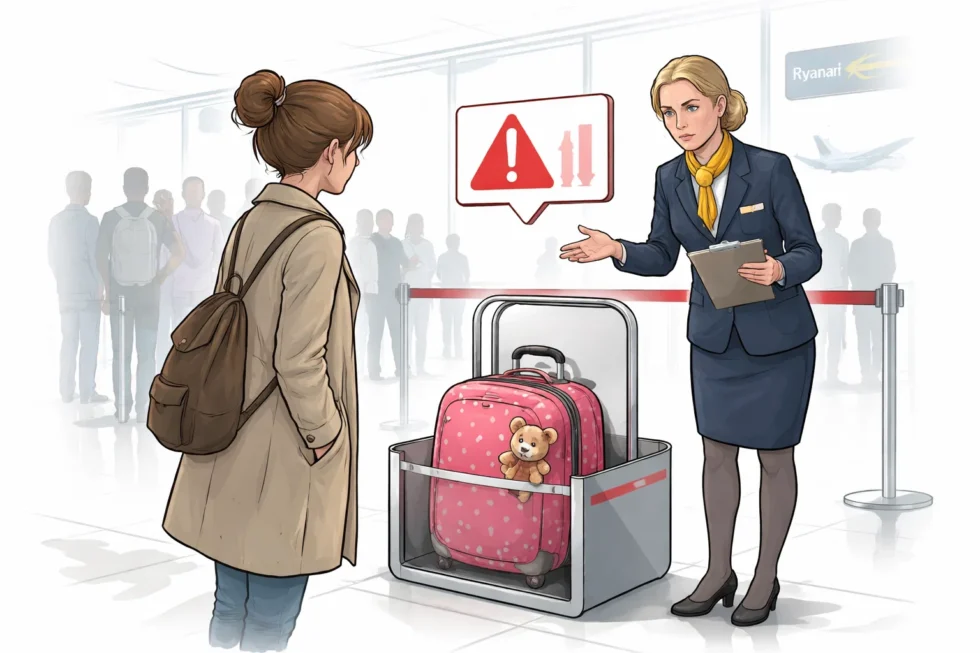
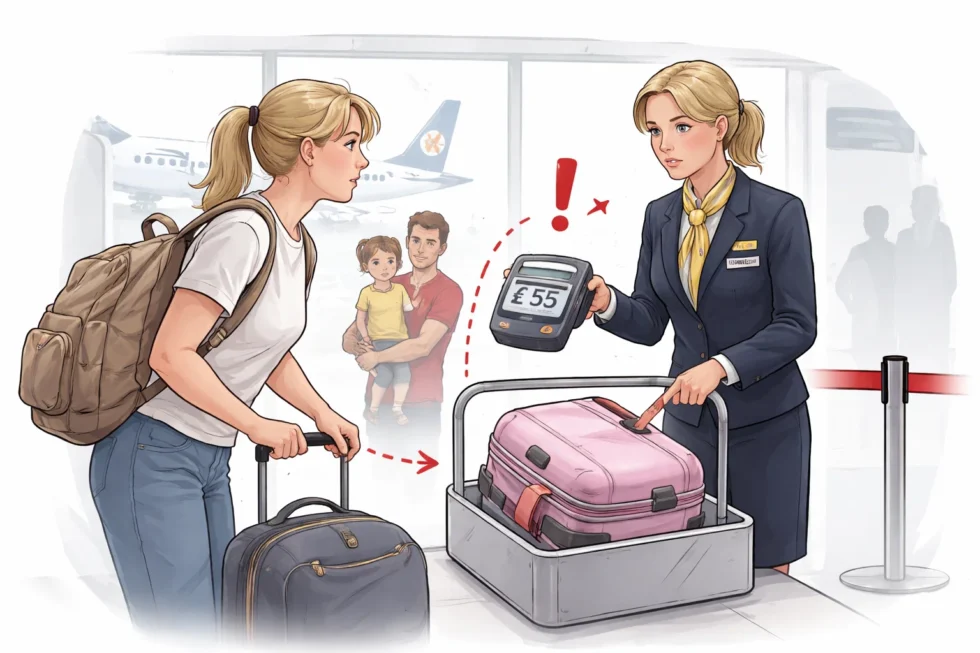
A dispute involving Ryanair has drawn attention to how strictly applied baggage rules can escalate into passenger conflict, after a Birmingham mother was charged £55 at Budapest Airport on 3 April 2026 for her seven-year-old daughter’s suitcase, which failed to fit into a hand luggage sizer despite claims it qualified under an exemption category, The WP Times reports. The incident highlights a recurring tension between published airline policy and real-time enforcement, particularly in high-pressure boarding environments where staff rely on physical measurements rather than interpretative wording such as “Trunki or similar”, leaving little room for negotiation once boarding is underway.
The passenger, Luana Botas, had travelled outbound from Birmingham without issue, stating that luggage of similar size had been accepted earlier in the journey, but was stopped during boarding on the return leg in Budapest when staff requested that the child’s hard-shell suitcase be placed into the sizer, where it did not fully fit due to its rigid structure. Measurements of the case were reported at 48 x 26 x 33 cm, exceeding both the standard small cabin bag allowance of 40 x 30 x 20 cm and the approximate reference dimensions of Trunki-style children’s luggage, which the airline cites at around 46 x 20 x 31 cm.
According to the airline’s published guidance, children aged between two and eleven may carry one Trunki case or similar item that can exceed standard small bag limits, but the interpretation of “similar” is not defined by brand category alone and instead depends on physical size compliance at the point of boarding. This distinction became decisive in the case, as gate staff applied measurement-based enforcement, requiring immediate payment of a £55 surcharge before allowing boarding to proceed. The passenger described the experience as “embarrassing and humiliating”, explaining that attempts to reference the airline’s own policy were unsuccessful due to time pressure and the absence of any escalation mechanism at the gate. “I tried to explain that this is your own policy… but boarding was almost complete,” she said (Luana Botas, passenger statement, Budapest Airport, April 2026). The situation reflects a broader operational reality in low-cost aviation, where decisions are made rapidly and consistently based on visible criteria rather than contextual interpretation.
In response, Ryanair stated that the charge was applied correctly under its rules, noting that the bag exceeded permitted dimensions and therefore did not qualify for exemption. “This passenger’s bag exceeded the permitted dimensions and was correctly required to pay a standard gate baggage fee,” a spokesperson said (Ryanair statement, April 2026). The airline’s position underscores its reliance on uniform enforcement standards across airports, even where passenger expectations may have been shaped differently at departure.
The case illustrates a wider pattern within the low-cost travel model, where pricing efficiency is supported by strict rule enforcement, and where even minor deviations from stated limits can result in additional charges. For passengers, the practical implication is that category-based assumptions — such as whether an item appears similar to an approved type — carry less weight than exact measurements at the point of control. Industry observers note that such disputes often arise not from rule changes but from differences in interpretation between digital guidance and physical verification, particularly when wording introduces flexibility that is not operationally supported. As passenger volumes remain high and turnaround times tight, gate-level enforcement is likely to remain binary: items either fit or they do not.
For travellers, the case reinforces the importance of measuring luggage precisely against airline limits and allowing margin for rigid materials that may not compress into sizing frames. It also highlights the potential for inconsistency across different airports, where enforcement intensity may vary but outcomes ultimately depend on compliance at the final boarding check.
Background: Ryanair baggage rules explained
Ryanair operates one of the most strictly standardised cabin baggage policies in Europe, built around fixed dimensions and rapid gate-side enforcement rather than discretionary interpretation. Under current rules, passengers are entitled to bring one small personal bag on board free of charge, provided it fits under the seat in front. The standard maximum size is:
- 40 x 30 x 20 cm (small personal bag, included in base fare)
Additional cabin baggage requires a paid upgrade (Priority & 2 Cabin Bags), which allows:
- One small personal bag (as above)
- One larger cabin bag up to 55 x 40 x 20 cm (max 10 kg)
For children, the airline provides a limited exception:
- Children aged 2–11 years may carry one Trunki case or similar item
- This item may exceed small bag dimensions, but must remain comparable in size to a standard Trunki
The reference dimensions for a typical Trunki case are approximately:
- 46 x 20 x 31 cm
Crucially, enforcement is based on physical fit within the airport sizer frame, not on product category or marketing description. Hard-shell suitcases are more likely to fail this test because they cannot compress. At the boarding gate, if a bag exceeds permitted dimensions:
- It is classified as non-compliant cabin baggage
- A standard gate fee (typically £50–£70 / €60+) is charged
- Payment must be made immediately to proceed with boarding
Airline policy does not provide for on-the-spot appeals or discretionary exemptions once the sizing check has failed. This makes the gate decision final in practice, particularly when boarding is near completion. This structure reflects the airline’s low-cost model, where speed, consistency and ancillary revenue are prioritised over case-by-case flexibility.
Read about the life of Westminster and Pimlico district, London and the world. 24/7 news with fresh and useful updates on culture, business, technology and city life: Lufthansa strike Germany flights: Hundreds of cancellations hit Frankfurt and Munich as unions escalate dispute
Reporting for this article was based on material from Daily Mirror, Birmingham Mail, Irish Mirror