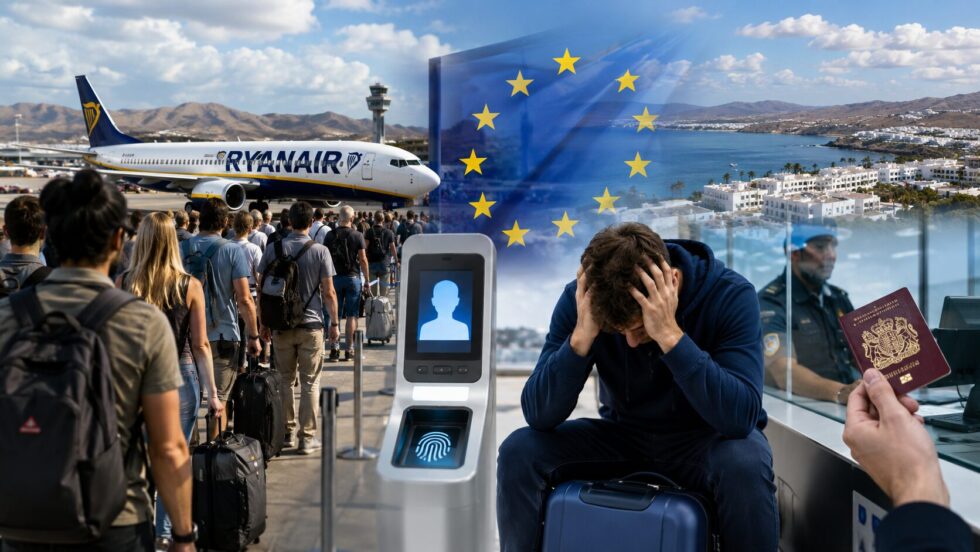
Ryanair Lanzarote passport issue left dozens of travellers unable to board flights from Lanzarote Airport on 4 May 2026 after a failure in the EU’s new Entry/Exit System (EES) disrupted passport control processing, delaying departures and forcing airlines to close boarding without affected passengers present, The WP Times reports. Nearly 70 passengers bound for Edinburgh were among those stranded as biometric checks failed to process in time, highlighting systemic risks in the rollout of digital border controls during peak travel periods.
The disruption began late morning at Lanzarote Airport, where passport control systems reportedly slowed or failed entirely, affecting travellers leaving the European Union, particularly British passengers required to register biometric data. While the issue was resolved by midday, the operational impact had already led to missed flights, confusion in departure areas, and renewed scrutiny of the EES rollout across multiple European airports.
EES system failure disrupts Ryanair operations in Lanzarote
The Ryanair Lanzarote passport issue was directly linked to the Entry/Exit System, a new EU-wide digital border control mechanism replacing traditional passport stamping. Under EES rules, non-EU travellers must submit fingerprints and facial images, creating a digital record valid for three years.
On 4 May, the system reportedly failed or slowed significantly, causing long queues at passport control. As a result, passengers were unable to clear security and reach boarding gates before closure. Airlines, including Ryanair, proceeded with departures according to schedule, leaving behind those delayed in the system. Reports from local sources suggested the issue may not have been isolated. Some indicated a broader disconnection affecting multiple airports across Europe, raising concerns about system stability during high traffic periods. Key operational impacts reported:
- Delays at passport control exceeding standard processing times
- Passengers unable to reach boarding gates before closure
- Flights departing without affected travellers
- Confusion in departure zones due to lack of real-time updates
- Temporary disruption resolved by midday but with lasting effects
Why nearly 70 passengers missed an Edinburgh flight
The most visible consequence of the Ryanair Lanzarote passport issue involved a flight to Edinburgh, where approximately 68–70 passengers reportedly missed departure. These travellers were still waiting at passport control when boarding closed.
Ryanair confirmed that all passengers who arrived at the boarding gate on time were accommodated and travelled as scheduled. The airline stated that missed passengers were not present at the gate during boarding, in line with standard aviation procedures.
However, the case highlights a structural gap between airport border control systems and airline boarding processes. Even when delays originate from government-controlled passport checks, airlines are not required to hold flights beyond operational limits.
Timeline of the disruption:
| Time (local) | Event |
|---|---|
| ~11:00 | Passport control system slowdown begins |
| 11:00–12:00 | Queues build, passengers delayed |
| Boarding time | Passengers unable to reach gates |
| Departure | Flight leaves without delayed passengers |
| ~12:00 | System reportedly restored |
“Passengers are paying the price” — airline response
Ryanair has been openly critical of the EES rollout, arguing that the system is being introduced prematurely during one of the busiest travel periods of the year.
(“Governments across Europe are attempting to roll out a half-baked IT system in the middle of the busiest travel season, and passengers are paying the price,” Neal McMahon, Chief Operations Officer at Ryanair, said in a statement.)
The airline has formally called on EU governments to suspend the system during peak summer months, citing existing legal provisions that allow temporary delays in implementation. Greece has already taken steps in this direction, raising the possibility of uneven application across member states.
What the Ryanair Lanzarote passport issue means for travellers
The Ryanair Lanzarote passport issue underscores broader risks associated with the transition to digital border systems in Europe. While EES is designed to improve efficiency and security, early implementation has revealed operational vulnerabilities. For travellers, particularly those flying from EU destinations to the UK or other non-EU countries, the incident highlights the importance of allowing additional time at airports where biometric checks are required. Practical implications for passengers:
- Arrive significantly earlier than standard check-in recommendations
- Expect longer processing times at passport control
- Monitor airport updates for system delays
- Proceed to gates as early as possible once cleared
- Be aware that airlines may not delay flights due to border issues
The incident also raises questions about coordination between national authorities, airport operators, and airlines. Passport control in Spain falls under the authority of the Ministry of the Interior and National Police, not airport operators or carriers, creating a fragmented responsibility structure during disruptions. As the EU continues rolling out EES across member states, further incidents may test the resilience of the system. For now, the Lanzarote disruption serves as a clear signal that the transition to digital borders remains a work in progress, with real consequences for passengers caught between technology and tight departure schedules.
Read about the life of Westminster and Pimlico district, London and the world. 24/7 news with fresh and useful updates on culture, business, technology and city life: Manchester Airport Flights May 2026: Jet2 Launches New Samos Route Twice Weekly, UK Rollout to Birmingham