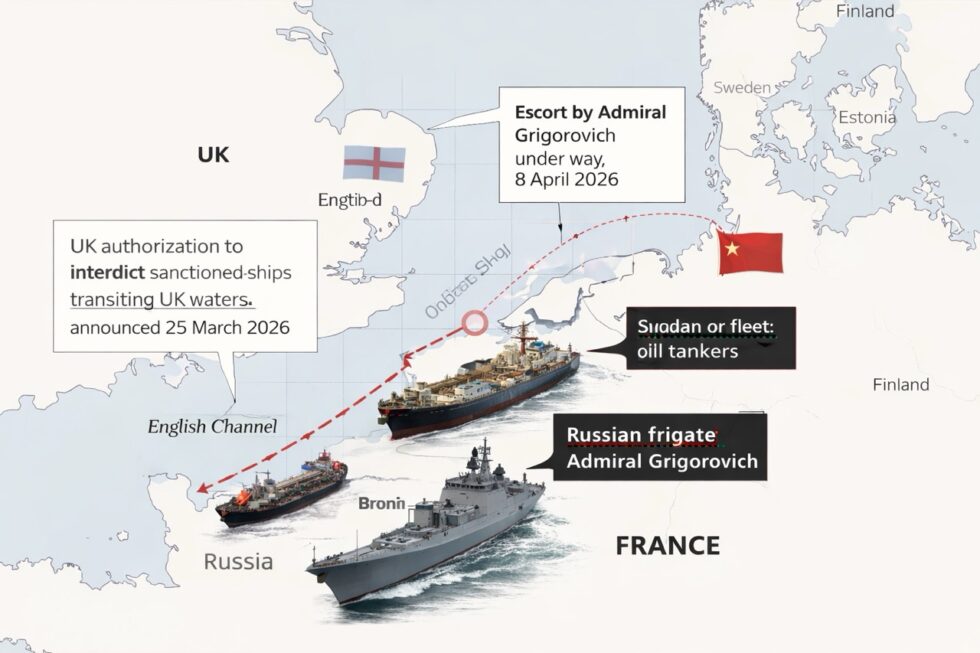
Sanctioned Russian oil tankers linked to the shadow fleet transited the English Channel under escort of a Russian naval warship, days after the UK authorised the interception of such vessels in its waters, according to reports published on 8 April 2026 — reported The WP Times.
A Russian frigate, Admiral Grigorovich, accompanied sanctioned tankers including Universal and Enigma through the Channel, according to reporting by The Telegraph and The Times (The Telegraph, 8 April 2026; The Times, 8 April 2026). Additional vessels linked to the same network, including Desert Kite and Kousai, were also referenced (The Times, 8 April 2026). The transit took place in a corridor where more than 500 vessels pass daily, combining commercial, energy and naval traffic. The movement follows a decision taken on 25 March 2026, when UK Prime Minister Sir Keir Starmer authorised British forces to interdict sanctioned vessels transiting UK waters (UK Government release, 25 March 2026). The government stated that preparations included boarding non-compliant vessels, responding to ships that may be armed and countering attempts to evade detection through surveillance or signal disruption (Downing Street, March 2026).
The UK has supported monitoring and tracking of shadow fleet vessels across European and Mediterranean waters in recent weeks (UK Government release, March 2026). Joint Expeditionary Force partners, including Finland, Sweden and Estonia, have carried out operations targeting suspected sanction-evading vessels in the Baltic Sea (Downing Street, March 2026).
Russia responded through its ambassador to the United Kingdom. “Such a decision will not go unanswered. Appropriate measures are being developed. Let this come as a surprise to the British,” said Andrei Kelin (response to RIA Novosti, reported 8 April 2026). He added: “To protect our interests and ensure freedom of navigation, we may employ all available legal, political and other instruments – including asymmetrical ones, and not necessarily in the vicinity of British territorial waters” (RIA Novosti interview, reported 8 April 2026). Kelin also stated that “seizing the ships and their cargoes would lead to legal action by the shipowners and huge associated costs” (RIA Novosti, reported 8 April 2026). The shadow fleet refers to a network of oil tankers used to transport Russian crude under sanctions. These vessels typically operate using flags of convenience, multi-layered ownership structures and insurance arrangements outside Western systems, with limited transparency on cargo origin and destination.
The English Channel remains one of the busiest maritime routes globally, used for oil shipments, container traffic, naval movements and passenger ferries. Its traffic density requires coordinated navigation and monitoring across civilian and military operations.
Under the UK policy framework, interdiction of sanctioned vessels may involve boarding, inspection and potential seizure, subject to legal procedures. Russian officials have stated that such actions would lead to legal responses from shipowners (Andrei Kelin, RIA Novosti, reported 8 April 2026). The sequence of events places the Channel transit after the UK authorisation of enforcement measures and alongside expanded monitoring of shadow fleet activity across northern European waters.
Read about the life of Westminster and Pimlico district, London and the world. 24/7 news with fresh and useful updates on culture, business, technology and city life: Fuel prices surge: what is the jet fuel price impact airlines and what happens next for travellers
This report was prepared using materials from The Telegraph, The Times, UK Government, Downing Street, RIA Novosti and Shipping Telegraph.