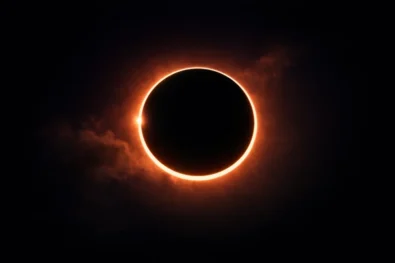
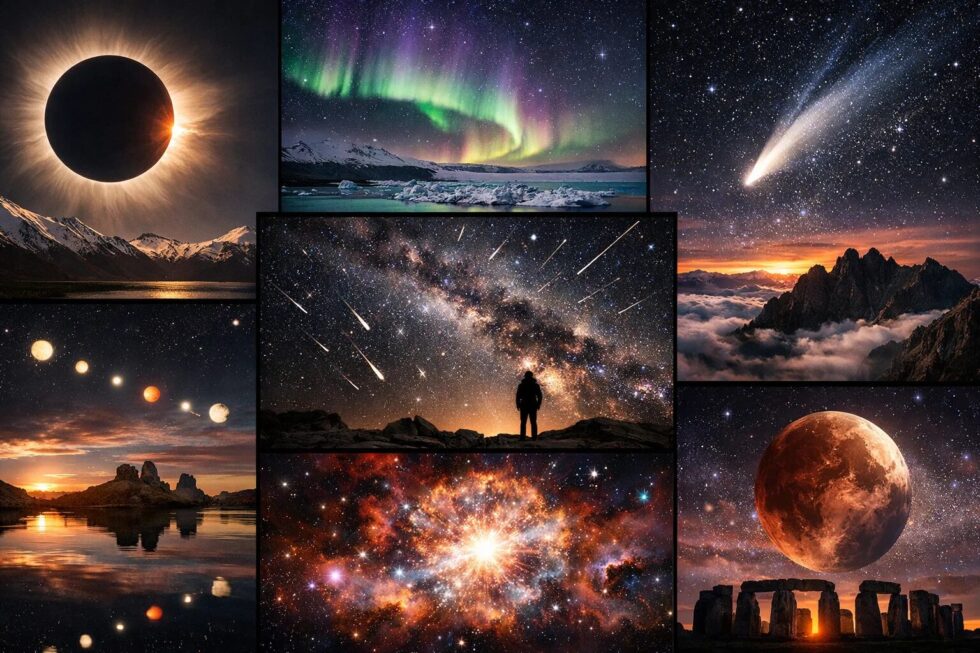
The UK night sky in 2026 is set to deliver one of the most spectacular astronomical years in decades, with a major solar eclipse, multiple supermoons, a rare blue moon, intense meteor showers and a striking planetary alignment all visible from Britain. The centrepiece will be the partial solar eclipse on 12 August 2026, when up to 90% of the Sun will be covered across the United Kingdom, making it the most dramatic solar event seen in Britain for years, according to astronomical observatories and forecast data reported by The WP Times with reference to the Royal Observatory Greenwich.
Skywatchers in London, Manchester, Edinburgh, Glasgow, Cardiff and Belfast will all be able to observe the eclipse, along with three supermoons, a blue moon, and some of the strongest meteor showers of the decade, placing 2026 among the most important years for stargazing in the UK.
Meteor Showers: A Sky Full of Shooting Stars
The year begins with the Quadrantids, active since late December 2025. Their peak occurs on the night of 3–4 January between 3:00–4:00 GMT, providing potentially over 100 meteors per hour under clear skies. In London, parks and riverbanks offer ideal viewing, while in Manchester, elevated city outskirts are preferred. Edinburgh and Glasgow benefit from nearby hills, and in Cardiff and Belfast, rural locations away from city lights offer optimal visibility.
Other meteor showers to watch in 2026 include:
- Lyrids: 22–23 April, about 20 meteors per hour, debris from Comet C/1861 G1 Thatcher
- Eta Aquarids: 6–7 May, best seen before sunrise, remnants of Halley’s Comet
- Perseids: 12–13 August, famous for bright meteors, best seen in open countryside
- Geminids: 13–14 December, originating from asteroid 3200 Phaethon, often bright and colorful
Observation tips: Dark clothing, warm layers, a blanket or chair, allow eyes 15 minutes to adjust, binoculars optional but not necessary.
Supermoons and the rare Blue Moon
Three supermoons will light up the UK night sky in 2026, when the Moon appears larger and brighter than usual because it is closest to Earth in its orbit.
The first will be the Wolf Moon on 3 January, which is expected to be particularly striking over London and Edinburgh, where winter air often delivers sharper, clearer skies. The second, the Beaver Moon on 24 November, will rise low and bright in the autumn sky and is best viewed from rural locations near Glasgow or Cardiff, where light pollution is lower. The final supermoon of the year, the Cold Moon on 23 December, will offer excellent visibility from elevated viewing points around Belfast and Manchester, just days before Christmas.
In addition, a rare Blue Moon will occur on 31 May 2026, marking the second full Moon within a single calendar month — an event that happens only about once every two to three years. City parks, hilltops and open countryside across the UK will provide some of the best vantage points for observing this unusually bright and visually striking lunar display. across the UK.
Partial Solar Eclipse on 12 August
The partial solar eclipse on 12 August 2026 will be the most important solar event visible from the United Kingdomfor generations. The eclipse will begin at 18:17 BST, with the maximum phase at 19:13 BST, when up to 90% of the Sun will be obscured across much of England and Scotland.
Skywatchers in London, Manchester and Edinburgh will experience the deepest coverage, while observers in Glasgow, Cardiff and Belfast may see slightly reduced visibility depending on local buildings, hills and the position of the south-west horizon. Even so, the Moon will block a dramatic portion of the Sun across all parts of the UK, creating a striking twilight effect as daylight fades.
This type of solar eclipse will not be seen again in Britain until 23 September 2090, making the 2026 event a once-in-a-lifetime viewing opportunity for most people living in the UK.
Viewing advice:
Never look directly at the Sun without protection. Use certified solar-eclipse glasses that meet international safety standards. Cameras, binoculars and telescopes must be fitted with proper solar filters. For the best view, choose a location with a clear south-west horizon, such as parks, hilltops, coastal areas or open countryside.
Partial lunar eclipse on 28 August 2026
A dramatic partial lunar eclipse will be visible across the United Kingdom on 28 August 2026, beginning at 20:30 BST, when the Earth’s shadow will gradually cover up to 90% of the Moon. Unlike a solar eclipse, a lunar eclipse is completely safe to watch with the naked eye, making it one of the most accessible major astronomical events of the year.
Observers in London and Manchester will benefit from viewing points in parks, hills and open fields, while Edinburgh and Glasgow offer excellent visibility from elevated urban areas and surrounding high ground. In Cardiff and Belfast, wide open coastal and countryside locations provide clear sightlines as the Moon darkens and turns a deep copper-red colour during the peak phase of the eclipse.
Planetary alignment on 28 February 2026
On 28 February 2026 from 18:00 GMT, a rare planetary alignment will unfold across the UK night sky, bringing six planets into view along the same arc of the ecliptic. Jupiter, Saturn, Venus and Mercury will be visible to the naked eye, while Uranus and Neptune can be observed using binoculars or a small telescope, making this one of the most photogenic astronomical events of the year.
The near-full Moon will appear close to Jupiter, creating a striking visual pairing above the horizon in London, Edinburgh and Manchester, particularly just after sunset — an ideal window for astrophotography and wide-angle night-sky shots.
At the same time, astronomers are forecasting elevated solar activity in early 2026, raising the likelihood of Northern Lights (aurora borealis) being visible from parts of the United Kingdom. The best chances come on dark, cloud-free nights with a clear northern horizon.
Hills and open countryside outside London and Manchester, lakeside and high-ground areas around Edinburgh, Glasgow and Belfast, and elevated locations near Cardiff offer some of the best viewing conditions. When strong solar storms driven by coronal mass ejections (CMEs) reach Earth’s magnetic field, auroras can light up the sky in green, red, blue and purple bands, occasionally becoming visible even far south in Britain.
Read about the life of Westminster and Pimlico district, London and the world. 24/7 news with fresh and useful updates on culture, business, technology and city life: January Wolf Moon 2026: When and how to see the last UK supermoon over London and Scotland.