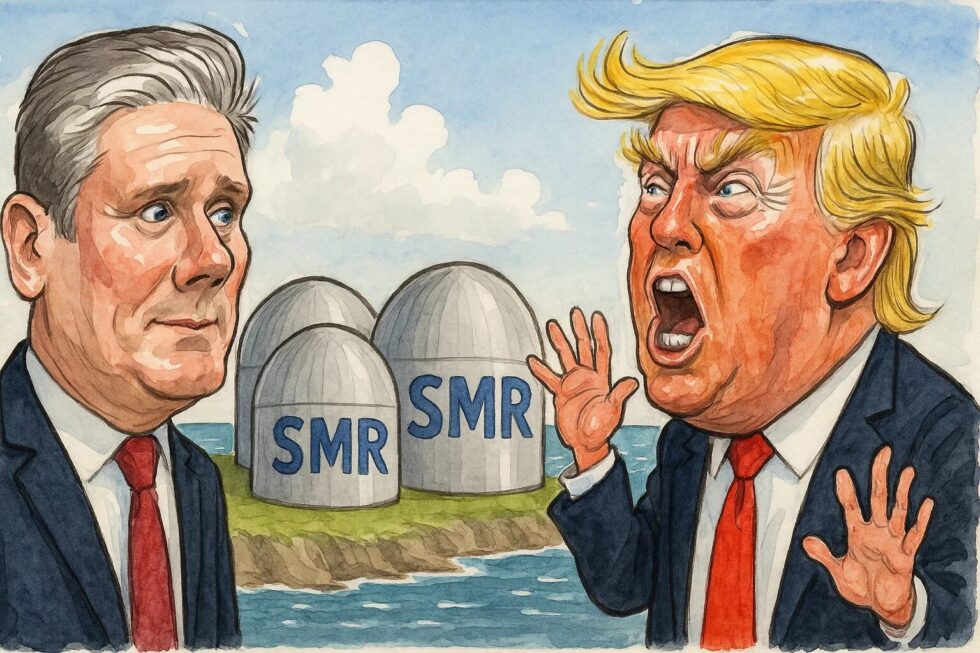
Prime Minister Keir Starmer has announced that the United Kingdom's inaugural set of small modular nuclear reactors (SMRs) will be constructed in north Wales, a decision that immediately triggered a public dispute with the Donald Trump administration, which advocated for the selection of an American manufacturer. The chosen location is Wylfa on the island of Anglesey, or Ynys Môn, which is slated to host three SMR units to be built by the British firm Rolls-Royce SMR. The government confirmed that this flagship program will receive an investment of £2.5 billion, reports The WP Times with reference to the Тheguardian.
SMRs represent a cutting-edge, though currently untested, technology aiming to standardize the construction of nuclear power stations by fabricating them in factory settings, primarily in Derby, to significantly lower costs and accelerate deployment. Rolls-Royce SMR’s design specifies reactors, each capable of generating 470 megawatts of power. Furthermore, the government revealed that its newly formed agency, Great British Energy – Nuclear (GBE-N), will report on potential locations for subsequent, larger reactor projects. These would follow the 3.2 GW reactors already under construction by the French state-owned company EDF at Hinkley Point C in Somerset and Sizewell C in Suffolk.
The Labour government under Starmer has enthusiastically backed nuclear energy, viewing it as a vital pathway to generating electricity free of carbon dioxide emissions, while simultaneously cultivating a substantial new export industry centered on SMR technology. However, the decision created the potential for friction with the United States, whose ally was visibly displeased at the omission of the American Westinghouse Electric Company as the manufacturer for the Wylfa site.
Prior to the official UK announcement, US Ambassador Warren Stephens issued a statement urging Britain to pursue “a different path” in Wales. Stephens expressed “extreme disappointment by this decision, not least because there are cheaper, faster and already-approved options to provide clean, safe energy at this same location.” This intervention follows the Trump administration’s recent $80 billion (£61 billion) agreement with Westinghouse, which had faced financial difficulties, to construct several large reactors similar to those proposed for Wylfa. Under the terms of that US deal, the Trump administration could potentially acquire a stake in the company.
A source close to the UK government defended the choice, stating that it was "the right choice for Britain," emphasizing that the program uses a British company to produce "homegrown clean power" at the "best site for it." While the ambassador’s criticism is unlikely to reverse the Wylfa decision, it may increase pressure on the UK to choose Westinghouse for any future large-scale reactor projects.
It is understood that Torness, east of Edinburgh, and Hunterston, west of Glasgow, are being considered as potential locations for future large reactors. A source close to the Energy Secretary, Ed Miliband, confirmed the government’s intent to pursue nuclear power generation in Scotland, despite opposition from the ruling Scottish National Party. Wylfa previously generated nuclear power from 1971 until 2015, when the last operational reactor was decommissioned. Efforts by Japan's Hitachi to build a new plant there collapsed in 2019 due to failure to secure government funding, and GBE-N subsequently purchased the site from Hitachi.
Starmer commented that Britain, once a world leader in nuclear power, had been failed by “years of neglect and inertia,” leading to places like Anglesey being “let down and left behind.” He affirmed that the current government is not just reversing decline but is “delivering thousands of future-proofed jobs, driving billions in investment and providing cheaper energy bills in the long term.”
Nevertheless, Sharon Graham, General Secretary of the trade union Unite, criticized the decision to build three smaller reactors instead of one larger one at Wylfa, calling it a mistake that would fail to maximize the number of jobs for British workers in the nuclear industry. Graham warned that a “failure to support a gigawatt nuclear power station at Wylfa would be a huge missed opportunity in securing the UK’s energy security.”
The site confirmation is a welcome development for Rolls-Royce, the FTSE 100 jet engine manufacturer, which was selected as the government’s preferred developer in June. Rolls-Royce holds a majority stake in Rolls-Royce SMR, alongside partners including Qatar’s sovereign wealth fund, France’s BNF Resources, the US energy company Constellation, and the Czech utility CEZ, the latter of which may order up to six of the SMR units. Rolls-Royce SMR employs over 1,000 workers and is actively working on technology slated for installation at Temelín in the Czech Republic.
Tom Greatrex, Chief Executive of the Nuclear Industry Association lobby group, hailed the Wylfa project as “an exciting opportunity for a UK technology, our domestic supply chain and skilled workforce.” He added that the country requires both large and small reactors to achieve the necessary nuclear capacity for a secure and reliable electricity mix, noting that partnerships with allies, including the US, will be crucial.
Read about the life of Westminster and Pimlico district, London and the world. 24/7 news with fresh and useful updates on culture, business, technology and city life: Morrisons Confirms Major Closure Plan: 145 Locations and In-Store Services to Be Axed Across the UK.