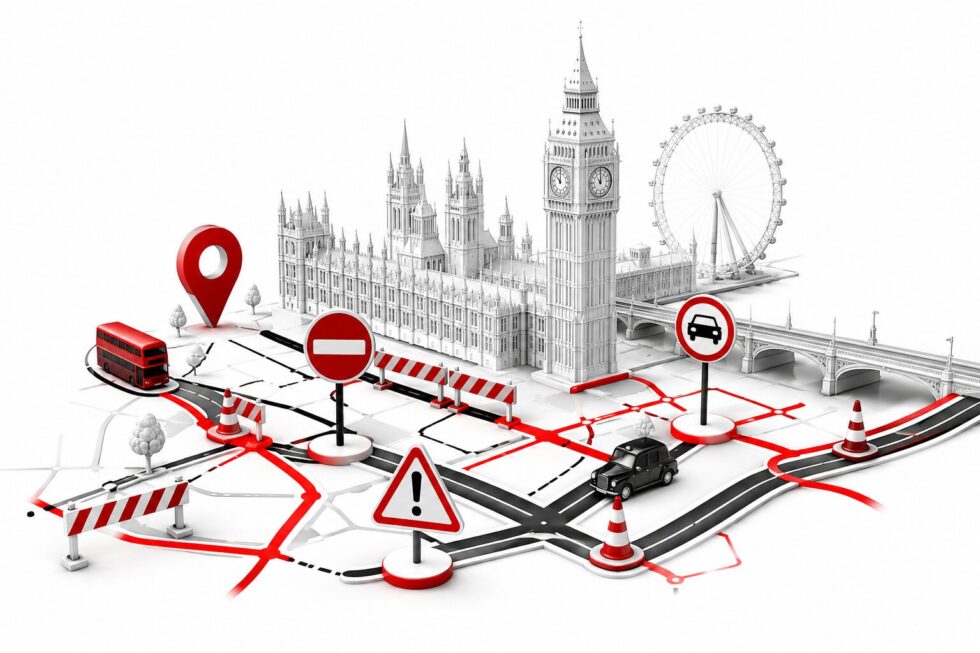
Westminster today is once again operating under heightened traffic pressure as central London moves into another week shaped by demonstrations, transport disruption, overnight road management works and ongoing crowd-control operations around Whitehall, Parliament Square and major government corridors. Drivers travelling through Victoria, St James’s, Trafalgar Square and the Strand corridor on Monday 18 May 2026 are already facing slower journey times following a weekend of large-scale protest activity and traffic restrictions that stretched across Westminster and nearby central boroughs, while TfL continues rolling maintenance operations affecting both road users and public transport. Authorities warned during the weekend that disruption could continue into Monday morning as barriers, temporary traffic systems and operational clean-up procedures remain in place around key routes, with The WP Times reporting that Westminster has effectively entered another period where event management and policing operations are directly shaping daily commuting patterns across the political heart of London.
The pressure is not limited to one isolated event. Westminster is currently experiencing overlapping disruption from planned demonstrations, traffic management systems linked to previous weekend marches, taxi-rank suspensions, utility works and wider TfL engineering operations affecting parts of central London transport infrastructure. The Metropolitan Police deployed around 4,000 officers for weekend protest operations across Westminster and central London, while Transport for London confirmed extensive diversions, lane management systems and public transport changes that continue to affect movement into Monday.
For office workers returning after the weekend, tourists heading toward Buckingham Palace and Parliament, delivery operators serving Soho and Victoria, and commuters travelling through Westminster stations, the result is a slower and more fragmented travel picture than a standard Monday morning in May.
Westminster road closures and traffic disruption today
Several traffic management measures remain active across Westminster and neighbouring central London areas on Monday 18 May following large-scale demonstrations and event operations held over the weekend. Westminster City Council warned residents and businesses that planned demonstrations would create travel disruption and advised Londoners to allow extra time when moving through the city centre. Traffic pressure continues around Whitehall, Parliament Square, Trafalgar Square approaches and sections connecting Westminster to the West End due to residual crowd-control layouts and vehicle diversions.
TfL also confirmed operational restrictions around St James’s Park station and Broadway on Monday linked to carriageway utility works, while temporary suspensions around Berkeley Street and nearby sections of Mayfair continue due to traffic management operations.
Although some demonstration routes officially concluded during the weekend, central London frequently experiences delayed recovery periods after major marches because barriers, police routing systems and street-cleaning operations remain active beyond the formal end time of events.
The broader Westminster corridor remains especially vulnerable because several critical London arteries converge there simultaneously:
| Area | Main issue on 18 May | Impact |
|---|---|---|
| Parliament Square | Residual traffic controls | Slow-moving traffic |
| Whitehall | Demonstration recovery operations | Diversions and congestion |
| Victoria corridor | Utility and carriageway works | Delayed bus services |
| Trafalgar Square approaches | High pedestrian volume | Taxi and bus slowdown |
| St James’s area | Temporary restrictions | Local rerouting |
Drivers are also being advised to monitor live TfL updates before entering central London because even small operational incidents inside Westminster can rapidly cascade into larger congestion patterns affecting the Embankment, Hyde Park Corner, Vauxhall Bridge Road and the Strand.
Areas where delays are expected to remain strongest
The most sensitive pressure points today include Whitehall, Parliament Square, Victoria Street, Birdcage Walk connections and approaches toward Charing Cross. These areas are particularly vulnerable because they combine tourist traffic, parliamentary movement, buses, taxis, delivery traffic and official security operations in a highly compressed part of central London.
Morning congestion is expected to intensify between approximately 07:30 and 10:00, while secondary peaks may appear again after 16:00 when office commuters begin returning toward major rail terminals including Victoria, Charing Cross and Waterloo. TfL officials have repeatedly advised travellers to use journey-planning tools before entering central London corridors.
Tube disruption and transport problems affecting Westminster
Transport disruption today is not limited to roads. Parts of the London Underground and connected transport network continue to feel the effects of planned engineering works and operational adjustments announced during the weekend. TfL and travel updates published ahead of 18 May warned that several routes across London had already been operating under altered service patterns due to maintenance and closures.
For Westminster commuters, this matters because the borough acts as a transport interchange zone connecting multiple Underground lines, rail stations and bus corridors simultaneously.
Even when engineering work occurs outside Westminster itself, ripple effects frequently push passenger overload into Victoria, Green Park, Westminster station and Charing Cross.
Key transport issues Londoners are watching today include:
- Reduced service reliability after weekend engineering works
- Possible delays around Central London interchanges
- Bus diversions linked to road management systems
- Higher-than-normal pedestrian density near Westminster stations
- Congestion around tourist corridors and government zones
One of the biggest challenges for Westminster today is not necessarily complete shutdowns but fragmented reliability. Trains may continue running while interchange times increase sharply, buses may operate but under diversions, and journey times may become unpredictable even when systems technically remain open.
Why Westminster becomes vulnerable faster than other boroughs
Westminster is structurally different from most London boroughs because it concentrates several functions into one district at once. It is simultaneously:
- The political centre of the United Kingdom
- A major tourism destination
- A commuter transport hub
- A diplomatic and security zone
- A protest and demonstration focal point
That combination means even moderate operational disruption can create outsized consequences. A demonstration near Parliament Square, for example, does not only affect local traffic — it also affects bus routing, pedestrian flow, police deployment and station access.
As one TfL advisory noted in recent updates, Londoners should expect “increased footfall and traffic levels” around major event zones and central London corridors.
Demonstrations and policing operations continue to shape Westminster
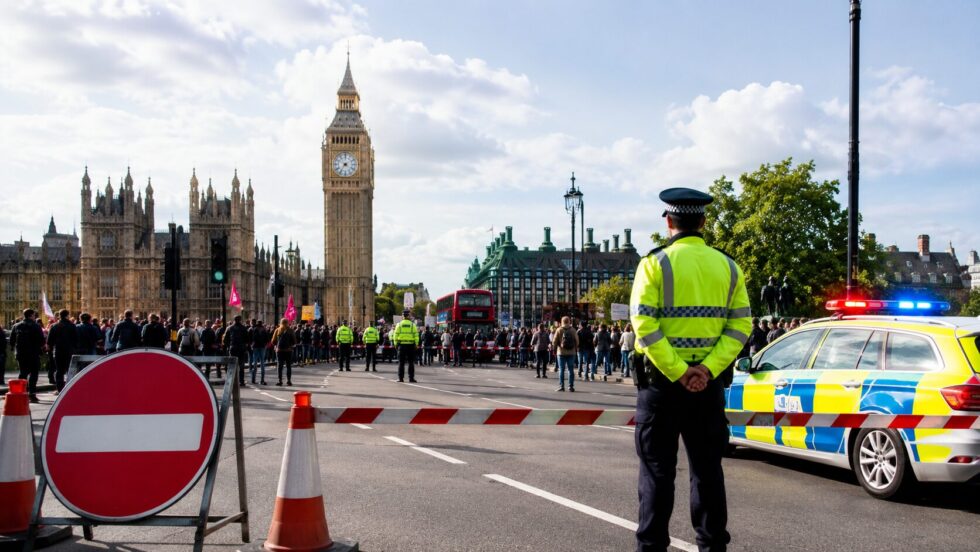
Large-scale protest activity over the weekend remains one of the defining reasons Westminster is under pressure today. The Metropolitan Police confirmed that thousands of officers were deployed across central London for simultaneous demonstrations and counter-protests, with operational planning focusing heavily on Westminster and nearby government districts.
Police and Westminster authorities warned in advance that road closures, diversions and restricted movement would likely continue beyond the demonstrations themselves. Security infrastructure, crowd-control barriers and vehicle restrictions often remain in place after major operations conclude, especially in politically sensitive zones near Parliament and Whitehall.
A Westminster City Council notice stated:
“Traffic restrictions and diversions will be in place.”
That short warning has translated into real operational consequences for businesses, delivery drivers, taxi operators and commuters attempting to cross central London today.
Business impact across Westminster
Restaurants, cafés, retail shops and hospitality venues around Westminster often experience mixed outcomes during major disruption periods. Footfall can rise sharply due to crowds and visitors, while logistics simultaneously become more complicated.
Businesses are currently dealing with:
- Delivery timing uncertainty
- Slower courier access
- Reduced taxi availability
- Delayed staff arrivals
- Increased security presence nearby
Some hospitality operators near Whitehall and Trafalgar Square have already adjusted staffing and supplier schedules following the weekend disruption cycle. Westminster City Council advised businesses to warn employees about travel disruption and modify delivery schedules where possible.
Events, tourism and crowd pressure across central Westminster
Even outside formal demonstrations, Westminster remains unusually crowded today because May traditionally marks one of London’s busiest tourism periods. International visitors continue flowing toward Buckingham Palace, Big Ben, Westminster Abbey and St James’s Park, while event season across London intensifies pedestrian density throughout the West End and surrounding districts.
Transport planners have also been monitoring spillover effects from broader London event activity, including sporting fixtures, cultural programmes and seasonal tourism surges. TfL bulletins issued before the weekend specifically warned that increased pedestrian and traffic volumes were expected around multiple central venues.
The combination of tourism and disruption creates a particular Westminster dynamic:
| Pressure factor | Effect on Westminster |
|---|---|
| Tourists | Slower pedestrian movement |
| Demonstrations | Police-controlled diversions |
| Utility works | Reduced traffic capacity |
| Events | Higher station congestion |
| Government activity | Security restrictions |
Unlike ordinary commuter districts, Westminster rarely experiences only one type of disruption at a time.
What drivers and commuters should do today
London authorities are strongly encouraging commuters to avoid unnecessary vehicle travel through Westminster during peak periods today. Alternative transport routes, earlier departures and real-time journey monitoring remain the most effective ways to reduce delays.
Practical travel advice for 18 May includes:
- Check TfL updates before departure
- Avoid Whitehall during rush periods
- Allow additional journey time
- Expect bus diversions
- Consider walking short central distances
- Use rail alternatives where possible
Drivers entering Westminster from south London through Vauxhall or Chelsea routes may experience secondary congestion as traffic attempts to avoid pressure around Parliament Square and Trafalgar Square.
Pedestrians should also expect periodic crowd-control measures near political landmarks and tourist hotspots.
Why Westminster disruption has become more common in 2026
Westminster has entered 2026 facing a broader structural problem: central London now operates with near-constant overlap between political activity, demonstrations, tourism recovery, infrastructure maintenance and event programming.
Several factors are accelerating disruption frequency:
Security intensity around government zones
Policing operations around Westminster have become larger and more visible during high-attendance events and protests. Large deployments require road management systems that can remain active for extended periods.
Infrastructure strain
Transport for London continues major maintenance and operational works across the network. Even relatively small engineering projects can affect Westminster because the borough depends on tightly interconnected routes.
Event-driven London economy
London’s event calendar is now operating at near full pre-pandemic intensity again, increasing demand across hotels, rail systems, buses and public spaces.
Tourism rebound
Visitor numbers around Westminster landmarks continue to climb during spring 2026, increasing crowd pressure across already constrained streets.
Westminster tonight: what happens after rush hour
Although traffic intensity may gradually ease after approximately 19:00, Westminster rarely becomes completely quiet during late spring evenings. Restaurants, theatres, hospitality venues and tourism activity continue generating movement deep into the night across Soho, Victoria and the Strand corridor.
Tonight’s conditions are expected to include:
- Slower evening bus movement
- Elevated pedestrian traffic
- Residual congestion near Whitehall
- Taxi demand spikes after theatre hours
- Higher police visibility than normal
Late-night drivers should also monitor for temporary operational restrictions or rolling lane controls if additional crowd-management activity develops around central London.
What is happening in Westminster today reflects a wider transformation of central London itself. The city’s political centre is increasingly operating as a hybrid space where governance, tourism, security operations, activism and entertainment now overlap almost continuously.
That reality changes how London functions on an ordinary Monday. Westminster is no longer simply a district commuters pass through on the way to work. It has become an active operational environment shaped daily by events, policing requirements, international tourism and infrastructure management.
For Londoners, the practical takeaway is straightforward: Westminster in 2026 requires more planning, more flexibility and more real-time monitoring than it did only a few years ago. Road closures, demonstrations and transport disruption are no longer exceptional moments in central London — they are becoming part of the routine rhythm of the capital itself.
Read about the life of Westminster and Pimlico district, London and the world. 24/7 news with fresh and useful updates on culture, business, technology and city life: Jet2 flight fuel supply update as UK flights to Rome, Naples, Pisa and Venice face delays on 11 May 2026