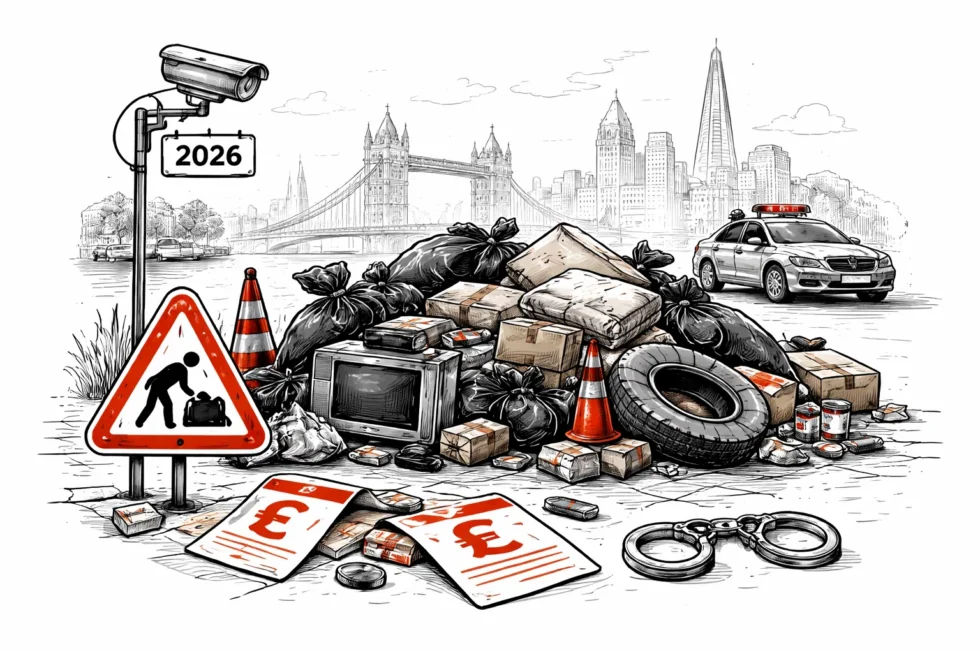
The illegal dumping of waste, colloquially known as fly-tipping, has reached a critical flashpoint in the capital, with London fines for rubbish disposal surging as local authorities struggle to contain a record 480,000 incidents recorded in the 2024/2025 period. According to the latest Department for Environment, Food and Rural Affairs (Defra) statistics released in February 2026, London remains the worst-hit region in the United Kingdom, accounting for nearly 40% of the national total, with boroughs like Croydon reporting over 53,000 cases annually, reports The WP Times via wigan.
Defining Fly-Tipping: Legal Classification and the 2026 Regulatory Framework
Under Section 33 of the Environmental Protection Act 1990, fly-tipping is defined as the illegal deposit of "controlled waste" (household, commercial, or industrial) onto land that does not have a waste management license. While often confused with littering—which typically involves small items like cigarette butts or food wrappers—fly-tipping involves larger volumes, such as appliances, construction debris, or multiple bags of household refuse.
The legal distinction is critical because, in 2026, the sentencing guidelines have stiffened; fly-tipping is a criminal offense that can lead to an unlimited fine or up to five years' imprisonment if the case proceeds to the Crown Court.
- Statutory Offense: Violation of Section 33(1)(a) of the Environmental Protection Act 1990 regarding unlicensed waste deposits.
- Controlled Waste: Includes all household refuse, garden waste, demolition materials, and commercial by-products.
- Vicarious Liability: Under the "Duty of Care" laws, homeowners are legally responsible for their waste even after it leaves their property.
- Strict Liability: The person in control of a vehicle used for fly-tipping can be prosecuted even if they did not physically dump the waste.
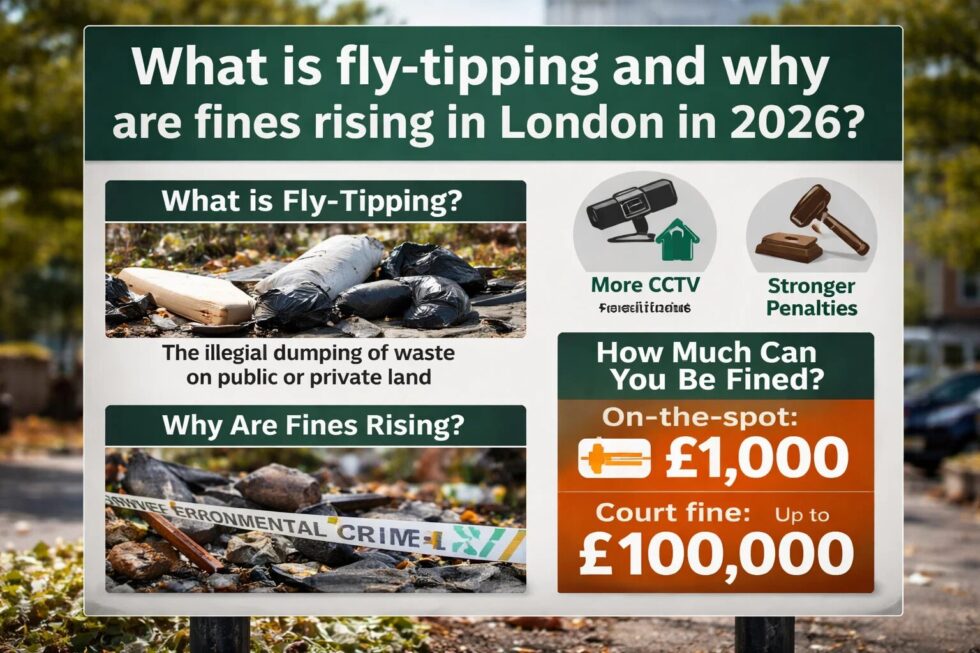
The Financial Cost: Why London Fines Have Scaled to £1,000
The primary driver behind the 2026 fine increases is the unsustainable cost of waste clearance, which reached an estimated £19.3 million for large-scale incidents in England last year. Many London boroughs, including Bexley and Croydon, have exercised their right under the Environmental Offenses (Fixed Penalties) (Amendment) Regulations to increase the maximum FPN from the previous £400 cap to £1,000. This adjustment serves a dual purpose: it acts as a deterrent for organized waste crime and helps offset the £1,000 average clearance cost per incident faced by local taxpayers.
| Fine Category | 2023 Rate (Avg) | 2026 Rate (London Max) | Legal Basis |
| Fly-Tipping FPN | £400 | £1,000 | Environmental Protection Act s.33ZA |
| Littering FPN | £150 | £300 | EPA 1990 Section 88 |
| Duty of Care Breach | £300 | £600 | Waste (England/Wales) Regs 2011 |
| Court-Issued Fine | Limited | Unlimited | Magistrates' or Crown Court Conviction |
Duty of Care: The Hidden Risk for Homeowners and Businesses
A significant portion of fly-tipping in London—approximately 62%—originates from household waste that was handed over to unauthorized "man-with-a-van" services found on social media. Under the Waste (England and Wales) Regulations 2011, every householder has a statutory "Duty of Care" to ensure their waste is handled only by a licensed waste carrier. If your rubbish is found fly-tipped and you cannot prove you verified the carrier's license, you face an automatic FPN of £600 or prosecution, regardless of whether you intended for the waste to be dumped illegally.
- License Verification: Always check the Environment Agency’s public register for a valid Waste Carrier License.
- Receipt Documentation: Request a Waste Transfer Note or a detailed receipt describing the waste and the disposal site.
- Vehicle Identification: Record the registration number of the vehicle collecting your waste for your legal protection.
- Price Red Flags: Extremely low quotes often indicate that the carrier is avoiding legitimate disposal fees by fly-tipping.
Enforcement 2026: Digital Tracking and License Confiscation
The landscape of enforcement has changed dramatically in 2026 with the introduction of the Mandatory Digital Waste Tracking System. This technology requires all waste movements to be logged in real-time, making it significantly harder for rogue operators to "lose" waste between the collection point and the tip. Furthermore, the 2026 Waste Crime Action Plan has granted the Environment Agency "police-like powers," allowing for the seizure of vehicles involved in waste crime and, in a landmark move, the potential confiscation of driving licenses for repeat fly-tippers.
- CCTV Surveillance: London boroughs have increased the use of AI-powered "smart cameras" that trigger alerts when vehicles stop in known hotspots.
- Vehicle Seizure: Authorities can now seize and crush vehicles used in fly-tipping without a prior court conviction.
- Offender Naming: New "shame" initiatives allow councils to publicly name individuals who fail to pay their fly-tipping FPNs.
- Prosecution Rates: Successful prosecution rates for waste crimes reached 99.1% in 2025, according to the latest government data.
Practical Recommendations for Legal Waste Disposal in London
To avoid the risk of a £1,000 fine or a criminal record, residents and businesses must utilize official channels for waste management. Most London councils provide a "Bulky Waste Collection" service for a nominal fee (typically £25–£50), which is a fraction of the cost of a legal penalty. Additionally, Household Waste Recycling Centres (HWRCs) remain free for residents, though new 2026 regulations require digital booking to manage traffic flow and ensure commercial vehicles are correctly billed.
- Council Services: Use your local borough's bulky waste service for furniture, mattresses, and large appliances.
- Charity Donations: Many organizations like the British Heart Foundation offer free collection for reusable furniture.
- Commercial Waste: Businesses must have a formal contract with a registered waste management company; using residential bins for business waste is a crime.
- Reporting Crime: Use the "Love Clean Streets" app to report fly-tipping; reports with vehicle registrations significantly increase the chance of a fine being issued.
AI-Powered Surveillance and the "Digital Witness"
As of April 2026, London boroughs such as Brent and Wandsworth have fully integrated AI-enabled CCTV networks specifically designed to detect fly-tipping in real-time. Unlike traditional cameras that require manual review, these systems utilize machine learning to identify the "behavioral signatures" of illegal dumping—such as a vehicle stopping in a non-designated area for more than 30 seconds or the removal of large objects from a boot. Once triggered, the system captures high-definition footage and cross-references license plates with the DVLA database, allowing councils to issue a £1,000 Fixed Penalty Notice (FPN) within hours of the incident.
- Real-time Detection: AI algorithms trigger instant alerts for enforcement officers.
- Night Vision: Advanced thermal imaging allows for 24/7 monitoring of dark alleyways.
- Privacy Compliance: Systems are legally vetted to monitor environmental crime only, not individuals.
- Evidence Quality: High-resolution footage now serves as "irrefutable evidence" in Magistrates' Courts.
Comparative Penalties: The 2026 Enforcement Tiers
The government’s strategic "clampdown" on rogue operators has resulted in a tiered penalty system that distinguishes between accidental non-compliance and professional waste crime. While the maximum FPN is often the first line of defense, the Sentencing Act 2026 has empowered courts to impose "Community Orders" involving unpaid work specifically related to environmental cleanup for those who contest and lose their cases.
| Offense Type | Enforcement Tool | 2026 Fine/Penalty | Legal Statute |
| Professional Fly-Tipping | Prosecution | Unlimited Fine / 5yrs Prison | EPA 1990 s.33 |
| Individual Fly-Tipping | FPN | £1,000 | EPA 1990 s.33ZA |
| Breach of Duty of Care | FPN | £600 | Waste Regs 2011 |
| Littering (Minor) | FPN | £300 | EPA 1990 s.88 |
| Breach of Restriction | Arrest | 51 Weeks Prison | March 2026 Plan |
The "Vehicle Crush" Mandate: Asset Destruction Protocols
Under the March 2026 Waste Crime Action Plan, London local authorities have been granted the specific statutory power to destroy vehicles used in the commission of a waste crime without a prior court conviction. If a vehicle is seized under suspicion of fly-tipping and the registered keeper cannot prove they hold a valid Environmental Permit within 14 days, the council can move to crush the vehicle. This is increasingly used in 2026 as a visual deterrent, with "Crush Days" being publicized by councils like Redbridge to warn rogue "man-with-a-van" operators.
- Seizure Authority: Can be executed on "reasonable suspicion" by a Tier-1 Enforcement Officer.
- Disposal Power: Vehicles are crushed to prevent their return to the illegal market.
- Cost Recovery: Proceeds from any scrap metal are retained by the council to fund clearance.
- Publicity: High-definition video of the destruction is often used in public awareness campaigns.
Comparative Liability: 2026 Penalty Tiers and Legal Triggers
The 2026 regulatory framework distinguishes clearly between accidental non-compliance and deliberate criminal activity. While a Fixed Penalty Notice (FPN) is the most common tool, the severity of the fine is dictated by the volume of waste and the "Duty of Care" level of the offender.
| Offense Category | Legal Trigger | 2026 London Fine | Max Court Penalty |
| Professional Fly-Tipping | S.33 EPA 1990 | £1,000 (FPN) | Unlimited Fine / 5yrs Prison |
| Householder Duty of Care | Waste Regs 2011 | £600 (FPN) | £5,000 + Criminal Record |
| Commercial Ad-Hoc Dump | S.34 EPA 1990 | £1,000 (FPN) | Corporate Dissolution Risk |
| Public Littering | S.88 EPA 1990 | £300 (FPN) | £2,500 Fine |
AI-Enhanced CCTV: The "Digital Witness" Network
London has implemented a "Smart Surveillance" grid in 2026 that uses machine learning to identify fly-tipping behavior in real-time. These AI-powered cameras do not just record footage; they analyze movement patterns—such as a vehicle stopping in a high-intensity zone or the opening of a van's rear doors for more than 30 seconds. Once a "deposit event" is flagged, the system automatically cross-references the vehicle's plate with the DVLA, allowing an FPN to be generated and posted within 48 hours of the offense.
- Behavioral Analysis: Algorithms detect the physical act of unloading large items.
- Instant ANPR: Automatic Number Plate Recognition identifies owners immediately.
- Night-Ops Capability: Thermal imaging ensures 24/7 coverage of industrial "hotspots."
- Evidence Integrity: Digitally watermarked footage is accepted as primary evidence in court.
The "Restriction Notice": Instant Site Closures
A new and potent legal tool introduced in March 2026 is the Restriction Notice. This allows the Environment Agency or a local council to immediately shut down a site or stop a vehicle's operation if they suspect "serious environmental non-compliance." Unlike an injunction, which requires a court hearing, a Restriction Notice is an "instant-stop" order. Breaching this notice in 2026 is a high-tier criminal offense, carrying a potential sentence of up to 51 weeks in prison.
- Immediate Effect: Activity must cease as soon as the notice is served.
- Duration: Can remain in place for up to 72 hours before a court review is required.
- Custodial Risk: Designed specifically to stop large-scale commercial dumping in progress.
- Scope: Applies to land, premises, and any mobile plant equipment.
Vicarious Liability for Commercial Landlords
In 2026, London landlords are being held to a higher standard regarding "knowingly permitting" waste deposits. If a landlord is aware that a tenant is operating an unlicensed waste site or accumulating rubbish and fails to report it, they can be prosecuted under Section 33(1)(c) of the EPA 1990. The legal burden of proof in 2026 has shifted; landlords must now demonstrate they have conducted regular site inspections and requested "Waste Transfer Notes" from their commercial tenants to avoid shared liability for clearance costs.
- Inspection Mandate: Landlords are advised to conduct quarterly waste audits.
- Lease Clauses: Standard 2026 commercial leases now include "Environmental Indemnity" clauses.
- Clearance Costs: Landlords may be billed for the full cost of removal if the tenant absconds.
- Fine Level: Landlords can face the same £1,000 FPN as the physical dumper.
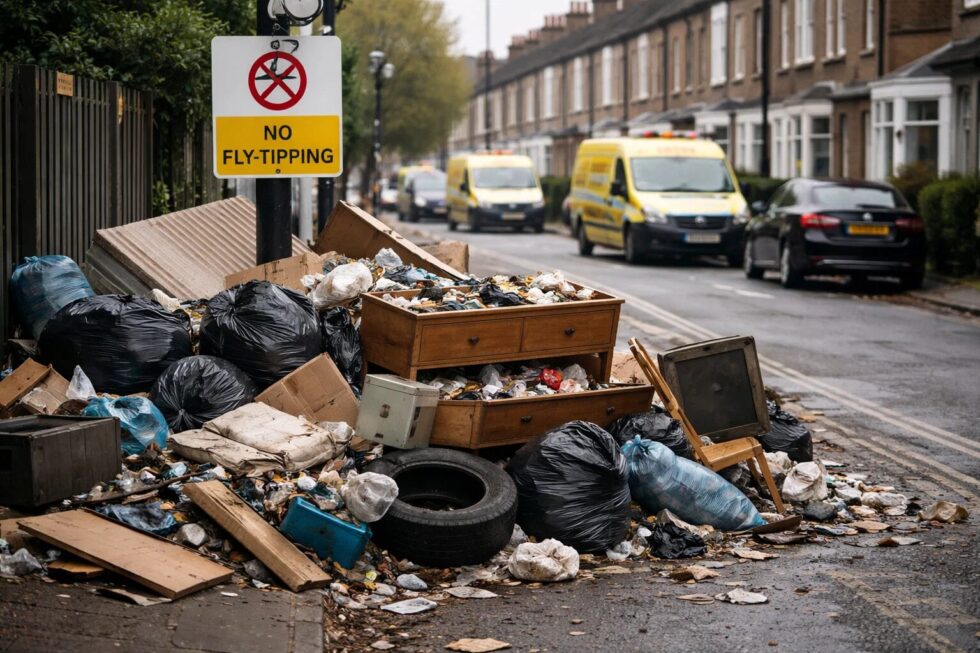
The "Duty of Care" Verification Checklist
To avoid a £600 fine for a "Duty of Care" breach, Londoners must now meet the "Reasonable Measures" test. Simply hiring a carrier is no longer a defense; you must follow a specific verification protocol to prove you were not complicit in a fly-tipping event.
- Register Check: Verify the carrier on the Environment Agency’s public website.
- ID Capture: Take a photograph of the waste carrier’s license card.
- Waste Transfer Note: Demand a signed document describing the waste and its destination.
- Digital Footprint: Use traceable payment methods (bank transfer/card) rather than cash.
Organised Waste Crime: The Shift to Crown Court
The March 2026 Waste Crime Action Plan has instructed prosecutors to escalate "systemic" fly-tipping—defined as more than three incidents by the same operator—directly to the Crown Court. In 2026, the sentencing guidelines for these cases have shifted toward mandatory custodial sentences. This move is designed to dismantle the business model of rogue traders who previously viewed the £1,000 FPN as a "cost of doing business."
- Cumulative Offending: Three or more FPNs trigger a full criminal investigation.
- Asset Seizure: Under the Proceeds of Crime Act (POCA), authorities can seize luxury items bought with illegal waste profits.
- Prohibition Orders: Convicts are permanently banned from the waste industry.
- Prison Benchmarks: 12 to 24 months is the new standard for professional "night-dumping."
Direct Impact: Statistics and Economic Pressure
The financial pressure on Londoners to comply with waste laws has never been higher. According to 2026 economic data, the average cost of a legal bulky waste collection in London is £45, whereas the risk-weighted cost of an illegal dump (including fines and potential vehicle loss) is now estimated at £3,500.
- Total Fines Issued: London councils issued over 85,000 FPNs in the first quarter of 2026.
- Clearance Deficit: Despite the fines, councils still face a £5.2 million shortfall in cleanup costs.
- Public Support: 88% of Londoners surveyed in 2026 support the "Seize and Crush" policy.
- Detection Rate: Digital tracking has increased the identification of fly-tippers from 12% to 41%.
New "Police Powers" for Environment Officers
As of March 20, 2026, Environment Agency officers have been granted "Police-Style" powers under the Criminal Justice (Environmental) Act. This includes the power to stop and search vehicles, enter premises without a warrant in "emergency environmental situations," and demand immediate access to digital waste logs. Resistance to these officers in 2026 carries the same legal weight as "obstructing a police officer," often leading to immediate arrest and a £1,000 fine for non-cooperation.
- Stop and Search: Applies to any vehicle carrying a load that appears to be "controlled waste."
- Warrantless Entry: Limited to cases where there is a risk of hazardous chemicals entering the water table.
- Digital Access: Operators must unlock phones or tablets used for waste logging upon demand.
- Authority: Officers now carry warrant cards and wear body-worn video (BWV) for evidence.
The "Wall of Shame" and Credit Score Impacts
In an effort to utilize social pressure, several London boroughs have launched "Wall of Shame" portals in 2026. Images of unidentified fly-tippers are posted publicly for identification. Beyond the social stigma, a major 2026 development is the inclusion of unpaid environmental fines in credit reports. A single unpaid £1,000 fine for fly-tipping now triggers a "Default" status on credit profiles, significantly hindering the offender’s ability to secure mortgages or loans.
- Public Crowdsourcing: Residents can identify "wanted" fly-tippers through council websites.
- Credit Impact: Unpaid FPNs are reported to Experian and Equifax after 28 days.
- Employment Checks: Some high-security employers now screen for "Environmental Offenses" during hiring.
- Payment Plans: Councils offer 3-month installments to encourage payment and avoid credit damage.
The "Seize and Crush" Protocol for Unlicensed Carriers
A critical update in the March 2026 Waste Crime Action Plan is the formalization of the "Seize and Crush" protocol. Local authorities no longer require a prior court conviction to impound a vehicle suspected of being involved in a waste offense. If a vehicle is seized and the owner cannot prove they hold a valid Environmental Permit or Waste Carrier License within 14 days, the council has the statutory right to dispose of the vehicle. In 2026, many London councils are opting to publicly crush these vehicles as a visual deterrent to "man-with-a-van" rogue traders.
- Immediate Seizure: Vehicles can be impounded on "reasonable suspicion" of waste crime.
- Evidence Search: Authorities have the right to search seized vehicles for waste transfer notes.
- Disposal Power: Unclaimed or unlicensed vehicles are crushed to recoup clearance costs.
- License Checks: All professional advertisements must now display a valid permit number by law.
Homeowner Responsibility: The "Reasonable Measures" Test
The Waste (England and Wales) Regulations 2011 (as enforced in 2026) impose a strict "Duty of Care" on householders. To avoid a £600 fine, residents must pass the "Reasonable Measures" test if their waste is later found fly-tipped. It is no longer sufficient to claim you "hired someone in good faith." You must demonstrate a proactive effort to verify the legality of the service provider, or you face the same legal culpability as the person who physically dumped the rubbish.
- Digital Verification: You must check the Environment Agency’s online register for a carrier’s status.
- Waste Transfer Notes: You are legally required to keep a record of the transaction for two years.
- ID Checks: Experts recommend taking a photo of the waste carrier’s ID and their vehicle registration.
- Payment Transparency: Avoid cash-in-hand deals; digital payments provide a traceable legal audit trail.
Frequent Questions
What is the maximum fine for fly-tipping in London in 2026?
Local authorities can issue a Fixed Penalty Notice of up to £1,000. If the case goes to court, the fine is unlimited and can include a prison sentence.
Can I be fined if someone else dumps my rubbish?
Yes. Under the "Duty of Care" law, if your household waste is found illegally dumped, you are liable for a fine (often £600) unless you can prove you used a licensed waste carrier.
How do I check if a waste carrier is licensed?
You must search the Environment Agency’s official "Register of Waste Carriers, Brokers and Dealers" online before handing over any waste.
Is fly-tipping the same as leaving a bag next to a full bin?
Legally, yes. Placing waste outside of a designated bin or on the pavement, even if it is in a bag, is classified as fly-tipping and is subject to the same £1,000 fine.
What happens if I don't pay a fly-tipping FPN?
Failure to pay a Fixed Penalty Notice within 14 days usually results in a criminal prosecution, which leads to a court appearance, a permanent criminal record, and much higher costs.
Can fly-tipping affect my driving license?
Under new 2026 government proposals, courts have the power to add penalty points or disqualify offenders from driving if a vehicle was used in the commission of the crime.
Read about the life of Westminster and Pimlico district, London and the world. 24/7 news with fresh and useful updates on culture, business, technology and city life: What is happening with M60 traffic today after motorway shut near Trafford Centre