
Wimbledon 2026 will begin later this month with a record prize-money fund and without, for now, the player protests that had threatened to overshadow the Championships before a ball was struck. The All England Lawn Tennis Club has raised the total purse by 20 per cent to £64.2 million, the largest single-year increase in Wimbledon’s history, after months of pressure from leading ATP and WTA players over their share of Grand Slam revenues, The WP Times reports, citing The Guardian.
The decision is a major concession, but not a final settlement. Wimbledon’s new package gives the men’s and women’s singles champions £3.6 million each, lifts first-round prize money to £80,000 and raises the qualifying fund by 25 per cent to more than £6 million, giving the organisers a measure of calm before the Championships open at the All England Club on 29 June. Yet the players had been seeking a prize-money level closer to 16 per cent of tournament revenue, which would have taken the 2026 fund to roughly £71 million; the new £64.2 million purse is historic, but still short of that demand, leaving the wider fight over how tennis divides its biggest revenues unresolved.
What the All England Club has actually agreed
The headline number is striking. Wimbledon’s total prize money for 2026 will rise by £10.7 million, from £53.55 million last year to £64.2 million this summer. That increase of 20 per cent is the largest annual rise in the tournament’s long history. The two singles champions will each receive £3.6 million, while players beaten in the first round of the main draw will still leave with £80,000. For a Grand Slam that trades so heavily on tradition, the numbers are a reminder that Wimbledon is also one of the most valuable properties in global sport. The increase in qualifying is especially important. More than £6 million has been set aside for the qualifying event, an increase of 25 per cent. That part of the package is not aimed at the millionaire end of the tour. It is designed for players trying to break into the main draw, many of whom travel with limited support and carry heavy costs for coaching, flights, accommodation, medical care and preparation. In that sense, the rise is not just about rewarding the two champions on Centre Court. It is also about keeping the professional ladder viable below the top tier.
That matters because tennis is an expensive individual sport. Unlike footballers at major clubs, lower-ranked players are not protected by a team salary. They are effectively small businesses: they pay their staff, fund their travel, manage their injuries and carry the financial risk of losing early. A first-round cheque of £80,000 at Wimbledon can change the economics of a season for a player outside the elite. It can cover training blocks, physio support, coaching and travel to the next swing of tournaments.
Wimbledon’s argument is that the money must be viewed as part of a wider investment. The All England Club points to its not-for-profit structure, to its spending on facilities and to its support for British tennis through the Lawn Tennis Association. Reuters reported that the AELTC reinvests 90 per cent of its surplus into British tennis and contributed £48.1 million to the LTA last year. To Wimbledon, this is evidence that the tournament’s money is not being extracted by shareholders, but put back into the game. To players, the same figures show that there is substantial money in the system — and that more of it should reach those on court.
Why the players accepted the rise — and why they are still not satisfied
The players’ reaction was careful. According to The Guardian, representatives of leading ATP and WTA players accepted the rise as a “genuine and significant step forward”, allowing Wimbledon to avoid the protests that had been threatening the tournament. That phrase matters. It gives the All England Club political cover, but it does not close the dispute. The wording recognises movement from Wimbledon while keeping the players’ wider demands alive.
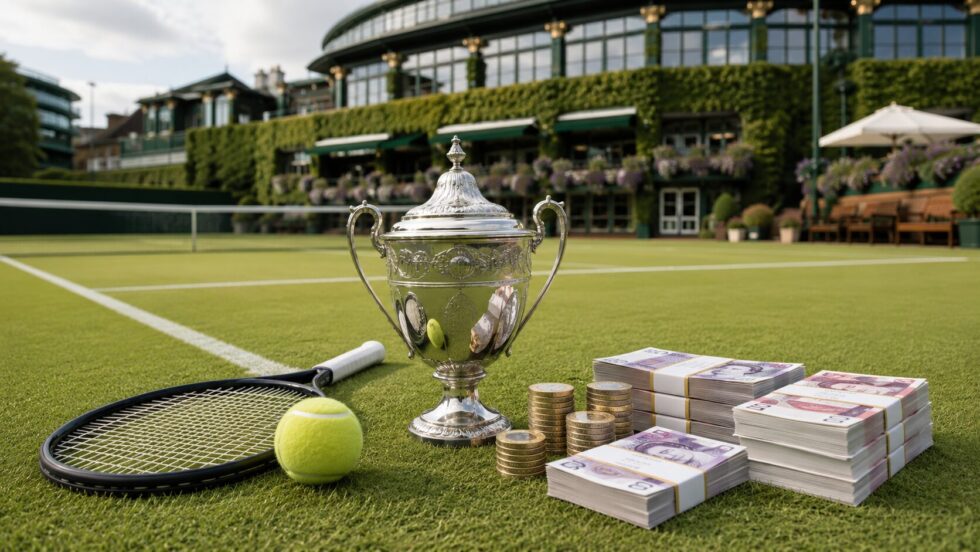
The dispute is about more than this year’s prize fund. Players want a formal revenue-sharing model, contributions to a player welfare fund and a stronger voice in how the Grand Slam tournaments are run. They argue that the Slams have become global entertainment businesses powered by the athletes, while the share returned to the players has not kept pace with the scale of revenues. In their view, headline prize-money increases are welcome, but one-off increases are not enough. The gap between the two sides can be seen in the numbers. The players had pushed for Wimbledon to return around 16 per cent of its revenue in prize money, which would have meant a purse of about £71.2 million. The confirmed £64.2 million fund is still roughly £7 million short of that level. The Guardian also reported that the new figure represents about 14.4 per cent of tournament revenue, below the 14.9 per cent offered in 2015. That is why the argument is not just about whether the figure is bigger than last year. It is about whether the players’ relative share has kept pace with Wimbledon’s commercial growth.
This is where the language becomes important. Wimbledon speaks about investment, costs and sustainability. Players speak about revenue, fairness and the value of their labour. Both sides are using different measurements of the same business. The All England Club says a tournament cannot be run on revenue percentage alone because revenue does not account for costs. The players answer that without them there is no broadcast product, no ticket demand and no global story to sell. That is why this looks less like a pay dispute and more like a struggle over power. Prize money is the visible number. Beneath it is a deeper question: should players have a formal say in the economics of the four biggest tournaments in tennis?
Debbie Jevans and Wimbledon’s defence of its model
Debbie Jevans, chair of the All England Club, has defended Wimbledon’s position by stressing that the tournament cannot be judged solely by the percentage of revenue returned as prize money. Wimbledon’s case is that it is a not-for-profit institution with long-term responsibilities. It has to maintain facilities, invest in technology, support the grass-court season, fund British tennis and protect the event’s status as one of the most prestigious sporting tournaments in the world. That argument is not without force. Wimbledon is expensive to run. It is not a travelling event that appears for two weeks and disappears. The All England Club must maintain grass courts, stands, player facilities, broadcasting infrastructure, security systems, hospitality operations and year-round development work. The tournament also has to keep pace with modern expectations: electronic line calling, video review, improved player areas, better media facilities and more comfortable conditions for spectators.
But the players’ counterargument is equally strong. The prestige of Wimbledon is not created by buildings alone. Centre Court becomes valuable because the best players in the world play there. The rights are valuable because broadcasters can sell Sinner against Alcaraz, Świątek against Sabalenka, Djokovic against the next generation, and the drama of a major title being decided under pressure. The economic product is not the grass itself. It is the competition. Wimbledon’s 20 per cent increase should therefore be seen as a strategic compromise. The club has moved far enough to avoid immediate conflict, but not so far that it concedes the principle of a fixed revenue share. That is a crucial distinction. A one-year increase can be controlled by the tournament. A binding revenue formula would permanently change the balance of power.
The French Open protest changed the pressure before Wimbledon
The timing of Wimbledon’s decision is closely linked to what happened at Roland Garros. The French Open increased prize money by 9.5 per cent, but the reaction from players was sharper than organisers may have expected. Leading players limited their pre-tournament media commitments to 15 minutes, a symbolic protest that turned private frustration into a public issue. The Guardian reported that Wimbledon’s prize-money announcement had become a pivotal moment after that dispute in Paris. That matters because tennis players are not naturally organised in the way team-sport athletes are. The tour is fragmented, individual and global. Players compete against one another every week, have different sponsors, different national federations and very different financial realities. Collective action is therefore difficult. When top men and women begin to move in the same direction, Grand Slam organisers pay attention.
The French Open episode showed that players were prepared to use visibility as leverage. Grand Slams depend on media obligations. They need press conferences, interviews, quotes, broadcast access, promotional appearances and social-media content. If the players restrict that access, they attack part of the tournament’s commercial machine without refusing to play. It is a controlled form of pressure — less dramatic than a strike, but still damaging to the event’s image.
For Wimbledon, avoiding a repeat was essential. The Championships are built around order, prestige and calm. A coordinated media protest at the All England Club would have clashed with the tournament’s carefully managed identity. By announcing a record increase before the draw and before the first ball is struck, Wimbledon has reduced the risk of the money dispute dominating the first week.
Who won Wimbledon last year — and why it matters now
The prize-money debate arrives after a 2025 Wimbledon that produced two important champions: Jannik Sinner in the men’s singles and Iga Świątek in the women’s singles. Their victories matter in the current context because they are not fringe figures in the sport. They are exactly the kind of global stars who carry the commercial weight of Grand Slam tennis.
Sinner won his first Wimbledon title by beating Carlos Alcaraz in four sets, 4–6, 6–4, 6–4, 6–4. It was a victory with significance beyond the trophy. Alcaraz had already made Centre Court feel like one of his natural stages, and his athletic, improvised, crowd-pleasing style had become one of the defining images of the new tennis era. Sinner’s win changed that balance. He lost the first set, absorbed the early pressure, tightened his game and took control with cleaner hitting, better rhythm and colder decision-making.
The match also added another layer to the Sinner-Alcaraz rivalry. Tennis has been searching for its next central rivalry after the Federer-Nadal-Djokovic era, and Sinner against Alcaraz has the right ingredients: contrasting styles, major finals, youth, global appeal and a sense that the sport’s future is being written in real time. For Sinner, winning Wimbledon was proof that his game could dominate not only on hard courts, but also on grass, the surface that exposes movement, reaction and nerve more brutally than any other.
Świątek’s title was even more historically emphatic. She beat Amanda Anisimova 6–0, 6–0 in the final, winning her first Wimbledon title in just 57 minutes. It was one of the most one-sided major finals of the modern era and the first women’s Wimbledon final to end with that scoreline since 1911. For a player long viewed as most dominant on clay, it was a devastating answer to the idea that grass remained her weak surface.
The scoreline was cruel on Anisimova, whose run to the final had been a strong comeback story. But finals do not reward sentiment. Świątek gave her no rhythm, no time and no emotional opening. She dominated the return games, controlled the rallies and turned the final into a demonstration of how quickly a Grand Slam title match can become one-way traffic when one player is fully locked in.
These two champions help explain why the money dispute has force. Wimbledon is not selling an abstract tournament. It is selling Sinner, Świątek, Alcaraz, Djokovic, Sabalenka, Gauff and the possibility of history. The players know that. The organisers know that. The dispute is over how that value should be divided.
Why the lower rounds are central to the argument
The biggest headline always belongs to the champions’ cheque, but the politics of prize money often sit lower down the draw. The difference between £60,000 and £80,000 for a first-round loser may not sound decisive in a sport where champions earn millions. For many professionals, it is decisive. Tennis below the top level is financially unforgiving.
A player outside the top 100 can have the costs of an elite athlete without the income of one. Coaching, fitness, hotels, flights, visas, medical care, stringing, equipment and tournament travel all have to be paid before prize money arrives. Injuries can destroy a season. A bad draw can mean a first-round exit. A player may be good enough to compete at Grand Slam level and still not be financially secure.
This is why Wimbledon has placed emphasis on qualifying and early rounds. The 25 per cent increase in qualifying prize money allows the club to argue that its rise is not merely cosmetic. It is not only giving more to the winners. It is pushing money into the part of the sport where it may make the biggest difference.
That also helps Wimbledon politically. The public may have limited sympathy for already wealthy champions demanding more money. There is more sympathy for players outside the spotlight who are fighting to stay on tour. By directing some of the rise towards qualifying and first-round payments, Wimbledon makes the package easier to defend.
For the players’ group, however, the point remains wider. They are not arguing only for the bottom of the draw. They are arguing for a system. If the Grand Slams continue to grow commercially, they want the player share to grow with them automatically rather than depending on annual negotiation and public pressure.
The US Open now becomes the next test
Wimbledon has reduced the temperature, but it has not ended the season’s financial story. The US Open is now the next major test. Last year, the United States Tennis Association offered a prize fund of $90 million, and the 2026 announcement will be watched closely by players, agents and the other Grand Slam tournaments.
If the US Open moves beyond $100 million, it could increase pressure on Wimbledon, Roland Garros and the Australian Open. Tennis politics often works through comparison. Once one major pays more, the others face questions about why they cannot match the level. That is especially true if the US Open comes closer to the revenue share the players are seeking.
The US Open also has a different commercial personality from Wimbledon. It is louder, more entertainment-driven and tied to the New York market. Wimbledon sells tradition, restraint and prestige. But both events rely on the same global stars. If players can extract a more favourable settlement in New York, they will have more leverage in future talks with the other Slams.
That is why the 2026 Wimbledon increase should not be viewed in isolation. It is part of a larger negotiation across the four majors. Roland Garros exposed the anger. Wimbledon has offered a record rise. The US Open may set the next benchmark.
Analysis: Wimbledon has bought calm, not peace
The All England Club has achieved its first objective. Wimbledon 2026 can begin without the immediate threat of a visible player protest. That matters for the image of the Championships. The club can now present the tournament as stable, generous and responsive. The players, meanwhile, can claim a genuine victory: the largest single-year increase in Wimbledon’s history did not arrive in a vacuum. It arrived after pressure.
But the deeper conflict remains exactly where it was. Players want a formal mechanism that connects their compensation to Grand Slam revenue. Wimbledon does not want revenue percentage to become the defining measure. That is the unresolved issue.
In practical terms, both sides have reasons to avoid escalation during the tournament. Players want to compete for a major title. Wimbledon wants two weeks of elite tennis rather than two weeks of questions about money. But after the trophies are presented, the conversation will continue.
The most important sentence in this story is not that Wimbledon has raised prize money by 20 per cent. It is that the players accepted the rise while making clear that other demands remain unresolved. That is the shape of the modern tennis economy: record money, record visibility and still a fight over whether the people on court are receiving the share they believe they deserve.
For spectators, Wimbledon 2026 will still be about grass, pressure, champions and Centre Court drama. For the sport, it will also be about power. The tournament has bought calm. It has not bought peace.
Hintergrund: Wer Wimbledon zuletzt gewann — und wie stark das Preisgeld gestiegen ist
Wimbledon 2026 ist die 139. Auflage des Turniers und findet vom 29. Juni bis 12. Juli statt. Zur Einordnung der aktuellen Preisgeld-Debatte lohnt sich ein Blick auf die jüngsten Champions und auf die Entwicklung des Gesamtpreisgeldes. Denn die Zahlen zeigen, warum die Auseinandersetzung zwischen den Grand-Slam-Veranstaltern und der Spielerschaft nicht nur eine symbolische Debatte ist. Seit 2021 ist der Gesamtpreistopf von 35 Millionen Pfund auf 64,2 Millionen Pfund gestiegen. Damit hat sich die Summe innerhalb von fünf Jahren nahezu verdoppelt. Genau dieses Wachstum steht im Zentrum der Forderung der Spielerinnen und Spieler nach einem grösseren Anteil an den Einnahmen.
| Jahr | Herreneinzel | Dameneinzel | Gesamtpreisgeld |
|---|---|---|---|
| 2026 | noch offen | noch offen | £64,2 Mio. |
| 2025 | Jannik Sinner (ITA) | Iga Świątek (POL) | £53,55 Mio. |
| 2024 | Carlos Alcaraz (ESP) | Barbora Krejčíková (CZE) | £50,0 Mio. |
| 2023 | Carlos Alcaraz (ESP) | Markéta Vondroušová (CZE) | £44,7 Mio. |
| 2022 | Novak Đoković (SRB) | Elena Rybakina (KAZ) | £40,35 Mio. |
| 2021 | Novak Đoković (SRB) | Ashleigh Barty (AUS) | £35,0 Mio. |
Iga Świątek gewann 2025 ihren ersten Wimbledon-Titel mit einem historischen 6:0, 6:0 im Final gegen Amanda Anisimova. Es war das einseitigste Damenfinale in Wimbledon seit 114 Jahren und zugleich der endgültige Beweis, dass Świątek auch auf Rasen zu den dominierenden Kräften des Welttennis gehört. Jannik Sinner sicherte sich seinerseits seinen ersten Titel an der Church Road durch einen Vier-Satz-Sieg gegen Carlos Alcaraz. Der Italiener gewann das Endspiel mit 4:6, 6:4, 6:4, 6:4 und bestätigte damit seinen Status als einer der prägenden Spieler der neuen Tennisgeneration.
Bemerkenswert ist vor allem die Dynamik beim Preisgeld. Seit 2021 hat sich der Gesamttopf von £35,0 Mio. auf £64,2 Mio. nahezu verdoppelt. Die Champions im Einzel erhalten 2026 jeweils £3,6 Mio., während selbst Erstrundenverliererinnen und Erstrundenverlierer £80.000 bekommen. Männer und Frauen erhalten in Wimbledon bereits seit 2007 gleich hohe Preisgelder. Gerade deshalb geht es in der aktuellen Debatte weniger um Gleichstellung zwischen Damen- und Herrentennis, sondern um die grundsätzliche Frage, welchen Anteil die Athletinnen und Athleten am wirtschaftlichen Wachstum der Grand-Slam-Turniere erhalten sollen.
Read about the life of Westminster and Pimlico district, London and the world. 24/7 news with fresh and useful updates on culture, business, technology and city life: UK Visa Changes 2026: What Foreign Workers Need To Know About New Salary Rules, English Tests And Settlement Delays