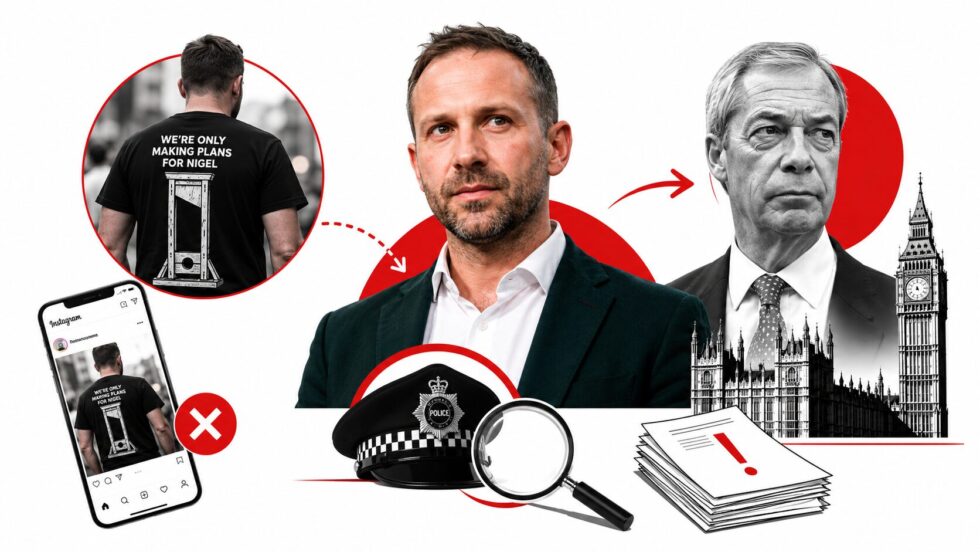
Zack Polanski is facing police enquiries after Reform UK reported an Instagram post shared by the Green Party leader that included a photograph of a man wearing a guillotine-themed T-shirt referring to Nigel Farage. The image carried the words “We’re only making plans for Nigel”, combining the title of a well-known XTC song with imagery that Reform UK interpreted as a threat against its leader. Polanski removed the collaborative post after the photograph was brought to his attention, while the Green Party said he had accepted a collection of event pictures without examining every image and unequivocally rejected the message displayed on the shirt.
The Metropolitan Police confirmed on Monday, 27 July 2026, that officers had received a third-party report concerning an image shared on social media and were conducting enquiries. That statement does not mean Polanski has been arrested, charged or found to have committed an offence. Nigel Farage and Reform UK home affairs spokesman Zia Yusuf nevertheless argued that the post should be investigated as possible incitement to violence, while the Greens described the image as dangerous, deeply inappropriate and particularly irresponsible during a period of heightened concern about the safety of British political figures, The WP Times reports.
The dispute has quickly become more than a row over a single Instagram photograph. It raises questions about how political leaders manage collaborative social-media posts, where responsibility lies when potentially threatening material is shared to a large audience, and how police distinguish offensive political satire from communication that may cross a criminal threshold.
At the centre of the controversy are Zack Polanski, Nigel Farage, the Green Party, Reform UK and the Metropolitan Police. The confirmed facts remain relatively limited: the image appeared in a multi-picture post connected to a Green Party event; Polanski’s account shared it with his followers; Reform UK complained to police; the picture was removed; and officers began preliminary enquiries. There has been no public announcement of an arrest, formal interview under caution or criminal charge.
What exactly did Zack Polanski share on Instagram
Zack Polanski shared a collaborative Instagram post containing a carousel of photographs from a Green Party event held on Sunday. Among the images was a picture of a man wearing a black T-shirt displaying the words We’re only making plans for Nigel above or alongside an illustration of a guillotine. The wording is a reference to Making Plans for Nigel, a song released by the English band XTC in 1979. In the context of the T-shirt, however, the addition of guillotine imagery gave the slogan an unmistakably political and potentially threatening interpretation because Nigel Farage is the leader of Reform UK and one of Britain’s most recognisable public figures.
The photograph did not appear to have been created or commissioned by Polanski. According to the Green Party’s account, he had been invited to collaborate on a post containing around 20 images and accepted the request without noticing everything included in the carousel. Once the disputed photograph was pointed out, the post was removed from his account. A photographer who said he had taken and uploaded the picture subsequently accepted responsibility for publishing it. He characterised the T-shirt as satire rather than a genuine threat and argued that criticism should be directed at him rather than Polanski. That explanation may be relevant to questions of intent, but it does not decide whether the image was appropriate to publish or whether its circulation could meet any legal test.
Key facts about the Zack Polanski Instagram post
| Issue | Confirmed position |
|---|---|
| Who shared the post? | Zack Polanski’s Instagram account accepted a collaborative post |
| What did it contain? | A carousel of event photographs, including a man wearing the disputed T-shirt |
| What was written on it? | We’re only making plans for Nigel |
| What image appeared with the words? | A guillotine |
| Who was apparently referenced? | Reform UK leader Nigel Farage |
| What happened afterwards? | Polanski removed or unshared the collaborative post |
| Who contacted police? | Reform UK |
| What have police said? | Officers received a third-party report and are conducting enquiries |
| Has Polanski been charged? | No charge has been publicly announced |
| Has the allegation been proved? | No |
Why did Nigel Farage report Zack Polanski to police
Nigel Farage published a screenshot of the photograph on X and argued that Polanski should face the same police scrutiny that Farage believed would follow if he circulated comparable imagery about another political leader. Farage described the material as inflammatory and said he would expect to be arrested if he posted something similar. His intervention transformed what might otherwise have remained an internal social-media mistake into a national political and policing controversy.
Reform UK’s position is that the combination of Farage’s first name and the guillotine image cannot be dismissed merely as a reference to a song. The party argues that the visual message could reasonably be interpreted as endorsing or encouraging violence against its leader. Zia Yusuf, Reform UK’s home affairs spokesman, publicly characterised the photograph as a call for Farage’s beheading and said it should be treated as possible incitement to murder. That remains Reform UK’s allegation rather than a legal conclusion reached by police, prosecutors or a court.
Reform UK has also reportedly raised the matter with the monitoring officer responsible for standards at the Greater London Authority, where Polanski serves as an elected London Assembly member. A standards complaint would be separate from any police assessment and would consider political or institutional conduct rather than determine criminal guilt.
What has the Metropolitan Police said about Zack Polanski
The Metropolitan Police said it had received a third-party report relating to an image shared on social media and that officers were conducting enquiries. This wording matters. Police enquiries can involve preserving the post, establishing who created and shared it, reviewing its full context, examining whether an offence may have occurred and deciding whether further action is justified. It does not establish that the person reported is formally under criminal investigation, and it certainly does not establish guilt.
No public police statement cited in the initial reporting said that Polanski had been arrested or charged. Reports also indicated that he had not, at that stage, been contacted by officers. The next steps could include no further action, a request for information, contact with the people responsible for the original image, a voluntary interview or a more formal investigation. Until the Metropolitan Police provides an update, claims that Polanski is already being prosecuted or has committed incitement would go beyond the confirmed position.
What police enquiries do not yet mean
The Metropolitan Police statement does not currently confirm:
- that Zack Polanski intended to threaten Nigel Farage;
- that Polanski personally selected the photograph;
- that officers have identified a criminal offence;
- that the Instagram post legally amounted to incitement;
- that Polanski has been interviewed under caution;
- that the Crown Prosecution Service has considered the case;
- that any charge will follow.
What has the Green Party said about the guillotine T-shirt
The Green Party said Polanski condemned the picture and did not support the message associated with the T-shirt. Its explanation was that Polanski attended a public event and later accepted an Instagram collaboration request involving numerous images. He did not realise the carousel included the photograph in question and removed the post when it was drawn to his attention. The party did not attempt to defend the guillotine design as acceptable political communication. Instead, it described the T-shirt as being in poor taste and acknowledged the wider concern created by violent imagery involving public figures.
The Greens also said Polanski had himself experienced threats and recognised the risks faced by politicians. Their response called for greater kindness in public debate and urged people not to encourage further division. That defence rests on the distinction between intentionally endorsing an image and inadvertently sharing it through a collaborative post. It may explain how the photograph reached Polanski’s profile, but critics are likely to argue that political leaders remain responsible for material distributed through their verified accounts, particularly when those accounts reach hundreds of thousands of people.
Was “We’re only making plans for Nigel” intended as satire
The words themselves come from XTC’s 1979 single Making Plans for Nigel. Without the accompanying image, the phrase may be understood as a musical reference, a slogan or a piece of wordplay. The dispute arises because the T-shirt paired the reference with a guillotine. That visual addition changed the political meaning perceived by Farage and Reform UK. They interpreted it as depicting the execution or beheading of a politician named Nigel rather than simply quoting a song title. The photographer who accepted responsibility reportedly maintained that the image was satirical and was not intended as a genuine threat. However, the intention of the photographer, the intention of the person wearing the T-shirt and Polanski’s knowledge when accepting the collaborative post are separate factual questions.
Satire does not automatically become criminal because it is offensive, disturbing or directed at a politician. Equally, describing an image as satire does not necessarily prevent police from examining whether its wording, imagery, context and distribution could encourage violence. Any criminal assessment would require much more than political outrage. Investigators would need to consider the relevant communication, the surrounding circumstances, the likely audience, the conduct of those involved and the evidence of intention.
Could Zack Polanski be arrested or charged over the post
There is currently no confirmed basis for saying that Polanski will be arrested or charged. Reform UK has reported the material and has described it as incitement to murder, but police must independently assess whether the available evidence points to a specific offence. The threshold for political criticism is not the same as the evidential threshold for prosecution. A central question would be whether Polanski knowingly and intentionally shared material capable of encouraging a criminal act. The Green Party’s account—that he accepted a collaborative collection without seeing every image and removed it immediately—would be relevant to any assessment of knowledge and intention. Police may also consider the original photographer, the person who created or sold the shirt, the person pictured wearing it and the account that initiated the collaboration. Responsibility for an online post can involve several participants, but their individual intentions and actions cannot simply be treated as identical. Even where police believe an offence may have occurred, prosecutors generally must decide whether there is sufficient admissible evidence and whether prosecution is in the public interest. No indication has been given that the matter has reached that stage.
Why has the Zack Polanski and Nigel Farage dispute become a major UK politics story
The story has gained national attention because it combines online political communication, alleged violent imagery, party rivalry and growing concern about the personal security of politicians. Polanski has positioned the Green Party as a direct challenger to Reform UK’s populist approach and has previously discussed the effectiveness of Farage’s political communication. That makes any direct clash between Zack Polanski and Nigel Farage significant beyond the immediate content of the Instagram post.
Farage’s decision to publicise the image ensured that it reached a far larger political audience than the original event carousel. Reform UK has used the incident to argue that violent language or imagery aimed at its politicians is not treated with the same seriousness as comparable material aimed at figures from other parties.
The Greens, meanwhile, are attempting to draw a firm distinction between Polanski’s political beliefs and a photograph that their leader says he did not knowingly select. Their response accepts that the image was unacceptable while rejecting Reform UK’s allegation that Polanski intended to promote violence. The incident also highlights the dangers of Instagram collaboration tools. When an account accepts a collaborative post, material prepared by another user can appear directly on that account’s profile and be distributed to its followers. For politicians, publishers and public institutions, accepting such posts without checking every image creates a clear editorial and reputational risk.
Who is Zack Polanski
Zack Polanski is the leader of the Green Party of England and Wales and an elected member of the London Assembly. He became party leader in September 2025 after previously serving as deputy leader. His political strategy has frequently been described as eco-populist: an attempt to combine environmental policies with direct economic arguments about inequality, living costs, public services and concentrated wealth.
Polanski has sought to increase the Greens’ visibility and present the party as a broader electoral force rather than a movement focused narrowly on environmental policy. He has also identified Reform UK and Nigel Farage as important political opponents and has argued that progressive parties need clearer, more effective communication to compete with them. That profile helps explain why the Instagram controversy matters politically. Polanski is not simply an activist whose account repeated an obscure image; he is a national party leader whose public communications are likely to receive intense scrutiny.
What happens next in the Zack Polanski police complaint
The immediate next step rests with the Metropolitan Police. Officers will decide whether the reported image requires further investigation and whether there is sufficient evidence to contact Polanski, the photographer or other people linked to the post. Reform UK may continue pursuing its separate complaint through the Greater London Authority’s standards procedures. That process could examine whether Polanski breached any relevant conduct expectations as an Assembly member, although a complaint itself does not demonstrate a breach.
The Green Party is likely to maintain that Polanski did not knowingly approve the disputed photograph and acted promptly once it was identified. Reform UK will continue to argue that a party leader with a large online following should be accountable for content appearing on his profile regardless of whether it arrived through Instagram’s collaboration function. The most important unanswered questions are therefore factual:
- Did Polanski view the entire carousel before accepting the collaboration?
- Who selected and uploaded the photograph?
- What was intended by the photographer and the person wearing the shirt?
- Does the complete context support any reasonable suspicion of a criminal offence?
- Will the Metropolitan Police take further action or close the matter after its enquiries?
- Will the Greater London Authority consider a formal standards investigation?
Until those questions are answered, the accurate position is that Reform UK has reported Zack Polanski, the Metropolitan Police is conducting enquiries, the disputed post has been removed, and no criminal wrongdoing has been established.
What is known about Zack Polanski, Nigel Farage and the police report
Zack Polanski shared a collaborative Instagram carousel containing a photograph of a man wearing a T-shirt that paired the phrase We’re only making plans for Nigel with a guillotine image. Nigel Farage published a screenshot and argued that Polanski should be arrested, while Reform UK reported the post to police and characterised it as possible incitement to murder.
Polanski’s party said he had not noticed the photograph among approximately 20 event images, immediately removed the collaboration when alerted and unequivocally condemned the design. The Metropolitan Police confirmed that it had received a report and was making enquiries, but it has not publicly announced an arrest, charge or finding that an offence occurred. The case is therefore at a preliminary stage. The political accusations are serious, but they must remain clearly separated from the conclusions of investigators and courts. For readers following UK politics news, the next authoritative development will be a Metropolitan Police update, a decision on further action or a response from the Greater London Authority’s monitoring process.
Materials used: Metropolitan Police statement as reported by UK media, Green Party response, statements from Nigel Farage and Zia Yusuf, The Guardian, The Times, public social-media posts.
Read about the life of Westminster and Pimlico district, London and the world. 24/7 news with fresh and useful updates on culture, business, technology and city life: Will Elon Musk’s Tesla Tiny House Really Reach the UK – or Is It Just Another Vision