As the global real estate market stabilizes in 2026, Catalonia remains a primary focus for international investors and lifestyle buyers. However, the price gap between the urban density of Barcelona’s city center and the varied coastal stretches of the Costa Brava and Costa Dorada has reached a critical inflection point. For the modern buyer, the decision is no longer just about the view; it is a calculated trade-off between the high liquidity of a metropolitan "safe haven" and the significant lifestyle premiums—and occasional entry-level bargains—found along the Mediterranean shore. With new rental regulations (Law 11/2025) now in full effect across Catalonia, understanding the precise cost-per-square-meter and the associated tax burdens is the only way to ensure a sustainable investment in 2026.
According to reports from The WP Times, citing the Spanish news portal BCN24, property prices in Barcelona’s prime districts have seen a 7% year-on-year increase, while certain coastal micro-markets are outperforming the city due to a severe shortage of new-build inventory.
Urban Premium: The Reality of Barcelona City Centre Prices in 2026
Buying in Barcelona’s center in 2026—specifically in Eixample, Sarrià-Sant Gervasi, or the Gothic Quarter—requires a substantial capital outlay that reflects the city's status as a tech and cultural hub. The average asking price for a renovated apartment in the city center now hovers around €5,144 per square meter, with prime "Golden Square" (Quadrat d'Or) properties often exceeding €7,500/m². Unlike previous years, the 2026 market is defined by "Smart Housing" premiums; apartments with high energy efficiency ratings and integrated home automation command a 15% price increase over unrenovated stock.
Key considerations for city center buyers:
- Eixample Right: The most expensive district, where 3-bedroom apartments average between €600,000 and €850,000.
- Sant Martí (22@ District): A high-growth area where yields remain strong (5-7%) due to the concentration of international tech companies.
- Old Town (Ciutat Vella): While prices are lower (approx. €4,200/m²), maintenance costs and structural risks in centuries-old buildings are higher.
- New-Build Scarcity: New developments are almost non-existent in the center, making "royal estate" (Finca Regia) renovations the gold standard for value retention.
- Inventory Turnover: Properties priced correctly (within 4% of market valuation) sell in less than 45 days.
Coastal Escape: Pricing Dynamics of the Costa Brava and Costa Dorada
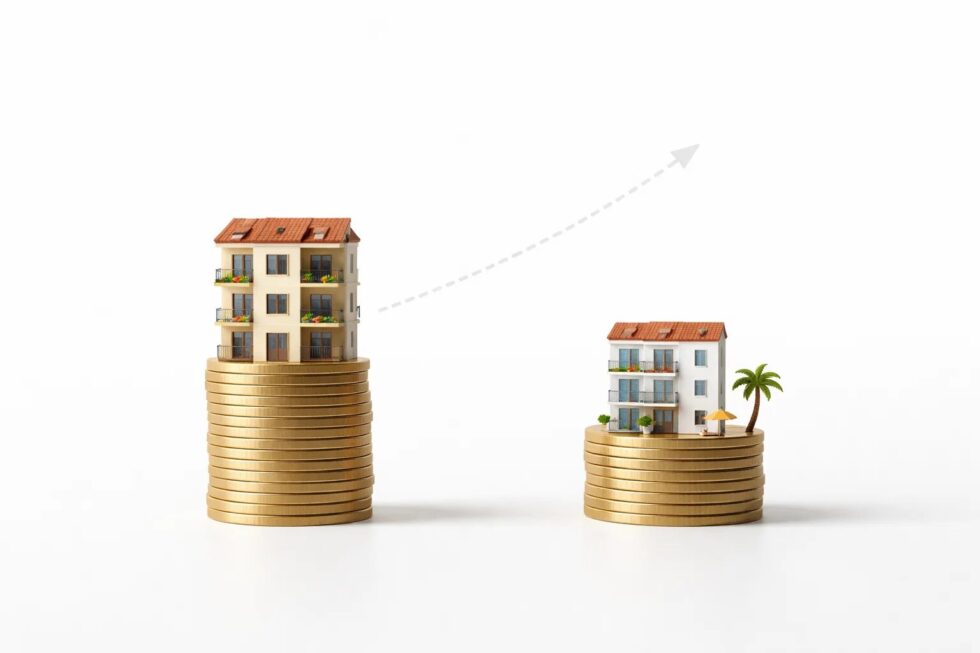
The coastal areas of Catalonia offer a drastically different value proposition, characterized by a wider price variance. In the prestigious North (Costa Brava), towns like Cadaqués and Begur have reached price parity with Barcelona’s luxury districts, with sea-view villas averaging €4,000/m². Conversely, the South (Costa Dorada) remains the "value play" for 2026, where towns like Cambrils or L'Ametlla de Mar offer modern apartments for as low as €2,500/m², providing a significantly lower barrier to entry for secondary residences.
| Region / Town | Avg. Price per m² (2026) | Typical 2-Bed Flat Cost | Market Sentiment |
| Barcelona City Centre | €5,144 | €410,000 - €500,000 | Seller-Leaning |
| Costa Brava (Begur/Llafranc) | €4,050 | €360,000 - €450,000 | High Demand / Low Supply |
| Costa Brava (Roses/Empuriabrava) | €2,970 | €240,000 - €310,000 | Stable / Secondary Home |
| Costa Dorada (Salou/Cambrils) | €2,450 | €190,000 - €260,000 | Value / Family Oriented |
| Sitges (Premium Coastal) | €4,800 | €380,000 - €460,000 | High Liquidity |
The Hidden Costs: Taxes and Closing Fees in 2026
In Catalonia, the "sticker price" of a property is only part of the financial equation. In 2026, buyers must budget for closing costs that typically range from 12% to 14% of the purchase price. The most significant component is the Property Transfer Tax (ITP), which in Catalonia is set at a standard 10% for resale properties up to €600,000, with progressive rates thereafter. For new-build properties, you will pay 10% VAT plus a 1.5% Stamp Duty (AJD). These fees are non-negotiable and must be paid within 30 days of signing the public deed.
Detailed breakdown of transaction costs:
- ITP (Resale): 10% (can drop to 5% for young buyers or large families purchasing a primary residence).
- Notary Fees: Roughly €600 - €1,200, depending on the complexity of the deed and property value.
- Property Registry: Approximately €400 - €800.
- Legal Fees: Expect to pay 1% + VAT for an independent lawyer (highly recommended for non-residents).
- Banking Fees: If using a mortgage, be aware of the valuation (tasación) fees, which cost around €300 - €600.
Investment Outlook: Rental Caps and Yields in the 2026 Market
The introduction of the New Catalonia Rental Law (11/2025) has fundamentally shifted the buy-to-let strategy. As of 2026, rent caps now apply not only to long-term leases but also to "mid-term" (temporary) and room rentals in "stressed areas" like Barcelona and Sitges. While this has slowed the explosive growth of urban rents, it has pushed investors toward the coast where "tourist use" licenses (HUT) are still attainable in certain municipalities. Gross rental yields in Barcelona city now average 4-5%, whereas successful vacation rentals on the Costa Brava can still hit 6-8% during the peak season (June–September).
What to do as an investor in 2026:
- Verify the License: Never buy a coastal flat for investment without a pre-existing "HUT" license; many towns have stopped issuing new ones.
- Target "Green" Buildings: Properties with an Energy Certificate (CEE) of 'A' or 'B' are exempt from certain price cap restrictions in the new law.
- Consider Sitges: It offers a unique hybrid of city-center liquidity and coastal lifestyle, maintaining high demand year-round.
- Review Tax Residency: Non-EU residents pay a flat 24% tax on rental income, whereas EU residents pay 19% and can deduct expenses.
- Focus on Renovations: Buying unrenovated flats in Eixample and modernizing them remains the most effective way to "create" equity in a flat market.

Practical Advice: Choosing the Right Location for Your Profile
For the 2026 buyer, the "right" choice depends entirely on the intended use and time horizon. If you are a digital nomad or professional working in Catalonia's tech sector, the city center is unbeatable for connectivity (high-speed 5G/6G and rail). However, if your goal is a retirement home or a sanctuary from the urban heat, the northern Costa Brava offers a micro-climate that is significantly more pleasant. It is essential to visit these areas in the "off-season" (November–February); a bustling summer town like Salou can feel deserted in winter, whereas Barcelona remains vibrant 365 days a year.
Expert recommendations for 2026:
- The "20-Minute Rule": If buying on the coast for commuting, ensure you are within 20 minutes of a Rodalies (train) station; highway tolls and traffic into Barcelona have increased by 15% since 2024.
- Inspect the "ITE": For city center buildings over 45 years old, always check the Inspección Técnica de Edificios report to avoid surprise community fees.
- Negotiation Margin: In 2026, the average gap between asking and sale price is 4%. If a seller won't budge, look for "hidden" value like a storage room (trastero) or terrace rights.
- Currency Hedging: For non-Euro buyers, use specialized brokers rather than high-street banks to save up to 3% on the transfer.
- Local "Gestoria": Hire a local manager to handle the IBI (property tax) and rubbish collection fees to avoid administrative surcharges.
Frequent Questions (FAQ)
Is 2026 a good time to buy in Barcelona?
Yes, but it is a "selective" market. Prices are stable rather than booming, making it ideal for long-term buyers rather than flippers.
Do I need a Spanish bank account to buy?
Technically no, but in practice, yes. You need it to pay local taxes and utilities. High-street banks now offer "non-resident" accounts specifically for property owners.
How long does the buying process take?
Expect 2 to 3 months. The Arras (deposit contract) usually gives you 60-90 days to finalize the mortgage and notary appointment.
Are there still "Okupas" (squatters) risks in 2026?
The risk is manageable but exists for empty properties. Installing a "Smart Alarm" connected to a central station is a standard requirement for insurance in 2026.
Which coastal town has the best growth potential?
Palamós and Sant Antoni de Calonge are currently seeing high infrastructure investment and offer better value than the overpriced "prime" villages.
Can I get a Golden Visa in 2026?
As of early 2026, the Spanish government has introduced stricter wealth-creation requirements for the Golden Visa; always consult a specialized immigration lawyer before proceeding.
Read about the life of Westminster and Pimlico district, London and the world. 24/7 news with fresh and useful updates on culture, business, technology and city life: Why the tax burden in the UK has reached a record level and what it means for residents