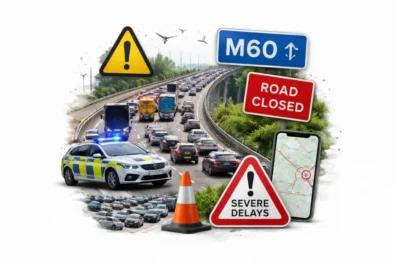
Fuel protests NI are driving severe traffic watch NI disruption across Belfast on Tuesday, 14 April 2026, with a coordinated convoy of tractors and vehicles deliberately slowing movement along the Sydenham Bypass, a key arterial route linking east Belfast to the city centre and Belfast City Airport, forcing some passengers to abandon vehicles and continue on foot, The WP Times reports. The convoy initially occupied city-bound lanes during the early morning peak, before reversing direction and re-entering country-bound lanes, effectively prolonging congestion cycles and preventing normal traffic recovery across the corridor.
The disruption forms part of a wider escalation of fuel protests across Northern Ireland, with parallel actions reported at Ballygawley Roundabout in County Tyrone and Nutts Corner in County Antrim, while officials warn that up to eight locations could be affected throughout the day, according to reporting by BBC News NI, Belfast Live and Belfast Telegraph. The protests are linked to mounting fuel price pressures and supply instability across Europe, creating a compound impact on transport, logistics and public services in the region.
Traffic watch NI: Real-time breakdown of disruption points and movement patterns
Traffic disruption has not been static but instead follows a rolling blockade model, where convoys move continuously to maximise impact while avoiding rapid clearance by authorities. This has created shifting congestion zones rather than a single fixed incident.
Detailed situation by location:
- Sydenham Bypass (East Belfast):
- Tractor convoy moving at low speed (crawl pace)
- Repeated directional switching (city-bound → country-bound)
- Severe delays affecting airport access roads
- Secondary congestion spreading to feeder routes (A2 corridor)
- Belfast City Airport access:
- Vehicles unable to reach drop-off zones
- Passengers observed walking from stationary traffic
- Airport advisory issued urging early arrival
- Ballygawley Roundabout (Co Tyrone):
- Circular slow-moving protest pattern
- Traffic stacking on all approach roads
- Delays affecting regional east–west movement
- Nutts Corner (Co Antrim):
- تجمع протестующих с сельхозтехникой
- Intermittent blocking behaviour
- Impact on routes connecting Belfast to rural areas
The operational tactic—low-speed mobility rather than full closure—is significantly harder to manage, as it prevents authorities from reopening routes quickly.
Fuel protests NI: Underlying causes and cross-border escalation dynamics
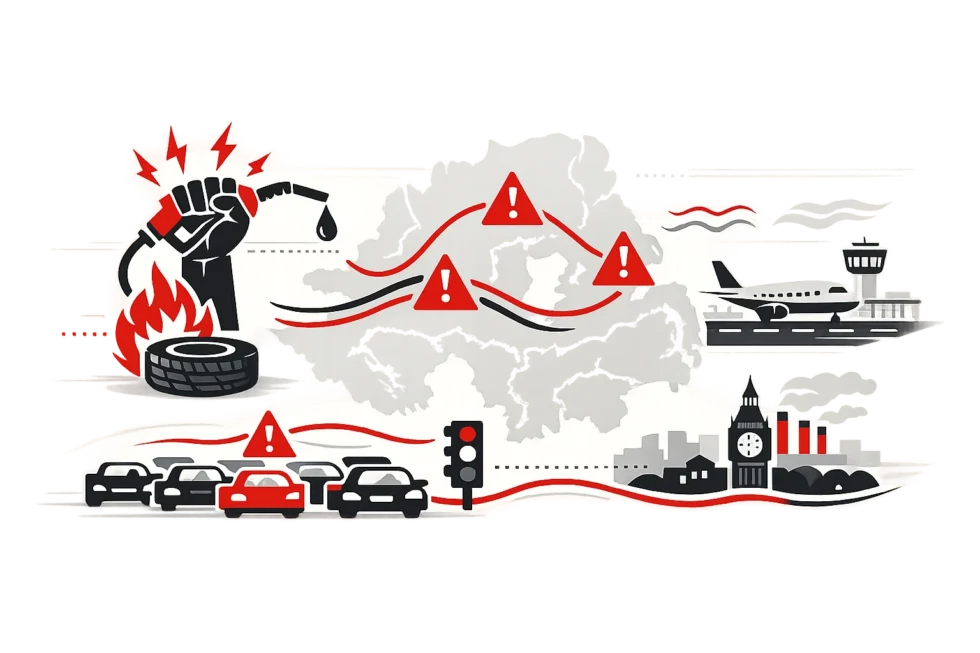
The protests in Northern Ireland cannot be viewed in isolation. They are part of a broader chain reaction linked to fuel supply instability across Ireland and mainland Europe. Over the past week:
- Large-scale protests in the Republic of Ireland disrupted:
- Fuel distribution networks
- Port operations
- Motorway traffic, particularly in Dublin
- Although major blockades were cleared, residual disruption remains, creating:
- Delayed deliveries
- Reduced availability in some regions
- Heightened anxiety among transport operators
Core drivers of the protests:
| Driver | Mechanism | Result |
|---|---|---|
| Rising global fuel prices | Linked to geopolitical tensions | Increased cost pressure on farmers and logistics |
| Supply chain fragility | Delays from Irish network disruptions | Reduced confidence in fuel availability |
| Agricultural sector pressure | High diesel dependency | Visible participation via tractors |
| Social media coordination | Rapid mobilisation across regions | Multi-location protests |
This combination has turned local protests into a regional transport disruption event.
Belfast Live and BBC News NI: Official warnings and political response
Authorities have adopted a cautious but increasingly urgent tone, focusing on public safety and service continuity. The Education Authority confirmed that it is monitoring the situation in real time:
“School transport and other services will operate as normal, but there is potential for diversions or delays… parents and pupils should allow additional travel time” (Education Authority, Belfast, 14 April 2026). Northern Ireland Agriculture Minister Andrew Muir issued a direct warning regarding unintended consequences: “Your actions will actually disadvantage those you purport to stand for… there will be real challenges in bringing livestock to marts and in relation to milk tankers” (statement reported by BBC News NI, 14 April 2026).
He further referenced recent disruption in the Republic of Ireland:
“We had issues last week where people were struggling to get to cancer appointments… that is not a situation we want to see” (BBC News NI, 14 April 2026).
Separately, political figures cited by Belfast Telegraph warned of systemic risks:
“When people block roads… emergency services will struggle to reach calls and key workers may not get to work” (Belfast Telegraph, 14 April 2026).
Sydenham Bypass: Why this corridor creates system-wide disruption
The selection of the Sydenham Bypass is strategically significant, not incidental. This route acts as a critical pressure point within Belfast’s transport network. Key structural role of the route:
- Connects east Belfast to the city centre
- Provides primary access to Belfast City Airport
- Functions as a high-volume commuter artery
- Supports freight and service logistics flows
When traffic slows here:
- Queue lengths increase rapidly
- Alternative routes become overloaded
- Recovery time extends beyond the protest window
The convoy’s tactic of reversing direction ensures that both carriageways are affected within a short time frame, preventing stabilisation. With further protests expected, transport authorities and media outlets including BBC News NI and Belfast Live are issuing consistent guidance. Immediate actions for the public:
- Allow extended travel time (significantly beyond normal peak estimates)
- Avoid Sydenham Bypass and A2 corridor where possible
- Monitor live updates from trusted sources
- Use alternative routes even if longer in distance
- Airport passengers: arrive early and prepare for walking segments
The risk is not only delay but complete access breakdown near critical infrastructure such as the airport. Fuel protests are expected to remain active through the afternoon and into the evening peak, with disruption likely to shift between routes rather than concentrate in one place, particularly around pressure points such as the Sydenham Bypass. Updates carried by BBC News NI indicate that further locations may activate with little warning, meaning conditions on the road network can change within minutes rather than hours.
In practical terms, this creates a travel environment where timing matters more than distance. Journeys that normally take predictable routes may become unreliable even after apparent clearance, as slow-moving convoys can re-enter key corridors and rebuild congestion quickly. Anyone travelling should assume that delays will compound rather than ease, especially near critical infrastructure such as airport access roads or major junctions, and plan with a margin that accounts for sudden standstills rather than gradual slowdowns.
The broader picture is that disruption is no longer isolated to single incidents but is spreading in a pattern that affects how the entire network functions. Because the underlying pressure—fuel cost and supply instability—has not been resolved, there is a realistic prospect that these conditions will persist beyond today. For now, movement across Northern Ireland depends less on official timetables and more on real-time conditions, and the most effective response is to stay flexible, monitor verified updates closely, and treat every journey as potentially subject to change until the situation stabilises.
Read about the life of Westminster and Pimlico district, London and the world. 24/7 news with fresh and useful updates on culture, business, technology and city life: What is behind Kemi Badenoch’s plan to rethink licence points for minor 20mph speeding in UK