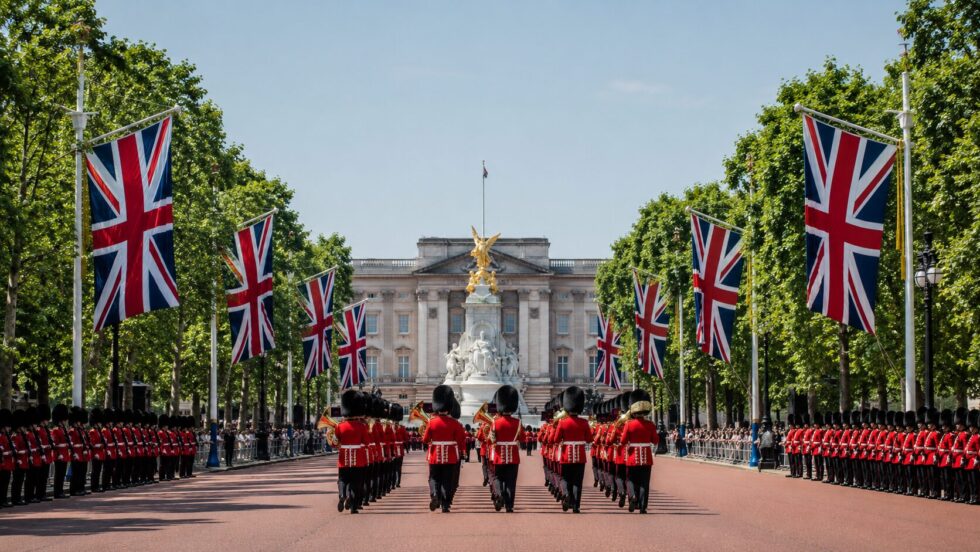
On Saturday 13 June 2026, shortly after the clock on Horse Guards strikes eleven, King Charles III will arrive on the gravel of Horse Guards Parade to take the Royal Salute, and for a few suspended minutes the noise of central London — the buses, the river of pedestrians, the wail of distant sirens — will fall away behind a wall of brass, drum and the slow, hypnotic crunch of more than 1,350 pairs of polished boots moving as one, as The WP Times reports. This is Trooping the Colour, the King's official Birthday Parade, and in 2026 it falls on the second Saturday of June with the King's Company, 1st Battalion Grenadier Guards trooping their Colour in the presence of the Sovereign.
If you have never stood on The Mall on the morning of the parade, it is hard to convey what the spectacle does to a crowd. People who arrived as strangers, jostling for kerbside space at half past eight, find themselves an hour later sharing flasks of tea, lifting children onto shoulders and going quiet together as the first Sovereign's Escort of the Household Cavalry comes clattering up the avenue, breastplates throwing back the sun. The ceremony is, on paper, a military review. In practice it is one of the last great communal rituals the city still performs in the open air, free to anyone willing to turn up early and stand. This guide sets out everything you need to plan that morning properly: the confirmed date and times, the exact route the procession takes, where the road closures bite, how to reach the area when half the surrounding streets are shut, and — most importantly for the tens of thousands who come without a ticket — precisely where to stand to see the most for nothing.
The headline facts for 13 June 2026
Let us deal first with the things that are fixed and confirmed, because around them swirl a great deal of well-meaning but outdated advice. The King's Birthday Parade takes place on Horse Guards Parade in central London, and 2026 follows the long-established pattern of three consecutive Saturdays in late May and June. The dates are 30 May, 6 June and 13 June 2026, with the main event — the parade reviewed by the King himself — held on Saturday 13 June 2026.
The two earlier Saturdays are not the real thing, though they are spectacular in their own right and far easier to get tickets for. The 30 May date is the Major General's Review, the first full dress rehearsal; 6 June is the Colonel's Review, the final rehearsal, traditionally taken by the Colonel of the regiment that is trooping. The 13 June date is the parade proper, the one the King attends, the one followed by the gun salute, the balcony appearance and the RAF flypast. If somebody tells you they are "going to Trooping the Colour" and they mean the cheaper, less crowded experience, they almost certainly mean one of the reviews. If they mean the King, the flypast and the full sense of occasion, they mean 13 June.
The regiment at the centre of it all in 2026 is the Grenadier Guards. The King's Company, 1st Battalion Grenadier Guards will Troop their Colour, with His Majesty The King serving as Colonel-in-Chief and Her Majesty The Queen as Colonel of the Grenadier Guards. That detail matters for spectators more than it might first appear: the trooped Colour, the single flag carried with ceremony through the ranks, belongs to the Grenadiers this year, and their distinctive uniform — white plume on the left of the bearskin, evenly spaced tunic buttons — is what you will see at the heart of the parade. The scale is enormous and worth fixing in the mind before you go. Over 1,350 soldiers of the Household Division and King's Troop Royal Horse Artillery take part, including more than 300 musicians from the Massed Bands, and a further 250 Service Personnel line the processional route along The Mall. Add roughly two hundred horses and you have a moving city of ceremony filling the space between Buckingham Palace and Whitehall. As of late May 2026, no modifications to the 13 June schedule had been announced, indicating preparations remained fully on track.
A short history, because it explains what you are watching
It is genuinely worth understanding why all this happens, because the ceremony makes far more sense — and is far more moving — when you can read it.
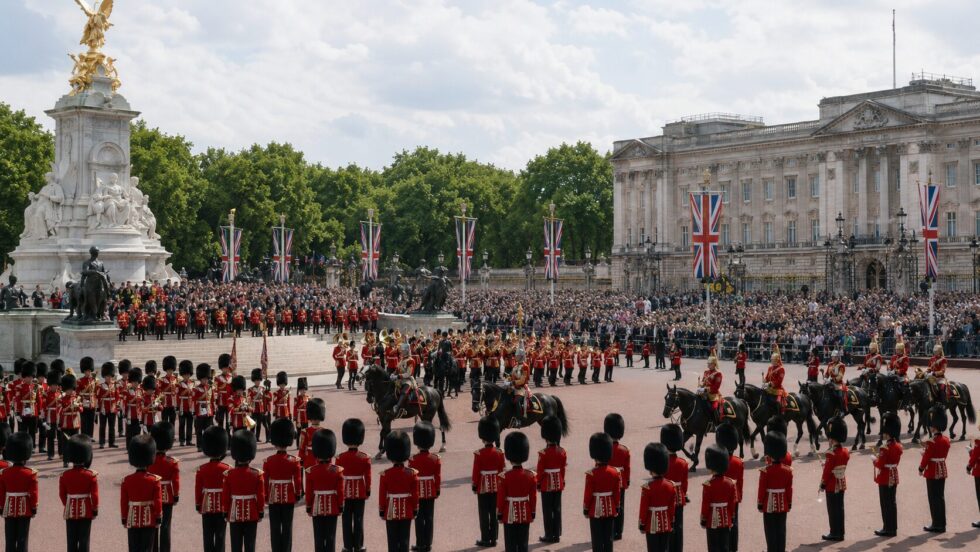
The ceremony of Trooping the Colour is believed to have first been performed during the reign of King Charles II, who was monarch from 1660 to 1685. The origins are entirely practical and entirely martial. In an age when battles were fought at close quarters in dense formations, with gunpowder smoke blinding everyone within seconds of the first volley, a soldier needed some way of knowing where his own unit was. The answer was the regiment's Colours: large, distinctively patterned flags carried at the centre of the formation. They were the rallying point, the thing you ran towards when the line broke and the place you re-formed around when the smoke cleared.
To make sure every soldier could recognise his own Colours instantly, the flags were "trooped" — carried slowly down the ranks so that every man saw them at close range and committed the pattern to memory. The loss of a Colour in battle was the deepest disgrace a regiment could suffer; the capture of an enemy's Colour, the highest glory. That is why, even today, the trooped Colour is escorted with such reverence, and why the soldiers' eyes follow it. You are watching a memory drill that once decided whether men lived or died, performed now as living theatre.
In 1748 it was decided that this parade would be used to mark the official birthday of the Sovereign, and the link has held ever since. The "official" birthday is a separate thing from the monarch's actual birthday — a sensible British compromise, given the unreliability of the weather on any given royal's real birth date. King Charles III, who was born on 14 November 1948, accordingly celebrates his birthday twice: once on his actual birthday in November, and then publicly at Trooping the Colour in June. The June date gives the best chance of dry warmth for an outdoor parade, which, anyone who has stood on The Mall in changeable weather will tell you, is no small consideration.
The continuity is the quiet marvel of it. Unlike most modern nations, the UK retains ceremonial state occasions that remain virtually unchanged in structure for centuries; where many countries have streamlined or eliminated formal pageantry, Britain has preserved Trooping the Colour as a living historical artifact. When you stand on the kerb you are not watching a re-enactment. You are watching a thing that has been done, in recognisable form, by professional soldiers, year after year, for the best part of three centuries.
The route: where the procession actually goes
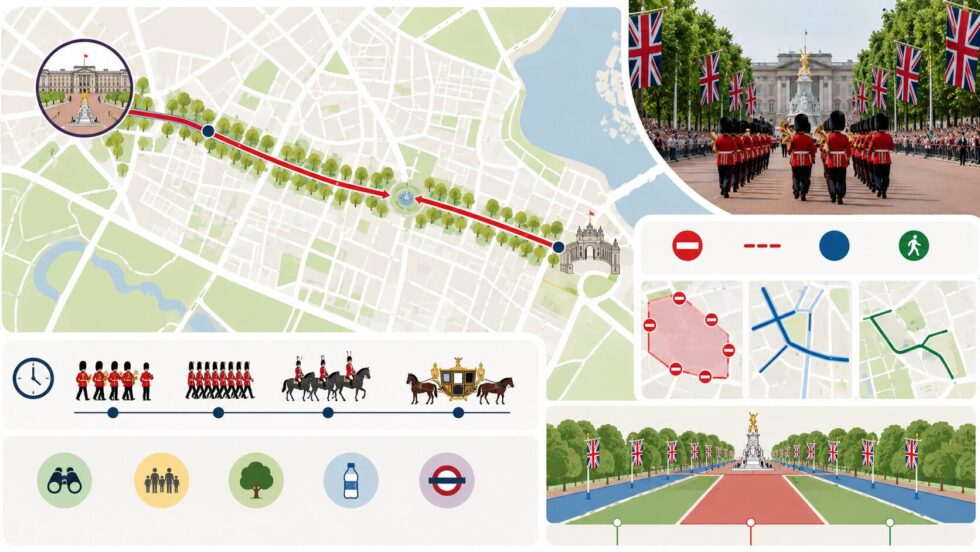
This is the part most first-time spectators get wrong, and getting it right is the single biggest factor in whether you have a great day or a frustrating one. The parade route begins at Buckingham Palace, travels along The Mall to Horse Guards Parade, and then returns to Buckingham Palace. That is the whole of it, and its simplicity is deceptive, because the procession passes along that stretch twice — once outbound, once on the return — and the two passages have very different characters. Picture the geography. The Mall is the long, straight, plane-tree-lined ceremonial avenue running roughly southwest to northeast. At its western end sits the Queen Victoria Memorial and the gates of Buckingham Palace. At its eastern end, where it meets the open space at the top of Whitehall, stands Admiralty Arch, and just before that, on the southern side, the archway leading through to Horse Guards Parade itself — the gravelled square hemmed by Horse Guards building, the Old Admiralty and the trees of St James's Park, where the main ceremony unfolds.
The King traditionally travels from Buckingham Palace down The Mall to Horse Guards Parade, where the troops march slowly past while he inspects the Colours. The King then returns up The Mall to Buckingham Palace, where he and the family assemble on the balcony. So the morning's movement, in plain terms, runs: out from the Palace, down The Mall, into Horse Guards for the ceremony; then back out of Horse Guards, up The Mall, to the Palace for the salute and balcony. One caution on the King's mode of travel, which has changed in recent years and may change again. The parade traditionally sees the King ride on horseback, though given his age and recent state of health it is more likely he will travel by carriage. In 2023 and 2024 the King travelled by carriage rather than on horseback; whether he rides in 2026 will likely depend on his health closer to the day. Either way, the route is identical — only the conveyance differs — so it has no bearing on where you should stand.
The timetable, hour by hour
Times are the thing people most want and most often find muddled, because different sources quote slightly different schedules and because the rehearsals run on marginally different timings to the main event. Here is the clearest picture available for 13 June, drawn from the official and ceremonial sources, with the inevitable caveats flagged.
The first thing worth knowing is that the action begins long before the King appears. From around 09:15 onwards, troops start forming up on Horse Guards Parade. If you have a ticket for the seated stands, this early-morning assembly — the bands tuning, the sergeants' barked corrections, the horses being walked into position — is part of the show and worth arriving for. If you are on The Mall without a ticket, this is roughly the window in which you should be claiming your spot. The headline timings then run as follows. At about 10:45 His Majesty The King leaves Buckingham Palace escorted by the Household Cavalry. At 11:00 precisely, the King arrives on Horse Guards Parade to take the Royal Salute. This is the moment the ceremony formally begins: as the Horse Guards clock chimes eleven, the King is in position and the salute is given.
There is a genuine discrepancy in the public sources here that is worth being honest about. Some guides — including some reputable ones — state that the parade begins at Horse Guards at 10:30 and finishes by 12:25, and the official ticketing site itself uses the 10:30 start figure in its public information. The ceremonial-specialist timetable, by contrast, gives the King's arrival as 11:00 precisely. The likely reconciliation is that the parade movement and the lining-up begin around 10:30, while the King's own arrival and the Royal Salute come at 11:00. For planning purposes the safe rule is simple: be in position by 10:00 at the very latest, and treat everything before 11:00 as build-up you will not want to miss anyway. Once the King has taken the salute, the heart of the ceremony unfolds. The King reviews his Guards, riding down the ranks of foot guards and cavalry. The Colour is then trooped through the ranks before the Foot Guards march past the King, after which the Household Cavalry and King's Troop Royal Horse Artillery rank past. This middle section — the slow march, the musical "troop", the march-past — is the most intricate and the most drilled, the product of months of rehearsal, and to the trained eye it is where the precision is most astonishing.
The return then begins. At around 12:20 the King, at the head of his Guards, returns up The Mall to Buckingham Palace, and at the gates of the Palace he watches the parade march past in salute. For anyone standing on The Mall, this is the second and arguably better viewing opportunity of the day — the full body of troops and the King himself passing close by, this time moving towards you and the Palace Then come the three flourishes that exist only on 13 June and not at the rehearsals. At 12:52, the King's Troop Royal Horse Artillery fire a 41-gun salute in Green Park to mark the King's official birthday. At approximately 12:55, the King and other members of the Royal Family make a balcony appearance at Buckingham Palace. And the day reaches its climax overhead. The official ticketing information gives the flypast timing as 1:00pm on 13 June, when a fly-past by the Royal Air Force takes place, which can be watched from The Mall.
A quick word on the flypast, because it is the bit casual visitors most want and most often miss by leaving early. Aircraft in tight formation pass directly over the Palace and The Mall, and the crowd reaction every year is worth experiencing on its own. In recent years the formation has been substantial — fast jets, transport aircraft, helicopters and, weather permitting, the Red Arrows trailing red, white and blue smoke. If you possibly can, stay until at least 1:15pm. The temptation to beat the crowds out at 12:30 is strong; resisting it is the difference between "I saw a parade" and "I saw the whole thing."
Here, then, is the morning at a glance:
- 09:15 onwards — troops form up on Horse Guards Parade
- ~10:30 — parade movement and route-lining begins (be in position by now)
- 10:45 — the King leaves Buckingham Palace with the Household Cavalry
- 11:00 — the King arrives at Horse Guards Parade; Royal Salute taken
- 11:00–12:20 — inspection, trooping of the Colour, march-past and rank-past
- 12:20 — the King leads the Guards back up The Mall to the Palace
- 12:52 — 41-gun salute fired in Green Park
- ~12:55 — Royal Family balcony appearance
- 13:00 — RAF flypast over Buckingham Palace and The Mall
Where to stand: the best free viewing spots, ranked
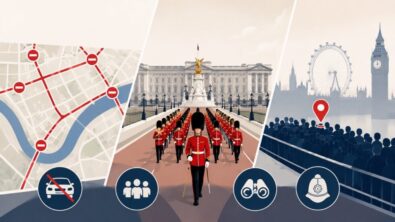
This is the section to read twice. Tens of thousands come without tickets, and where you put yourself among them decides everything. The seated stands on Horse Guards Parade are the only ticketed, guaranteed-view option, and for 13 June they were allocated by ballot well in advance. The ballot for 2026 concluded on 27 March, so tickets have already been assigned, but spectators without tickets can still line The Mall or the edge of St James's Park for free viewing of the parade procession. If you are reading this without a ticket, the free route is your route — and the good news is that it can be a wonderful one.
There are, in practice, two free viewing zones, and they offer quite different experiences.
The Mall is the premier free option and the one most knowledgeable Londoners recommend. You will not see the central ceremony on Horse Guards Parade itself — the inspection, the trooping of the Colour, the march-past — because that happens out of sight inside the square. What you will see is the full procession passing close by, twice: the Sovereign's Escort, the carriages or mounted King, the Massed Bands, the marching columns, all at conversational distance. Those without tickets to the seated stands can choose a spot on The Mall or on the edge of St James's Park overlooking Horse Guards to watch the parade from the sidelines.
Within The Mall, position matters. The single most useful piece of insider advice from the ceremonial specialists is precise: head for The Mall on the St James's Park side, and take up a position close to the junction with Marlborough Road. Marlborough Road is the short street running up beside St James's Palace, roughly two-thirds of the way along The Mall towards the Palace, and the junction there gives a clean sightline along the avenue. The St James's Park side — the southern side — is generally preferable because the park behind you offers room to retreat, shade and, crucially, facilities.
The corner of St James's Park, overlooking Horse Guards Parade, is the second free zone, and here expectations must be managed. It is the only free vantage from which you can glimpse the parade ground itself rather than just the procession route — but the view is partial and frequently blocked. The view from the corner of St James's Park can be restricted by the troops and horses on parade. The honest position is that this spot is a gamble: on a good day you catch fragments of the ceremony over and between the ranks; on a busy day you see backs and bearskins. Most regulars judge The Mall the better bet for a reliable, satisfying view, and the park corner a worthwhile add-on only if you arrive early enough to claim the front edge.
The general principle holds across both: if you do not have tickets for the ceremony on Horse Guards Parade, you can join the crowds on the edge of St James's Park overlooking Horse Guards Parade or along The Mall for the parade.
A ranked summary for the ticketless spectator:
- The Mall, southern (St James's Park) side, near the Marlborough Road junction — best balance of view, comfort and escape routes. This is where to aim.
- The Mall, anywhere with a clear sightline along the avenue — the procession passes twice, so even a "lesser" Mall spot delivers two good passes.
- The Queen Victoria Memorial / Palace end of The Mall — for those who prioritise the balcony appearance and the flypast directly overhead, at the cost of a more distant view of the marching.
- The corner of St James's Park overlooking Horse Guards — only for early arrivals willing to risk a partly blocked view in exchange for a glimpse of the actual parade ground.
How early is early enough?
Earlier than you think. This is the most common rookie miscalculation, and it is an expensive one because there is no recovering from it on the day.
A free spot along The Mall, the ceremonial road leading to Buckingham Palace, requires reserving a seat early or even queuing the night before, and the parade troops may block the view from these seats. That reference to queuing overnight is not hyperbole for the very best front-row positions, though it is overkill for most. As a realistic working rule: for a comfortable spot with a good sightline on the St James's Park side of The Mall, plan to be in position by around 08:30 to 09:00. The official guidance is blunt about conditions: Central London is expected to be extremely busy on Saturday 13 June 2026, and visitors are advised to plan their route in advance and allow plenty of time to travel.
Bring what a long static morning demands: water, sun protection, a light waterproof regardless of the forecast (this is England in June), something to stand or sit on, and patience. Restrooms and refreshments can be found in St James's Park, which is the practical clincher for choosing the park side of The Mall — you are never far from a loo or a coffee.
Road closures and street access
Now the logistics that trip up drivers and the unprepared. The exact, street-by-street road closure schedule for 13 June 2026 had not been published by Transport for London or the Metropolitan Police at the time of writing, which is entirely normal — the detailed closure notices and the official TfL travel-advice page for the day are typically released in the days and couple of weeks before the event. What follows is therefore the reliable shape of it, drawn from the fixed geography and the consistent pattern of previous years, with a strong recommendation to check the official TfL status page closer to the date for the precise timings.
The principle is straightforward. Because the procession travels from Buckingham Palace down The Mall, the entire stretch of road between the Palace and Horse Guards becomes part of the day. The Mall itself is closed to traffic for the duration, as is the immediate ceremonial precinct: Horse Guards Road, the approaches to Horse Guards Parade, and the roads ringing the Queen Victoria Memorial and the front of Buckingham Palace. Constitution Hill and Spur Road, the routes around the Palace, are also typically affected, and there are usually rolling closures and crowd-management measures across the wider Westminster grid — around Whitehall, Birdcage Walk and the streets bordering St James's Park — that come and go with the movement of the procession and the gun salute in Green Park.
The single most important piece of advice for anyone tempted to drive: do not. Even setting aside the closures, parking near the route is effectively impossible on the day, and the surrounding controlled zones make dropping off and picking up a misery. TfL's standard advice for major central London events is to avoid driving in central London, as large events are expected to cause travel disruption. Treat the entire area bounded roughly by Hyde Park Corner, Victoria, Westminster and Trafalgar Square as a place to arrive at on foot, having got close by public transport, rather than anywhere to bring a vehicle.
One more practical note on the controlled zone: because this is a major royal and ceremonial occasion with a substantial security operation, expect bag checks, barriers and stewarded pedestrian flows around the route. Travel light, build in extra time for getting through to your chosen spot, and follow the stewards' directions — the pedestrian management is there precisely to keep an enormous crowd moving safely in a confined historic space.
Getting there by public transport
With driving ruled out, the question becomes which station to aim for. The route sits in one of the best-connected parts of London, which is a mercy, but the nearest stations are also among the most crowded on the day, so a little strategy helps.
The closest Underground stations to the route, in rough order of usefulness, are St James's Park (District and Circle lines), which sits right by the southern edge of the park and is arguably the best single choice for reaching The Mall's park side; Green Park (Jubilee, Piccadilly and Victoria lines), which puts you at the Palace end of The Mall and is excellent if your priority is the balcony and flypast; Westminster (Jubilee, District and Circle lines), a short walk along Birdcage Walk or up Whitehall to the Horse Guards end; and Charing Cross (Bakerloo and Northern lines, plus the mainline rail station), which delivers you near Trafalgar Square and Admiralty Arch at the eastern end of The Mall. Victoria (Victoria, District and Circle lines, plus the mainline terminus) is a slightly longer but very high-capacity option that many find less of a crush on the way out.
Two tactical points. First, expect the nearest stations to be managed with queuing, one-way systems and occasional temporary "exit only" or "no entry" measures during the busiest windows, especially as the crowd disperses after the flypast. The standard pattern at major central events is that short-term safety measures such as queuing and closures of stations and roads are put in place due to the increase in travel, with key interchanges particularly busy. Second, the smart move on departure is to walk a little further to a less obvious station — Victoria or Charing Cross rather than Green Park or St James's Park — and let the immediate crush thin out before you descend.
A genuine insider's tip: rather than racing for the Tube the moment the flypast ends, consider walking ten or fifteen minutes into St James's Park or up towards Trafalgar Square, finding a coffee, and letting the worst of the surge pass. You will lose nothing — the trains will still be running — and you will swap a sweaty, shoulder-to-shoulder platform for a far more civilised exit. Check the official TfL website for the day's specific line statuses before you set out, as weekend engineering works frequently close sections of individual lines, and a closure on your intended line is the kind of thing best discovered at home rather than at the barrier.
What to expect on the parade ground itself
For those who did secure a balloted seat on Horse Guards Parade — or who simply want to understand what the lucky ticket-holders are watching while you enjoy the procession from The Mall — it is worth sketching the ceremony's choreography, because it rewards understanding.
The sequence inside the square follows a tightly scripted arc. As the clock on Horse Guards chimes eleven, the King arrives to take the Royal Salute from the officers and men of the Household Division on parade; after the salute the King rides up and down the ranks inspecting the troops. Then comes the centrepiece. After the massed bands have performed a musical "troop", the Regimental Colour being trooped is escorted up and down the ranks of Guards; the Foot Guards and the Household Cavalry then march past the King, and the King's Troop, Royal Horse Artillery, rank past with their guns.
The detail that astonishes newcomers is the stillness as much as the movement. Hundreds of soldiers stand motionless for long stretches, in heavy wool tunics and bearskin caps that can top a foot and a half in height, in what may be considerable June heat. Fainting is not unknown and is dealt with by a drilled, almost invisible protocol — the fallen soldier is left where he lies until the moment allows him to be quietly removed, the ranks closing around the gap without breaking step. It is, in its way, as impressive as the marching: a demonstration of discipline that the cameras rarely capture and that you have to be there, or watching closely, to appreciate.
Then the whole great machine reverses itself and flows back out onto The Mall, which is your cue — if you are on the avenue — for the day's second and closest view.
Watching from home, and why you might still go
Not everyone can or wants to stand on a kerb from half past eight, and there is no shame in the alternative. The King's Birthday Parade is broadcast live on the BBC in the UK on 13 June 2026. The television coverage is genuinely excellent: it gives you the close-up of the trooped Colour and the inside-the-square ceremony that no free spectator on The Mall ever sees, the expert commentary that decodes the regimental detail, and the aerial shots of the flypast. Many TV stations and media outlets cover the event, so you can enjoy the spectacle without leaving home.
And yet. The argument for going in person is not about seeing more — the television viewer arguably sees more of the ceremony itself. It is about being in it: the physical thrill of the cavalry passing within a few feet, the ground-shudder of the gun salute carrying across the park, the collective intake of breath as the jets come over low and loud, the sheer human scale of a crowd that has gathered, as crowds have for nearly three centuries, to watch the same old beautiful thing. Some experiences do not translate down a wire. This is one of them.
Tickets, the ballot, and the rehearsal alternative
A word for anyone still hoping for a seat, or planning ahead for a future year, because the ticketing system is widely misunderstood.
For the King's Birthday Parade on 13 June reviewed by the King, seated tickets on Horse Guards Parade are allocated by ballot, not sold on a first-come basis. The 2026 ballot was expected to be open until midday on 27 March 2026; entrants could apply for between one and four seated tickets, with successful applicants informed by email and invited to purchase from 30 March 2026, at £30 per person. There is no group purchase across multiple events — tickets for each of the three Saturdays must be applied and paid for separately. Wheelchair-accessible tickets include both a wheelchair space and a seat for a companion, so a separate companion ticket is not required.
If the 13 June ballot has passed you by, do not despair, because the rehearsals are the open secret of the whole affair. The two earlier Saturdays — the Major General's Review on 30 May and the Colonel's Review on 6 June — run the same parade, the same trooping of the same Colour, the same massed bands and the same precision drill, with tickets that are far easier to come by than the balloted main event. What you miss at the rehearsals is the King in attendance, the 41-gun salute, the balcony appearance and the flypast, all of which are reserved for 13 June. But if your priority is to see the ceremony itself — the marching, the music, the spectacle — close up and from a seat, the reviews are arguably the better-value proposition, and the seasoned advice for first-timers is often to go to a review for the pageantry and to The Mall on 13 June for the full sense of occasion.
The same logic extends to the Household Division's other summer ceremonies. Beating Retreat, the military evening pageant, takes place at the same Horse Guards location in mid-July and offers another route to the music and drill in a different, dusk-lit register. None of these is a substitute for the main parade, but all are reminders that the ceremonial calendar around Trooping the Colour is richer than the single famous Saturday suggests.
What the weather might do, and why it matters more than you think
It is easy to treat the forecast as an afterthought. Do not. A static morning of several hours, standing in a dense crowd in an exposed avenue, turns mild weather into a real factor and bad weather into a genuine ordeal — and June in London is nothing if not unreliable.
Warm sun is the more common problem than rain, counterintuitively, because the crowd is packed, the avenue offers limited shade once the sun is up, and the morning stretches long. Sunburn and dehydration catch out far more spectators than downpours do. The shaded, tree-lined St James's Park side of The Mall is kinder on a hot day than the open Palace forecourt, which is another quiet argument for that southern position. Equally, a June shower can arrive from a clear sky within the hour, and a light packable waterproof weighs nothing and saves the day. The parade itself proceeds in almost any weather — these are professional soldiers, and only genuinely dangerous conditions disrupt the programme — so your comfort, not the event's survival, is what the forecast governs. Dress in layers, carry water, and assume you will be outdoors and on your feet from before nine until at least one.
A practical checklist for the day
To pull the planning together, here is the distilled version — the things that, done right, make the difference between a great morning and a wasted one.
Plan your viewing spot before you leave home, and commit to it: the southern, St James's Park side of The Mall near Marlborough Road for the best free view, the Palace end if the balcony and flypast are your priority. Arrive early — in position by 08:30 to 09:00 for a good Mall spot, earlier still for the front row. Travel by public transport, aiming for St James's Park, Green Park, Westminster or Charing Cross, and plan a less obvious station for the journey home. Do not drive: assume the whole ceremonial precinct and much of the Westminster grid will be closed or controlled, and check the official TfL travel-advice page in the days before for the precise closures. Pack for a long static morning in unpredictable June weather: water, sun protection, a waterproof, something to sit on, and snacks. Use the facilities and refreshments in St James's Park. Allow for security checks and stewarded crowd flows, and travel light to get through them quickly. And whatever you do, do not leave early — stay through the 12:52 gun salute, the balcony appearance and, above all, the 1:00pm RAF flypast, which is the finest finale London ceremony has to offer and the part the impatient always miss.
Above all, take the long view of the thing. After existing in various forms since the 17th century, Trooping the Colour has taken place every year in London to mark the sovereign's official birthday since the accession of King George IV in 1820, except during the world wars and a national strike in 1955. On 13 June 2026 it happens again, exactly as it has for generations, free for anyone who turns up. Find your patch of kerb on The Mall, wait for the brass and the boots, and watch a piece of living history go by.
Frequently asked questions about Trooping the Colour 2026
When is Trooping the Colour 2026? The King's Birthday Parade — the main Trooping the Colour event reviewed by the King — takes place on Saturday 13 June 2026 on Horse Guards Parade in central London. Two dress rehearsals precede it: the Major General's Review on 30 May and the Colonel's Review on 6 June 2026.
What time does Trooping the Colour start on 13 June 2026? Troops begin forming up from around 09:15. The King leaves Buckingham Palace at about 10:45 and arrives at Horse Guards Parade for the Royal Salute at 11:00. The ceremony runs until roughly 12:20, when the King returns to the Palace, followed by a 41-gun salute at 12:52, the balcony appearance at around 12:55, and the RAF flypast at 1:00pm. Be in position by 10:00 at the latest, as some sources cite a 10:30 start for the parade movement.
Do you need tickets for Trooping the Colour? You need a balloted ticket only for a seat in the stands on Horse Guards Parade, where the central ceremony happens. The 2026 ballot closed at midday on 27 March, so seats are already allocated. However, you can watch the procession for free, without any ticket, from The Mall or the edge of St James's Park.
Where is the best free place to watch Trooping the Colour? The best free spot is The Mall on the St James's Park (southern) side, near the junction with Marlborough Road, which gives a clean sightline along the avenue plus shade and nearby facilities. The procession passes there twice — outbound to Horse Guards and on the return to the Palace. The Palace end of The Mall is best if your priority is the balcony appearance and the flypast overhead.
What time is the flypast at Trooping the Colour 2026? The Royal Air Force flypast takes place at 1:00pm on 13 June 2026 and passes over Buckingham Palace and The Mall. It is the grand finale, so stay until at least 1:15pm rather than leaving early.
How early should I arrive for a good spot on The Mall? For a comfortable position with a good view on the St James's Park side, aim to be in place by around 08:30 to 09:00. The very best front-row spots may require arriving even earlier. Central London is expected to be extremely busy on the day.
Which Tube station is closest to Trooping the Colour? St James's Park (District and Circle lines) is the most convenient for The Mall's park side. Green Park is best for the Palace end and the flypast; Westminster and Charing Cross serve the Horse Guards end. Victoria is a higher-capacity option that is often less crowded on the way home.
Will roads be closed for Trooping the Colour 2026? Yes. The Mall and the surrounding ceremonial precinct — including Horse Guards Road and the roads around Buckingham Palace — close to traffic, with rolling closures across the wider Westminster area. The detailed, street-by-street closure schedule is published by Transport for London in the days before the event, so check the official TfL travel-advice page closer to 13 June. Driving into central London on the day is strongly discouraged.
Which regiment is trooping its Colour in 2026? The King's Company, 1st Battalion Grenadier Guards will Troop their Colour in 2026, in the presence of King Charles III as Colonel-in-Chief, with Queen Camilla as Colonel of the Grenadier Guards.
Can I watch Trooping the Colour on TV? Yes. The King's Birthday Parade is broadcast live on the BBC in the UK on 13 June 2026, with close-up coverage of the inside-the-square ceremony that free spectators on The Mall do not see.
This is a sensitive scheduling note rather than a fixed guarantee: timings, the King's mode of travel, and the precise road-closure schedule can change in the run-up to 13 June. Always confirm the latest details on the official King's Birthday Parade and Transport for London websites before you travel.
Read about the life of Westminster and Pimlico district, London and the world. 24/7 news with fresh and useful updates on culture, business, technology and city life: UK state pension rises in 2026 as retirement age increase to 67 begins