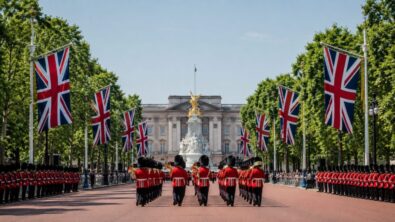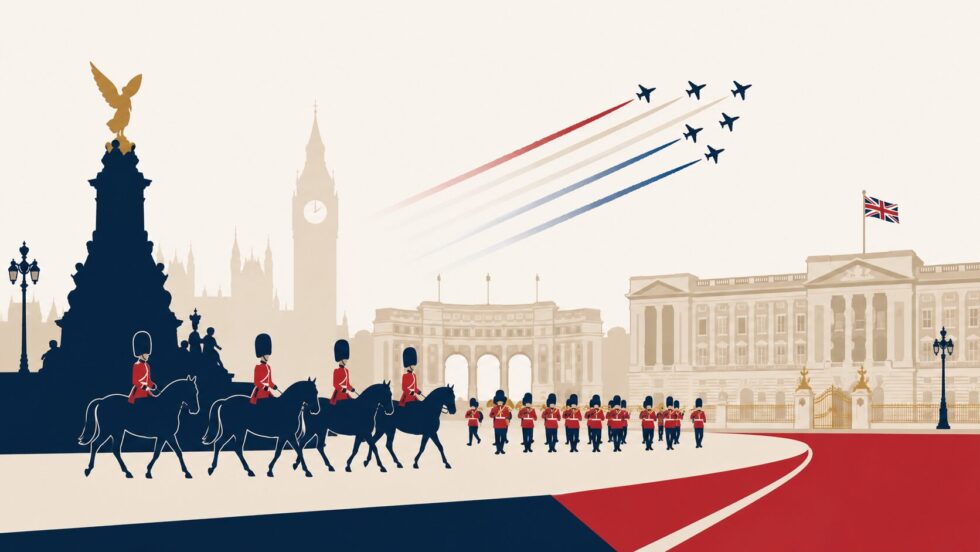
LONDON– Trooping the Colour returns to central London on Saturday, 13 June 2026, bringing more than 1,300 soldiers, 300 musicians and hundreds of horses to the ceremonial heart of Westminster as King Charles III's official birthday is marked with one of Britain's oldest royal traditions. Tens of thousands of spectators are expected to gather along The Mall, around Buckingham Palace and at Horse Guards Parade, while millions more follow the event worldwide through live television coverage.
This year's celebrations come with an important warning for visitors travelling into central London. Major engineering works linked to Transport for London's £3.4 billion Piccadilly line modernisation programme will affect several of the most commonly used routes into Westminster on the morning of the parade. The WP Times reports that parts of the Piccadilly line will remain closed until the afternoon, potentially affecting visitors heading towards Green Park, Hyde Park Corner and Buckingham Palace. Officials are urging spectators to plan alternative routes, arrive early and allow extra time for security checks, road closures and large crowds throughout the royal procession area.
The guide below explains everything visitors need to know about Trooping the Colour 2026, including the full schedule, parade route, best free viewing locations, transport alternatives, security arrangements and practical tips for navigating one of London's biggest ceremonial events.
What is Trooping the Colour
For the uninitiated, Trooping the Colour can look like an impossibly complex piece of military choreography. In essence, it is a ceremonial parade that marks the official birthday of the reigning monarch. The British sovereign actually has two birthdays — the real one, and an official one celebrated each June, a tradition that dates back to the reign of King George II in the eighteenth century, when it was decided that the monarch's birthday should be marked in the summer months regardless of when it actually fell.
The word "trooping" refers to the historic practice of carrying, or "trooping", the regimental colours — the flags — down the ranks of soldiers so that every man would recognise them on the battlefield. In an age before radio and modern communications, a regiment's colours were its rallying point, and the loss of a colour in battle was considered the deepest disgrace. The ceremony preserved today is a direct descendant of that practice, stripped of its battlefield function but retaining all of its drama. This year, the colour being trooped belongs to The King's Company, 1st Battalion Grenadier Guards. King Charles III is Colonel-in-Chief of the regiment, while Queen Camilla holds the title of Colonel of the Grenadier Guards. More than 1,350 soldiers of the Household Division and the King's Troop Royal Horse Artillery take part, alongside over 300 musicians drawn from the massed bands. Some 200 horses are involved, and a further 250 service personnel line the processional route along The Mall.
It is, by any measure, a substantial undertaking — and one that the British Army rehearses thoroughly. The 13 June parade is, in fact, the third of three consecutive Saturday events. The Major General's Review was held on 30 May, the Colonel's Review on 6 June, and Saturday's King's Birthday Parade is the main occasion, the one attended by the King himself.
The timings: when does it all happen
The ceremony itself begins at 10am at Horse Guards Parade, the large gravelled square off Whitehall. However, anyone hoping to see the King and the wider Royal Family will want to be in position considerably earlier, because the processions along The Mall begin before the parade proper. Here is the rough running order for the day:
The King travels in a royal procession from Buckingham Palace down The Mall to Horse Guards Parade, escorted by the Household Cavalry. Members of the Royal Family also make their way along the route, some by carriage and some on horseback. The procession sets off in good time for the 10am start, so the action on The Mall is well underway by mid-morning.
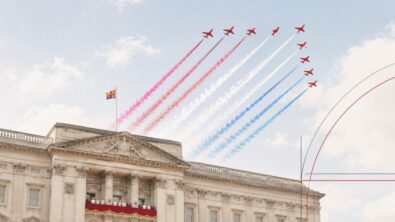
At Horse Guards Parade, the formal ceremony unfolds: the inspection of the line, the trooping of the colour itself, the march past in slow and quick time, and the musical drives of the mounted bands. The whole sequence takes a little under two hours. Once the ceremony concludes, the procession returns to Buckingham Palace, and the Royal Family gathers on the famous balcony. The day is brought to a close with a flypast by the Royal Air Force, which is scheduled for 1pm and can be watched from along The Mall and the area in front of the Palace. The flypast is weather-dependent — in years of low cloud it has been scaled back or cancelled — but in clear conditions it is one of the highlights, with a procession of military aircraft passing low over central London.
In short: aim to be in position by around 9am if you want a good spot, expect the main ceremony between 10am and just before noon, and stay put for the 1pm flypast if the skies are clear.
The route: where exactly does Trooping the Colour take place?
Although Trooping the Colour attracts hundreds of thousands of visitors and television viewers around the world, the entire event takes place within a surprisingly compact section of central Westminster. The ceremonial route stretches for roughly one kilometre between Buckingham Palace and Horse Guards Parade, passing through some of the most recognisable locations in Britain.
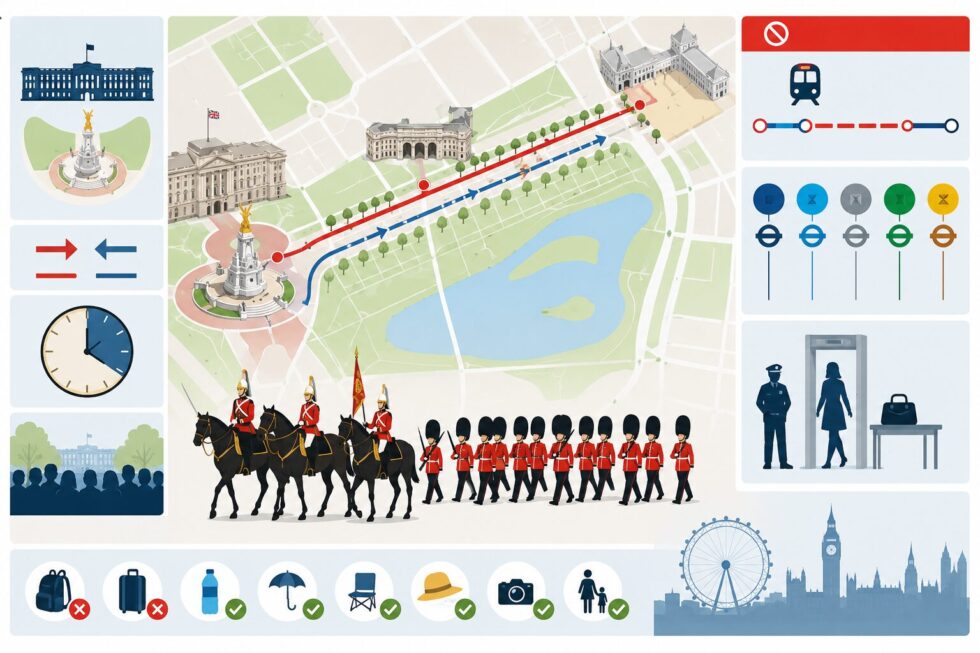
The day begins at Buckingham Palace, where members of the Royal Family assemble before travelling along The Mall. This broad ceremonial avenue, lined with Union Flags and mature trees, serves as the main artery of the parade. The procession passes the Queen Victoria Memorial, continues along the full length of The Mall, moves through Admiralty Arch and arrives at Horse Guards Parade, where the formal military ceremony takes place.
Horse Guards Parade is a historic parade ground located between Whitehall and Horse Guards Road, directly adjacent to St James's Park. It has been used for royal and military ceremonies for centuries and becomes the focal point of Trooping the Colour each June. Here, more than 1,300 soldiers, around 300 musicians and hundreds of cavalry horses perform one of the most precise military displays in the world before the King. Once the ceremony concludes, the Royal Procession returns along the same route. This means spectators positioned along The Mall have the advantage of seeing the royal carriages, mounted troops and Household Cavalry twice — once heading toward Horse Guards Parade and again during the return journey to Buckingham Palace. The day concludes with the Royal Family appearing on the Buckingham Palace balcony and the traditional Royal Air Force flypast over central London.
Where to watch Trooping the Colour for free
For most visitors, free viewing areas provide the best overall experience. While several thousand ticket holders watch from grandstands inside Horse Guards Parade, the majority of spectators gather along The Mall and around Buckingham Palace. The most sought-after location is the Queen Victoria Memorial directly outside Buckingham Palace. From here, visitors can see the King's procession depart, watch the return journey, witness the Royal Family gathering on the balcony and enjoy the RAF flypast. It is the only free location where all major elements of the day can be seen from a single position.
The eastern and central sections of The Mall are also extremely popular. Spectators standing against the barriers enjoy close views of mounted soldiers, military bands, royal carriages and Household Cavalry units. Many experienced visitors regard this as the most atmospheric part of the route because the parade passes within a few metres of the crowd.
Those looking for a calmer experience often choose St James's Park. While the ceremony itself is not visible from here, visitors can still watch parts of the procession and avoid some of the intense crowding found near Buckingham Palace. Families with children frequently prefer this area because it offers open space, shade and easier movement throughout the day. Visitors should be aware that the best positions are usually occupied very early. In many years, dedicated royal enthusiasts begin arriving before 6:00 a.m., and prime spots near Buckingham Palace are often filled by 8:00 or 9:00 a.m. Arriving later may mean standing several rows back from the barriers.
Security, road closures and practical advice
Security around Trooping the Colour is among the most extensive for any public event in London. Large sections of Westminster are placed under special security arrangements from the early morning hours. Roads surrounding Buckingham Palace, The Mall, Whitehall and St James's Park are subject to closures and restrictions. Pedestrian movement is controlled at various points and visitors may be directed through designated access routes. Bag searches are routine throughout the area. Security officers and police may inspect backpacks, handbags and other personal belongings before allowing access to crowded viewing zones. Large suitcases, oversized rucksacks and bulky items are strongly discouraged because they can slow entry and may be refused.
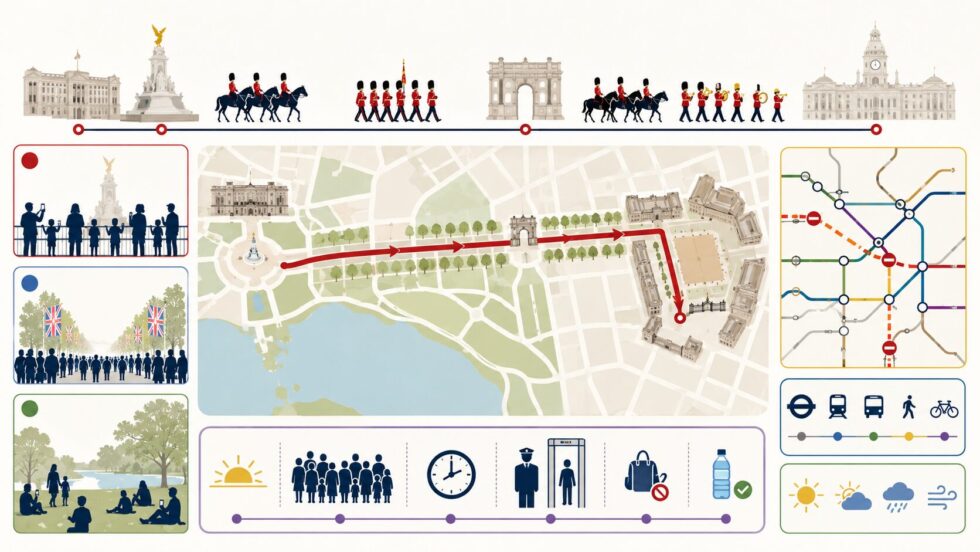
Visitors are advised to travel light, carry only essential items, bring water and be prepared for security procedures similar to those encountered at airports. Comfortable footwear is also recommended, as many spectators spend several hours standing before the parade begins.
The Piccadilly line problem: why transport will be more complicated this year
One of the biggest challenges facing visitors this year is the ongoing modernisation of London's Piccadilly line. Transport for London is carrying out a major £3.4 billion upgrade programme that will introduce 94 new walk-through air-conditioned trains across the network. To prepare for the introduction of the new rolling stock, sections of the line are being closed periodically for testing, engineering works and infrastructure improvements.
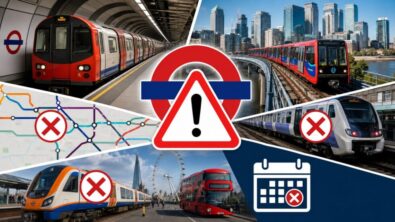
As a result, there will be no Night Tube service on the Piccadilly line during the night before the parade. More importantly, on the morning of Trooping the Colour there will be no service between Hyde Park Corner and Acton Town until 2:00 p.m. This creates a significant issue because Hyde Park Corner and Green Park are traditionally among the most convenient Underground stations for reaching Buckingham Palace and The Mall. Visitors who usually rely on the Piccadilly line from Heathrow, West London or central London will need to alter their travel plans. Fortunately, alternative Underground routes remain fully operational and provide straightforward access to the event.
Best stations to use instead
Green Park remains one of the most practical stations despite the Piccadilly disruption. The station is also served by the Victoria and Jubilee lines, both of which are operating normally. From Green Park, Buckingham Palace can be reached in approximately five minutes on foot. St James's Park station is another excellent choice. Served by the Circle and District lines, it places visitors within easy walking distance of Horse Guards Parade and provides one of the most reliable routes into the security zone.
Westminster station is particularly useful for visitors who wish to combine the parade with sightseeing. Located beside Big Ben and the Houses of Parliament, it offers access via the Jubilee, Circle and District lines and is approximately ten minutes' walk from Horse Guards Parade. Charing Cross and Embankment stations also provide convenient access from the eastern side of the route. These stations are especially useful for visitors arriving from South London or via National Rail services.
For those arriving from elsewhere in Britain, Victoria Station remains a major transport hub with connections to National Rail services, the Victoria line, Circle line and District line. Although it is likely to be busy throughout the day, it remains one of the most practical arrival points for Trooping the Colour visitors. Travellers coming from West London who would normally use the Piccadilly line should consider switching to the District line before reaching the closed section. This provides direct access to stations such as St James's Park and Westminster and avoids the disruption entirely.
A note on buses and walking
Be aware that the road closures around Westminster on parade day affect bus routes across the area. Many services are diverted or curtailed near the controlled zone, so a bus that normally takes you to the door may stop some distance away. Check the TfL website or the TfL Go app on the morning itself for live diversions, as these can change at short notice on the day.
Once you are in central London, walking is often the easiest way to move between viewing points. The distances between the key stations and The Mall are short — fifteen minutes or less in most cases — and on a busy ceremonial morning you may well find it quicker to walk than to wait for a diverted bus. Comfortable shoes are a sensible investment.
Checking before you travel
The golden rule for any journey across London on an engineering-works weekend is the same: check before you travel. TfL's Journey Planner and the TfL Go app are updated in real time and will reflect the latest position on closures, diversions and replacement services. What is true on Thursday may have shifted by Saturday morning, and live disruption — a signal failure, an unexpected delay — can layer on top of the planned works.
Give yourself plenty of extra time. On a normal Saturday you might allow half an hour to cross town; on parade day, with the Piccadilly closure, the crowds, and the road restrictions, doubling that is wise. There is nothing worse than missing the King's procession because you were stuck on a replacement bus.
What to expect on the day: the weather
London's June weather is famously unreliable, and this year has been no different. After an unusually warm spell in May, the capital has settled back into a more typical early-summer pattern — mild, often grey, with the occasional shower. For an outdoor event lasting several hours, in which you may be standing in one spot for a long time, dressing in layers is the sensible approach.
Bring a light waterproof, just in case, and if the forecast turns sunny, a hat and sun cream are worth having too — there is little shade along The Mall, and a few hours in the open can catch you out. A small foldable seat or cushion can make the long wait more comfortable, though bear in mind the security restrictions on what you can carry into the controlled area.
A refillable water bottle is also a good idea. The day can be long, particularly if you arrive early and stay for the flypast, and the area around The Mall gets extremely busy, so do not assume you will be able to nip out for refreshments easily once you are settled in your spot.
Accessibility and families
For visitors with mobility needs, the route presents both opportunities and challenges. The Mall is broad and largely level, which helps, but the crowds make movement difficult once the event is underway. Green Park station has step-free access, as do Westminster and several other nearby stations, but you should check the step-free status of your specific route in advance, particularly given the Piccadilly line closures, which may force you onto a less accessible alternative.
Families with young children should plan carefully. The long wait, the dense crowds, and the noise of the bands and the gun salutes can be overwhelming for little ones. Arriving early to secure a spot near the front, where children can actually see, is worth the effort, and bringing snacks, drinks and a small distraction or two will help see you through the wait. The St James's Park area, with its open grass and gentler crowds, is often a better bet for families than the crush against the Palace railings.
Beyond the parade: making a day of it
If you are coming into central London for Trooping the Colour, it makes sense to build the rest of your day around it. The parade and its associated processions are largely done by early afternoon, leaving plenty of time to explore.
St James's Park itself, right beside the route, is one of the loveliest of the royal parks, with its lake, its pelicans and its views back towards Buckingham Palace. Green Park and Hyde Park are within easy reach for a post-parade stroll. The galleries and museums of the West End are a short distance away, and the restaurants and pubs of St James's, Victoria and Westminster will be doing a brisk trade.
It is worth remembering, too, that Trooping the Colour falls in the middle of an extraordinarily busy week for the capital. The 2026 World Cup, hosted across the United States, Canada and Mexico, kicked off on 11 June, and pubs and bars across London are screening the matches. The Lido Festival has been drawing crowds to Victoria Park, and Harry Styles is curating this year's Meltdown at the Southbank Centre. If you are already in town for the parade, there is no shortage of ways to extend the day into the evening.
For those in the Westminster and Pimlico area in particular, the parade is very much a local event — it unfolds, after all, on your doorstep — and the days around it bring a steady stream of visitors into the neighbourhood. Local residents who would rather avoid the crowds may wish to plan their own movements around the road closures, which affect a wide area of Westminster from early morning until the processions are complete.
The history behind the spectacle
It is easy to watch Trooping the Colour purely as a piece of theatre, but the ceremony carries real historical weight. The tradition of marking the sovereign's official birthday with a parade dates back to 1748, and the event has been held with remarkable consistency ever since, interrupted only by exceptional circumstances. Queen Elizabeth II attended almost every one of her Trooping the Colours across her seven-decade reign, missing only 1955, when a rail strike disrupted the country, and 2020, during the pandemic.
The continuity is part of the appeal. When you watch the Grenadier Guards troop their colour on Saturday, you are watching a ceremony performed in much the same way that it was performed for previous monarchs, in a setting that has changed little in centuries. The bearskins, the scarlet tunics, the slow march, the massed bands — all of it connects the present day to a long line of British ceremonial tradition.
For King Charles III, now firmly established in his reign, the parade is among the most visible expressions of the monarchy's ceremonial role, broadcast live on the BBC and watched by millions at home and around the world. It is, in its way, a piece of national continuity made visible — and on Saturday, for the price of an early start and a well-planned journey, you can watch it unfold in person.
Security: what you can and cannot bring
The area around Horse Guards Parade and The Mall becomes a controlled security zone on parade day, and entry points are staffed by police and stewards. Expect bag searches, and in some areas airport-style screening. The smoother you make this for the officers on duty, the quicker you get through and to your spot.
Leave large rucksacks and suitcases at home — there is no left-luggage facility, and oversized bags will slow you down or be turned away. A small day bag is fine. Sharp objects, glass bottles, and anything that could be considered a weapon are prohibited, as are drones, which are strictly banned over the entire area for the duration of the event. Folding chairs and picnic blankets are generally tolerated in the park areas but may not be permitted in the densest crowd zones along the barriers, so do not rely on having somewhere to sit right at the front.
Alcohol is best left out of your bag; while a quiet drink in St James's Park is one thing, attempting to bring quantities of alcohol into the controlled zone is likely to cause problems at the search points. As ever, treat the occasion as the formal national event it is, and you will have no difficulties.
A station-by-station guide
To make the planning as simple as possible, here is a quick rundown of the most useful stations and how to use them on the day.
Green Park is your best bet for the Buckingham Palace end of the route. It is served by the Jubilee, Victoria and Piccadilly lines — and because the Jubilee and Victoria lines are running normally, you can still reach it despite the Piccadilly closure. From the station it is a short walk through Green Park itself down to the Queen Victoria Memorial. The station has step-free access from street to platform.
St James's Park sits on the Circle and District lines, both running on the day, and brings you out close to the southern end of Horse Guards Parade. This is arguably the most convenient station for the ceremony itself.
Westminster, on the Jubilee, Circle and District lines, is a few minutes' walk away and has the advantage of depositing you beside the Houses of Parliament — a fine spot for photographs before you make your way up to The Mall.
Charing Cross and Embankment, both a short walk from the Whitehall end, are useful if you are arriving on the Northern or Bakerloo lines, or via mainline rail into Charing Cross.
Victoria, around fifteen minutes' walk from the Palace, is the natural arrival point for anyone coming in on Southern, Southeastern or Gatwick Express mainline services, or on the Victoria line.
Whichever you choose, avoid relying on the Piccadilly line to reach Hyde Park Corner in the morning — that stretch is closed until 2pm.
Frequently asked questions
Is Trooping the Colour free to watch? Yes. While seated tickets on Horse Guards Parade were sold and balloted earlier in the year, watching from The Mall and around Buckingham Palace is completely free. You simply turn up and find a spot along the route.
What time should I arrive? For a good free viewing position near the Palace or along The Mall, aim to be in place by around 9am at the latest. The prime barrier-side spots fill up well before then.
Will I see the King? If you are positioned along The Mall or near the Queen Victoria Memorial, you should see the royal procession pass on its way to and from Horse Guards Parade, and you will be well placed for the balcony appearance after the ceremony.
Is there a flypast? Yes, weather permitting. The RAF flypast is scheduled for 1pm and is best viewed from The Mall or in front of Buckingham Palace. In poor weather it can be reduced or cancelled.
How long does it last? The formal ceremony runs from 10am to a little before noon, with the processions before and after, and the flypast at 1pm. Allow the best part of the morning and early afternoon if you want to see the whole thing.
Can I bring children? Absolutely, and many families do. Just plan for the long wait and the crowds — arrive early, bring snacks and drinks, and consider the more open St James's Park area if the crush near the Palace feels too much for young ones.
Travel & Closures — Trooping the Colour, Saturday 13 June 2026
Road closures
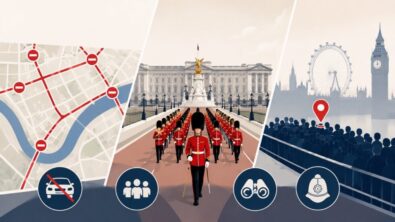
The ceremonial zone in Westminster closes to traffic from early morning until the processions finish. There is no parking and no dropping-off anywhere in Whitehall or around Horse Guards, and vehicles are not permitted within the controlled area. The streets affected are those framing the parade route:
- The Mall — closed end to end, from the Queen Victoria Memorial (Buckingham Palace) through Admiralty Arch. This is the spine of the route.
- Horse Guards Road (north and south sections) — closed; runs along the west side of Horse Guards Parade, bordering St James's Park.
- Whitehall — restricted around Horse Guards Arch, the eastern entrance to the parade ground.
- Birdcage Walk / Great George Street — closed or controlled along the southern edge of St James's Park.
- Spur Road and Constitution Hill — closed around the Palace for the processions.
Expect bus diversions across the whole of Westminster, St James's and Victoria. Routes that normally pass Trafalgar Square, Whitehall, Victoria Street and the Palace are diverted or curtailed. Check the TfL Go app on the morning itself, as on-the-day diversions change at short notice.
Official security access points (ticket holders)
Entry point depends on your stand:
- Stands A, B, C and Standing North — via The Mall, Horse Guards Road (north) and Admiralty Citadel.
- Stands D, E, F, G and Wheelchair — via Whitehall and Horse Guards Arch.
- Stands H, J, K, L, M, N — via Birdcage Walk / Great George Street, Horse Guards Road (south) and the Churchill War Rooms.
Nearest stations — addresses and which lines are running
| Station | Address | Lines | Running on the day |
|---|---|---|---|
| St James's Park | Broadway, SW1H 0BD | Circle, District | Yes — closest to the parade ground |
| Westminster | Bridge Street, SW1A 2JR | Jubilee, Circle, District | Yes — by Parliament and Big Ben |
| Green Park | Piccadilly, W1J 9DZ | Jubilee, Victoria, Piccadilly | Yes — via Jubilee or Victoria only |
| Charing Cross | Strand, WC2N 5DN | Northern, Bakerloo | Yes — Whitehall end |
| Embankment | Victoria Embankment, WC2N 6NS | Northern, Bakerloo, Circle, District | Yes — Whitehall end |
| Victoria | Victoria Street, SW1E 5ND | Victoria, Circle, District, mainline | Yes — about 15 minutes' walk |
| Hyde Park Corner | Knightsbridge, SW1X 7LY | Piccadilly | No — closed until 2pm |
The key transport problem
- Friday 12 June, overnight: the entire Piccadilly line is shut (no Night Tube).
- Saturday 13 June: no Piccadilly service between Hyde Park Corner and Acton Town until 2pm. The closest western Tube stop to the Palace is out of action all morning.
Workaround: do not plan to arrive at Hyde Park Corner. Use Green Park via the Jubilee or Victoria line (both running normally), or come in from the south on the Circle or District line to St James's Park or Westminster. Nearest mainline stations are Charing Cross, Victoria and Waterloo.
Practical points
- Be in place by around 9am for a free spot on The Mall or by the Victoria Memorial.
- Parade begins 10am at Horse Guards Parade; RAF flypast at 1pm, weather permitting.
- No parking and no drop-off in the zone — do not drive.
- Travel light. Bag searches operate at entry; no large rucksacks, no glass, and drones are banned over the area.
If you take nothing else away from this guide, remember these points. The King's Birthday Parade takes place on Saturday 13 June, beginning at 10am at Horse Guards Parade, with the royal processions along The Mall before and after, and the RAF flypast scheduled for 1pm. The best free viewing is along The Mall and around the Queen Victoria Memorial, and you should aim to be in position by around 9am.
Crucially, the Piccadilly line is closed between Hyde Park Corner and Acton Town until 2pm on the day, with the whole line shut overnight on Friday. Use Green Park via the Jubilee or Victoria line, or St James's Park and Westminster via the Circle and District lines, and check TfL's Journey Planner or the TfL Go app before you set off. Allow extra time, dress for changeable weather, travel light to clear security quickly, and arrive early.
Get those things right, and you will be well placed to enjoy one of London's great free spectacles — a morning of pageantry, music and ceremony in the heart of Westminster, played out as it has been for generations.
Read about the life of Westminster and Pimlico district, London and the world. 24/7 news with fresh and useful updates on culture, business, technology and city life: UK Visa Changes 2026: What Foreign Workers Need To Know About New Salary Rules, English Tests And Settlement Delays