Kurban Bayram 2026 — known across the Muslim world as Eid al-Adha and in Britain simply as the Festival of Sacrifice — falls this year on Wednesday 27 May 2026, with celebrations beginning on the evening of Tuesday 26 May and continuing through the days of Tashreeq until Friday 29 May; for London’s Muslim communities — more than a million people across districts from Whitechapel to Southall, Wembley to East Ham — it is the holier of the two annual Eids and the spiritual climax of the Hajj pilgrimage taking place simultaneously in Mecca, as The WP Times reports.
This guide brings together everything a Londoner needs in one place: confirmed dates and how moon-sighting works, prayer times and locations across the capital, the legal realities of Qurbani in Britain, where Eid is most visible, the events worth attending, the transport patterns to plan around, and — uniquely this year — how to observe safely during the forecast heatwave across southern England. This is not a public holiday in the United Kingdom. Schools and workplaces remain open. And yet, on the morning of 27 May, tens of thousands of worshippers will gather in mosques, parks and community halls across Greater London before sunrise has fully warmed the streets, and the rhythm of the city will shift — quietly but unmistakably — around a festival now firmly woven into the fabric of British public life.
When Kurban Bayram 2026 begins in London and across Britain
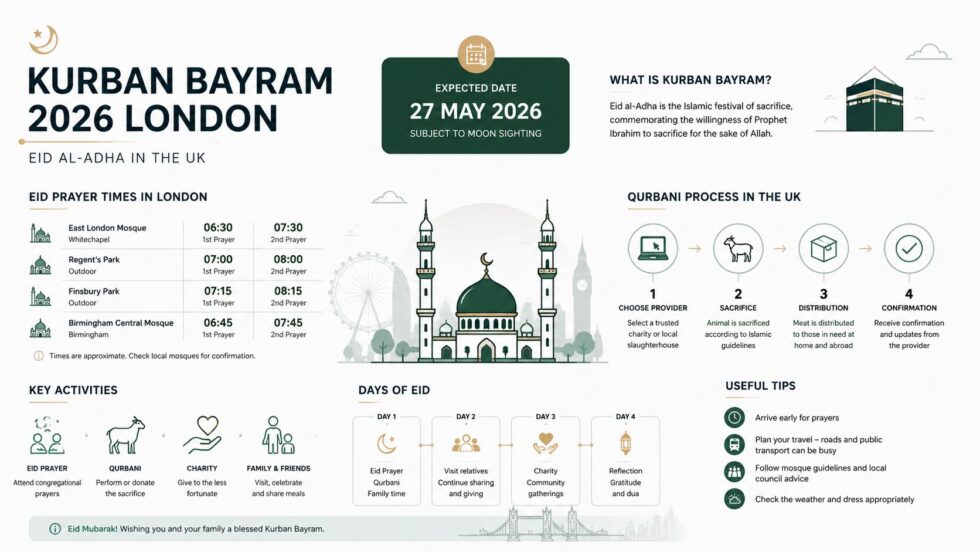
The short answer: the main day of Eid al-Adha in the UK is Wednesday 27 May 2026, corresponding to the 10th of Dhul Hijjah 1447 in the Islamic lunar calendar. The festival begins at sunset on Tuesday 26 May and the four days of celebration — the Day of Sacrifice followed by the three Days of Tashreeq — run through to roughly Friday 29 or Saturday 30 May, depending on which sighting convention a given community follows.
The longer answer requires understanding how the date is fixed, because it is not fixed in the way a Western calendar date is. Dhul Hijjah, the twelfth and final month of the Islamic year, begins on Monday 18 May 2026. The Hajj pilgrimage proper begins around Monday 25 May. The Day of Arafah — the most spiritually significant single day of the Islamic year, when pilgrims gather on the plain of Arafat and Muslims worldwide fast — falls on Tuesday 26 May 2026. Eid al-Adha then begins the following day, the 10th of Dhul Hijjah, which is Wednesday 27 May.
Because the Islamic calendar is lunar, every date depends ultimately on the sighting of the new crescent moon, and this is where London's communities sometimes diverge. Broadly there are two approaches. Many British Muslims follow the official announcements from Saudi Arabia, aligning their Eid with the dates of Hajj; under this convention the 27 May date is settled. Others follow local UK moon-sighting, coordinated by bodies such as the New Crescent Society and confirmed by individual mosque committees, which can occasionally shift the observance by a day. The practical upshot for 2026 is that the overwhelming majority will mark Eid on Wednesday 27 May, but a minority of mosques may announce a different day after the crescent is — or is not — sighted on the evening of 25 or 26 May. Anyone planning prayer attendance should confirm with their own mosque in the final twenty-four hours rather than assume. It is worth dwelling on the date's coincidence with the Western calendar this year. Falling on a Wednesday in late May, immediately after the spring bank holiday weekend of 23–25 May, Eid al-Adha 2026 lands in a window when many families are already part-way through a half-term break. That timing has consequences for transport, for school attendance, and for the texture of the week across London's most heavily Muslim boroughs — all of which this guide returns to below.
What Eid al-Adha commemorates and why it is the greater Eid
To understand the scale of observance in London, it helps to understand the weight of what is being marked. Eid al-Adha commemorates the willingness of the Prophet Ibrahim — Abraham in the Judeo-Christian tradition — to sacrifice his son Ismail in obedience to a command he believed came from God. At the moment of sacrifice, according to Islamic teaching, God intervened and provided a ram in the boy's place, rewarding Ibrahim's submission and sparing his son. The festival therefore celebrates obedience, trust, mercy and the substitution of life for life.
This is the theological reason Eid al-Adha is often described as the "greater" of the two Eids. Eid al-Fitr, which closes the fasting month of Ramadan, is a joyful release after a period of discipline; Eid al-Adha is bound up with the central narrative of submission to the divine will and with the Hajj, the once-in-a-lifetime obligation that sits as one of the five pillars of Islam. There are practical differences in observance too that newcomers to the festival often notice. For Eid al-Fitr it is customary to eat something sweet, traditionally dates, before attending the morning prayer; for Eid al-Adha, eating is delayed until after the prayer and, traditionally, until after the sacrifice. The charitable obligation differs as well: Eid al-Fitr is associated with Zakat ul-Fitr, a modest per-person donation, whereas Eid al-Adha is associated with Qurbani, the sacrifice itself or its monetary equivalent.
For the roughly 3.9 million Muslims in the United Kingdom — and the more than one million living in Greater London — these distinctions are not abstract. They shape how the day is structured from before dawn onwards, and they explain why the Festival of Sacrifice carries a gravity that even non-Muslim Londoners can sense in the streets of Tower Hamlets or Newham on the morning of Eid.
Kurban Bayram 2026 London prayer times and locations
The defining communal moment of Eid al-Adha is the Eid prayer — Salat al-Eid — held in congregation shortly after sunrise. In a city the size of London, with so many worshippers concentrated in particular districts, the logistics are formidable, and the major mosques respond by running multiple consecutive prayer sessions, sometimes called "jamaats," through the early morning to move tens of thousands of people through their prayer spaces in waves.
Exact times for 2026 will be confirmed by each mosque in the days before Eid, and they depend partly on the sunrise time and partly on each institution's own scheduling. As a rough guide, sunrise in London on 27 May falls very early — before 5am — and Eid prayers typically begin somewhere between 6.30am and 9am across the various sessions. The table below sets out an approximate picture of the kind of schedule London's major prayer hubs operate; treat it as indicative and verify against the specific mosque's announcement.
| Prayer location | First jamaat (approx.) | Later jamaats | Notes |
|---|---|---|---|
| East London Mosque, Whitechapel | 06:30 | 07:30, 08:30, 09:30 | Among the largest in Europe; very high demand, arrive early |
| London Central Mosque, Regent's Park | 07:00 | 08:00, 09:00 | Iconic open and indoor spaces; weather-dependent overflow |
| Finsbury Park Mosque | 07:15 | 08:15 | Family-friendly, established community hub |
| Harrow Central Mosque | 06:45 | 07:45, 08:45 | Serves north-west London's large community |
| Croydon Mosque & Islamic Centre | 07:00 | 08:00 | Key hub for south London |
| Open-air Eid gatherings (various parks) | 07:30 onwards | rolling | Borough-organised; subject to council permissions and weather |
A few practical points matter more than the precise minute of any one session. First, demand is intense and the most popular early sessions fill fastest, so arriving well ahead of your chosen jamaat — thirty to forty-five minutes early is sensible at the largest venues — is the difference between praying inside the main hall and praying in an overflow space or on the street. Second, many mosques request that worshippers bring their own prayer mats for overflow areas. Third, families with young children often opt for the later sessions or the open-air gatherings, which tend to be less crushingly busy than the flagship 6.30am jamaat at a venue like the East London Mosque.
Open-air Eid prayers in London's parks have become a visible feature of the festival over the past decade, with boroughs and mosque partnerships organising gatherings in green spaces that can accommodate far larger numbers than any single building. These depend on council permissions and, critically this year, on the weather — a point that takes on real significance given the forecast (see the section on heat safety below).
How Qurbani works in Britain: the legal and practical realities
For anyone unfamiliar with how Eid al-Adha is observed in the United Kingdom, the single biggest point of difference from practice in Muslim-majority countries concerns Qurbani — the ritual sacrifice of an animal. In many countries the sacrifice is carried out at home, on the street, or at informal sites, often within sight of the family. In Britain this is not permitted, and understanding why and how the alternative works is essential for any London Muslim intending to fulfil the obligation.
The law
British animal-welfare legislation, principally the Welfare of Animals (Slaughter or Killing) Regulations 1995 and the framework overseen by the Food Standards Agency, requires that all religious slaughter — including halal Qurbani — takes place in a licensed, FSA-approved slaughterhouse under the supervision of trained, licensed slaughtermen. Performing Qurbani at home, in a garden, or anywhere outside an approved abattoir is illegal in England, Scotland and Wales. There is no exemption for the festival. FSA inspectors are required to be present at slaughterhouses during production, and the carcasses must meet hygiene and labelling standards.
This is not a restriction designed to obstruct the festival; it is the same regulatory regime that governs all meat production in the country, applied without religious exception. But it does mean that the romantic image of a family carrying out the sacrifice themselves, familiar from observance abroad, simply does not translate to the British context. London Muslims who wish to perform Qurbani take one of two routes.
Route one: the licensed halal butcher or supplier
The first option is to arrange Qurbani through a local halal butcher or licensed supplier who works with an approved slaughterhouse. The animal is slaughtered at the abattoir according to halal requirements and after the Eid prayer, and the meat is then collected from or delivered by the butcher. London's heavily Muslim districts — Whitechapel, East Ham, Southall, Wembley — are well served by butchers offering pre-booked Qurbani services, and demand around Eid is so high that booking well in advance is strongly advised.
There is an important religious-timing nuance here that the Halal Food Information Centre has campaigned on for years. A valid Qurbani sacrifice can only take place after the Eid prayer on the morning of Eid al-Adha — not before. Because sunrise on the first day of Eid in 2026 is so early, and because slaughterhouses are mostly located in the rural countryside far from urban butcher shops, the earliest a genuine Qurbani slaughter can be performed is roughly 45 minutes after sunrise at the abattoir's location — meaning around 5.30am in the north, 5.45am in the Midlands and 6.00am in the south. Meat slaughtered before that window is ordinary halal meat, not Qurbani, and selling it as Qurbani is fraud. The practical lesson for consumers: if you want certainty, ask your butcher to provide the slaughterhouse's Qurbani label showing the time and date of slaughter.
Route two: charitable Qurbani
The second route, and the one an increasing number of London families now choose, is to donate the value of the Qurbani through an established UK Islamic charity. The charity arranges the sacrifice on the donor's behalf — sometimes domestically, but very often in countries facing food insecurity — and distributes the meat to vulnerable families. Major providers include Islamic Relief UK, Muslim Aid, Human Relief Foundation and Human Appeal, among many others. Islamic Relief, for example, runs a "Quality Assured Qurbani" programme intended to guarantee both sharia compliance and humanitarian standards from livestock inspection through to distribution.
Costs in 2026 reflect the full chain of animal, slaughter, transport and distribution. As a guide, a single share — typically a sheep or goat, or one of seven shares in a larger animal such as a cow — runs from roughly £65 to £160 depending on the charity and the country of distribution, while a whole animal ranges from around £200 to £350. Domestic UK Qurbani through a butcher tends towards the higher end, with sheep or goats commonly priced between £120 and £150.
The meat from Qurbani, whichever route is taken, is traditionally divided into three equal portions: one third for the family, one third for relatives and friends, and one third for those in need. The emphasis on the final third — feeding the poor — is central to the festival's meaning, and it is why so many London Muslims feel that donating through a charity to communities facing genuine hunger fulfils the spirit of Qurbani even more completely than a local sacrifice would.
| Qurbani option | Typical 2026 cost | What it involves |
|---|---|---|
| Single share (charity) | £65 – £160 | One share via UK charity, distributed locally or abroad |
| Whole animal (charity) | £200 – £350 | Full sheep, goat or share of cattle via charity |
| Local halal butcher (UK) | £120 – £150 (sheep/goat) | Slaughter at approved abattoir, meat collected in person |
| International Qurbani | varies by country | Distributed to food-insecure communities overseas |
A final legal point worth noting for employees: Eid al-Adha is not a UK bank holiday, and employers are not legally obliged to grant the day off. However, the Equality Act 2010 requires employers to consider reasonable accommodation for religious observance, and many London workplaces — particularly in boroughs with large Muslim workforces — handle annual-leave requests around Eid as a matter of routine.
Where Kurban Bayram is most visible in London
Eid al-Adha is observed by Muslims right across the capital, but in certain boroughs the festival becomes a visible, public phenomenon — reshaping the high street, the transport network and the soundscape of the morning. These are the districts where decades of settlement have built dense communities and the infrastructure of mosques, halal butchers, sweet shops and clothing retailers that the festival depends on.
Tower Hamlets — encompassing Whitechapel, Stepney and Bethnal Green — is perhaps the single most concentrated focal point, anchored by the East London Mosque, one of the largest in Western Europe. On Eid morning the area around Whitechapel Road fills with families in new clothes moving between prayer sessions, and the bakeries and restaurants of the district run at peak capacity.
Newham, and East Ham in particular, is another epicentre, with a large and diverse Muslim population spanning South Asian, African and Arab heritage. The high streets here see some of the most intense pre-Eid shopping in the city.
Ealing's Southall, long the heart of London's South Asian communities, brings its own distinct character to the festival, with a strong Pakistani and Bangladeshi Muslim presence alongside its better-known Sikh and Hindu communities.
Brent, including Wembley and surrounding areas, hosts a large and varied Muslim population served by significant mosques across the borough.
Beyond these, communities in Redbridge, Waltham Forest, Croydon, Harrow and elsewhere mark the day with their own gatherings. What unites them is a set of predictable rhythms in the days before and during Eid: halal butchers experience their peak demand of the year; bakeries and sweet shops ramp up production of festival sweets and pastries; clothing retailers see a spike in last-minute purchases of new outfits for the prayer; and, on the morning itself, public transport and the streets near major mosques grow noticeably busier in the early hours.
Eid events and gatherings across London in 2026
Although Eid al-Adha is the more solemn and religiously weighted of the two Eids, its public, celebratory dimension has expanded considerably in London over the past decade. The model pioneered by "Eid in the Park" and similar borough festivals — combining communal prayer with funfair rides, food stalls, children's entertainment and cultural performances — has spread across the capital, transforming what was once a primarily private, family-and-mosque occasion into something with a genuine civic profile.
Typical events around Eid al-Adha in London include community festivals held in parks and open spaces; charity food drives and communal meals organised by mosques; children's entertainment zones with rides and activities; and cultural performances reflecting the heritage of the communities involved. Borough councils, mosque partnerships and community organisations are the usual organisers, and many of these gatherings are free to attend and open to all, including non-Muslim neighbours curious to learn about the festival.
Because the precise line-up of 2026 events is confirmed by organisers closer to the date — and because some open-air gatherings depend on council permissions and weather — anyone wanting to attend a specific festival should check with their local mosque, their borough council's website, or community social-media channels in the week before Eid. The pattern across recent years suggests that families in Tower Hamlets, Newham, Brent and the south-London boroughs will have well-organised public gatherings within easy reach, with the open-air prayer often forming the centrepiece around which the rest of the day's festivities build.
Transport, travel and movement patterns during Eid
Eid morning creates a distinctive pulse across London's transport network, and planning around it makes the difference between a smooth start to the day and a frustrating one. The key feature is concentration in time and place: tens of thousands of people travelling to a relatively small number of prayer sites within the same early-morning window, then dispersing.
What to expect, in practical terms: an early-morning surge on buses and Underground lines serving the major prayer hubs, particularly between roughly 6am and 9am; heightened demand for taxis and private-hire vehicles near mosques, both before and after prayers; and temporary congestion — pedestrian and vehicular — in the immediate vicinity of the largest gathering sites such as the East London Mosque in Whitechapel or London Central Mosque at Regent's Park. Transport for London does not typically alter its scheduled services for Eid, so the network runs to its normal weekday timetable, but the localised demand spikes are real.
The advice that follows from this is straightforward. Travel early, ideally ahead of the peak prayer window rather than into it. Avoid arriving at a major mosque by car if you can possibly use public transport, as parking near the largest sites is effectively impossible on Eid morning. Plan your return journey in advance, since the dispersal after each jamaat creates its own crowds. And build in extra time — what looks like a fifteen-minute walk from the station to the mosque can take considerably longer when thousands of others are making the same journey.
A 2026 complication: Piccadilly line closures and the heatwave
Two factors specific to this year deserve flagging. First, Transport for London is running an extensive programme of Piccadilly line closures through the summer of 2026 to test its new train fleet, and one of the earliest of these — a four-day closure of the western section between Acton Town and Heathrow — runs from Thursday 28 to Sunday 31 May, immediately after Eid. This will not affect the prayer-morning commute of most worshippers on 27 May itself, but it is highly relevant to the many families who travel to visit relatives or fly abroad in the days following Eid, particularly anyone heading to or from Heathrow during that window. Check the TfL journey planner before travelling and allow for replacement routes to the airport.
Second, and more immediately, the south of England — including London — is forecast to be in the grip of an early-summer heatwave across the Eid period, with the UK Health Security Agency having issued a heat-health alert and temperatures climbing well into the high twenties and, on the hottest days, towards the low thirties Celsius. For a festival whose central communal act is an outdoor or semi-outdoor dawn gathering of large crowds, this is not a trivial detail.
Health, safety and observing Eid in the 2026 heatwave
In most years, a section on health and safety for Eid would be a brief note about arriving early and supervising children in crowds. In 2026 it carries more weight, because the combination of very large outdoor gatherings and a genuine heatwave creates conditions that warrant real attention — especially for the elderly, the very young, pregnant women, and anyone with a heart or respiratory condition.
The early timing of Eid prayers is, fortunately, a help here: a 6.30am or 7am jamaat takes place in the coolest part of the day, before the sun has reached its full intensity. The risk grows later — at mid-morning and midday community gatherings, funfairs and outdoor festivals where families may spend hours in direct sun. Sensible precautions make a meaningful difference. Stay hydrated, carrying water to outdoor prayers and gatherings, and remember that those observing the festival are not fasting on Eid day itself, so there is no religious barrier to drinking water freely. Seek shade during the hottest hours, roughly 11am to 3pm. Dress for the heat within the bounds of modest, festive clothing — light, loose, breathable fabrics. Watch over children and older relatives in particular, as both are more vulnerable to heat. And be alert to the signs of heat exhaustion — dizziness, headache, nausea, excessive thirst, cramping — moving anyone affected to a cool, shaded place and giving fluids.
For those organising or attending open-air prayers and festivals, the heatwave may also affect the events themselves: some organisers may add shade, water points or earlier start times, and a small number may adjust or relocate gatherings if conditions become extreme. This is another reason to check with your mosque or borough in the final day or two before Eid rather than relying on last year's arrangements.
Beyond the heat, the standard crowd-safety advice holds: arrive early to avoid the worst crush, follow the stewarding and guidance issued by mosque organisers, keep children within sight in busy areas, and identify in advance where to reunite if your group is separated.
Shopping, food and the economic footprint of Eid in London
Kurban Bayram leaves a measurable mark on London's economy in the days surrounding it, concentrated in a handful of sectors and most visible in the city's Muslim-majority districts. The halal food industry sees its single biggest demand peak of the year, as families buy in bulk for the festive meals that follow the prayer and, where they perform domestic Qurbani, for the meat itself. Butchers in Whitechapel, East Ham and Southall report queues; sweet shops and bakeries extend their hours and ramp up production of the pastries, halva and confectionery central to Eid hospitality.
Retail beyond food benefits too. The tradition of wearing new clothes to the Eid prayer drives a reliable spike in clothing sales — formal and traditional wear especially — in the days beforehand, with last-minute shopping a familiar feature of the final evening. Gift-giving, particularly money or presents to children (the custom often called "Eidi"), adds another layer of spending. And travel sees its own surge, both domestic, as families journey to visit relatives across the country, and international, as some travel abroad to be with extended family for the festival — which is precisely why the post-Eid Piccadilly line closures to Heathrow matter to so many households this year.
| Spending category | Typical Eid behaviour in London |
|---|---|
| Food | Bulk purchases of halal meat and ingredients for family feasts |
| Clothing | New outfits, especially formal and traditional wear, for the prayer |
| Charity | Qurbani donations plus additional giving to those in need |
| Gifts (Eidi) | Money and presents, particularly for children |
| Travel | Domestic visits to relatives; some international travel |
Charitable giving deserves its own emphasis. Beyond Qurbani, Eid al-Adha prompts a broader wave of donations — to mosques, to food banks (a growing number of which now accept Qurbani meat), and to humanitarian appeals. For many London Muslims the festival is as much about this outward generosity as about the family celebration, and the charities that handle Qurbani report that allocations fill up well before Eid arrives, which is why every charity's advice is the same: give early.
The multicultural character of Eid in Britain
One of the defining features of Kurban Bayram in London — and what makes it so different from the festival as experienced in any single Muslim-majority country — is its multicultural expression. The capital's Muslim communities are extraordinarily diverse, and Eid al-Adha is a moment when those distinct heritages are both celebrated and brought into a shared frame.
Turkish and Turkish-Cypriot families — for whom the festival's very name in Britain, "Kurban Bayram," is the Turkish term — prepare traditional dishes and observe customs particular to Anatolian and Balkan traditions. South Asian communities, the largest Muslim grouping in the UK, host large extended-family gatherings with the food and customs of Pakistan, Bangladesh and India. Arab families often place particular emphasis on charity and hospitality. African Muslim communities, from Somalia, Nigeria and beyond, bring their own traditions. And across all of them, converts and mixed-heritage families add further texture.
What is striking is how the core of the festival holds constant beneath all this variety. Whatever the cuisine on the table or the language of the greeting — "Eid Mubarak," "Bayramınız kutlu olsun," and dozens of others — the essential elements are shared: the dawn prayer in congregation, the sacrifice or its charitable equivalent, the emphasis on charity to the poor, and the gathering of family. In a city as diverse as London, Eid al-Adha functions as a kind of demonstration of unity-in-difference, a single festival observed in a hundred culturally distinct ways that nonetheless recognise one another instantly.
Practical checklist for Eid al-Adha 2026 in London
For readers who want the essentials distilled, here is a practical summary for the days around 27 May 2026:
Confirm the date. The main day is Wednesday 27 May, but check your own mosque's announcement in the final 24 hours, as moon-sighting conventions differ between communities.
Choose and verify your prayer session. Decide which mosque or open-air gathering you will attend, check its specific jamaat times, and plan to arrive 30–45 minutes early at the larger venues. Bring a prayer mat for overflow areas.
Sort your Qurbani early. Whether through a local halal butcher or a charity, book well in advance — allocations and slots fill up before Eid. If using a butcher, ask for the slaughterhouse Qurbani label to confirm the meat is valid.
Plan transport around the peaks. Travel early, use public transport rather than driving to major mosques, and remember the Piccadilly line closure to Heathrow from 28–31 May if you are travelling onward after Eid.
Prepare for the heat. Carry water to outdoor prayers and gatherings, seek shade in the middle of the day, dress in light breathable clothing, and keep a close eye on children and elderly relatives.
Give generously and early. Beyond Qurbani, the festival is a moment for charity to those in need — and the organisations that handle it ask donors not to leave it to the last minute.
Why Kurban Bayram 2026 matters more than ever in Britain
It is tempting to treat a festival that is not a public holiday as a marginal event in the national calendar. That would be a mistake. Kurban Bayram 2026 reflects the evolving and increasingly central role of Muslim communities in British public life. Its scale — more than a million observers in London alone — its visibility in the city's high streets and parks, and its measurable economic footprint all continue to grow year on year. The expansion of public "Eid in the Park" festivals, the routine accommodation of Eid leave in major employers, the borough councils issuing guidance and granting park permissions: all of it signals a festival that has moved from the private sphere into the shared civic life of the capital.
At the same time, the festival illuminates broader themes that run through modern Britain — the negotiation between religious obligation and secular regulation, visible in the careful legal framework around Qurbani; the practice of religious freedom within a pluralist society; the reality of urban diversity, nowhere more concentrated than in London; and the resilience and self-organisation of communities that have built, over generations, the mosques and institutions that make a festival of this scale possible in a city that offers it no official holiday.
For London, Eid al-Adha is no longer simply a religious observance confined to the faithful. It has become a city-wide moment — one that reshapes the daily rhythms of entire boroughs, connects diverse communities to one another and to their global co-religionists on Hajj, and reinforces, every late spring or early summer, London's standing as one of the most genuinely diverse capital cities in the world. On the morning of Wednesday 27 May 2026, before most of the city has stirred, hundreds of thousands of Londoners will rise in the dawn heat, dress in their finest, and gather to pray. The roads will be a little busier, the butchers a little fuller, the parks a little louder. And the city, as it does every year, will quietly make room.
Read about the life of Westminster and Pimlico district, London and the world. 24/7 news with fresh and useful updates on culture, business, technology and city life: Trooping the Colour 2026: 13 June Route, Road Closures, Mall Times and Best Free Viewing Spots Guide