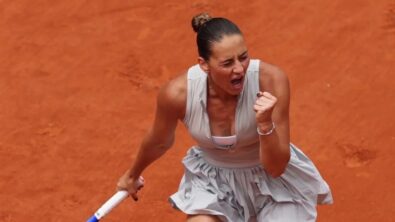
Emma Raducanu and Katie Boulter have given British tennis its first serious Wimbledon marker of the summer after a rain-affected week at Queen’s produced two semi-final runs of real consequence. Boulter delivered the result of the tournament on Friday 12 June 2026, defeating world No 2 Elena Rybakina 7-5, 2-6, 6-4 in west London, while Raducanu followed her victory over Sorana Cirstea by beating Kamilla Rakhimova 6-3, 7-5 on Saturday, even after slipping in the second set and requiring treatment on her left thigh.
The WP Times reports, citing BBC Sport, that the two results have changed the tone of Britain’s grass-court build-up. Queen’s is no longer merely a staging post before Wimbledon; for Raducanu and Boulter, it has become a test of form, durability and competitive authority. Boulter’s win over Rybakina was the biggest of her career by ranking, built on resistance under pressure rather than sentiment. Raducanu’s progress was less spectacular but just as important, because it came through consecutive wins, a delayed schedule and a visible fitness concern less than three weeks before SW19.
Emma Raducanu: why Queen’s matters before Wimbledon
Emma Raducanu arrived at Queen’s needing something more durable than one polished performance. She needed a week that showed her tennis could survive pressure, delays and physical uncertainty, rather than simply produce flashes of quality in isolated sets. Her 6-4, 6-2 win over Sorana Cirstea was important because it was her first victory over a top-20 opponent in more than a year and came against a player who had beaten her heavily in the Transylvania Open final earlier in 2026. The scoreline looked clean, but the significance was deeper: Raducanu started sharply, protected the advantage and refused to let Cirstea turn the match into a longer, more physical fight.
The following match against Kamilla Rakhimova became a different kind of examination. Because of the rain-hit schedule, Raducanu had to return on Saturday and play through a quarter-final that became complicated when she slipped while changing direction in the second set. She clutched her left thigh, received medical treatment and briefly lost fluency before recovering enough control to close out the match 6-3, 7-5. Reuters and The Guardian both reported the injury scare and the concern it created before her semi-final later the same day. For Raducanu, the value of the win was therefore not only technical. It showed that she could manage a messy grass-court match, absorb discomfort and still finish under home pressure.
What changed in Raducanu’s tennis at Queen’s
Raducanu’s best tennis at Queen’s has looked more purposeful than some of her stop-start performances earlier in the season. Against Cirstea, she stepped inside the baseline, took the ball early and used the grass to rush an opponent who had previously hurt her. That was important because grass rewards the first player who controls time. Raducanu did not allow the earlier defeat in Romania to sit inside the match, and that psychological correction mattered. When Cirstea threatened to push back, Raducanu did not fall into passive tennis. She returned to first-strike patterns and forced the match back onto her own terms.
| Area | What happened | Why it matters |
|---|---|---|
| Cirstea win | Raducanu won 6-4, 6-2 | First top-20 win in more than a year |
| Rakhimova match | Raducanu won 6-3, 7-5 | Took her into the Queen’s semi-finals |
| Injury concern | She slipped and needed treatment on her left thigh | Her movement becomes a Wimbledon question |
| Prize money | Semi-final guarantees $104,770 | The run now has financial weight |
| Ranking points | Semi-final gives 195 points | Useful movement before Wimbledon |
| Grass-court style | She played early, aggressive tennis | Positive sign before SW19 |
Raducanu said after beating Cirstea that it felt “incredible” to play that way at home and that she was pleased to “get her back” after the defeat earlier in the year. That quote matters because this was not merely a technical win. It was a psychological answer to a recent loss, and players remember those matches. For Raducanu, whose career since the 2021 US Open has often been framed through injuries, interruptions and expectation, Queen’s has offered something more concrete: consecutive wins, a semi-final, guaranteed prize money and a real test of her body before Wimbledon.
Katie Boulter: how she turned the Rybakina match into the result of the week
Katie Boulter’s win over Elena Rybakina was the most significant British performance of the tournament because of the opponent, the timing and the amount of pressure she had to absorb. Boulter had already beaten Jaqueline Cristian 6-1, 6-3 earlier on Friday before returning to face Rybakina, a former Wimbledon champion and one of the most dangerous grass-court players in the world. The match lasted two hours and 39 minutes, and for long stretches it looked as though Rybakina’s serve and baseline weight would eventually overwhelm her. Boulter saved 12 of the 14 break points she faced, including nine in the opening set and six in one service game. That was the difference between a brave performance and a career-defining win.
The first set shaped the upset. Boulter had to survive repeated pressure before taking her first real opening on Rybakina’s serve at 5-5, then serving out the set to put the top seed under genuine stress. Rybakina responded like an elite player in the second set, raising her level and taking it 6-2. But Boulter’s composure in the final set was the decisive part of the match. At 4-4, she broke again, then served out the victory on her third match point when Rybakina netted a return. The Guardian described it as the biggest win of Boulter’s career and one of the strongest British results on grass in years.
Why Boulter’s victory was not just emotion
This was not a sentimental win created by a noisy home crowd. Boulter earned it tactically. She accepted that she would have to suffer through long service games, kept enough first balls in play and stayed brave when Rybakina threatened to take control. Against a player of Rybakina’s quality, that distinction is important. Boulter did not win because the world No 2 simply collapsed. She won because she forced enough difficult moments, protected the scoreboard and refused to play safe tennis at the points that mattered.
| Match detail | Result |
|---|---|
| Event | Queen’s, HSBC Championships |
| Date | Friday 12 June 2026 |
| Round | Quarter-final |
| Winner | Katie Boulter |
| Score | 7-5, 2-6, 6-4 |
| Opponent | Elena Rybakina |
| Rybakina ranking | World No 2 |
| Match length | 2 hours 39 minutes |
| Break points saved | 12 of 14 |
| Prize money secured | $104,770 |
| Ranking points secured | 195 |
| Next opponent | Donna Vekic |
Boulter said afterwards that the crowd had carried her through the night and that she wanted to keep backing herself rather than leave the court with regrets. Those words fitted the match because the decisive moments were not cautious. She went after her shots when the safer option would have been to wait for Rybakina to miss. That is why the result feels more substantial than a home upset. It was a win built on nerve, service resilience and a willingness to accept risk.
Queen’s prize money: how much have Raducanu and Boulter already won?
The money now matters because Raducanu and Boulter have gone beyond early-round momentum. The WTA 500 event at Queen’s has a total prize fund of $1.915 million, and semi-finalists receive $104,770 each. That means both British players have already turned their Queen’s runs into six-figure weeks before Wimbledon. If either reaches the final, the prize rises to $181,745. If one wins the title, the champion’s cheque is $294,445, alongside 500 ranking points.
| Round | Prize money | Ranking points |
|---|---|---|
| Champion | $294,445 | 500 |
| Finalist | $181,745 | 325 |
| Semi-finalist | $104,770 | 195 |
| Quarter-finalist | $53,135 | 108 |
| Round of 16 | $28,245 | 60 |
| Round of 32 | $20,160 | 1 |
That financial context is important for the article because it makes Queen’s feel like a serious professional event, not merely a Wimbledon rehearsal. Raducanu’s run is about confidence and body management, but it is also about ranking points and a meaningful prize-money return after an interrupted period. Boulter’s run is about the biggest win of her career, but also about using the grass season to rebuild status after arriving as world No 73. For both players, the numbers add weight to the story. Queen’s is now a sporting test, a ranking opportunity and a significant earning week.
Donna Vekic now tests whether Boulter can back up the biggest win of her career
Donna Vekic is a dangerous semi-final opponent because she will not be intimidated by the emotional noise around Boulter’s Rybakina win. The Croatian has experience, grass-court instincts and enough attacking quality to punish a player who arrives physically and mentally drained after a landmark victory. Boulter spent almost four hours on court on Friday across two matches, and that matters before another high-level contest. The test now is not whether she can produce one brilliant result. It is whether she can reset and build a tournament from it.
For Boulter, the semi-final is about avoiding the classic fall after a major upset. She cannot expect the crowd or the adrenaline of beating Rybakina to carry her through another match. Vekic will attack second serves, move her into uncomfortable positions and ask whether Boulter can show the same discipline when she is no longer the surprise of the evening. That makes the match a different kind of examination. Friday proved she could beat one of the best players in the world. The semi-final will show whether she can turn that result into a final run.
Boulter’s priorities against Vekic are clear:
- keep the first-serve percentage high enough to protect short points;
- avoid long early service games, especially after Friday’s physical load;
- attack Vekic’s second serve without overplaying;
- use the home crowd without becoming emotionally loose;
- keep the forehand aggressive but controlled;
- reset mentally after the Rybakina win rather than replay it;
- stay brave on break points, the area that defined her quarter-final.
Where is Queen’s tennis and why the London venue matters
Queen’s tennis is played at the Queen’s Club in West Kensington, London, one of the most recognisable grass-court venues in the sport. The tournament is officially the HSBC Championships, and its place in the calendar gives it particular importance because it sits directly before Wimbledon. For readers asking “where is Queen’s tennis”, the answer is simple: it is in west London, at a private club that has long been part of the British grass-court season. The LTA lists the HSBC Championships as being played at The Queen’s Club in West Kensington.
The location matters because grass in Britain is never neutral ground for British players. It brings expectation, home noise and a crowd that reacts sharply to momentum. Boulter used that energy against Rybakina, while Raducanu appeared to draw from it in both her wins. But Queen’s also exposes weakness quickly. The surface rewards clean timing, punishes hesitation and gives little cover to players who arrive short of confidence or movement.
Queen’s will not predict Wimbledon perfectly, but it can reveal readiness. A player who serves well, moves confidently and handles low-bouncing points in London usually takes useful information into SW19. For Raducanu, the week has shown that her attacking game can still trouble strong opponents on grass, though the thigh issue must now be watched carefully. For Boulter, it has proved that her ceiling remains high enough to damage the very best when her serve, defence and nerve align. For British tennis, that is a more serious story than vague pre-Wimbledon optimism.
| Player | Queen’s result | Immediate meaning |
|---|---|---|
| Emma Raducanu | Beat Cirstea and Rakhimova | Reached the semi-finals and rebuilt momentum |
| Katie Boulter | Beat Cristian and Rybakina | Claimed the biggest win of her career by ranking |
| Donna Vekic | Reached the semi-finals | Tests Boulter’s ability to back up the upset |
| Elena Rybakina | Lost to Boulter | Major surprise before Wimbledon |
| Kamilla Rakhimova | Lost to Raducanu | Pushed Raducanu after the rain delay |
British tennis often reaches mid-June with hope, pressure and familiar questions about Wimbledon. This week at Queen’s has offered something more concrete. Raducanu has put together meaningful wins after a disrupted season and shown that her grass-court game still has the pace and timing to hurt strong opponents. Boulter has beaten one of the most powerful players in the world on grass and turned a difficult week into the biggest ranking win of her career. These are not abstract positives. They are results with dates, scorelines, money, ranking points and consequences. The next question is whether either player can turn momentum into a final. Boulter must beat Vekic after the emotional high of defeating Rybakina. Raducanu must prove that her left thigh issue does not limit her movement in the semi-final and beyond. An all-British final remains possible only if both keep winning, but Queen’s has already shifted the tone of the British grass season. Wimbledon will ask harder questions. Raducanu and Boulter have at least made those questions more serious, more valuable and far more interesting.
Read about the life of Westminster and Pimlico district, London and the world. 24/7 news with fresh and useful updates on culture, business, technology and city life:Why Did Basketball Fans Compare De’Aaron Fox’s NBA Finals Mistake to JR Smith