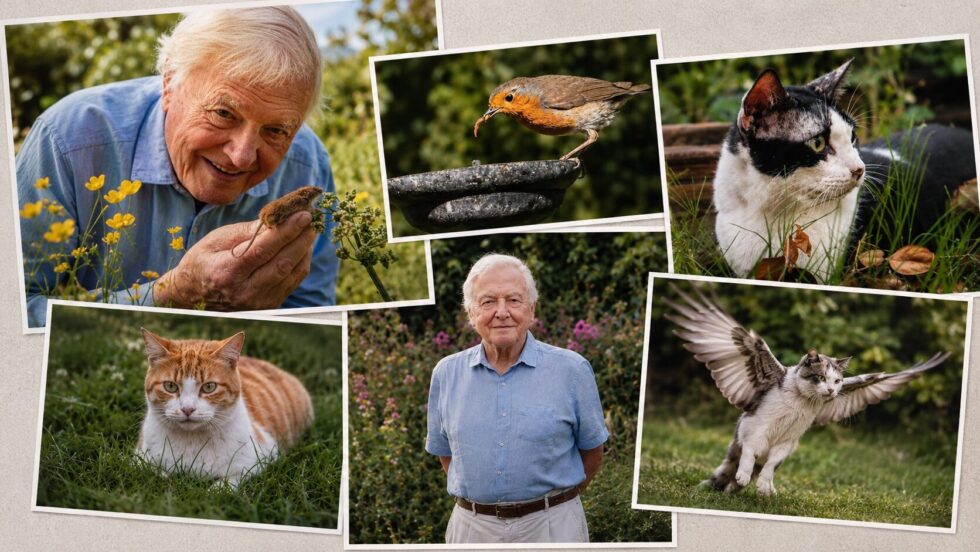
David Attenborough has warned UK cat owners to take simple but urgent steps to protect garden birds after his 2026 BBC One series Secret Garden showed how Britain’s back gardens have become one of the country’s most important wildlife habitats. The WP Times reports, citing the walesonline, that the advice is aimed particularly at households whose cats are allowed outdoors, especially in gardens where robins, blue tits and other small birds come to feed, nest and shelter during the spring and summer months. The warning is not an attack on cats, but a practical conservation message from Britain’s best-known natural historian. With millions of domestic cats living in the UK and private gardens covering a vast area of everyday wildlife space, even small changes by owners can reduce the pressure on birds. Attenborough’s advice is direct: fit outdoor cats with a bell, keep them indoors at dawn and dusk where possible, and place bird feeders higher and away from fences, shrubs, decking or other points cats can use to ambush prey.
David Attenborough and the BBC series that turned ordinary gardens into a national wildlife issue
Sir David Attenborough is Britain’s most famous natural historian, a broadcaster whose work has shaped public understanding of wildlife for decades. In 2026, shortly before his 100th birthday, he returned to BBC One with Secret Garden, a five-part series focused not on remote jungles or oceans, but on the hidden animal life inside British gardens. The programme showed that the garden is not a decorative extra to a house; it can be a working habitat, a feeding ground, a nesting site and a corridor for wildlife moving through towns and countryside. That is why the advice to cat owners matters beyond one household or one pet. A garden that welcomes birds but also leaves them exposed to predators can become a trap rather than a refuge.
In the series, Attenborough described British gardens as “magical places” and said that some are “almost as diverse as tropical rainforests”. He also underlined a striking point: gardens cover a greater area than Britain’s national nature reserves combined. That makes the behaviour of ordinary householders important, because millions of small decisions about feeders, shrubs, ponds, lawns and pets shape the survival chances of wildlife. The cat warning sits inside that wider argument. It is not about blaming owners, but about changing small details so gardens work better for more species.
What did David Attenborough tell cat owners to do
The central advice is to put a bell on a cat’s collar. According to the material around Secret Garden, this can reduce a pet cat’s hunting success by around a third, because birds get an earlier warning before an attack. The point is practical rather than dramatic: cats are natural hunters, but owners can still reduce the risk to birds without keeping every cat permanently indoors. A bell does not remove all danger, and it does not solve every problem in a wildlife garden. But as a cheap, quick and visible intervention, it is one of the easiest steps for owners to take.
The second recommendation is to bring cats indoors during the highest-risk periods, especially around dawn and dusk. These are moments when birds are active and cats are also more likely to hunt. For many owners, keeping a cat inside for the whole day may be unrealistic, but changing access during these short windows can make a real difference. It is also a safer arrangement for the cat in some areas, particularly near roads or in dense urban neighbourhoods. The serious point is that responsible ownership does not stop at feeding and vet care; it also includes understanding how a pet behaves outdoors.
Practical steps for UK cat owners:
| What to change | Why it matters |
|---|---|
| Fit a bell to the collar | Gives birds an audible warning and may reduce successful hunting |
| Keep cats indoors at dawn and dusk | These are peak-risk periods for birds and hunting behaviour |
| Move bird feeders higher | Reduces the chance of a cat reaching birds from the ground |
| Keep feeders away from fences and decking | Stops cats using nearby objects as launch points |
| Avoid placing feeders beside dense shrubs | Shrubs can protect birds, but can also hide stalking cats |
Why garden birds are especially vulnerable in British back gardens
Garden birds are drawn to food, water, nesting boxes and shelter, which means a well-kept wildlife garden can attract exactly the species people want to protect. Robins, blue tits, sparrows and other small birds may come repeatedly to the same feeder, especially during nesting season or cold weather. That repeated movement makes them easier for predators to learn and track. A cat does not need to be unusually aggressive to cause damage; it only needs patience, cover and an easy launch point. This is why feeder placement is just as important as the food itself. A bird feeder placed low, close to a fence or near thick vegetation can become dangerous. Birds may feel hidden, but cats can also use the same cover to stalk unnoticed. Decking, planters, bins, low walls and garden furniture can all help a cat get closer to a feeder. The safer approach is to raise feeders, keep them away from obvious jumping points and give birds a clear line of sight. The aim is not to make a garden sterile, but to design it so birds can feed without being ambushed.
The wider meaning of Attenborough’s warning
The strength of Attenborough’s advice is that it turns a national biodiversity issue into something people can act on immediately. Many environmental problems feel too large for one household, but garden management is different. A single owner can move a feeder, add a bell, create safer cover, put out fresh water and reduce unnecessary risk within one weekend. Across millions of homes, these decisions become part of a larger wildlife system. That is why Secret Gardentreated private gardens as serious ecological spaces, not just lifestyle settings. For cat owners, the message should not be read as an accusation. Cats are loved pets and instinctive hunters, and many owners will recognise the difficulty of balancing freedom for a pet with protection for birds. But the evidence presented in the programme makes clear that small changes can reduce harm. A bell, controlled outdoor access and safer feeder placement are modest steps, not extreme rules. They allow owners to keep cats, enjoy gardens and still take responsibility for the wildlife their gardens attract.
What UK households can do now
The most effective response is to look at the garden from a bird’s point of view and from a cat’s point of view at the same time. If a feeder is close to a fence, a shed roof, a low branch or a planter, it may be too easy for a cat to reach. If a nesting box is low or exposed, it may need to be moved. If birds gather on the ground under a feeder, spilled food should be cleared more often. If a cat regularly brings prey home at particular times, those hours should be treated as high-risk. A simple weekend checklist:
- Put a bell on the cat’s collar and check that the collar is safe-release.
- Keep the cat indoors during dawn and dusk where possible.
- Move feeders higher and away from fences, decking, walls and thick shrubs.
- Place fresh water for birds in an open, visible position.
- Clean up fallen seed so birds do not feed on the ground for long periods.
- Use enclosed or guarded feeders where suitable.
- Check nesting boxes are not easy for cats to reach.
These steps are small, but they change the balance of risk. They also reflect the central lesson of Attenborough’s programme: wildlife protection does not only happen in reserves, parks or remote landscapes. It also happens in back gardens, on patios, beside sheds and around ordinary homes.
Read about the life of Westminster and Pimlico district, London and the world. 24/7 news with fresh and useful updates on culture, business, technology and city life: London festivals June 2026 — line-ups, dates and tickets for SXSW London, Lido and West End Live Festival season
The article was prepared on the basis of materials from WalesOnline, Liverpool Echo, the BBC One series Secret Garden, The Guardian, Plimsoll Productions and The Open University.