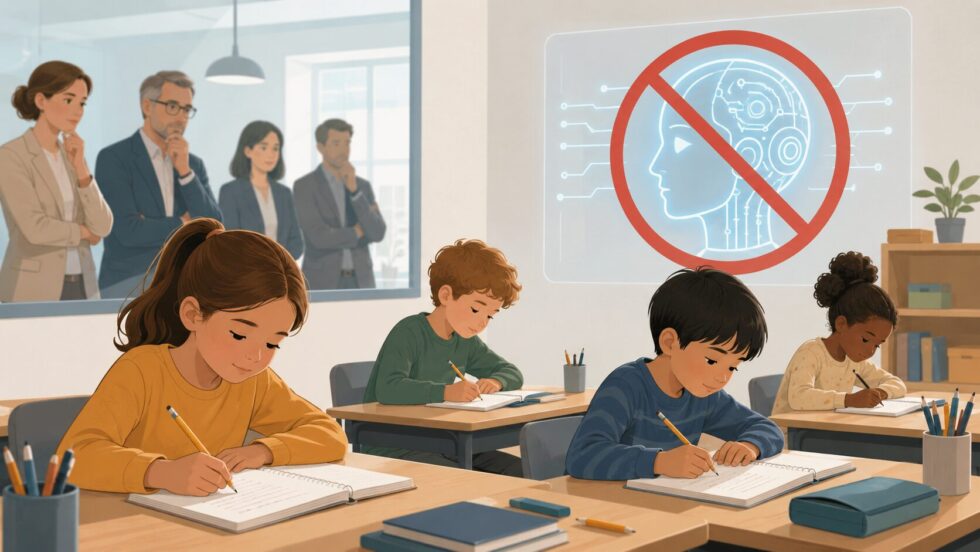
Falling test scores and fears of "skipped" learning have pushed Oslo to pull the plug on ChatGPT, Gemini, Copilot and Claude for its youngest pupils — and the policy is already feeding Westminster's own argument about screens, smartphones and the future of the classroom.
For the better part of three decades, Norway has been the country the rest of Europe pointed to when it wanted to talk about the digital classroom. Computers arrived in Norwegian schools back in the 1990s. From around 2010, tablets such as the iPad steadily displaced the printed textbook and, with it, the slow business of writing by hand. By 2016, the government was committed to handing a tablet to every child from the age of five. It was, for a long time, the Scandinavian template that ministries from London to Lisbon studied with a degree of envy.
That template has now been torn up. The WP Times reports that the Norwegian government has announced a sweeping restriction on the use of generative artificial intelligence in schools — a near-total ban for primary-age children — in direct response to falling national test results and a deepening anxiety that technology is quietly eroding the foundations of how children learn. Prime Minister Jonas Gahr Støre confirmed the measures at a press conference on Friday 19 June 2026, and the new standards are due to take effect with the coming school year, which in Norway begins in late August.
For a story that broke in a small Nordic nation of fewer than six million people, the reverberations have been remarkably loud. Within forty-eight hours the decision was being dissected by education ministries, EdTech investors and IT administrators across the continent — and, increasingly, in the United Kingdom, where the question of how much screen-based technology belongs in front of a child has become one of the most charged debates in education policy. This is the full picture: what Norway has actually done, why it has done it, what the evidence really says, and what it means for Britain.
What Norway Has Actually Decided
Strip away the headlines and the policy is more carefully calibrated than the word "ban" suggests. Rather than attempting the near-impossible task of cataloguing which AI products are harmful and which are benign, Oslo has done something blunter and, in its own terms, clearer: it has drawn a line by age, and handed schools the responsibility for enforcing it.
A tiered, age-based model
The structure follows three distinct bands, each tied to a stage of a child's development.
For pupils in years one through seven — children aged roughly six to thirteen — there is a general prohibition on generative AI tools during the school day. This is the heart of the policy and the part that has drawn the "near-total ban" label. The restriction is intended to cover school-sanctioned activity broadly: lessons, school-managed devices and homework set by the school. Tools such as ChatGPT, Google's Gemini, Microsoft Copilot and Anthropic's Claude fall squarely within its scope.
For the next band — lower secondary pupils aged fourteen to sixteen — AI tools are not forbidden outright, but they may only be used under the direct supervision of a teacher, and with what officials have described as considerable caution. The presumption is reversed: AI is the exception, deployed deliberately, rather than the default sitting open in a browser tab.
Only in upper secondary education — for young people aged seventeen to nineteen — does the policy shift towards active instruction. Here the framework envisages the deliberate teaching of AI competence, so that students approaching university and the labour market are equipped to use these tools appropriately and on their own judgement. The logic is developmental rather than prohibitionist: protect the foundations first, then build the skills once the foundations are secure.
Why an age line rather than a product list
Støre's central justification, as relayed by the Reuters news agency, was that the uncritical use of AI carries a specific and serious risk — that children will simply skip essential steps in their educational journey. The most important thing in school, he argued, remains that children learn reliably to read, to write and to do mathematics. As he put it at the press conference: "The most important thing in school is that our children learn to read, write and do mathematics."
There is a deliberate philosophy buried in that sentence. In most of the economy, the value of generative AI is precisely that it removes friction — it drafts, summarises, translates, calculates and explains, sparing the adult user the laborious middle steps. But a classroom is one of the few places where that friction is the entire point. A child sounding out an unfamiliar word, redrafting a clumsy paragraph or grinding through long division is not failing to optimise a workflow. The struggle is the work. Norway's argument is that a tool built to autocomplete the hard parts is structurally at odds with an institution whose job is to make children do the hard parts themselves.
That is why Oslo chose an age line over a product blacklist. A blacklist invites an endless, losing game of definitions and loopholes. An age threshold is crude, but it is enforceable and it is unambiguous — and the government has been explicit that the burden of enforcement now sits with schools and the municipalities that run them.
The Numbers Behind the Decision
The scale of the problem Norway is responding to becomes clearer once you look at how deeply these tools had already embedded themselves. According to reporting by the Norwegian outlet VG, a survey of school leaders earlier this year found that AI tools were already in use by pupils in nearly three out of four Norwegian primary and lower-secondary schools, and in more than ninety per cent of upper-secondary schools. The same reporting indicated that only around a quarter of primary and lower-secondary schools had any kind of plan governing that use.
That gap — near-universal adoption set against almost non-existent governance — is arguably the strongest case for acting now. The argument is not that AI single-handedly caused every decline in Norwegian results; the country's performance troubles predate the arrival of ChatGPT. The argument is that schools were adopting the technology far faster than they were able to govern it, and that waiting for the harm to show up in the next round of national tests would mean acting too late.
The country also has a sense of how badly the previous bet on screens went. The 2016 push to issue a tablet to every pupil from the age of five did not deliver the gains its advocates promised. In the years that followed, Norway watched literacy measures slide and test scores fall — an outcome sobering enough that the political class has now swung decisively in the opposite direction. The tablet generation, in the government's telling, became a cautionary tale rather than a model.
To soften the transition, Oslo has paired the AI restriction with a separate legislative plan to subsidise the purchase of traditional printed textbooks. It is, quite literally, a return to pen and paper — a deliberate and funded retreat from the years of "tablet classes" that Norway once championed.
The Smartphone Precedent — and What the Evidence Really Shows
The AI restriction did not appear out of nowhere. It follows the same logic, and the same political instinct, as Norway's 2024 decision to ban smartphones from schools. The underlying claim in both cases is identical: young learners need protection from technologies capable of disrupting the very foundation of learning, because those technologies compete for the scarcest resources in any classroom — attention, memory, motivation and the authority of the teacher.
And here the government can point to data, though the data deserves to be read carefully rather than waved around.
The Abrahamsson study
The most cited evidence is a study by the researcher Sara Abrahamsson, a postdoctoral fellow at the Norwegian Institute of Public Health, who examined more than four hundred Norwegian middle schools — 477 schools, analysed across the period from 2010 to 2018. Because individual schools introduced restrictions at different moments, and because the timing of those bans was largely uncorrelated with a school's prior achievement or prior trends, Abrahamsson was able to construct a quasi-experimental design and link school policies to Norway's unusually rich administrative registry data, which tracks pupils' grades, exam results and use of healthcare services including psychologists.
The headline findings were striking. Bullying fell for both boys and girls after a ban. Girls saw measurable improvements in their GPA and scored higher on externally graded mathematics examinations — gains on the order of around 0.22 standard deviations, which Abrahamsson contextualised by noting that reducing class size by a single pupil is associated with an improvement of roughly 0.00 to 0.05 standard deviations. Girls were also more likely to go on to an academic high-school track. And perhaps the most quoted figure of all: the number of consultations girls made with psychological specialists fell by nearly sixty per cent relative to the period before a ban. The effects were strongest for girls from lower socioeconomic backgrounds, and strongest of all at schools with the strictest policies — those requiring phones to be handed in or locked away, rather than merely switched to silent.
A note of caution on the evidence
In fairness — and good journalism demands it — the study has not gone unchallenged. Some commentators have pointed out that many of the "bans" studied amounted to requiring phones on silent rather than physical confiscation, that several of the effects sat close to conventional thresholds of statistical significance, and that Abrahamsson herself found no comparable effect on the mental health or academic performance of boys, which she attributed to substantially higher phone usage among girls. The honest summary is that the smartphone evidence is suggestive and points consistently in one direction, but it is not the slam-dunk that some political framing implies.
Crucially, the government has been candid that the AI case is weaker still. The 2024 smartphone ban arrived against a backdrop of documented declines in national test scores. With AI, by contrast, it is simply not yet clear whether classroom use has reached a level capable of producing a similar, measurable harm. Oslo's position is essentially precautionary: it would rather act before the damage shows up in the data than wait for the next bout of bad results to vindicate inaction. Whether that is prudent foresight or a moral panic in policy form is precisely the debate now playing out across Europe.
How Norway's Approach Differs from Everyone Else's
Part of what makes the Norwegian move notable is how sharply it diverges from the regulatory approaches being tried elsewhere — particularly the contrast with the United States.
The American contrast: the GUARD Act
In the United States, the relevant legislative vehicle is the so-called GUARD Act — the Guidelines for User Age-verification and Responsible Dialogue Act — which has advanced past the Senate Judiciary Committee but has not yet been voted into law. Critically, its focus has narrowed. As originally drafted, the bill reached towards nearly every AI-powered chatbot. During its passage, however, the language was softened to centre on "AI companions" — chatbots specifically designed to simulate sustained interpersonal relationships.
The practical consequence of that narrowing is significant: broad, general-purpose tools such as ChatGPT, Gemini and Copilot could slip through the definitional gap, because they are not primarily marketed as companions. Critics warn that this is exactly the kind of loophole companies can exploit. Norway, by contrast, sidesteps the entire definitional quagmire within the education sector. It does not try to decide which tools are companions and which are assistants; it simply says that below a certain age, in school, they are off-limits.
The European weather
Norway is not a member of the European Union, but it sits within the European Economic Area and tends to move in the same regulatory climate as its neighbours. The EU's AI Act, in force since 2024, classifies educational AI as high-risk and imposes demanding transparency and human-oversight requirements — but it stops short of prescribing age limits. Norway's tiered, age-based model could therefore offer a template that EU states adapt, rather than something the bloc itself has mandated.
The wider regional mood is unmistakable. Sweden has moved to ban mobile phones in compulsory schools. Denmark and the Netherlands have been wrestling with their own fights over screens, attention and learning. France's education ministry has issued cautionary guidance, and in April 2026 the Italian data-protection authority temporarily blocked a mainstream AI chatbot over privacy concerns. The screens-out-of-school instinct is no longer a Norwegian eccentricity; it is becoming a Northern European consensus.
The Limits of a School-Hours Ban
For all its clarity, the Norwegian strategy runs into an obvious wall — one the government itself acknowledges. Generative AI now runs on practically any internet-enabled device. A ban that operates inside the school gates ends the moment the bell rings. Whatever a child cannot do at their desk at two o'clock, they can do on a phone at home at four.
This is why Norway is simultaneously pushing on a second front, beyond the classroom entirely. The government announced in April that it intends to introduce legislation banning access to social media for children under the age of sixteen, with the bill expected to reach parliament by the end of 2026. Because a school-hours rule cannot reach into the private sphere, this proposed social-media law leans on a different mechanism: mandatory age verification carried out by the platform operators themselves.
That proposal places Norway in fast-growing international company. Australia brought a world-first ban on social media for under-sixteens into force at the end of 2025. The United Kingdom is pursuing its own version of an under-sixteen restriction, and several EU member states are weighing comparable steps. Underlying all of it is a single strategic question that no country has yet resolved: is a strict age-and-ban model genuinely more effective than the harder, slower work of regulating the technology companies and their products directly? And even where the political will exists, no state has yet found a reliable way to police age limits for AI tools used outside of institutions, in a child's own bedroom, on a device the school never sees.
What It Means for Britain
For readers in Westminster and beyond, the Norwegian decision is not a distant curiosity. It lands directly in the middle of an argument the United Kingdom is already having with itself.
Britain's own screens debate
The British conversation about technology in schools has been moving steadily in a sceptical direction. After years of investment in classroom Wi-Fi, interactive whiteboards and one-to-one device schemes, a growing chorus of teachers, parents and researchers has begun questioning whether too much was rolled out too fast. Concerns about distraction, collapsing attention spans, and the quiet loss of "analogue" skills — chief among them handwriting — now feature prominently in the policy discussion. The UK's pursuit of an under-sixteen social-media restriction sits in exactly the same family of measures as Norway's, and the Norwegian AI ban hands fresh ammunition to those who favour a more restrictive line.
At the same time, there is a competing pressure that Britain shares with every advanced economy. Bildung — for want of a less Germanic word, the formation of capable young citizens — is supposed to prepare children for a labour market that will be saturated with these tools. Education bodies and digital-policy advocates argue that AI literacy belongs in the curriculum, that pretending the technology does not exist leaves children unprepared, and that the right answer is teaching critical, supervised use rather than blanket prohibition. The tension between these two imperatives — protect the young child's developmental window, but equip the older student for an AI-shaped world — is precisely the tension Norway's tiered model is attempting to resolve.
The practical headache nobody mentions
There is also a deeply unglamorous dimension to all of this that any British head teacher will recognise instantly: enforcement is hard and expensive. In Norway, the policy lands as a significant operational burden on the IT staff of roughly 2,800 primary and secondary schools, most of which run fleets of Windows devices. Blocking the obvious AI websites is the easy part. The difficulty is that these capabilities increasingly arrive bundled inside other software — built into browsers, code editors and productivity suites — and that tech-savvy teenagers find network-level blocks trivially easy to circumvent. Schools are being pushed towards more sophisticated controls, additional IT support hours and consultancy costs that were never in any budget. For cash-strapped British schools, that practical reality may matter more than any point of principle.
A question of teacher confidence
Finally, there is the matter of who is supposed to police all this. A telling objection surfaced during Norway's own consultations, when a student representative pointed out the obvious flaw in "supervised use" for older pupils: if the AI is meant to be supervised, the teacher had better understand it better than the student does — a bar that, today, is not always met. Norway has committed to an upskilling programme for teachers and a national awareness campaign for parents. Any British equivalent would face the same hurdle. A rule is only as good as the adult enforcing it, and a generation of teachers is being asked to referee a technology many of them are still learning to use.
A Deliberate Experiment in Restraint
What Norway has chosen, in the end, is an experiment in deliberate restraint. In a moment when the reflexive response to any new technology is rapid, uncritical adoption, a small Nordic country has decided to do the opposite — to place the welfare of the developing child and a particular philosophy of education ahead of efficiency, competitiveness and the gravitational pull of the next shiny tool.
Whether it works is genuinely unknown. The evidence underpinning it is suggestive rather than conclusive. The enforcement challenges are real, the school-hours boundary is porous, and the AI landscape may have shifted again before the policy has had a chance to prove itself. But Norway has decided that the cost of waiting for certainty is higher than the cost of acting on a well-founded suspicion. For a Britain caught between the same two slogans — children need digital skills for the future; children are losing the basics in the present — the Norwegian wager will be one of the most closely watched in European education for years to come.
Frequently Asked Questions
What exactly has Norway banned? Norway has introduced a general prohibition on generative AI tools — such as ChatGPT, Gemini, Copilot and Claude — for primary-school pupils in years one to seven, covering children aged roughly six to thirteen, during the school day. The restriction applies to lessons, school-managed devices and school-set homework.
When does the policy take effect? The new standards take effect with the start of the coming school year, which in Norway begins in late August 2026. Prime Minister Jonas Gahr Støre announced the measures on 19 June 2026.
Are older pupils affected too? Yes, but more lightly. Pupils aged fourteen to sixteen may use generative AI only under direct teacher supervision. Pupils aged seventeen to nineteen are actively taught how to use AI appropriately on their own, to prepare them for university and work.
Why is Norway doing this? The government is responding to falling national test results and a concern, voiced by the Prime Minister, that uncritical AI use lets children skip essential steps in learning. The stated priority is that children first learn to read, write and do mathematics.
Is there evidence that it will work? The closest evidence is a study by Sara Abrahamsson on Norway's 2024 school smartphone ban, which found reduced bullying, improved grades for girls and a roughly sixty per cent drop in girls' visits to psychological services. However, the smartphone evidence has been contested, and the government concedes the case for an AI ban specifically is weaker and largely precautionary.
Could this happen in the United Kingdom? Britain is already pursuing an under-sixteen social-media restriction and is in the middle of its own debate about screens in schools, so the Norwegian model gives weight to advocates of a more restrictive approach. No equivalent UK AI school ban has been announced, but the policy is being watched closely.
Read about the life of Westminster and Pimlico district, London and the world. 24/7 news with fresh and useful updates on culture, business, technology and city life: How Long Do Crypto Firms Have to Apply for FCA Authorisation Before the 2027 Deadline