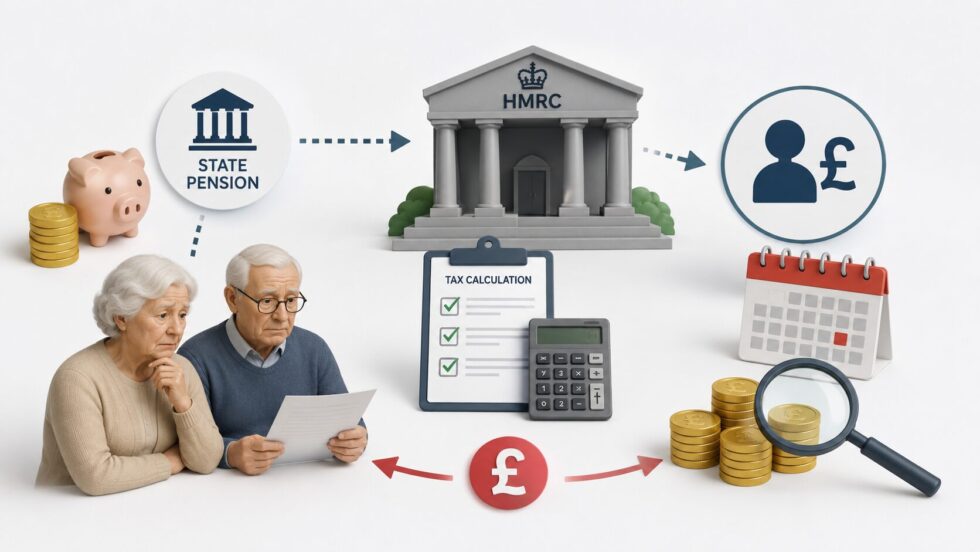
The hmrc pensioner tax increase row has become a serious Westminster issue after reports that millions of UK retirees may have been overcharged income tax for years because of a state pension calculation error. The dispute centres on how HM Revenue & Customs treated the annual April uprating of the state pension, including the 2025/26 rise from £221.20 to £230.25 a week. Instead of reflecting the mixed tax-year reality — with part of the year paid at the old rate and the rest at the new rate — some calculations were reportedly based on 52 weeks at the higher amount, The WP Times reports.
The individual sums appear small, but the national total is politically significant. Around 8.7 million pensioners who pay income tax may have been affected, with an average overcharge of about £5 and a possible annual total of £43.5 million. If the same mistake has been repeated since 2016, the disputed amount could rise to roughly £350 million. That turns a technical tax-code error into a wider question for HMRC and ministers: when was the problem first identified, why was it not corrected earlier, and will pensioners receive automatic refunds rather than being forced to chase small but wrongly collected sums themselves?
Why HMRC pensioner tax increase reports now matter for millions of retirees
The core of the case is not that the state pension itself was secretly taxed in a new way. The state pension is taxable income, but it is usually paid gross, meaning tax is collected through other routes such as PAYE, Self Assessment or later assessment. The problem is the annual state pension increase, which takes effect in April under the triple lock mechanism. Because the tax year and the first uprated pension payment do not align perfectly, the correct annual figure is not always a simple multiplication of the new weekly rate by 52.
According to the reports, HMRC’s system used the higher current-year weekly pension rate for the whole year. That can inflate taxable income by a small amount. For a basic-rate taxpayer, the difference is often only a few pounds. For a higher-rate taxpayer, it can be slightly more. But when the same method is applied to millions of pensioners, the error becomes a national-scale tax issue.
The new state pension rose from £230.25 a week in 2025/26 to £241.30 a week in 2026/27. The full new state pension is now only just below the frozen Personal Allowance of £12,570, making calculation precision more important than ever. Frozen tax thresholds mean more pensioners are being pulled into income tax, even when their real income has not risen strongly in purchasing-power terms.
That is why this story is politically sensitive. It comes at a time when older households are already watching tax codes, pension upratings, savings tax, winter support and inflation closely. Even a £5 overcharge can matter symbolically because pensioners expect the tax authority to calculate automatically and correctly.
What exactly went wrong with the HMRC state pension calculation?
The reported mistake centres on how HMRC calculates annual state pension income after an April rise. The correct approach, according to the explanation reported in the British press, should reflect that pensioners do not receive the higher uprated amount for every week of the tax year. In practice, this means a mixed calculation: most weeks at the new rate, but one week at the previous lower rate.
The alleged HMRC method was simpler but less accurate: 52 weeks at the new rate. That creates a small excess income figure. Once that inflated figure is put into a tax code or Self Assessment calculation, the pensioner may pay too much income tax.
This is especially important for pensioners who have more than one income source. A person receiving a state pension plus a workplace pension, private pension, salary, rental income or savings income may have tax collected through PAYE or Self Assessment. The state pension itself is not normally taxed at source, so the tax due is often collected by adjusting the code on another income stream.
The error reportedly affected both pensioners using Self Assessment and those still working or receiving another income taxed through PAYE. That makes the problem broader than a single form or a single group of taxpayers. It also explains why many pensioners may not immediately notice the mistake: the overcharge can be hidden inside a tax code, a pre-filled pension figure or a final tax bill.
| Issue | What happened | Why it matters |
|---|---|---|
| State pension uprating | Pension rises every April | Tax year timing creates a mixed-rate year |
| HMRC calculation | Reports say 52 weeks at the new rate were used | This can overstate taxable income |
| Average effect | Around £5 in many cases | Small individually, large nationally |
| Potential scale | Up to 8.7 million pensioners | Could mean tens of millions per year |
| Historic concern | Reports suggest cases back to 2016 | Raises refund and accountability questions |
How much could pensioners have overpaid?
The most widely reported figure is around £5 per affected pensioner in many cases. That may sound minor, but the national total changes the picture. If up to 8.7 million pensioners were affected, the amount for one year could reach around £43.5 million. If similar errors were repeated across ten years, reports have suggested a possible total of more than £350 million.
The exact amount for each pensioner depends on their tax position. A basic-rate taxpayer would normally lose less than someone paying a higher rate. Additional income, tax code changes, Self Assessment corrections and historic year-by-year rates can all change the final figure.
What matters most is that the error appears mechanical. This is not a complex avoidance dispute, nor a question of pensioners misunderstanding the law. The reported issue is whether the state’s own calculation system used the right annual pension income figure.
For pensioners, the practical point is simple: check the taxable state pension figure shown in the tax code, Self Assessment return or HMRC account. If the figure assumes the new weekly state pension rate for all 52 weeks, it may be too high.
Who is most likely to be affected by the HMRC pensioner tax increase issue
Not every pensioner will have paid too much tax. Pensioners whose only income is below the Personal Allowance may not have paid income tax at all. The issue mainly matters for those whose total income is above the tax-free threshold or whose state pension figure affects another taxed income stream.
The most likely groups include pensioners with a state pension and workplace pension, retirees with private pension income, pensioners still working part-time, self-employed retirees, landlords, people with savings interest above allowances, and anyone required to submit a Self Assessment return. Those on PAYE may see the effect through a tax code adjustment. Those on Self Assessment may see it in the pre-populated state pension figure. In both cases, the danger is the same: pension income may have been overstated because the April increase was treated as if it applied for the entire tax year. Key checks for pensioners:
- Look at the annual state pension figure used by HMRC.
- Compare it with the amount actually received during the tax year.
- Check whether the calculation uses 52 weeks at the new rate.
- Review tax codes for current and previous years.
- If using Self Assessment, check whether the pre-filled figure is correct.
- Contact HMRC if the figure appears inflated.
- Keep pension statements, bank records and tax calculations.
Why the ten-year timeline creates a bigger political problem
The most damaging element is not only the money. It is the timeline. Reports say concerns may have been raised years ago, with pensioners spotting discrepancies as far back as 2016. One affected taxpayer reportedly contacted the former HMRC chief executive directly after failing to resolve the issue through normal channels.
That detail changes the tone of the story. It suggests the problem may not have been a fresh technical glitch discovered and fixed quickly. Instead, it raises questions about whether complaints were escalated, whether HMRC understood the scale, and why affected pensioners were not notified earlier.
The public-service issue is clear. Many pensioners do not have accountants. Many rely on HMRC’s figures because they assume the tax authority has direct access to DWP pension data. If those figures are wrong, the burden should not fall only on elderly taxpayers to challenge the system line by line. There is also a transparency problem. HMRC has said the impact is small in most cases and that it is working to fix the issue. But critics argue that “small” does not mean irrelevant, especially when millions of people may be involved and when the same error may have repeated over many tax years.
What HMRC says and what pensioners should do now
HMRC has apologised for the calculation issue and said it is working to fix it. The authority has also indicated that the average impact is small, with the difference in tax owed around £5 in many cases. However, the central unresolved questions are how many people were affected, how far back refunds will go, and whether repayments will be automatic.
Pensioners should not wait passively if they suspect a mistake. The first step is to check the state pension income figure used in their tax calculation. The second is to compare it with real payments received. The third is to contact HMRC and ask for the calculation to be reviewed.
For Self Assessment taxpayers, the issue is particularly practical. If the return has not yet been submitted, the pension income figure should be checked before filing. If the return was already filed with an incorrect figure, the taxpayer may need to amend it or ask HMRC for a repayment.
For PAYE taxpayers, the focus is the tax code. A pensioner with a private pension or salary may have tax collected through that route. If the state pension deduction in the code is too high, the monthly tax deducted from another income source may also be too high.
What documents pensioners need before contacting HMRC
Pensioners should prepare evidence before calling or writing. This reduces the risk of a vague response and makes it easier to ask for a precise correction.
Useful documents include:
- State pension award letters.
- Bank statements showing pension payments.
- PAYE coding notices.
- P60s from pension providers or employers.
- Self Assessment calculations.
- HMRC online account screenshots.
- Any earlier correspondence with HMRC.
- Notes of phone calls, including dates and reference numbers.
The request should be specific. Pensioners should ask HMRC to review whether their state pension income was calculated using 52 weeks at the uprated rate instead of the correct mixed-year figure. They should also ask whether previous tax years can be checked and whether a repayment is due.
Why this matters beyond £5
A small tax error can become a serious governance issue when it affects millions of people. Pensioners are a vulnerable group in administrative terms because many are not actively engaged with tax codes, online accounts or Self Assessment rules. They may receive multiple letters from different bodies and still not know which figure is correct.
The case also arrives against a wider backdrop of tax complexity for older people. The Personal Allowance remains frozen at £12,570, while the state pension continues to rise. The full new state pension is now close to the tax threshold. That means more pensioners will face tax administration even if they have only modest income. This increases pressure on HMRC to get automatic calculations right. A system that relies on pensioners spotting hidden errors is weak. A system that corrects known errors automatically is far more defensible. The political question is therefore bigger than one pension line. It is about whether the tax authority can handle a growing pensioner taxpayer population with clarity, speed and accountability.
What happens next for HMRC and affected pensioners?
The immediate expectation is that HMRC will complete a fix and clarify how affected pensioners can recover overpaid tax. But the crucial issue is whether the authority will issue automatic refunds or require individuals to apply. Automatic refunds would be simpler for pensioners, but they would require HMRC to identify affected taxpayers accurately across multiple years.
There may also be pressure for ministers to publish the number of affected cases, the estimated total overpaid, the first year in which the problem occurred, and the process for repayment. Without those details, pensioners may remain unsure whether they are included.
The issue could also lead to further parliamentary scrutiny. MPs are likely to ask why the problem was not resolved earlier, whether DWP data was handled correctly, and whether HMRC’s internal complaints system responded properly when pensioners raised the issue. For now, the most practical advice is to check, document and challenge. Pensioners who paid tax on state pension income should not assume the figure was correct simply because it came from HMRC. The reported error shows that even small automated calculations can produce large national consequences when repeated across millions of taxpayers.
FAQ
Is the state pension taxable in the UK?
Yes. The state pension is taxable income, but it is usually paid gross. Tax is normally collected through another income source, Self Assessment or later assessment if total income exceeds the Personal Allowance.
Does every pensioner need to claim a refund?
No. Only pensioners whose tax calculation included an overstated state pension figure may be affected. People who paid no income tax may not have lost money.
How much money could one pensioner get back?
Reports suggest the average overcharge is around £5 in many cases, but the amount depends on the year, pension rate, tax band and individual circumstances.
What should pensioners check first?
They should check the state pension income figure used by HMRC and compare it with the amount actually received during the relevant tax year.
Could the error go back ten years?
Reports suggest pensioners identified similar problems as far back as 2016. The full historic scale has not yet been officially confirmed.
Should pensioners contact HMRC now?
Yes, if they believe their tax code or Self Assessment return used an inflated state pension figure. They should ask HMRC to review the calculation and any possible repayment.
Read about the life of Westminster and Pimlico district, London and the world. 24/7 news with fresh and useful updates on culture, business, technology and city life: HMRC pensioner tax error: millions overcharged on state pension as refund questions mount