Kostyantynivka has become one of the most dangerous points on Ukraine’s eastern front on Monday, 22 June 2026, after Russian troops infiltrated parts of the strategic Donetsk region city and began trying to surround it from the flanks, while Ukrainian commanders insisted the situation remained under control and denied Moscow’s claims of encirclement, The WP Timesreports.
The city matters because it is a gateway towards Kramatorsk and Sloviansk, the two major Ukrainian-held urban strongholds that still anchor Kyiv’s defence in Donbas. Ukrainian soldiers speaking from the area describe a battlefield that is no longer a clean line on a map: Russian groups are moving between damaged buildings, drone teams are hunting launch sites, supply routes are under constant pressure and parts of the city are being described by soldiers as a “grey zone” where neither side has uncontested control. The immediate question is not only whether Kostyantynivka falls, but whether Russia can turn slow infiltration into a wider threat to Ukraine’s last defensive belt in eastern Donetsk region.
Kostyantynivka becomes the key Donbas city under Russian pressure
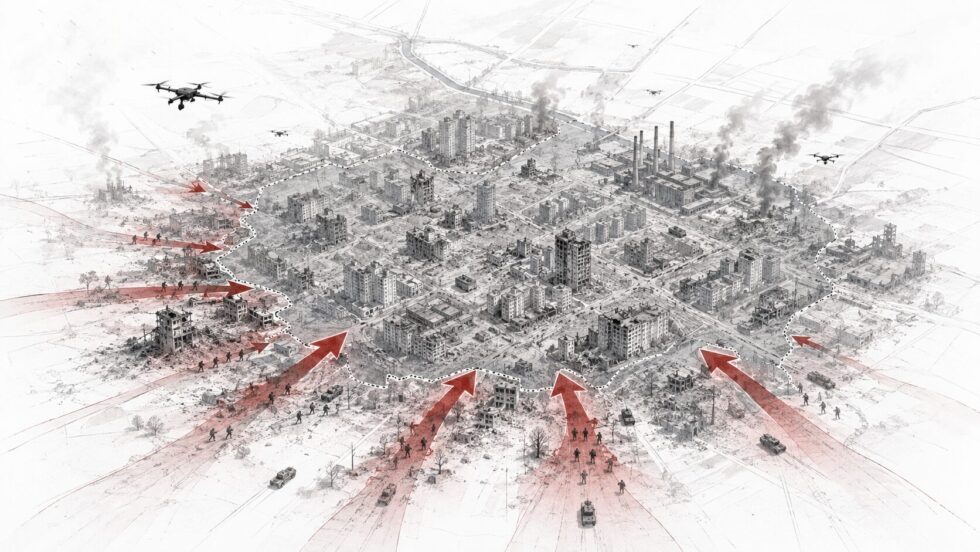
Kostyantynivka has been under Russian pressure for months, but the latest phase is more serious because Russian troops are no longer only attacking from outside the city. Reports from Ukrainian soldiers and military observers indicate that Russian groups have entered parts of the urban area, including contested zones where control can change from street to street. That does not mean Moscow controls Kostyantynivka. It does mean the battle has moved into the most difficult type of warfare: urban infiltration, where small groups can hide, observe, strike and force defenders to clear the same areas repeatedly.
Ukraine’s public position remains cautious. Brigadier General Oleksandr Bakulin, commander of Ukraine’s 19th Army Corps, has said the situation is under control and that Russian forces have not achieved decisive success. At the same time, Ukrainian reports have acknowledged the presence of roughly 100 to 130 Russian soldiers inside the city, a number that may look limited but can be operationally serious in urban combat. In a city of damaged apartment blocks, industrial sites, basements and tree cover, even small Russian groups can create pressure far beyond their size.
Russia’s Defence Ministry has claimed advances in the south-western part of Kostyantynivka and has suggested that Ukrainian units are being surrounded. Kyiv denies that. The most accurate current reading is therefore more complex: Kostyantynivka has not fallen, but the city is no longer a stable rear position. It is a contested urban battlefield, and that distinction matters because the front can deteriorate slowly before any official map changes.
Why Kostyantynivka matters for Kramatorsk, Sloviansk and the Donbas front
Kostyantynivka is important because of where it sits. It lies on the southern edge of the urban chain that protects the remaining Ukrainian-held part of Donetsk region. Behind it are Kramatorsk and Sloviansk, cities that have political, logistical and military importance for Ukraine’s eastern defence. If Russian forces take Kostyantynivka, they would gain a stronger platform for pushing north and north-west, while making Ukrainian movement around Kramatorsk more dangerous.
This does not mean Kramatorsk or Sloviansk would fall immediately. Large cities do not collapse simply because one nearby position is lost. But the fall of Kostyantynivka would narrow Ukraine’s defensive depth and expose roads, logistics hubs and command routes to heavier pressure. It would also give Moscow a narrative of momentum in Donbas at a time when Ukraine has been striking Russian oil infrastructure and supply lines far from the immediate front.
Russia’s strategic objective in Donbas has not changed. Moscow still wants full control of Donetsk and Luhansk regions. Its advances have often been slow, costly and heavily dependent on infantry attrition, artillery, glide bombs and drones. Kostyantynivka is now the place where those methods are being tested against Ukraine’s ability to hold a damaged city with limited manpower and stretched drone crews.
| Factor | Why it matters on 22 June 2026 |
|---|---|
| Geography | Kostyantynivka protects approaches towards Kramatorsk and Sloviansk |
| Urban terrain | Buildings, basements and trees allow small groups to hide and advance |
| Logistics | Roads into the city are vulnerable to drones, artillery and strikes |
| Russian tactics | Moscow is using infiltration and flank pressure rather than only frontal assault |
| Ukrainian risk | A slow loss of urban control can happen before a formal withdrawal is announced |
Russian infiltration turns Kostyantynivka into a street-by-street fight
The core danger in Kostyantynivka is not a single dramatic breakthrough. It is the accumulation of Russian small groups inside the city. Ukrainian soldiers describe Russian troops entering areas behind Ukrainian positions and making it extremely difficult to push them out. In urban warfare, a single building can become an observation point, a shelter, a drone launch position or a staging point for the next movement. That is why a few dozen soldiers can create a much larger operational problem.
The Russian method resembles earlier patterns seen in eastern Ukraine. Moscow presses on the flanks, sends infantry in small groups, accepts heavy losses and tries to make Ukrainian supply and rotation impossible. Instead of one visible armoured thrust, the battle becomes a slow compression of the city. One block becomes contested, then one road becomes too dangerous, then a supply route becomes unreliable, then Ukrainian units must choose between holding positions and preserving manpower.
Ukrainian soldiers have said that Russian troops may move only around 100 metres a day, and sometimes even crawl to reach the next building. That sounds slow, but in a city under constant drone and artillery pressure, 100 metres can change the tactical situation. If the same movement continues day after day, the defender can be forced into a harder and harder position without a single headline-grabbing collapse.
The phrase “grey zone” is therefore important. It does not mean nobody is fighting. It means control is blurred. Ukrainian forces may still have assault and clean-up groups inside the city. Russian groups may still be isolated or vulnerable. But the space between them is unstable, and that is exactly where urban battles become most dangerous.
Drones now decide movement, supplies and survival in Kostyantynivka
Kostyantynivka also shows how central drones have become to the war. Ukrainian drone teams have been essential in stopping Russian infantry and identifying movement before it reaches Ukrainian lines. But Russian drone units have adapted and are now targeting Ukrainian launch sites, operators and logistics. If Ukrainian drone crews are forced to move back, Russian infantry gains room. If Russian drone pilots can identify Ukrainian positions, artillery, glide bombs or multiple-launch rocket systems can follow.
The battle is therefore not only infantry against infantry. It is drone crew against drone crew, logistics route against surveillance system and electronic warfare against cheap commercial aircraft. Russian units close to the city do not always need advanced long-range drones. If they are near enough, cheaper short-range systems can be used for reconnaissance, target identification and pressure on Ukrainian movements.
For Ukraine, the problem is capacity. Drone crews must watch Russian infantry, protect their own positions, locate enemy operators, support Ukrainian assaults and help keep supply routes open. When crews are exhausted or too few, they cannot do everything at once. A Ukrainian drone pilot quoted in the reporting warned that if Russian drone teams are not targeted more systematically, they can continue to detect Ukrainian positions and force Ukrainian units to pull back.
This is one of the clearest military lessons from Kostyantynivka. The city may be decided not only by who has more infantry inside the buildings, but by who can see first, strike first and keep enough supplies moving under constant surveillance.
What Ukraine needs most to stabilise the city
- More rested drone crews able to rotate without losing coverage.
- Stronger counter-drone work against Russian pilots and launch points.
- Reliable electronic warfare to reduce Russian surveillance.
- Protected supply routes for ammunition, batteries, water and evacuation.
- Reinforcements for infantry units that have taken losses.
- Faster and more accurate reporting of lost positions.
- Better coordination between infantry, artillery and drone teams.
- More capacity to strike Russian logistics before small groups reach the city.
Moscow’s claims and Kyiv’s denials must both be read carefully
Russia says its forces are advancing inside Kostyantynivka and claims that Ukrainian units are being encircled. Such statements are part of Moscow’s military messaging and should not be treated as neutral battlefield confirmation. Russia has repeatedly used claims of encirclement before a city is fully surrounded, partly to pressure Ukrainian morale and partly to shape international perception. Kyiv denies that its units are encircled and says the situation remains under control.
At the same time, Ukrainian official language can also be cautious. Commanders often avoid giving full details while operations are ongoing. Soldiers on the ground may describe a situation as more dangerous than official statements suggest because they see the immediate tactical pressure: lost buildings, unsafe routes, destroyed drone sites and missing reinforcements. The gap between public command language and frontline testimony is not unusual in war, but in Kostyantynivka it is especially important.
The most reliable assessment is that the city is under severe pressure, Russian troops have infiltrated parts of it, Ukraine is still fighting inside and around it, and there is no confirmed full Russian control of the city as of 22 June 2026. That is the line a serious article must hold. Anything stronger would risk overstating Moscow’s claims; anything softer would understate the danger described by Ukrainian soldiers.
What the battle means for the wider war
Kostyantynivka is unfolding while Ukraine is also increasing pressure on Russia away from the front line. Ukrainian long-range drone strikes have targeted oil refineries, supply routes and infrastructure connected to Russia’s war effort. These attacks have sought to bring the cost of war closer to Russian cities and disrupt Moscow’s logistics. Russia, in turn, needs visible progress on the battlefield to show that its offensive strategy is still producing results.
That makes Kostyantynivka politically useful for Moscow. A gain there would allow the Kremlin to focus attention on Donbas advances rather than fuel shortages, refinery damage or logistical disruption. It would also support the claim that Russia can still grind forward despite Ukraine’s drone campaign. For Ukraine, holding the city would show that Russia’s costly infiltration tactics can still be contained.
The battle also shows the limits of old military language. “Advance”, “control” and “encirclement” are not simple terms in a drone-saturated urban fight. A force can enter a city without controlling it. A defender can remain inside a city while supply routes become increasingly dangerous. A grey zone can exist for days or weeks before either side can impose clear control. Kostyantynivka is now exactly that kind of battlefield.
What happens next in Kostyantynivka
The next stage will depend on whether Russia can keep feeding small assault groups into the city and whether Ukraine can destroy those groups before they link up into a stronger foothold. If Ukrainian forces improve counter-drone work and protect supply routes, Kostyantynivka may remain contested but defensible. If Russian troops continue to accumulate in buildings and pressure the flanks, the city could move closer to a slow operational collapse.
The danger for Ukraine is not only the loss of territory. It is the loss of defensive depth before Kramatorsk and Sloviansk. The danger for Russia is that even if it advances, it may pay heavily for every street and building, while Ukraine continues to strike deeper into Russian logistics and energy infrastructure. That is why the battle is strategically important but not yet decisive.
As of Monday, 22 June 2026, Kostyantynivka has not been confirmed as captured by Russia. Ukraine denies encirclement. Russian troops are present inside parts of the city. The front is unstable. The city is becoming a test of whether Moscow can turn infiltration into a wider Donbas breakthrough — or whether Ukraine can hold another critical urban gateway long enough to blunt the offensive.
Read about the life of Westminster and Pimlico district, London and the world. 24/7 news with fresh and useful updates on culture, business, technology and city life: House of the Dragon season 3: HBO turns the Targaryen war into its biggest test yet