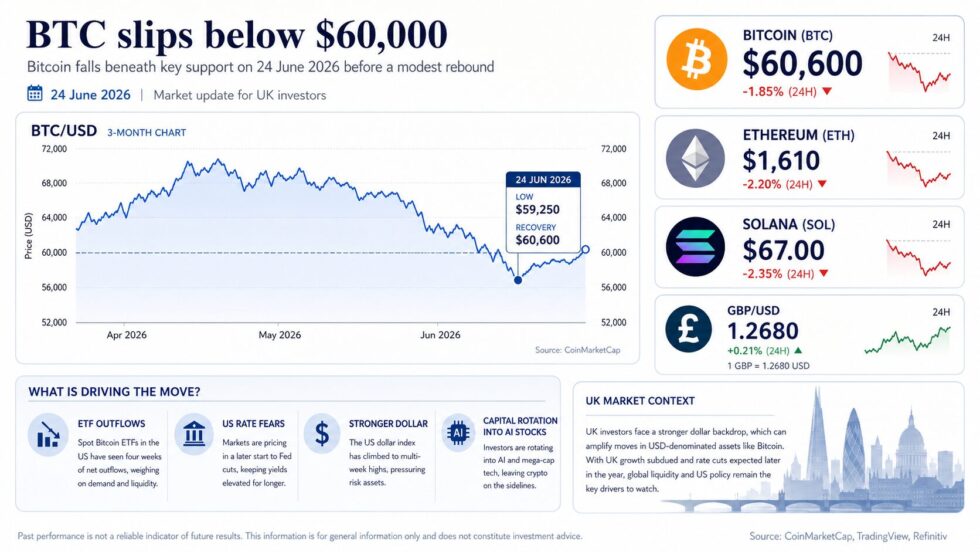
Bitcoin price UK moved back into the centre of London’s financial markets on Wednesday, 24 June 2026, after BTC fell below the psychologically important $60,000 level during the trading day. Bitcoin touched an intraday low near $59,100 before stabilising around $60,600, while Ethereum traded near $1,610 and Solana near $67. For UK investors, the dollar price is only the first layer of the story: the real portfolio impact also depends on GBP/USD, exchange spreads, platform fees, execution time and whether exposure is held directly, through a crypto platform or via a regulated market product, reports Westminster Pimlico News.
The fall is not just a crypto-market move. Bitcoin is again being priced as a global risk asset, alongside high-growth technology shares, AI-related equities and other liquidity-sensitive trades. Market pressure is coming from four main directions: outflows from US spot Bitcoin ETFs, renewed concerns over higher-for-longer US interest rates, a stronger dollar and the rotation of speculative capital into artificial-intelligence infrastructure and stocks. For London investors, there is also a regulatory layer: the FCA’s new cryptoasset regime is expected to come into force on 25 October 2027, meaning the UK market is moving towards tighter supervision rather than a free-for-all crypto environment.
Bitcoin price today: what happened on 24 June 2026
Bitcoin fell below $60,000 during Wednesday trading and briefly reached its lowest intraday zone since earlier in the month. The move mattered because $60,000 is not just a round number; it is a technical and psychological level watched by short-term traders, leveraged funds and algorithmic strategies. Once BTC moved below that threshold, selling pressure increased as stop-loss orders and margin adjustments likely accelerated the decline. The recovery above $60,000 was therefore important, but it did not remove the broader weakness in the market.
For London-based investors, the key question is not simply whether Bitcoin is “cheap” after the fall. The better question is whether the market has enough fresh demand to defend the $60,000 area. Bitcoin has already fallen sharply from its previous peak above $125,000, and the current price action shows that institutional demand is no longer one-way. A move below $60,000 can attract buyers, but it can also expose the market to another test of liquidity if ETF outflows continue.
Why Bitcoin is under pressure: ETFs, the Fed and AI stocks
The first pressure point is the US spot Bitcoin ETF market. These products helped bring institutional money into Bitcoin, but they also made the price more dependent on fund flows. When ETF inflows are strong, they create structural demand for BTC. When the same products see outflows, they can increase selling pressure and weaken confidence among traders. Deutsche Bank’s analysis, reported by CoinDesk, pointed to a hawkish Fed outlook, ETF outflows and AI-related capital rotation as key reasons behind the recent fall below $60,000.
The second pressure point is US interest-rate expectations. Bitcoin does not pay income, so it competes badly with cash, Treasury bills and money-market funds when rates stay high. If investors can earn attractive returns in dollar liquidity with lower volatility, the case for holding highly volatile assets becomes harder to justify in the short term. This is especially relevant for London funds and wealth managers that compare Bitcoin not against other crypto tokens, but against global equities, bonds, cash and commodities.
The third pressure point is the AI trade. Capital that might previously have moved into Bitcoin during a speculative cycle is now competing with AI infrastructure, chipmakers, cloud platforms and data-centre themes. That does not mean Bitcoin has lost its long-term narrative. It means that, in 2026, institutional investors have other high-conviction growth trades available. Bitcoin is no longer the only large speculative story in global markets.
What this means for London investors
For UK investors, Bitcoin should be viewed through three lenses: price, currency and regulation. The price lens is BTC/USD. The currency lens is sterling: if the dollar strengthens against the pound, UK investors may see a different result in GBP terms than the headline dollar chart suggests. The regulatory lens is the FCA, which continues to treat cryptoassets as high-risk products while preparing a fuller UK regime. The FCA says the new cryptoasset regime is expected to come into force on 25 October 2027, which gives firms time to prepare but also signals that the UK market is moving into a more formal rulebook.
The Bank of England also remains cautious about cryptoassets. It distinguishes Bitcoin from stablecoins and notes that cryptoasset values can move sharply because they are not backed by real assets. That matters because many retail investors still treat Bitcoin as if it were a defensive asset. In practice, the latest fall shows the opposite: BTC remains volatile, highly sensitive to liquidity and vulnerable when global risk appetite weakens.
London investors should therefore avoid reading the fall as either a guaranteed buying opportunity or the end of Bitcoin. It is a stress test. Anyone holding BTC should check position size, time horizon, liquidity needs and downside tolerance. If a further 10–20% fall would force a sale, the position may already be too large.
Bitcoin outlook: three scenarios for the UK market
The first scenario is stabilisation above $60,000. In this case, ETF outflows slow, the dollar stops rising and risk appetite improves. Bitcoin could then attempt to recover towards $63,000–$66,000. That would be constructive, but it would not yet confirm a new bullish cycle.
The second scenario is a choppy range between roughly $57,000 and $65,000. This is the most balanced short-term view. Bitcoin would remain tradable but difficult for long-only investors, with sharp rallies and sell-offs inside the same range. For London investors, this environment rewards discipline rather than excitement.
The third scenario is a deeper break below $57,000. That would become more likely if ETF outflows continue, the Fed sounds more hawkish and AI or technology shares keep pulling capital away from crypto. In that case, Ethereum and Solana could fall harder than Bitcoin because altcoins usually carry higher beta in risk-off markets.
Bitcoin’s fall below $60,000 on 24 June 2026 is a warning that the market is no longer driven by retail enthusiasm alone. BTC is now tied to ETF flows, US monetary policy, dollar liquidity, institutional positioning and competition from AI-related investments. That makes the market more mature, but not necessarily safer. For UK and London investors, the practical conclusion is clear: watch BTC/USD, but also watch GBP exposure, FCA developments, ETF flows and the wider risk environment. Bitcoin remains investable for those who understand volatility, but it is not a low-risk store of value in the short term. The next move depends less on crypto slogans and more on liquidity, rates and whether institutional buyers return at the $60,000 level.
Read about the life of Westminster and Pimlico district, London and the world. 24/7 news with fresh and useful updates on culture, business, technology and city life: Santander 8% savings account: what the new regular saver really means for UK customers