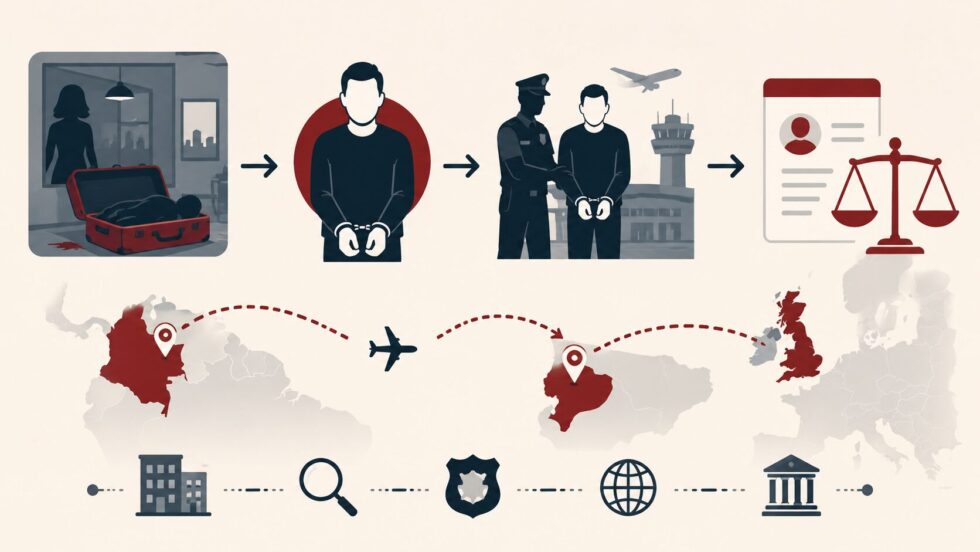
28 June 2026, Matthew Ashley Foster-Smith became the British name at the centre of a Colombian murder inquiry after police in Ecuador arrested him at Quito International Airport. Colombian authorities say the 46-year-old man from Bournemouth, Dorset, is suspected over the death of 36-year-old Natalia Villalba, whose body was found inside a suitcase in an apartment in Bogotá’s Chicó district. Prosecutors allege Villalba died on 18 June, that the scene was later altered, and that Foster-Smith left Colombia before being traced in Ecuador. The case now links Britain, Colombia and Ecuador through an arrest warrant, an Interpol Red Notice and consular contact from the UK Foreign Office, The WP Times reports.
Britain’s role is not symbolic. Bogotá mayor Carlos Fernando Galán said Dorset Police helped the international operation that led to Foster-Smith being located, while the UK Foreign, Commonwealth & Development Office confirmed it was supporting a British man detained in Ecuador and speaking with local authorities. Colombian prosecutors describe the case as aggravated femicide and alleged concealment, alteration or destruction of material evidence. Foster-Smith has not been convicted, and the allegations will have to be tested in court.
British man arrested in Ecuador after body found in Bogotá suitcase
The arrest took place in Quito, but the centre of the investigation remains Bogotá. Colombian authorities say Natalia Villalba was found dead in an apartment in Chicó, an area of the capital known for residential buildings, offices, hotels and short-term lets. That matters because the inquiry is likely to turn on building access records, CCTV, phone data, travel documents and forensic evidence from the apartment.
The official Bogotá statement says prosecutors obtained an arrest warrant and Interpol issued a Red Notice before Foster-Smith was detained in Ecuador. The same statement identifies the suspect as Foster Martinson; UK reporting has named him as Matthew Ashley Foster-Smith. Both names appear in coverage of the same case.
The word Britain now sits inside a Latin American murder investigation because the suspect is British, the assisting force is Dorset Police, and the next legal steps involve more than one jurisdiction.
The confirmed structure of the case is narrow but serious:
- Natalia Villalba, 36, was found dead in a suitcase in Bogotá.
- Colombian authorities place the alleged incident on 18 June 2026.
- Foster-Smith, 46, from Bournemouth, Dorset, was arrested in Ecuador.
- Colombia says an arrest warrant and Interpol Red Notice were active.
- Dorset Police were named by Bogotá’s mayor as part of the locating effort.
- The UK Foreign Office confirmed consular support for a British detainee.
What Colombia alleges against Matthew Ashley Foster-Smith
Colombian prosecutors allege that Foster-Smith entered the apartment where Villalba was alone, physically attacked her, caused her death, placed her body in a suitcase and took steps to conceal what had happened. These are prosecution allegations, not a verdict. The distinction is essential because the case has already travelled faster in headlines than it has in court.
“This painful case will not go unpunished,” Bogotá mayor Carlos Fernando Galán said after the arrest, according to UK reports.
That statement shows political pressure in Bogotá, but courts will need evidence rather than outrage. The prosecution case will likely depend on the timeline of death, signs of violence, fingerprints or DNA, footage from the building, phone location data and Foster-Smith’s movements after 18 June.
The legal description used by Bogotá is severe. Aggravated femicide is not a generic murder label in Colombia; it points to a gender-based killing allegation under Colombian law. The separate allegation concerning evidence concealment suggests prosecutors believe the suitcase and the condition of the apartment are part of the criminal act, not merely details found after death.
Matthew Foster-Smith Interpol Red Notice and Britain’s police link
The Matthew Foster-Smith Interpol Red Notice is the mechanism that pushed the case beyond Colombia. A Red Notice does not itself decide guilt. It tells police forces and border authorities that a person is wanted by another country for arrest pending extradition, surrender or a similar legal process. In this case, the practical chain appears clear. Colombia opened the case and sought the arrest. Interpol circulated the notice. Ecuadorian authorities detained the suspect at the airport in Quito. Dorset Police assisted with location work, according to Bogotá’s mayor.
| Actor | Role in the case | Why it matters |
|---|---|---|
| Colombian prosecutors | Homicide investigation and arrest warrant | They hold the core allegations |
| Bogotá authorities | Public security coordination | They confirmed the arrest operation |
| Interpol | Red Notice | It enabled international tracing |
| Ecuadorian authorities | Airport detention | They physically held the suspect |
| Dorset Police | Assistance from Britain | They connected the UK side to the inquiry |
| UK Foreign Office | Consular support | It confirmed official British contact |
Britain’s involvement does not mean the case will be tried in Britain. The alleged crime scene is in Colombia, the victim was found in Bogotá, and Colombian prosecutors are driving the file. The British role is narrower: policing assistance and consular support for a detained citizen.
What Foster-Smith reportedly said before being detained
Before the arrest, Foster-Smith reportedly contacted The Sun and denied involvement. He was quoted as saying he had been watching England play Croatia on a big screen in an Irish bar at the time of the incident, then went to a shopping centre, bought an ice cream and later returned for more football.
That claim is now part of the public record through British media, but it is not the same as a verified alibi. Investigators will need to compare it with timestamps, CCTV, card payments, mobile data and the forensic estimate of when Villalba died. If the times do not match, the claim weakens. If independent records support it, it becomes a central defence point.
In a case built across borders, a pub alibi is only as strong as the camera, phone and payment records behind it.
The reported phone calls may also matter for another reason. UK media have said Foster-Smith was located through calls made before his arrest. Colombian official material has not set out that detail in the same way, so it should remain attributed to media reporting unless investigators or prosecutors confirm it in court.
Natalia Villalba case and the evidence questions now ahead
The Natalia Villalba suitcase Colombia case now moves into the evidence stage. Public shock is already established. What remains is proof. Prosecutors must connect a named suspect to a specific room, a specific time window, a specific death and an alleged attempt to hide the body.
The most important questions are practical:
- When exactly did Natalia Villalba die, according to forensic examiners?
- Who entered and left the Chicó apartment before and after that time?
- What do building cameras, reception logs and lift footage show?
- Did phones, bank cards or travel records place Foster-Smith near the scene?
- What route did he take from Colombia to Ecuador?
- How will Ecuador process any transfer request from Colombia?
- What formal defence will Foster-Smith present once before the court?
These questions explain why the first hearing will matter more than the first headlines. The prosecution’s language is already clear, but the court will need documents, expert reports and admissible evidence.
Britain watches as Colombia seeks the next legal step
For Britain, the case is uncomfortable because it involves a British suspect abroad, a previous link to Dorset Police and a violent allegation in a foreign jurisdiction. For Colombia, it is a femicide investigation with international flight alleged by prosecutors. For Ecuador, it is a custody and transfer matter triggered at its main airport. The UK Foreign Office statement is deliberately limited. It says support is being provided to a British man detained in Ecuador and that officials are in contact with local authorities. It does not dispute the Colombian case, defend the suspect, or comment on evidence. That is standard consular practice.
“We are supporting a British man who has been detained in Ecuador and are in touch with the local authorities,” the UK Foreign, Commonwealth & Development Office said.
The next confirmed development should come from prosecutors, Ecuadorian court authorities or Colombian officials handling the transfer request. Until then, the fixed facts are these: Natalia Villalba is dead, Foster-Smith is detained, Colombia wants him before its justice system, and Britain is now formally present through police assistance and consular contact.
FAQ on the Matthew Ashley Foster-Smith case
Who is Matthew Ashley Foster-Smith?
Matthew Ashley Foster-Smith is a 46-year-old British man from Bournemouth, Dorset. Colombian authorities say he is suspected in the death of Natalia Villalba in Bogotá.
Why is Britain involved in the case?
Britain is involved because the detained suspect is British and Dorset Police were named by Bogotá’s mayor as assisting the operation to locate him. The UK Foreign Office is also providing consular support.
Where was Natalia Villalba found?
Natalia Villalba’s body was found inside a suitcase in an apartment in Bogotá’s Chicó district, according to Colombian authorities.
What is an Interpol Red Notice?
An Interpol Red Notice is an international request to locate and provisionally arrest a person wanted by another country. It supports extradition or surrender procedures but does not prove guilt.
Has Foster-Smith been convicted?
No. He has been arrested and is suspected by Colombian authorities, but there is no reported conviction in this case. The allegations must be tested through the legal process.
Read about the life of Westminster and Pimlico district, London and the world. 24/7 news with fresh and useful updates on culture, business, technology and city life: What’s on in London this weekend as free events, festivals and outdoor shows fill 6 June 2026