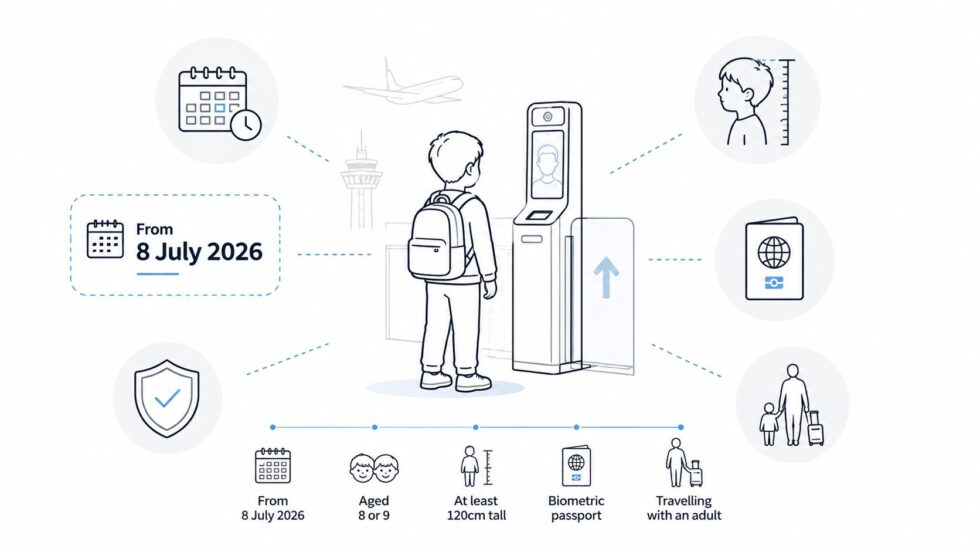
From Wednesday 8 July 2026, some younger children will be allowed to use UK airport eGates for the first time, cutting a common delay for families returning from summer holidays. The change applies to children aged eight and nine who are at least 120cm tall, hold an eligible biometric passport and travel through the border with an adult, as The WP Times reports.
The rule matters because it lowers the usual eGate age threshold from 10 to eight. The Home Office says the change could make up to 1.5 million more children eligible to use automated passport gates over the next year, based on 2025 UK arrivals data. Families arriving at Heathrow, Gatwick, Manchester, Edinburgh, Birmingham, Glasgow and other UK airports could see the difference during the busiest weeks of the school summer break.
What changes at UK airport eGates from 8 July
The practical change is narrow but important: UK airport eGate rules for children will include eligible eight- and nine-year-olds from 8 July 2026. Until then, the normal lower age limit is 10, and children under 17 must still be accompanied by an adult when using the gates. From 8 July, a child aged eight or nine can use an eGate only if all the main conditions are met:
- the child is already eight or nine on the day of travel;
- the child is at least 120cm, or 3ft 11in, tall;
- the child is accompanied by an adult;
- the child has an eligible biometric passport;
- the child’s nationality or immigration status allows eGate use.
The rule does not mean every child born after 2017 can automatically use an eGate.
That phrase needs care. A child born in 2018 will not qualify until their eighth birthday. A child born in late 2017 may already be old enough by July 2026, but still needs to meet the height, passport and accompaniment rules. The border system looks at eligibility on the day of arrival, not simply the year printed in a headline.
Who will be eligible under the new rule
The new access is aimed at children aged eight and nine who can be processed safely by the automated gates. The 120cm height requirement is linked to the facial-recognition camera in the eGate: the system must be able to capture and compare the child’s face with the image held in the passport chip.
Eligible passengers normally need a biometric passport and must be one of the nationalities allowed to use UK eGates. The UK Government lists British citizens, nationals of EU countries, Australia, Canada, Iceland, Japan, Liechtenstein, New Zealand, Norway, Singapore, South Korea, Switzerland and the United States among those who can normally use eGates. Members of the Registered Traveller Service may also be eligible.
| Traveller | Before 8 July 2026 | From 8 July 2026 |
|---|---|---|
| Child aged under 8 | Staffed Border Force desk | Staffed Border Force desk |
| Child aged 8 or 9, under 120cm | Staffed Border Force desk | Staffed Border Force desk |
| Child aged 8 or 9, 120cm+ | Staffed Border Force desk | May use eGate with adult |
| Child aged 10 to 17 | May use eGate with adult | May use eGate with adult |
| Adult with eligible biometric passport | May use eGate | May use eGate |
This is why the change is being presented as a family travel update, not a full border-policy overhaul. It affects a specific age group that previously had to use a staffed desk even when the rest of the family could use automated passport control.
“Travel with young children can be stressful for parents. By expanding eGate access, more families can experience a swifter and smoother journey home,” Migration and Citizenship Minister Mike Tapp said in the Home Office announcement.
What families should check before travelling
Parents should not assume the gate will open just because a child is eight or nine. The eGate is a border-control system, not an airport fast-track lane. If the document, image check or eligibility conditions fail, the family can be directed to a Border Force officer. The basic checks are simple:
- Confirm the child will be at least eight on the date of travel.
- Check the child is at least 120cm tall.
- Make sure the passport has the biometric chip symbol on the cover.
- Confirm the passport nationality is eligible for eGate use.
- Keep the child with an adult throughout the border process.
- Follow the screen instructions at the gate.
The adult requirement remains in place for children under 17.
Different surnames can also slow families down at the border, even though that is separate from the eGate rule. A parent travelling with a child who has another surname may still need evidence of the relationship or permission to travel, such as a birth certificate or a consent letter. The eGate change does not remove those normal border checks.
Which airports will families notice it in
The Home Office says the expansion will apply across more than 290 eGates at UK and juxtaposed ports. “Juxtaposed” ports are places where UK border checks happen outside the UK, such as some international rail terminals before travel to Britain.
Families are most likely to notice the rule at major UK airports with eGates, including:
- London Heathrow;
- London Gatwick;
- London Stansted;
- London Luton;
- London City;
- Manchester;
- Birmingham;
- Edinburgh;
- Glasgow;
- Bristol;
- Newcastle;
- Cardiff;
- East Midlands.
Some airport lists also include Southampton and Southend, but the live position can depend on terminal layout, operational use and Border Force deployment on the day. Passengers should follow the signs and staff instructions at the airport rather than relying only on a general airport list.
eGates for children aged 8 and 9 will be most useful at peak arrival times, especially when several long-haul and European flights land close together. The time saving will vary by airport and queue length, but the effect is clear: more family groups can move through the automated channel instead of adding to staffed passport-control queues.
Why the rule is changing now
The UK first lowered the child eGate threshold to include more younger passengers in 2023, when access was extended to eligible 10- and 11-year-olds. The 2026 change goes further by adding eight- and nine-year-olds, but only with the 120cm height limit and adult accompaniment. The Government’s explanation is partly operational. More passengers using eGates can reduce pressure on staffed desks, while Border Force officers remain available for higher-risk checks, document issues and travellers who cannot use automated gates. The Home Office says the policy is designed to speed up journeys while maintaining border security.
“eGates are an essential part of keeping our border secure,” Border Force Director General Phil Douglas said, adding that wider family access would free officers to focus on people who may pose a threat.
For airports, the change also fits the summer travel calendar. It starts on 8 July, just before many schools in England and Wales break up for the long holiday period. That timing means the first major test will come during late July and August arrivals, when family travel is at its heaviest.
What happens if the eGate does not work
An eGate can reject or refer a passenger for several ordinary reasons. The passport may not scan cleanly. The child may stand in the wrong place. The facial image may not match clearly enough. Glasses, hats, movement, shadows or a damaged passport can all interfere with the check. A referral does not mean the family has done anything wrong. It normally means the passenger must see a Border Force officer for a manual check. That can happen to adults as well as children.
The eGate is an option for eligible families, not a guaranteed shortcut.
Parents should also remember that some travellers need a passport stamp or must speak to an officer because of their immigration route. In those cases, the eGate may not be the right channel even if the passport itself is biometric.
How the change affects summer travel
The biggest gain is likely to be convenience. A family that previously had to use a staffed desk because one child was nine may now be able to stay together through the automated gates. That reduces a common source of confusion at the border, where adults and older children were technically eligible for eGates but younger siblings were not.
For families with more than one child, the rule will still depend on the youngest traveller. If one child is nine and 125cm tall but another is six, the family should expect to use the staffed route unless airport staff direct them otherwise. The new rule does not create a separate family eGate for every household. children born after 2017 airport rules is therefore a useful search phrase, but it is not the legal test. The real test is age, height, passport type, nationality or status, and adult accompaniment. AirportsUK chief executive Karen Dee described the change as a welcome development because more families will be able to use the technology and the border process should be quicker for many travellers. That does not remove queues altogether, but it should reduce one bottleneck for families arriving in Britain during the school-holiday surge.
FAQ
When does the new UK airport eGate rule start?
The rule starts on Wednesday 8 July 2026. From that date, eligible children aged eight and nine can use UK eGates if they meet the height, passport and adult-accompaniment conditions.
Can every child born after 2017 use an eGate?
No. The child must be at least eight years old on the day of travel. They must also be at least 120cm tall, hold an eligible biometric passport and be accompanied by an adult.
Do children still need an adult at the eGate?
Yes. Children under 17 must be accompanied by an adult when using UK eGates. The new rule lowers the age threshold but does not remove the adult-supervision requirement.
Which passports are accepted at UK eGates?
Eligible biometric passports include those from the UK, EU countries, the United States, Canada, Australia, New Zealand, Japan, Singapore, South Korea, Switzerland and several other approved countries listed by the UK Government.
What if the eGate rejects the child’s passport or face scan?
The family will be directed to a Border Force officer for a manual check. This is a normal part of border control and can happen even when the traveller is eligible to use an eGate.
Will the rule reduce airport queues?
It should reduce pressure on staffed passport-control desks by allowing more family groups to use automated gates. The Home Office estimates up to 1.5 million additional children could become eligible over the next year.
Read about the life of Westminster and Pimlico district, London and the world. 24/7 news with fresh and useful updates on culture, business, technology and city life: Why are Bayeux Tapestry UK tickets causing such huge demand at the British Museum