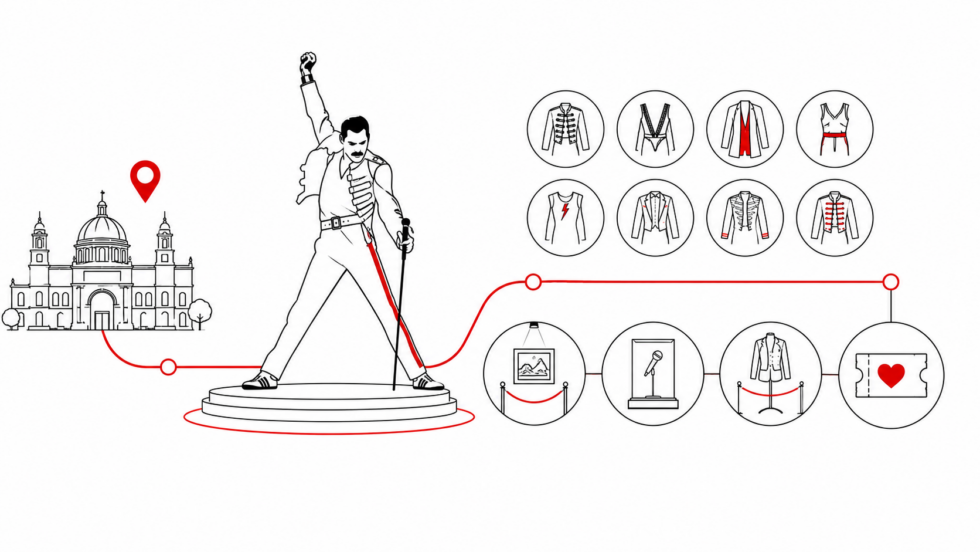
Freddie Mercury exhibition London will open at the Victoria and Albert Museum in South Kensington on 24 October 2026, placing eight stage looks from the Queen frontman’s career across six stops inside the museum’s permanent galleries. Titled Freddie Mercury | Splendid Things, the free display will run until 17 January 2027, requires no ticket and has been developed with Mary Austin, Mercury’s former fiancée and close friend, who is lending seven of the eight looks. The selection stretches from Queen’s early London years and the band’s 1973 debut album through the A Night at the Opera period, Mercury’s solo work and the 1986 Magic Tour. Rather than creating a conventional room-by-room retrospective, the V&A is building a trail in which costumes, accessories, lighting, sound and the museum’s own collections will be used to place Mercury’s visual language alongside art, fashion and design. The opening falls in the year in which Mercury, born on 5 September 1946, would have turned 80, The WP Times reports.
The display centres on clothes that were not simply decoration around the music but part of the mechanics of Mercury’s performances: garments cut to register from the back of an arena, monochrome silhouettes that translated cleanly into photography, and theatrical pieces that helped transform the singer from a club and college performer into the commanding figure seen on Queen’s later stadium tours. Among the confirmed exhibits are the “Mercury Wing” catsuit by Wendy de Smet, a monochrome outfit linked to an early Imperial College performance and Queen’s first album cover, Diana Moseley’s crown and cloak from the 1986 Magic Tour, and a costume from Mercury’s Made in Heaven video. The V&A says specially made mannequins will be posed to echo Mercury’s physical stage presence, while designer Tom Piper has created distinct settings for each part of the trail.
What will be shown at the Freddie Mercury exhibition in London
The V&A Freddie Mercury exhibition covers roughly a decade and a half in which Mercury’s wardrobe changed in parallel with Queen’s scale, music and live presentation. One of the earliest pieces is a black-and-white ensemble worn for an early Queen performance at Imperial College London. The same visual identity was later used on the cover of Queen, the band’s self-titled debut album released in 1973, linking an object in the museum directly to the group’s first recorded era. That matters to the architecture of the exhibition because it establishes Mercury before the crown, military jackets and stadium-scale imagery familiar from the 1980s. The V&A is therefore treating clothing as a chronological record of performance rather than presenting eight famous objects without context.
A second major object is Wendy de Smet’s “Mercury Wing” catsuit, worn during Queen’s A Night at the Opera touring period in 1975 and 1976. Its wing-like construction exaggerated Mercury’s movements on stage and became associated with the highly theatrical visual language surrounding Queen in the mid-1970s. The garment was also seen in the Bohemian Rhapsody video, giving it a second life away from the concert stage and connecting fashion, television and recorded music at the moment Queen’s international profile was expanding. De Smet later designed other garments for Mercury, including his black “spine suit” and “White Queen” ensemble, and she is due to discuss those stage looks at a V&A event on 23 October, the evening before the trail opens.
The eight looks are being used as evidence of how Mercury constructed a public image over time, not as a greatest-hits wardrobe display.
The confirmed selection includes:
- a monochrome look connected with an early Queen performance at Imperial College and the cover of the band’s 1973 debut album;
- the “Mercury Wing” catsuit designed by Wendy de Smet and worn during the A Night at the Opera tour in 1975–76;
- garments and accessories associated with Mercury’s performances during Queen’s rise through the 1970s;
- Diana Moseley’s crown and cloak from Queen’s 1986 Magic Tour;
- a costume worn in the Made in Heaven music video during Mercury’s solo career;
- accessories and pieces from Mercury’s personal wardrobe intended to show the distinction between the private wardrobe and the stage persona.
The crown and cloak provide the exhibition with its clearest late-career image. Designed by Diana Moseley, the pieces were worn on the Magic Tour in 1986, including Queen’s concert at Knebworth on 9 August. That show became Mercury’s final live performance with Queen, giving the costume a historical weight beyond its deliberately regal appearance. By placing it in the same trail as the early monochrome ensemble and the de Smet catsuit, the museum can show how Mercury’s stage wardrobe moved from graphic experimentation to a form of controlled spectacle suited to enormous audiences. The source material supplied for this report also identifies the Knebworth appearance and the 1986 costume among the exhibition’s central objects.
| Period | Confirmed look or object | Why it matters |
|---|---|---|
| Early 1970s | Monochrome Imperial College ensemble | Connects early Queen performances with the cover image of the band’s 1973 debut |
| 1975–76 | “Mercury Wing” catsuit by Wendy de Smet | Links the A Night at the Opera tour with the Bohemian Rhapsodyvisual era |
| 1985 | Made in Heaven video costume | Represents Mercury’s work outside Queen and his solo visual identity |
| 1986 | Crown and cloak by Diana Moseley | Worn on the Magic Tour, including Mercury’s final Queen performance at Knebworth |
| Across the period | Accessories and personal wardrobe | Provides material beyond the most recognisable stage costumes |
How the V&A will turn Freddie Mercury’s costumes into a six-stop trail
Freddie Mercury costumes will not be grouped inside a single temporary exhibition hall. The V&A has instead planned six installations across its South Kensington galleries, allowing the clothes to sit alongside objects, interiors and architectural spaces already associated with decorative art, fashion and design. Each intervention is intended to represent a different point in Mercury’s career, and the museum says some sections will use sound and lighting as part of the presentation. Specially constructed mannequins will be posed dynamically rather than standing in neutral fashion-display positions, an attempt to retain something of the way the clothes were designed to behave during performance.
The trail has been designed by Tom Piper, whose previous work includes productions for the Royal Shakespeare Company, the Tower of London poppy installation and the V&A’s Taylor Swift | Songbook Trail. His involvement gives Splendid Things a clear theatrical framework. The installations will use set dressing and, in selected spaces, sound and light to distinguish one period from another without converting the entire museum into a single immersive environment. Piper’s task is unusually specific: the clothes already carry heavy associations through photographs, music videos and concert footage, so the display has to provide context without reproducing a Queen stage show.
Why the exhibition is called Freddie Mercury | Splendid Things
The title comes directly from Mercury’s description of his taste in 1978.
“I like to be surrounded by splendid things.” (Freddie Mercury, 1978, quoted by the V&A and the official Freddie Mercury website.)
That phrase gives the museum a route beyond pop memorabilia. Mercury studied graphic design at Ealing College of Art after his family moved to Middlesex in 1964, according to Queen’s official biography, and his stage identity repeatedly drew on costume, typography, photography and theatrical presentation. The V&A can therefore connect familiar Queen objects with its broader remit rather than treating the display solely as a music anniversary event. Queen’s official site records that Farrokh Bulsara was born in Zanzibar on 5 September 1946 and later studied graphic design in London before becoming Freddie Mercury and fronting Queen.
The museum is using Mercury’s own interest in objects and visual presentation as the organising principle of the trail.
Mary Austin’s involvement is also unusually substantial. The V&A says she is lending seven of the eight looks, meaning most of the central material comes from a person who knew Mercury closely rather than from a broad institutional trawl. Austin has described the clothes as part of a deliberate performance language, arguing that Mercury understood the need for an image capable of matching the physical scale of the venues Queen was playing. “The clothes were part of that exploration,” she said in material quoted by the official Freddie Mercury site from A Life in Lyrics, published by HarperCollins on 1 September 2026.
That distinction is useful when reading pieces such as the crown and cloak. The costume can appear extravagant in isolation, but on the Magic Tour it had a practical visual function: it could be understood instantly from a distance and turned Mercury’s final entrance or exit into a recognisable piece of theatre. The same principle applies to the “Mercury Wing” catsuit, where exaggerated lines amplified bodily movement rather than simply providing an unusual silhouette. Clothing becomes part of the staging technology.
When is Freddie Mercury | Splendid Things open and is it free
Freddie Mercury Splendid Things opens on Saturday 24 October 2026 at V&A South Kensington and runs until Sunday 17 January 2027. Entry to the trail is free, and the museum states that no ticket is required. The display is spread throughout the building rather than confined to a separately ticketed exhibition space. V&A South Kensington is on Cromwell Road, London SW7 2RL, with South Kensington Underground station providing the principal nearby Tube connection.
For visitors planning specifically around the display, the practical details are straightforward:
- Opening date: 24 October 2026.
- Closing date: 17 January 2027.
- Venue: V&A South Kensington, Cromwell Road, London SW7 2RL.
- Format: six-stop trail across the museum.
- Number of looks: eight.
- Admission: free.
- Ticket requirement: none for the display itself.
The museum has also scheduled a related event for 23 October titled Staging Freddie, featuring Wendy de Smet and Diana Moseley, two designers directly associated with Mercury’s clothes. The in-person discussion is listed as sold out, while the V&A also offers a paid livestream. According to the museum, the session will cover the creation of pieces including de Smet’s “spine suit” and “White Queen” ensemble and Moseley’s crown, cloak and Made in Heavencostumes. That programme gives the display an additional layer of primary testimony from people who physically designed and made the clothes rather than later commentators interpreting them.
“Freddie will be very at home in the V&A galleries.” (Kate Bailey, V&A Senior Curator of Theatre and Performance, announcing the display.)
The timing also places the free exhibition London programme inside a wider run of V&A music and performance projects. The museum has previously used a distributed trail format for Taylor Swift, while the David Bowie Centre at V&A East Storehouse is already open in 2026. Splendid Things is smaller in object count than a conventional blockbuster retrospective, but the six-stop arrangement means the curatorial argument depends on where each costume is placed and what surrounds it rather than on volume alone.
Why 2026 is significant for the Freddie Mercury exhibition
Mercury was born Farrokh Bulsara on 5 September 1946, making 2026 the 80th anniversary year of his birth. Queen’s official biography records his death on 24 November 1991 at the age of 45, one day after he publicly confirmed that he had AIDS. The V&A display therefore arrives 35 years after his death as well as during his 80th birthday year, although the museum’s official framing is centred primarily on the anniversary of his birth.
The anniversary has generated other official Queen activity in 2026, including the Freddie Mercury Birthday Party programme promoted through Queen’s website and events connected with Queen’s 1986 performances. Yet the Queen exhibition London proposition at the V&A is narrower than a band history. Brian May, Roger Taylor, studio production, chart records and Queen’s wider catalogue are not the organising subjects. The museum is concentrating on Mercury as a performer whose clothes, movement and visual decisions developed alongside the music. That focus should make the trail particularly useful for visitors familiar with the songs but less familiar with how systematically Mercury constructed stage images. The black-and-white early outfit, winged catsuit, solo-video costume and royal cloak represent four very different solutions to the same problem: how a performer should look when music is being translated into photography, video, theatre and increasingly large live spaces. The objects also retain evidence of collaboration, because names such as Wendy de Smet and Diana Moseley sit behind looks that audiences often associate only with Mercury himself.
Eight costumes are enough to show a progression because each comes from a different point in the development of Mercury’s public image.
For a museum display, that is a more precise proposition than attempting to summarise his entire career. The earliest clothes connect Mercury with London’s art-school and club environment; the mid-1970s pieces coincide with Queen’s expansion into international touring and music video; the solo costume records an identity beyond the group; and the 1986 regalia belongs to the final phase of his live work with Queen. The six-stop route should make those transitions visible without requiring visitors to follow a dense chronological archive.
The most important practical point remains unusually simple for a major music display in London: Freddie Mercury | Splendid Things is free and does not require advance admission for the trail. Eight looks, seven of them loaned by Mary Austin, will be on view from 24 October 2026 to 17 January 2027 at the V&A South Kensington.
Materials used: Victoria and Albert Museum, official Freddie Mercury website, QueenOnline official Queen website, V&A Staging Freddie programme, source report supplied for this article.
Read about the life of Westminster and Pimlico district, London and the world. 24/7 news with fresh and useful updates on culture, business, technology and city life: London events October 2026: the rescued Chopin monument returns to life at the National Liberal Club