
For UK architects, developers, contractors and design-led studios, 2026 marks a clear turning point in how international exhibitions are evaluated. Persistent construction inflation, tightening energy and carbon regulation, mounting pressure on large-scale retrofit delivery and growing scrutiny of procurement decisions have fundamentally changed priorities across the British construction and design sector. In this environment, exhibitions are no longer assessed by reputation or scale alone, but by their ability to deliver specifiable systems, regulatory foresight and demonstrable delivery confidence for UK projects.
Across Britain, Europe and the United States, the exhibitions that matter most in 2026 are those closely aligned with the dominant industry trends: retrofit-first construction, low-carbon materials with verified data, industrialised building methods and digitally integrated delivery models. Nordic markets continue to act as regulatory testbeds, continental Europe concentrates on engineered systems and scale, while the United States remains a launchpad for construction technology and global platforms.
This article identifies the architecture and construction exhibitions that are strategically relevant for UK professionals in 2026, explains why they matter by region and trend, and sets out how British firms can use them to reduce risk, anticipate regulatory change and strengthen competitive positioning, reports The WP Times.
What UK professionals expect from exhibitions in 2026
In 2026, UK architects, developers and contractors attend fewer exhibitions than before the pandemic, but expect far more from each visit. Industry surveys and professional feedback show a clear shift: exhibitions are no longer used for inspiration, but for risk control, procurement validation and regulatory assessment. Decision-makers now dominate exhibition floors. Senior professionals arrive with defined questions about installability, compliance, delivery risk and long-term performance. As one London-based commercial architect involved in large mixed-use schemes put it: exhibitions are no longer about discovering ideas, but about confirming whether a system is mature enough to specify on a live project (industry interview, UK practice).

This change reflects market pressure. Construction inflation remains volatile, clients are increasingly risk-averse, and public-sector procurement demands audit-ready decisions. As a result, UK professionals approach exhibitions as filtering exercises: which systems can be installed, insured, maintained and defended under scrutiny.
What UK visitors prioritise
UK professionals consistently assess exhibitors against a narrow set of criteria:
- Retrofit-ready systems
Solutions that can be installed in occupied buildings, within tight programmes and without major structural disruption. Products viable only for new-build pilots are usually excluded early. - Verified low-carbon performance
Materials and systems supported by Environmental Product Declarations, lifecycle assessments and traceable sourcing. Unverified sustainability claims increasingly fail specification checks, particularly on publicly funded projects. - Delivery certainty
Transparent lead times, local installer capacity, maintenance strategies and warranty structures. Technically strong products with unreliable delivery are now seen as liabilities rather than assets. - Digital construction integration
Compatibility with BIM-based coordination, commissioning and asset management. Digital clarity is valued for reducing contractual risk and post-handover disputes, not for innovation alone. - Future regulatory alignment
Compliance with current standards is no longer sufficient. UK professionals look for solutions designed to meet anticipated tightening of energy performance, carbon reporting and building safety rules.
Exhibitions that fail to address these priorities increasingly struggle to justify international travel budgets. Events that combine credible suppliers, regulatory intelligence and demonstrable performance evidence continue to attract senior UK decision-makers, despite higher costs and tighter schedules.
Construction and architecture trends shaping 2026
Across UK and international markets, 2026 is defined by a move away from conceptual sustainability towards measurable and auditable performance. Clients, investors and public authorities now expect operational energy data, embodied-carbon calculations, post-occupancy evidence and clear maintenance strategies at early decision stages.

Procurement behaviour reinforces this shift. Rising costs and tighter margins have increased emphasis on supplier reliability, system maturity and long-term serviceability. Innovation remains welcome, but only when supported by data, warranties and a credible delivery path (industry briefing, UK development sector). Several structural trends determine which exhibitions remain relevant:
- Retrofit at scale
Driven by energy targets and the UK’s ageing building stock, retrofit has moved from pilot projects to programme delivery. Exhibitions focusing on low-disruption upgrades and performance monitoring attract the strongest interest. - Industrialised and offsite construction
Prefabrication and modular systems are assessed primarily on logistics, tolerances and integration, rather than novelty. - Timber and hybrid structures
Engineered timber continues to gain ground, with growing focus on fire performance, moisture control and regulatory acceptance. - Digital-to-site workflows
BIM is treated as part of a continuous chain linking procurement, installation and asset management, supporting contractual certainty. - Supply-chain resilience
Lead times, substitution strategies and local support now influence specification decisions as strongly as technical performance.
In this environment, exhibitions function less as showcases and more as decision filters, allowing UK professionals to interrogate suppliers, compare systems and identify solutions that are genuinely ready for deployment under real-world conditions.
United Kingdom: translation and market reality
UK-based exhibitions remain important in 2026, not as primary sources of innovation, but as translation platforms where international ideas are adapted to British regulation, procurement norms and delivery constraints.
Clerkenwell Design Week 2026
Clerkenwell Design Week is the UK’s most influential architecture and design festival, concentrated across London’s Clerkenwell district. It attracts architects, interior designers and developers seeking products that are already specification-ready for the UK market. For British professionals, the event’s value lies in:
- direct engagement with manufacturers active in the UK, including access to local representatives and technical support
- exposure to Nordic and European brands presenting systems adapted to UK compliance and certification requirements
- practical insight into how sustainability claims translate into procurement language, cost frameworks and installation realities
The festival is particularly relevant for workplace, hospitality and residential projects, where lifecycle cost, maintenance and durability increasingly shape design decisions.
London Build Expo 2026
London Build Expo focuses on contractors, engineering, infrastructure and delivery rather than design-led innovation. While its scope is broader and more operational, it provides a clear snapshot of current market capacity, labour availability and supply-chain pressures within the UK construction sector.
For developers and contractors, the exhibition functions as a reality check. “What matters here is not what could work in theory, but what can actually be delivered in the UK right now,” noted a senior project manager working across England (UK construction delivery perspective).
Nordic countries: where UK regulation is heading
The Nordic region has become a reference point for UK professionals because many practices already operate under regulatory frameworks stricter than those currently in force in Britain. Energy efficiency, material traceability and lifecycle thinking are standard, not aspirational.
Nordbygg 2026 (Sweden)
Nordbygg, held in Stockholm, is the largest construction and property exhibition in Northern Europe. It spans materials, building systems, HVAC, digital property management and large-scale retrofit solutions. For UK visitors, Nordbygg offers:
- systems exceeding current UK energy standards
- suppliers experienced in performance-critical environments
- practical retrofit technologies suited to social housing and public-sector projects
Many UK firms use Nordbygg to anticipate regulatory tightening several years ahead.
Stockholm Furniture Fair 2026 (Sweden)
Stockholm Furniture Fair focuses on durability, function and sustainability rather than short-lived trends. UK designers attend to understand how Nordic manufacturers integrate environmental performance with commercial viability.
EUROCONSTRUCT 2026 (Finland)
EUROCONSTRUCT, hosted in Helsinki, is a data-driven construction economics conference rather than a product fair. It provides verified forecasts used by developers, investors and policymakers. For UK professionals, its relevance lies in strategic planning, not specification.
Continental Europe: systems, engineering and scale
Outside the Nordics, major European exhibitions focus on industrialised construction, façade engineering and technical performance.
BAU 2026 (Germany)
BAU Munich is Europe’s largest construction trade fair. Held in Munich, it showcases building materials, façade systems, digital construction and large-scale engineering solutions.
UK firms involved in commercial, infrastructure and manufacturing-led projects often prioritise BAU for its technical depth and supplier scale.
Architect@Work (EU series)
Architect@Work events across Europe present curated, specification-focused innovations. These are particularly useful for UK architects working on refurbishment and design-led projects requiring niche systems.
United States: scale, technology and global influence
The US construction market continues to lead in scale, speed and software-driven innovation. Many global systems debut at US exhibitions before reaching Europe.
AIA Conference on Architecture & Design 2026
AIA Conference on Architecture & Design, taking place in San Diego, is the largest annual architecture event in the United States. It combines a major exhibition with a wide-ranging conference programme.
UK architects attend to:
- assess emerging construction technologies
- benchmark against global practice standards
- build international partnerships
Greenbuild International Conference & Expo 2026
The Greenbuild International Conference & Expo 2026 remains the United States’ most influential forum dedicated specifically to sustainable and low-carbon construction at scale. Unlike design-led fairs or broad construction expos, Greenbuild is structured around implementation rather than aspiration, bringing together developers, engineers, manufacturers, policymakers and institutional clients.
For UK professionals, the event’s relevance lies not in conceptual sustainability narratives, but in observing how net-zero strategies, ESG frameworks and performance standards are operationalised within large commercial and public-sector projects. Greenbuild provides insight into how sustainability requirements are translated into procurement models, certification pathways and repeatable delivery processes in a high-volume market.
British firms attending the conference typically focus on understanding which sustainability solutions have moved beyond pilot status in the US and how those approaches may influence global standards, investor expectations and client demands in the UK over the medium term.
Full exhibition calendar 2026 (UK, Europe, USA)

| Month | Exhibition | Country | City | Focus |
|---|---|---|---|---|
| March | Nordbygg | Sweden | Stockholm | Construction, retrofit, energy |
| March | Stockholm Furniture Fair | Sweden | Stockholm | Interiors, materials |
| April | BAU | Germany | Munich | Architecture, systems |
| May | AIA Conference on Architecture & Design | USA | San Diego | Architecture, technology |
| June | Clerkenwell Design Week | UK | London | Design, specification |
| June | Greenbuild | USA | TBC | Sustainable construction |
| September | EUROCONSTRUCT | Finland | Helsinki | Market forecasts |
| October | Architect@Work | EU | Multiple | Specification systems |
| November | Wood Building Nordic | Sweden | Stockholm | Timber construction |
How UK firms should use exhibitions strategically
In 2026, the most effective UK architecture and construction firms no longer treat exhibitions as standalone events. Attendance is increasingly framed as part of a wider commercial and delivery strategy, with clear objectives set in advance and outcomes assessed afterwards. Senior practitioners describe exhibitions less as networking opportunities and more as structured information-gathering exercises linked directly to live projects and future procurement cycles.
UK firms that extract value from exhibitions typically arrive with defined priorities: identifying systems suitable for specification, validating supplier capability under UK conditions, testing regulatory alignment, or strengthening their advisory position with clients. “If we don’t know what decision an exhibition is meant to support, we probably shouldn’t be there,” said one partner at a London-based multidisciplinary practice (industry interview).

Crucially, the return on investment is realised after the event, not during it. Firms that translate exhibition intelligence into procurement strategies, client recommendations or internal standards benefit long after travel budgets are spent. This post-event phase — reviewing documentation, comparing suppliers and embedding lessons into future project workflows — increasingly determines whether exhibitions justify their place in the calendar.
Why a Britain–Europe–US exhibition strategy matters in 2026
For UK professionals, Britain, Europe and the United States function as distinct but complementary reference pointswithin the global construction landscape.
- Britain operates primarily as a delivery and translation market, where international systems must be adapted to local planning frameworks, procurement rules and risk profiles.
- Europe, particularly the Nordic countries and Germany, acts as a regulatory and systems laboratory, often signalling where energy, carbon and material standards are likely to move next.
- The United States continues to serve as a technology and scale engine, where construction software, industrialised building platforms and commercial models are tested at scale.
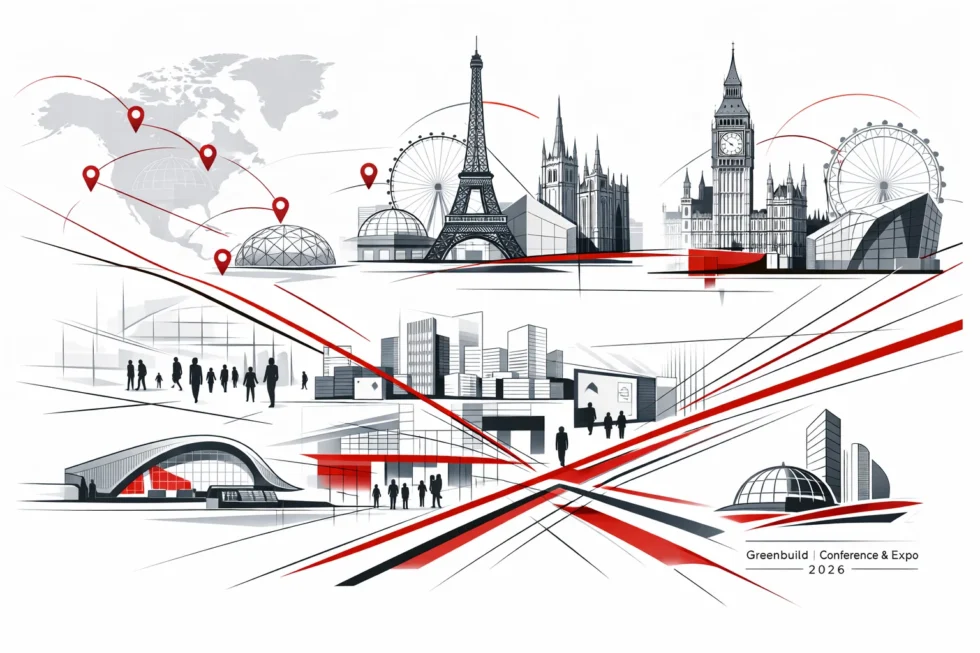
Engaging selectively with all three regions allows UK firms to benchmark solutions, anticipate regulatory change and reduce exposure to delivery risk. In an increasingly competitive global environment, this multi-regional perspective is less about following trends and more about maintaining strategic resilience.
Read about the life of Westminster and Pimlico district, London and the world. 24/7 news with fresh and useful updates on culture, business, technology and city life: Which erotic exhibitions will define 2026 — from London and Berlin to New York and Scandinavia