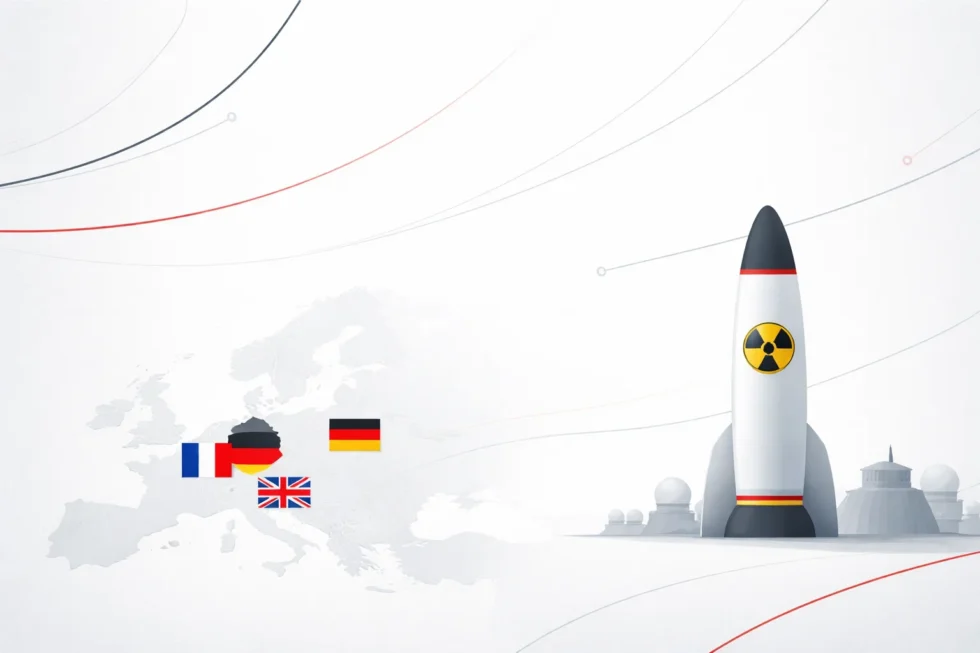
Several European Union countries are actively discussing the prospect of strengthening Europe’s own nuclear deterrence capabilities alongside existing US guarantees, amid a sharp decline in trust towards Washington following the return of Donald Trump to the centre of US foreign policy debate, according to Politico. The issue, long considered politically untouchable, has re-emerged as a serious topic of discussion among European leaders and defence officials, particularly in Eastern and Northern Europe. This is reported by The WP Times, citing Politico.
Senior officials from two Baltic states told Politico that while NATO continues to be viewed as the backbone of Europe’s nuclear security, governments are increasingly prepared to examine whether Europe itself should play a more direct and coordinated role in nuclear deterrence. According to these officials, the debate is no longer theoretical but driven by concrete political risk assessments.
The renewed urgency was evident both in public statements and in private conversations at the Munich Security Conference, where concerns centred on whether the United States would reliably honour its security commitments in the event of a Russian escalation. European diplomats noted that doubts over US resolve have intensified following Trump’s repeated scepticism towards NATO’s collective defence clause.
These concerns were not fully dispelled by a relatively conciliatory speech from US Secretary of State Marco Rubio. While the address reaffirmed America’s formal commitments, European officials said it lacked operational clarity and failed to address deeper strategic anxieties. Estonia’s Deputy Defence Minister Tuuli Duneton confirmed that Tallinn does not rule out early-stage participation in discussions on a shared European nuclear framework, should such talks formally emerge.
“We are always open to discussions with partners,” she said, while emphasising that the United States remains “committed to providing nuclear deterrence for allied countries.”
Latvian Prime Minister Evika Siliņa supported this position, describing nuclear deterrence as a potential tool rather than an immediate policy shift.
“Nuclear deterrence may give us new opportunities. Why not?” she said, stressing that any initiative must remain fully aligned with international treaties and non-proliferation obligations.
Trump’s past rhetoric has played a central role in reigniting the debate. During his presidency and subsequent campaign appearances, he questioned Article 5 of NATO’s charter, publicly criticised allied contributions to the US-led mission in Afghanistan and repeatedly floated the idea of annexing Greenland — a territory belonging to NATO member Denmark. According to Politico, such statements have fundamentally altered Europe’s risk calculations.
European officials told the publication that the emerging discussions are best understood as an attempt to build an additional layer of strategic “insurance” against Moscow, rather than a move to abandon NATO. The fear, they say, is not an immediate US withdrawal but growing unpredictability at the highest political level.
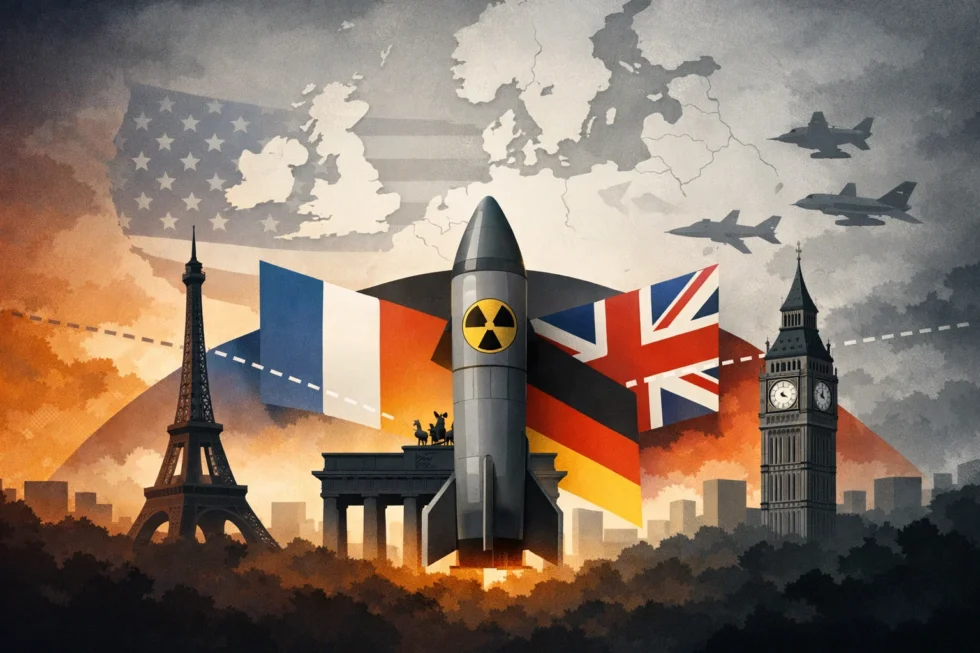
In practical terms, this has shifted attention towards France and the United Kingdom, Europe’s only nuclear-armed states. Unlike London, Paris does not participate in NATO’s Nuclear Planning Group, which coordinates nuclear policy within the alliance. French presidents have consistently argued that France’s nuclear force protects not only national interests but also has a broader European dimension — while maintaining that ultimate launch authority remains exclusively in Paris.
Both German Chancellor Friedrich Merz and French President Emmanuel Macron directly referenced European nuclear deterrence in their Munich speeches, signalling a notable shift in political tone. German officials have historically avoided such discussions due to domestic sensitivities and post-war constraints.
However, the proposal remains highly divisive across the EU. Spanish Prime Minister Pedro Sánchez acknowledged that Europe must strengthen its defence posture against Russia but warned that nuclear rearmament would undermine diplomatic credibility and risk escalating tensions.
From Washington’s perspective, US Deputy Secretary of Defence Elbridge Colby insisted that the United States is not withdrawing its nuclear umbrella from Europe. At the same time, he stressed that European allies are expected to significantly increase their contribution to conventional defence capabilities, suggesting a recalibration rather than a retreat. Earlier this week, Chancellor Merz confirmed that Germany and France are already holding exploratory talks on the future of European nuclear deterrence — a development that would have been politically unthinkable just a few years ago.
Read about the life of Westminster and Pimlico district, London and the world. 24/7 news with fresh and useful updates on culture, business, technology and city life: Keir Starmer may resign amid deepening crisis, Bloomberg reports