
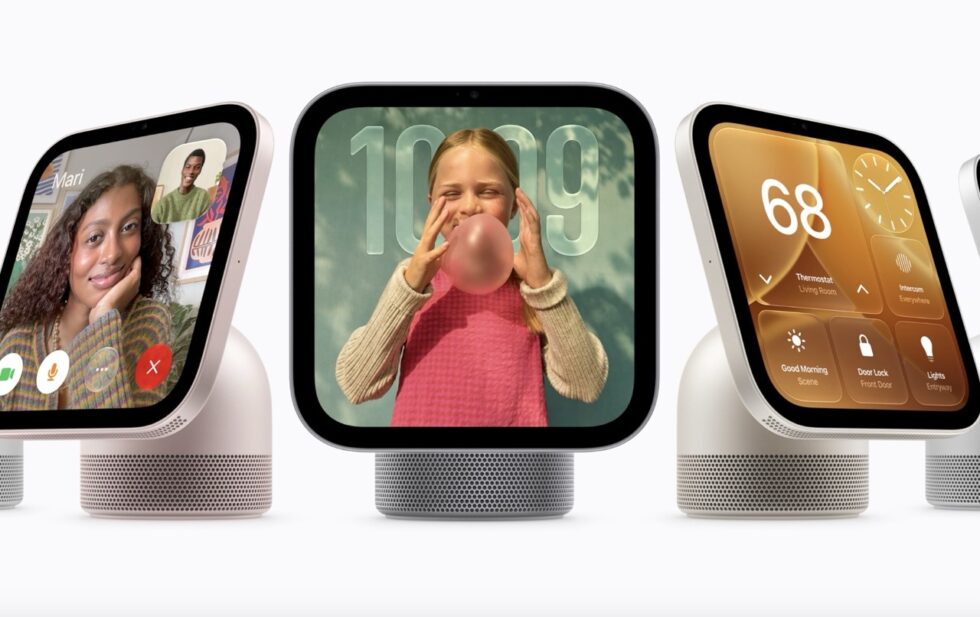
Apple HomeView arrives in the UK with a £299 price tag, a 7-inch Liquid Retina display and a new version of Siri designed to bring entertainment, communication and smart home controls into one device. Announced on 13 October 2026, the product is available to pre-order through Apple’s UK store ahead of its scheduled release on 13 November. Its defining feature is not the screen alone, but the combination of voice assistance, household personalisation and access to Apple services in a shared space. The launch also raises a practical question for British households: how much does a dedicated home display offer beyond an iPhone, an iPad or a conventional smart speaker? The The WP Times coverage of Apple’s launch centres on that distinction, including the UK price, the role of Siri AI and the product’s availability outside the European Union.
Apple is positioning HomeView as a permanent fixture for the kitchen, bedroom, hallway or living room rather than another portable screen. It can sit on a table or be installed on a wall, while facial recognition allows up to six household members to access individual screens, apps and widgets. The company says the device is powered by Apple Intelligence and an A18 chip, with compatible iPhones or iPads providing additional personal context for some requests. Both the standard and wall-mounted models are listed at £299 in the UK, although the wall-mounted version requires a suitable mounting and power solution. For British buyers, the central considerations are therefore the device’s everyday usefulness, the limits of its AI features, privacy in a shared household and the additional cost of installation.
What is Apple HomeView, and how does it work in the UK
Apple announced HomeView on 13 October 2026 as a dedicated screen for household communication, entertainment and smart home management. The product brings together functions that would otherwise be spread across a phone, tablet, speaker and compatible smart home accessories. Its 7-inch Liquid Retina display provides access to personal information, music, video, FaceTime and household controls without requiring the owner to pick up an iPhone every time.
The distinction from a conventional tablet is its intended role. HomeView is designed to remain in a fixed location and serve more than one person, adapting its interface according to who is using it. Apple also describes support for hands-free automations and voice-controlled smart home functions, making the device a potential control point for compatible accessories around the property.
The product is designed around the household as a shared space, rather than a single owner carrying a screen from room to room.
The UK product page lists HomeView in four finishes: silver, starlight, rose pink and space grey. The wall-mounted version comes in silver and space grey. Pre-orders opened on 13 October, with availability scheduled for Friday, 13 November 2026.
Apple’s official UK HomeView page sets out the principal features, while its UK online store lists the price and available configurations.
How much does Apple HomeView cost in the UK, and when does it go on sale
The starting price for both versions is £299, according to Apple’s UK store. The company has set the same price for the tabletop device and the wall-mounted model, so the choice is primarily about placement and installation rather than the initial hardware price.
| Product | UK price | Available finishes | Main consideration |
|---|---|---|---|
| Apple HomeView | £299 | Silver, starlight, rose pink, space grey | Tabletop placement |
| Apple HomeView (Wall Mounted) | £299 | Silver, space grey | Requires a separate mounting and power solution |
Pre-orders began on 13 October 2026. Apple lists 13 November as the availability date for both models in the UK.
The headline price does not tell the whole story for a wall-mounted installation. Apple lists three purpose-built mounting options from Schneider Home, with different requirements and prices.
- Power Mount USB-C Wall Connector: from £54.95, with a power adapter of at least 20W required separately.
- Power Mount AC Wired: from £69.95, with installation by a qualified electrician recommended.
- Power Mount PoE Wired: from £119.95, scheduled for early 2027 and requiring Power over Ethernet wiring.
These accessories are not interchangeable in their installation requirements. The USB-C option is intended for a simpler installation, while the hardwired alternatives are designed for a more integrated appearance. The PoE option also depends on suitable network cabling in the home. For a wall-mounted installation, the £299 device price should be considered separately from the cost of the mount, power equipment and any professional work.
Apple has not presented the two HomeView versions as different performance tiers. Both are listed with the same display size and core functions, although their physical design and speaker arrangements differ. The choice is therefore best understood as a decision about how the device will fit into a particular room.
What does the 7-inch display offer, and is HomeView designed for everyday use
The standard HomeView combines an aluminium enclosure with a 7-inch Liquid Retina display attached to a domed speaker base by a stainless-steel hinge. The hinge allows the screen to tilt, helping users adjust the viewing angle on kitchen counters, bedside tables and other surfaces.
Apple specifies True Tone and automatic brightness adjustment, with brightness ranging from 500 nits to 0.3 nits. That range is intended to make the display readable in a bright room while allowing it to dim substantially at night. The interface can also adjust the amount of information shown according to the user’s distance from the screen. At a distance, HomeView can display simpler information that is easier to read across a room. As someone approaches, the interface can present more detail. This is particularly relevant to a shared household display, where users may glance at reminders or controls while moving through a room rather than sitting directly in front of the screen.
The product’s aluminium finish and matching cable are part of its design, but the more consequential decision is where it will live. A screen on a kitchen counter can be used while cooking, whereas a wall-mounted device may be more suitable for a hallway or entrance.
How does the wall-mounted version differ
The wall-mounted HomeView retains the 7-inch display and provides audio tuned for its installation position. It is intended to offer the same broad set of functions without occupying a tabletop.
The mounting system introduces practical considerations that do not apply in the same way to the standard model. Buyers need to account for power access, cable routing and the suitability of the wall before choosing an installation method. The hardwired options may offer a cleaner finish, but they can require more planning than placing the standard model on a surface.
For rented homes, the tabletop version may be easier to accommodate because it avoids permanent installation. In a property where a fixed household control point is preferred, the wall-mounted model may be more convenient.
How does Siri AI change the Apple HomeView experience
Siri AI is the central software feature of HomeView. Apple describes it as a substantially more capable and conversational version of Siri, powered by Apple Intelligence and the A18 chip. The assistant is intended to answer questions, help users discover music and interpret information displayed on the screen. The significance is that HomeView is not being marketed simply as a display for apps. Apple wants the device to act as a voice-controlled interface through which members of a household can access information and manage compatible services. According to Apple, Siri AI combines broad world knowledge with onscreen awareness and, when paired with a compatible Apple Intelligence-enabled iPhone or iPad, can use personal context from apps such as Calendar and Messages. This could make certain requests more relevant to an individual’s schedule and existing information.
“Apple HomeView is designed to be shared by everyone in the home yet feel completely personal to each user.” (Greg Joswiak, Apple’s senior vice-president of Worldwide Marketing, Apple Newsroom, 13 October 2026.)
The distinction between general knowledge and personal context matters. Answering a general question does not necessarily require access to an individual’s calendar, while responding to a request that depends on a personal appointment may require relevant information from connected devices and apps. Apple says the additional personal context depends on pairing HomeView with an Apple Intelligence-enabled device. There are also limits to what the launch announcement establishes. The presence of Siri AI does not mean every request can be completed automatically, nor does it guarantee that all functions will work independently of other Apple devices or compatible services. Apple’s UK product page states that Siri AI will initially be available in English and that usage limits may apply.
The practical test for Siri AI will be whether its answers and actions are useful in ordinary household routines, rather than how conversational its demonstrations appear.
For British customers, the language restriction is particularly relevant. English support is listed for the UK at launch, but the availability of a language does not establish that every third-party service, regional feature or connected accessory will support every possible command.
How does Apple HomeView personalise the screen for up to six people?
HomeView can recognise up to six people and provide a separate personalised Home Screen for each enrolled household member. Each person can have their own apps and widgets, while shared albums and music remain available for household use, including use by guests.
The arrangement addresses one of the main complications of placing a connected device in a communal room. A single screen can serve several people without presenting precisely the same personal interface to everyone.
Apple says facial recognition allows HomeView to adapt to the person using it. Personal content can include information from Messages, FaceTime, Calendar, Reminders and Find My. The company also says personal information remains private from other household members, although the precise privacy arrangements depend on the relevant feature and account configuration.
To set up a household, Apple’s UK store specifies that each enrolled member must have an Apple Account and an iPhone or iPad running iOS 27.2 or iPadOS 27.2, respectively.
The setup requirements mean HomeView is not an entirely standalone purchase for households that do not already use compatible Apple devices. Its personalised features are tied to Apple’s existing account and device ecosystem. The distinction between personal and shared content is important in homes where several people use the same room. A household might want shared music and photographs to be available to everyone, while messages, reminders and calendars should remain associated with individual accounts. The product’s design depends on those two functions working together: shared access for communal activities and personalised access for individual tasks.
What can Apple HomeView do for entertainment and smart home control
HomeView combines entertainment, communication and household management in one interface. Its uses range from playing music to making FaceTime calls and operating compatible smart home accessories. Apple specifies a custom-engineered audio system in the tabletop model, including two full-range drivers associated with the display, a downward-firing woofer and two passive radiators in the base. The system uses computational audio to adjust loudness and bass response at different volume levels.
The wall-mounted version uses two custom drivers and computational audio tuned for wall placement. Apple also lists support for Spatial Audio on that model.
The entertainment features include Apple Music, Apple Podcasts, Apple TV, FaceTime, photographs and compatible third-party audio and video apps. Handoff allows users to continue listening to audio from an iPhone by bringing the phone close to HomeView. Multiple HomeView devices, HomePod speakers and AirPlay-compatible speakers can also be used for multiroom audio. The core functions include:
- Playing music and podcasts, with support for album artwork and lyrics.
- Making FaceTime calls through the device.
- Accessing compatible video and audio applications.
- Viewing personal information through supported Apple apps.
- Controlling compatible smart home accessories through the Home app.
- Using voice commands and supported automations to manage household functions.
These capabilities do not make HomeView a universal controller for every connected product. Smart home control depends on accessory compatibility and the services supported by the Apple Home ecosystem. Households using a mixture of connected products should check compatibility before assuming every existing device can be managed from the screen.
Home monitoring and automation also depend on the equipment already installed in the property. HomeView provides an interface for supported functions, but the launch information does not establish that the device itself replaces every dedicated camera, sensor or security system.
Is Apple HomeView private, and what are the limitations for UK buyers
Privacy is a central part of Apple’s positioning for HomeView because the device combines facial recognition, personal information and a screen that several people may share. Apple says the product has been designed with privacy and security at its core and that personal content remains private from other household members. Those assurances should be understood in the context of the features being used. Facial recognition supports personalisation, while access to calendars, messages and other app information depends on the connected account and compatible devices. Shared household content is treated differently from personal information.
For buyers, the relevant questions include who is enrolled, which accounts are connected, what information appears on the screen and how guests can use the device. These are practical configuration issues for any shared connected display, particularly when it sits in a room accessible to visitors.
Apple’s launch materials describe the intended privacy approach, but they do not establish that every possible configuration or third-party integration carries identical privacy implications. Households should review the available settings and permissions for the features they choose to enable.
Why is Apple HomeView unavailable in the European Union
The UK launch is distinct from availability in EU member states. Apple’s announcement says HomeView will not be sold in the European Union because Siri AI is currently unavailable in iOS in the EU. The company says it is working with the EU to find a way forward. That restriction matters for consumers living close to the UK’s borders or considering a purchase from another market. The UK is included in the launch list, while EU availability is explicitly excluded in Apple’s announcement. The distinction is not simply about hardware distribution. Siri AI is central to the product’s advertised experience, and Apple has linked EU availability to the service’s current status in the region.
The UK product page also lists English as the initial language for Siri AI and warns that usage limits may apply. Buyers should therefore distinguish the product’s advertised capabilities from the specific services and features available in their market.
Apple HomeView UK: what buyers need to know
The launch establishes HomeView as a £299 household display with a clear focus on Apple services, voice assistance and individual profiles. Its value will depend on whether those features solve everyday needs that are not already adequately covered by existing phones, tablets and speakers. For households already using Apple devices and compatible smart home accessories, the integration may be the strongest reason to consider it. For people seeking a general-purpose tablet or a smart display that works across several ecosystems, compatibility and the cost of additional equipment deserve closer attention.
Frequently asked questions
How much does Apple HomeView cost in the UK?
Both the standard Apple HomeView and the wall-mounted model are listed at £299.
When does Apple HomeView go on sale?
Apple opened pre-orders on 13 October 2026 and lists 13 November 2026 as the availability date.
Can Apple HomeView recognise different household members?
Yes. Apple says it can recognise up to six people and provide a personalised Home Screen for each enrolled user.
Does Apple HomeView work with Siri AI in the UK?
Yes. Apple lists English-language Siri AI support in the UK, with usage limits potentially applying.
Does the wall-mounted version include everything needed for installation?
Not necessarily. Apple lists separate mounting and power options, with requirements depending on the chosen installation method.
Is Apple HomeView available in the European Union?
No. Apple says the product is not currently available for sale in the EU because Siri AI is unavailable in iOS in the region.
Materials used: Apple Newsroom, 13 October 2026; Apple UK HomeView product page; Apple UK online store; Apple UK HomeView purchasing information.
Read about the life of Westminster and Pimlico district, London and the world. 24/7 news with fresh and useful updates on culture, business, technology and city life: Apple Newsroom: what do HomeView, Apple TV 4K and HomePod mini 2 cost in the UK, and when can households buy them
