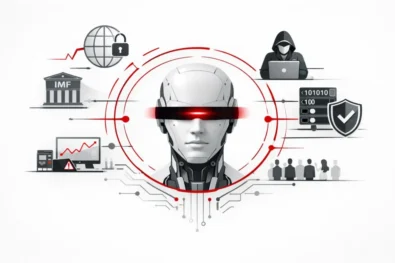
Claude AI Mythos is reshaping how risk is distributed across the crypto market, with new evidence indicating that the primary threat is no longer directed at bitcoin itself but at the infrastructure surrounding it, particularly exchanges, custodial platforms and financial intermediaries, according to regulators, analysts and industry executives assessing the implications of Anthropic’s latest model, The WP Times reports.
Developments confirmed on Wednesday 15 April 2026 show that European Central Bank supervisors are preparing to question banks on their exposure to AI-driven cyber threats, while US and UK authorities have already warned that models like Mythos could accelerate vulnerability discovery and exploitation at scale, fundamentally changing how attacks are executed against financial systems that manage digital assets and user data.
Claude AI Mythos and crypto risk: where the threat is shifting
The emergence of Claude AI Mythos introduces a structural shift in cybersecurity risk across the crypto sector. While the core architecture of bitcoin remains resistant to direct compromise, the surrounding ecosystem is increasingly exposed due to its reliance on software layers, APIs and user-facing systems. At the protocol level, bitcoin continues to operate on decentralised consensus and cryptographic validation. This makes direct manipulation extremely difficult without network-wide agreement. However, exchanges operate in a fundamentally different environment, where speed, liquidity and user access create a larger attack surface.
Industry participants highlight that AI models capable of scanning and analysing code at scale reduce the time required to identify exploitable weaknesses from months to minutes. This creates a new asymmetry between attackers and defenders, particularly for platforms managing high volumes of transactions in real time. In practical terms, the risk is migrating away from decentralised systems towards centralised service providers that aggregate funds and personal data.
Key exposure points identified across crypto platforms:
- Custodial wallets holding user funds on exchanges
- Identity verification systems storing sensitive data
- API endpoints used for trading and withdrawals
- Internal transfer and settlement systems
- Customer communication channels vulnerable to phishing
These areas are now considered the primary vectors where AI-assisted attacks could emerge first.
why bitcoin remains structurally resistant to AI-driven attacks
Despite concerns surrounding AI, the bitcoin network itself is not currently viewed as vulnerable to models like Claude AI Mythos. This is due to its reliance on established cryptographic principles and decentralised governance.
“Bitcoin is fundamentally secured by cryptography and a set of shared rules,” said Yan Pritzker, chief technology officer at Swan Bitcoin. “The cryptography itself isn’t affected by AI… it is very difficult to modify the rules of the network without full consensus.”
The distinction is critical for investors and regulators. While AI can influence behaviour, automate attacks and accelerate discovery of flaws, it does not directly break encryption or override decentralised validation mechanisms. This creates a two-layer risk model within crypto:
| Layer | Risk level with AI | Explanation |
|---|---|---|
| Bitcoin blockchain | Low | Decentralised consensus and cryptography |
| Exchanges & platforms | High | Centralised systems, user data, real-time operations |
| Wallet interfaces | Medium | Depends on custody model and implementation |
The table reflects a growing consensus that infrastructure risk now outweighs protocol risk in the short to medium term.
Regulators respond as Claude AI Mythos triggers security review
Regulatory scrutiny has moved from early awareness to structured assessment as authorities in Europe, the UK and the US integrate Claude AI Mythos into formal risk frameworks, focusing on how AI alters both the speed and scale of cyber threats across financial infrastructure. Supervisors are not reacting to a single incident but preparing for a systemic shift, where vulnerability discovery becomes continuous rather than episodic. Within the eurozone, sources indicate the European Central Bank has already embedded AI-related cyber risk into its regular supervisory dialogue, with banks expected to demonstrate preparedness for AI-assisted attacks without triggering ad hoc crisis protocols. This reflects a deliberate strategy: test resilience quietly before disruption forces public intervention.
“A new generation of AI models are becoming capable of doing work that previously required rare expertise: finding weaknesses in software, writing the code to exploit them, and doing so at a speed and scale that would have been impossible even a year ago,” UK officials said in a joint statement (London, April 2026). Parallel discussions in Washington, involving the Federal Reserve and Treasury leadership, have focused on scenario modelling and system-wide exposure, while political backing for safeguards has been publicly endorsed. Bank of England Governor Andrew Bailey also warned that regulators must “quickly understand the implications” of frontier AI models, reinforcing alignment across major financial centres. The convergence of central banks and governments indicates that AI-driven cybersecurity risk is no longer treated as a technical edge case but as a core financial stability issue, comparable to liquidity or credit risk.

Project glasswing and the defensive race against AI threats
In response to the capabilities demonstrated by Claude AI Mythos, Anthropic has launched Project Glasswing, positioning it as an industry-wide defensive framework designed to counterbalance the rapid acceleration of AI-enabled attack vectors. The initiative reflects a shift from isolated corporate security to coordinated ecosystem defence.
Claude Mythos Preview has already identified thousands of high-severity vulnerabilities across major operating systems, web browsers and core infrastructure software, including flaws that had persisted undetected for decades despite extensive human review and automated testing. In several cases, the model not only located vulnerabilities but autonomously generated viable exploit paths, marking a step-change in capability. Project Glasswing operational scope:
- Joint security work with companies including Amazon Web Services, Google and Microsoft
- Participation from financial institutions such as JPMorgan Chase
- Access extended to more than 40 organisations maintaining critical infrastructure
- Up to $100 million in AI usage credits allocated for defensive research
- $4 million in direct funding for open-source security projects
The programme is structured around a simple premise: the same AI capability that lowers the barrier to cyberattack can be redirected to pre-emptively secure systems at scale. However, the timeline mismatch remains critical—AI capability is advancing in months, while global infrastructure hardening may take years. Anthropic itself acknowledged the urgency, noting that frontier AI models are approaching or exceeding the capability of top human experts in vulnerability discovery, fundamentally compressing the time window between flaw identification and exploitation.
Exchange vulnerability: why crypto platforms are first in line
Crypto exchanges represent the most immediate point of exposure within the digital asset ecosystem because they combine high-value asset concentration with complex, continuously active software systems. Unlike decentralised protocols, these platforms operate as centralised hubs where a single vulnerability can cascade across millions of users.
“Any system that deals with money in a real-time basis is going to be a place that we try to look for cyber security holes,” said Cosmo Jiang, general partner at Pantera Capital. The risk profile is intensified by three structural factors: constant transaction flow, integration with banking systems, and storage of personally identifiable information. Together, these create an environment where AI-driven reconnaissance can rapidly identify weak points with financial consequences.
Primary AI-amplified attack vectors:
- Large-scale phishing campaigns generated with high linguistic accuracy
- Synthetic identity creation using aggregated user data
- Automated social engineering targeting support channels
- Exploitation of API endpoints and withdrawal systems
- Real-time manipulation of authentication and verification flows
Owen Lau, analyst at Clear Street, warned that AI agents can “generate large volumes of scam emails and create synthetic identities,” effectively industrialising fraud operations and increasing pressure on exchanges to upgrade detection systems. This expands the threat model beyond direct system compromise to include behavioural manipulation at scale, where trust itself becomes an attack surface.
Industry response: AI as both threat and defence
Major exchanges including Coinbase and Binance are accelerating integration of AI into their security architecture, recognising that defensive capability must evolve at the same pace as offensive tools. The industry is shifting towards continuous, AI-driven monitoring rather than periodic security audits.
“Mythos… will enable even deeper testing of software and systems at scale,” said Philip Martin, chief security officer at Coinbase. “This will accelerate digital threats as well as digital defence.” This dual-use dynamic is redefining cybersecurity strategy. Rather than attempting to restrict access to advanced AI models—an approach widely seen as impractical—firms are embedding similar capabilities internally to maintain equilibrium.
Emerging defence architecture across exchanges:
- AI-driven vulnerability scanning across codebases and infrastructure
- Real-time anomaly detection in transaction patterns
- Behavioural profiling to identify suspicious user activity
- Automated incident response and containment systems
- Continuous stress testing using simulated attack scenarios
Binance’s security leadership confirmed parallel experimentation, focusing on using AI to identify vulnerabilities “faster and more broadly,” signalling convergence across major platforms. The outcome of this race—between AI-enabled attackers and AI-enabled defenders—will likely determine whether exchanges can sustain operational trust in a high-speed threat environment.
What changes next for crypto investors and markets
For investors, Claude AI Mythos does not alter the foundational security of bitcoin but redefines how risk is distributed across the crypto value chain. The distinction between protocol security and platform security is becoming central to investment decisions. In the short term, markets are likely to respond to narrative risk rather than confirmed incidents, with cybersecurity emerging as a key driver of sentiment and valuation for exchange-linked equities and products.
Short-term market effects:
- Increased scrutiny of exchange security disclosures
- Volatility linked to AI and cybersecurity headlines
- Regulatory pressure on custodial and brokerage platforms
- Rising operational and compliance costs
Over the longer term, structural adjustments are expected as the market adapts to persistent AI-driven risk. Long-term structural shifts:
- Consolidation around platforms with demonstrable security resilience
- Higher institutional standards for custody and risk management
- Integration of AI into core financial infrastructure
- Growth of decentralised alternatives reducing reliance on intermediaries
Analysts caution that the threat landscape remains in development, but the trajectory is clear: risk is concentrating at the interface between users and systems, rather than within the blockchain itself. In this context, the long-standing principle “not your keys, not your coins” is being reframed not as ideology but as a practical risk management strategy, as control over assets becomes directly linked to exposure in an AI-accelerated threat environment.
Read about the life of Westminster and Pimlico district, London and the world. 24/7 news with fresh and useful updates on culture, business, technology and city life: What next for Bank of England interest rates as Iran conflict reshapes 2026 outlook