
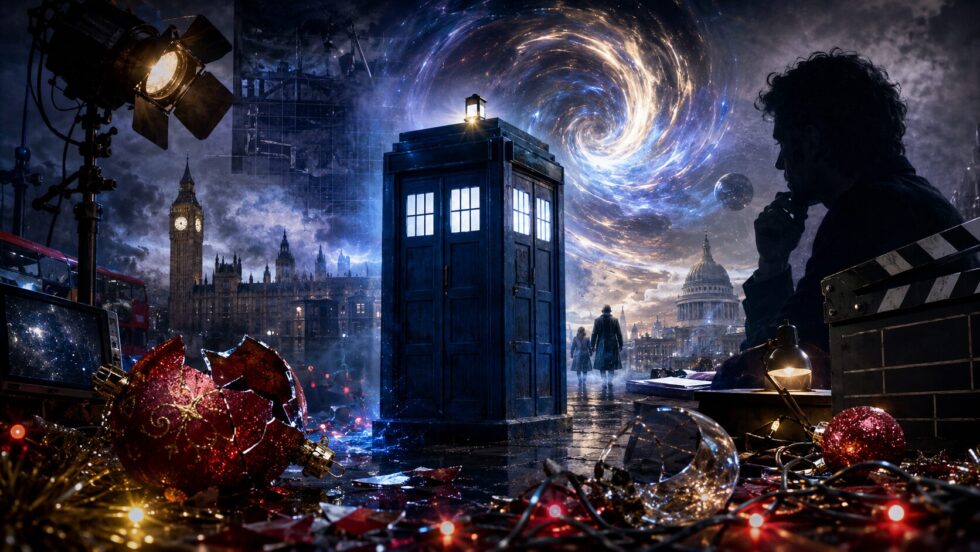
Doctor Who has entered one of the most uncertain periods in its modern BBC history after the broadcaster cancelled the planned 2026 Christmas special, confirmed the departure of showrunner Russell T Davies and production company Bad Wolf, and opened the next phase of the sci-fi drama to competitive tender. The decision ends the latest Davies era earlier than many viewers expected, leaves the Billie Piper cliffhanger unresolved for now, and shifts attention from one festive episode to the larger question of who will control the future of Dr Who, how the next Doctor will be introduced, and whether the programme can rebuild audience confidence after falling viewing figures and a difficult identity debate, The WP Times reports.
The BBC has framed the move not as a cancellation of Doctor Who itself, but as a long-term reset of one of its most recognisable cultural properties. The corporation says the Christmas special was not abandoned lightly and that the priority is now to invest in future series plans rather than produce a one-off bridge episode. For fans, however, the immediate result is stark: the Doctor Who Christmas special 2026 will not happen, Russell T Davies has stepped away from the Tardis again, Bad Wolf is leaving the production arrangement, and the franchise is being prepared for a new creative and industrial structure at a moment when its last televised ending raised more questions than it answered.
Doctor Who Christmas special cancelled as BBC chooses long-term reset over one-off episode
The cancellation of the Doctor Who Christmas special 2026 is significant because it removes the only confirmed television episode that had been expected to keep the main series visible during a transition year. The special had previously been announced as a future return point for the programme, with Russell T Davies attached to write it and Bad Wolf expected to produce it. Instead, the BBC has now decided that a single festive episode would not be the best way to manage the show’s next phase. The broadcaster’s position is that Doctor Who should return when the next production model is clear, rather than use Christmas 2026 as a temporary holding pattern.
That decision also confirms what many viewers had already suspected. A Christmas special of Doctor Who normally requires substantial preparation, filming, visual effects, music, marketing and post-production. The absence of visible production activity had already fuelled speculation that the episode was in trouble. Reports around the programme had increasingly pointed to uncertainty behind the scenes, especially after Ncuti Gatwa’s exit and the surprise final image of Billie Piper at the end of the most recent run. The formal cancellation now turns rumour into official direction.
The BBC has not said that Doctor Who is cancelled as a franchise. That distinction matters. The correct reading is not doctor who cancelled in the simple sense of the whole show being terminated, but rather doctor who christmas special cancelled while future series plans are being reworked. The corporation has said Doctor Who remains important to the BBC and has pointed to a future return. At the same time, the lack of a confirmed next Doctor, next showrunner, next main production partner or next transmission date leaves the television future of the programme open.
For viewers, the practical consequences are clear:
- There will be no Doctor Who Christmas special in 2026.
- Russell T Davies will not continue as showrunner for the next main phase.
- Bad Wolf is leaving the current production arrangement.
- The BBC will put the programme out to competitive tender.
- The Billie Piper cliffhanger remains unresolved on screen.
- The next full television return has not been dated.
- The BBC is prioritising long-term production planning over a single festive episode.
Russell T Davies leaves Doctor Who after a second era marked by ambition and pressure
Russell T Davies remains one of the most important figures in Doctor Who history because he led the 2005 revival that turned a dormant BBC classic into a mainstream Saturday-night drama again. His first era brought Christopher Eccleston, David Tennant, Billie Piper, Catherine Tate, Freema Agyeman and a new emotional grammar to the programme. It made Doctor Who feel domestic, contemporary and accessible while keeping the vast mythology of the Time Lord intact. That achievement is why his return in 2021 was treated as one of the most dramatic production announcements in modern British television.
His second era began with major expectations. David Tennant returned for anniversary specials, Ncuti Gatwa arrived as the Fifteenth Doctor, and the partnership involving Bad Wolf and Disney gave the series a more global industrial profile. The programme appeared to be entering a more international phase, with higher production values and a strategy designed to make the BBC series compete in a global streaming market. Davies was expected to bring clarity, energy and public attention back to the brand after years of debate about ratings, tone and audience direction.
The outcome has been more complicated. Some episodes from the new run were widely admired, including stories that used Doctor Who’s format to explore memory, war, prejudice, folk horror and social tension. At the same time, the broader arcs divided parts of the audience. Several finales were criticised for complex mythology, abrupt resolutions and emotional pay-offs that did not work equally well for committed fans and casual viewers. The use of returning villains, heavily symbolic storylines and surprise casting created conversation, but not always stable audience growth.
Davies’s departure therefore has two sides. It closes the return of a writer who will always be central to the show’s survival in the 21st century. It also gives the BBC a chance to define Doctor Who beyond the shadow of its most successful modern architect. The next creative team will inherit a format with enormous flexibility, but also a public argument about what the show should be: family drama, science-fiction anthology, British heritage brand, global streaming property, political allegory, children’s adventure, or all of those things at once.
Doctor Who future series plans now depend on competitive tender and a new production model
The phrase competitive tender may sound technical, but it is central to what happens next. Under the BBC’s production and charter framework, major shows can be opened to external competition, allowing different production companies to bid for the right to make them. In practical terms, this means Doctor Who is being prepared for a new production arrangement rather than simply being handed automatically to the existing team. Bad Wolf could theoretically bid, but the current public direction is that the partnership as viewers know it has ended.
This creates both risk and opportunity. The risk is that a long tender process may extend the gap before the next main television series. Doctor Who depends on public momentum, and long absences can weaken casual audience habits even if hardcore fans remain engaged through audio dramas, comics, novels and archive material. The opportunity is that a new production company and showrunner could relaunch the programme with a clear premise, a new Doctor, a new companion team and a simpler entry point for viewers who found the recent mythology difficult to follow.
The next producer will face an unusually difficult brief. Doctor Who is a British public-service institution, but it must now compete in an entertainment environment shaped by Netflix, Disney, HBO, YouTube, gaming, social media clips and short-form fan culture. The BBC may want Saturday-night family appeal, international sales value, merchandising potential and critical prestige at the same time. Those goals do not always align. A show designed for domestic family viewing may not automatically become a global streaming hit, while a show built for international genre competition may lose some of its British eccentricity.
The central tender questions are likely to include:
- Who can produce Doctor Who at the required scale within BBC expectations?
- Should the next era keep recent continuity or start with a clean slate?
- Will the show need a new Doctor immediately?
- Should Billie Piper’s appearance be resolved or quietly moved past?
- How often should Doctor Who air in the streaming era?
- Should the series remain a family Saturday-night event or become a more flexible prestige genre drama?
- How can the BBC preserve the show’s identity while making it commercially sustainable?
Billie Piper cliffhanger leaves the next Doctor Who team with a difficult story problem
The most visible creative problem is the Billie Piper cliffhanger. Ncuti Gatwa’s Doctor appeared to regenerate into the face of Piper, who is still strongly associated with Rose Tyler, one of the most famous companions of the modern series. The scene was designed to create immediate speculation. Was Piper playing the Doctor? Was she returning as Rose in another form? Was this a temporary regeneration, a trick, a memory, a cosmic intervention or the beginning of a new era? With the Christmas special cancelled, there is no immediate episode to answer those questions.
That matters because cliffhangers are promises. When a series ends on a major visual shock, audiences expect the next instalment to explain the rules. If the next production team wants a clean relaunch, it may see the Piper ending as a burden from a previous era. If it wants continuity, it must devote early screen time to explaining a twist it did not create. Either route is difficult. Ignoring the cliffhanger could frustrate fans; over-explaining it could trap the next era inside old business before it has established its own voice.
Doctor Who has survived continuity complications before. The show’s history is full of regenerations, missing years, revived villains, alternate timelines, memory gaps and unresolved mysteries. Yet the Piper ending is unusually sensitive because it sits at the exact point where a production handover is happening. It is not simply a story twist; it is also a branding question. A new team must decide whether Billie Piper is part of the future, a bridge from the Davies era, or a dramatic image that will be explained quickly and then left behind.
The cleanest options are limited:
- A special or opening episode could directly resolve the regeneration and transition to a new Doctor.
- The next series could treat Piper as a temporary manifestation rather than the permanent Doctor.
- The BBC could commission a short bridging scene, although no such plan has been confirmed.
- A new showrunner could start fresh and address the cliffhanger in dialogue.
- The show could use Doctor Who’s own mythology to make the unresolved moment part of a larger mystery.
Viewing figures and identity crisis put pressure on the next Dr Who era
Doctor Who’s ratings problem is not simple because television measurement has changed dramatically since the programme’s classic years and even since its 2005 revival. Linear overnight figures no longer tell the whole story, because audiences watch through iPlayer, catch-up platforms, clips, international services and delayed viewing. However, the recent decline in visible audience numbers has still become part of the public argument around the show. When a programme with Doctor Who’s history reaches low viewing figures, even in a fragmented market, the perception of weakness becomes difficult to ignore.
The identity problem may be even more important than the raw numbers. Doctor Who can be almost anything: horror, comedy, political allegory, historical adventure, romance, space opera, children’s fantasy or philosophical drama. That flexibility is its greatest strength, but it can also make the BBC’s strategic task harder. If the show tries to satisfy every audience at once, it risks feeling unstable. If it narrows too much, it loses the unpredictability that made it special. The next era must therefore decide not only who the Doctor is, but what contract the series is making with viewers.
Recent debate has focused on whether the programme became too dependent on mythology, too self-referential, too politically explicit, too childlike, too chaotic or too inconsistent. Those are audience arguments rather than settled facts, but they matter because they influence how the next relaunch will be received. A new showrunner will need to rebuild trust quickly. That does not mean removing ambition or social themes. Doctor Who has always reflected contemporary anxieties. The challenge is to make theme, story, character and adventure feel inseparable rather than competing for attention.
A practical relaunch would need to deliver four things at once:
- A clear introduction to the Doctor for new viewers.
- A companion whose emotional point of view grounds the story.
- A first episode with a simple, strong dramatic hook.
- A season arc that rewards fans without excluding casual audiences.
BBC must decide whether Doctor Who is family television, global franchise or British cultural asset
The BBC’s challenge is structural as much as creative. Doctor Who is a public-service programme, a commercial brand, a nostalgia property, a children’s gateway to science fiction and a global cultural export. Each role pulls the show in a different direction. As family television, it needs clarity, warmth and appointment-viewing appeal. As a global franchise, it needs scale, marketing, recognisable iconography and international accessibility. As a British cultural asset, it needs eccentricity, wit, moral intelligence and a sense that no other country would make it in quite the same way.
The Disney partnership was supposed to strengthen the show’s international reach, but the end of that arrangement has returned the question of scale to the BBC. Doctor Who can look expensive, but it cannot simply imitate American franchise television. Its core appeal has never been only visual spectacle. The Tardis, the police box, the sonic screwdriver, regeneration and the Doctor’s refusal to solve problems through ordinary violence are stronger assets than budget alone. A cheaper but sharper Doctor Who can work; an expensive but confused Doctor Who cannot.
The next production model should therefore be judged less by whether it looks bigger and more by whether it knows what it is for. The BBC needs a series that can bring in younger viewers without alienating older ones, serve domestic audiences while travelling internationally, and use continuity as flavour rather than homework. It also needs a production rhythm that avoids years of uncertainty. In the streaming era, long gaps can make even famous brands feel optional.
The strongest route may be a disciplined reset: a new Doctor, a new companion, a strong first adventure, fewer continuity traps, a clear seasonal structure and a public message that Doctor Who is returning not as a rescue operation, but as a confident British adventure series.
What happens next for Doctor Who after Russell T Davies and Bad Wolf
The immediate next step is the competitive tender process. Production companies will be invited to make their case for Doctor Who, and the BBC will have to decide which partner can deliver the programme creatively, financially and logistically. That process may take time. It may also involve decisions about showrunner, writing team, production base, budget, distribution, episode count and release strategy. Until those decisions are made, speculation about the next Doctor will remain only speculation.
Russell T Davies has publicly presented the exit as a handover to a future he is excited to see. That tone is important because it reduces the sense of a public rupture. The BBC has also avoided language suggesting final cancellation. The official message is continuity through change: the Christmas special is gone, the current team is leaving, but Doctor Who is expected to return. For a franchise built around regeneration, that message is thematically convenient. The harder task is making it credible on screen.
The risk is that the next era inherits too much uncertainty: unresolved cliffhangers, ratings pressure, fan division and a tender process that makes the programme look like an institutional problem rather than a living drama. The opportunity is just as real. Doctor Who has recovered before because its format allows reinvention. A clever alien, a blue box, a human companion and a dangerous universe remain one of television’s most durable storytelling engines.
For now, the facts are limited but serious. The Doctor Who Christmas special cancelled story is not just a scheduling change. It is the end of the latest Russell T Davies chapter, the end of the Bad Wolf production phase, and the beginning of a BBC search for a new way to make Dr Who work in a crowded television market. Whether that becomes a crisis or a regeneration depends on the next creative decision.
Doctor Who questions and answers after the Christmas special cancellation
Is Doctor Who cancelled?
No official announcement says Doctor Who as a whole has been cancelled. The confirmed decision is that the planned 2026 Christmas special will not go ahead. The BBC says the show remains important and is being prepared for future production through competitive tender.
Why was the Doctor Who Christmas special 2026 cancelled?
The BBC says it chose not to use a one-off Christmas episode as a bridge while the future production model is being reset. The broadcaster wants to focus on the long-term future of the programme rather than produce a temporary festive instalment.
Is Russell T Davies leaving Doctor Who?
Yes. Russell T Davies has said goodbye to Doctor Who again after returning for the anniversary specials and Ncuti Gatwa era. His departure coincides with the end of Bad Wolf’s current production role and the BBC’s decision to open future production to competition.
What does competitive tender mean for Doctor Who?
Competitive tender means production companies can bid to make the next phase of Doctor Who. The BBC will assess potential partners instead of simply continuing the existing arrangement. This could lead to a new production company, new showrunner and new creative direction.
What happens to Billie Piper’s Doctor Who cliffhanger?
There is no confirmed answer yet. The most recent ending suggested a major role for Billie Piper after Ncuti Gatwa’s regeneration, but with the Christmas special cancelled, the next team will have to decide whether to resolve, reinterpret or move beyond that cliffhanger.
When will Doctor Who return?
No confirmed date has been announced for the next main television series. The BBC has indicated that Doctor Who will continue, but future episodes depend on the tender process, production decisions and a new creative plan.
Could Bad Wolf still make Doctor Who?
In theory, any eligible production company could be part of a future process if it bids and is selected. However, the current announcement marks the end of the existing Russell T Davies and Bad Wolf phase.
Why is this moment important for British television?
Doctor Who is not only a sci-fi show but one of the BBC’s best-known cultural properties. The cancellation of the Christmas special, the exit of Russell T Davies and the move to competitive tender raise wider questions about how the BBC manages heritage brands in the streaming era.
Read about the life of Westminster and Pimlico district, London and the world. 24/7 news with fresh and useful updates on culture, business, technology and city life: Where to Find Affordable Rent in London 2025: A Borough-by-Borough Analysis.